
Understanding ERC Funding Grants: Your Gateway to Research Excellence

An erc funding grant is a prestigious European Research Council award supporting frontier research across all scientific fields. These grants fund individual researchers and their teams based solely on scientific excellence, ranging from €150,000 to €10 million.
Quick Overview of ERC Funding Grant Types:
| Grant Type | Funding Amount | Duration | Eligibility |
|---|---|---|---|
| Starting Grant | Up to €1.5 million | 5 years | 2-7 years post-PhD |
| Consolidator Grant | Up to €2 million | 5 years | 7-12 years post-PhD |
| Advanced Grant | Up to €2.5 million | 5 years | Established leaders |
| Synergy Grant | Up to €10 million | 6 years | Groups of 2-4 researchers |
| Proof of Concept | Up to €150,000 | 18 months | Existing ERC grantees |
The ERC operates on a “bottom-up” approach, allowing researchers to apply in any field. Evaluation is based on scientific excellence via international peer review. With a budget of €2.7 billion for 2026, the ERC is Europe’s premier body for investigator-driven research.
Success rates average 12%. These awards offer high prestige and flexibility, including institution mobility and coverage of 100% of direct costs. Notably, five ERC grantees have won Nobel Prizes.
Important distinction: While this guide covers scientific research grants, U.S. businesses may be looking for the Employee Retention Credit (ERC). If you need tax credits for COVID-19 employee retention, explore ERC funding solutions instead.
I’m Santino Battaglieri. While I help U.S. businesses with Employee Retention Credit claims at SFG Capital, I recognize the importance of securing proper funding. This guide details erc funding grant opportunities for European Research Council support.
What is the European Research Council (ERC)?
Established by the European Commission in 2007, the European Research Council (ERC) encourages high-quality research through competitive funding. It is a vital engine for pushing knowledge boundaries and recognizing scientific talent.
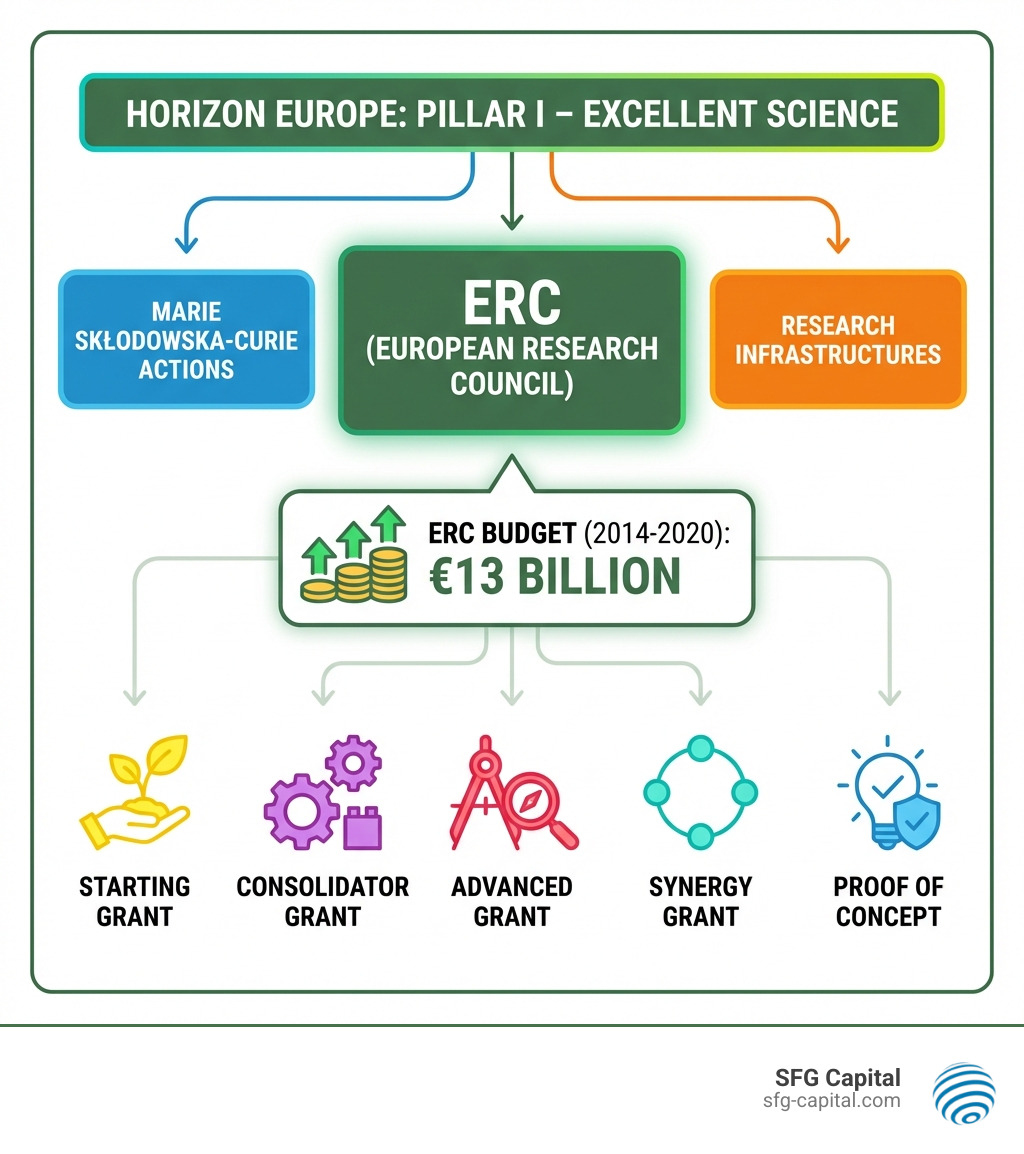
The ERC is part of Horizon Europe’s Pillar I – ‘Excellent Science’. It uses a “bottom-up” approach, meaning researchers can apply for an erc funding grant in any field without thematic priorities. This supports “frontier research”—high-risk, high-reward projects that lead to breakthroughs. The sole selection criterion is scientific excellence. For more details, visit the European Research Council Official Site.

The Role of the Scientific Council and ERCEA
The ERC’s structure includes the independent Scientific Council (ScC) and the ERC Executive Agency (ERCEA). The Scientific Council, composed of distinguished scholars, defines the funding strategy, grant schemes, and peer review processes autonomously.
The ERCEA handles operational implementation, including managing calls for proposals, the application process, and grant administration. This dual structure ensures scientific leadership is paired with efficient management. A five-member Steering Committee further integrates operational and strategic goals.
Main ERC Funding Grant Schemes and Eligibility
The ERC offers several erc funding grant schemes custom to different career stages. Understanding which aligns with your profile is the first step toward success.
| Grant Type | Funding Amount | Duration | Eligibility (Years since PhD) | Target Researcher |
|---|---|---|---|---|
| Starting Grant (StG) | Up to €1.5 million | 5 years | 2-7 years | Early-career independence |
| Consolidator Grant (CoG) | Up to €2 million | 5 years | 7-12 years | Consolidating teams |
| Advanced Grant (AdG) | Up to €2.5 million | 5 years | No limit (10-yr track record) | Established leaders |
| Synergy Grant (SyG) | Up to €10 million | 6 years | No limit (2-4 PIs) | Complex, collaborative problems |
| Proof of Concept (PoC) | Up to €150,000 | 18 months | Existing ERC grant holders | Research to innovation |
For U.S. businesses seeking info on the Employee Retention Credit process, see our guide on the ERC Funding Process.
Eligibility Criteria for Principal Investigators
Eligibility for an erc funding grant is primarily based on the time since PhD completion. The Starting Grant requires 2-7 years of experience, while the Consolidator Grant targets those with 7-12 years. The Advanced Grant requires a significant 10-year track record of leadership.
Extensions are available for maternity, paternity, illness, or national service. Research must be conducted at a Host Institution in an EU Member State or Associated Country. U.S.-based researchers must secure a European Host Institution to apply. For U.S. business tax credit requirements, SFG Capital can help you understand ERC requirements.
Supporting Interdisciplinary and Collaborative Research
Synergy Grants bring together 2-4 Principal Investigators with complementary skills to tackle complex problems. These grants foster innovative, interdisciplinary approaches that are beyond the scope of a single researcher. Funding can reach €10 million over 6 years. To see how these work, Watch the guide videos provided by the ERC.
The ERC Funding Grant Application and Evaluation Process
Securing an erc funding grant involves a rigorous multi-stage peer review. Applications are submitted electronically via the Horizon Europe Participant Portal following annual calls. National Contact Points (NCPs) provide local support for applicants.
For U.S. businesses seeking the basics of the tax credit program, refer to: What is ERC Funding?
Navigating the ERC Funding Grant Application
A successful application includes:
- Part A: Administrative info on the PI and Host Institution.
- Part B1: Extended synopsis, PI track record, and achievements.
- Part B2: The core scientific proposal detailing methodology and feasibility.
- Host Institution Support Letter: A formal commitment from the host.
- Ethics Self-Assessment (ESA): A mandatory review of ethical implications.
Allow ample time for refining your proposal and seeking peer feedback. For U.S. businesses claiming the tax credit, see our ERC Funding Application Guide.
Evaluation Criteria for an ERC Funding Grant
The sole criterion is excellence, applied to both the project and the PI. Evaluation is conducted by 25 international peer review panels across Life Sciences (LS), Physical and Engineering Sciences (PE), and Social Sciences and Humanities (SH).
- Stage 1: Assessment of PI creativity and project feasibility.
- Stage 2: In-depth evaluation and an interview with the PI.
Only the highest-ranked proposals receive funding, resulting in a competitive 12% success rate.
Maximizing Success and Ensuring Ethical Standards
An erc funding grant is a mark of prestige that attracts talent and opportunities. Grants are “portable,” allowing researchers to move between eligible European institutions. The ERC also mandates open access for all funded publications.
Ethical Considerations and Review
Integrity is paramount. Every proposal undergoes an ethics review involving pre-screening, screening, and assessment by independent experts. Applicants must complete an Ethics Self-Assessment (ESA) detailing measures to mitigate risks related to human subjects, animal models, or data privacy. Robust ethical reflection is essential for excellent science, as noted in scientific research on ERC principles.
From Research to Market: Proof of Concept
The Proof of Concept (PoC) Grant helps bridge the gap between research and innovation. Available only to existing ERC grantees, it provides up to €150,000 for 18 months to explore the commercial or societal potential of their findings. This includes IP rights, market studies, or prototype development, extending the impact of the original erc funding grant.
Future Outlook: ERC Work Programme 2026 and Beyond
The European Research Council continues to evolve and adapt to the changing landscape of global research, consistently demonstrating its commitment to sustained investment in scientific excellence. The ERC Work Programmes are key documents that outline the specific calls, budgets, and application requirements for upcoming funding cycles.
For instance, the European Commission has already published the Current Work Programme 2026, detailing the calls for the European Research Council for that year. This document provides invaluable information, including all call topics, eligibility criteria, and detailed instructions needed to apply for an erc funding grant. With a total budget of €2.7 billion in 2026, the ERC continues to be a significant force in European research funding.
These work programmes reflect recent developments and strategic priorities, while always maintaining the core principle of investigator-driven frontier research. Researchers should always consult the latest Work Programme to stay informed about upcoming changes, specific deadlines, and any new initiatives. The ERC’s consistent substantial budget allocations underscore Europe’s dedication to attracting and retaining top research talent and fostering a vibrant scientific ecosystem.
Frequently Asked Questions about ERC Funding
Can non-European researchers apply for ERC grants?
Yes. The ERC is open to all nationalities, provided the researcher is based in or moves to a Host Institution in an EU Member State or Associated Country. Additional funding (up to €2 million) is often available to cover relocation and start-up costs for those moving from non-associated countries. See ERC for non-European researchers for details.
What are the typical funding amounts and durations?
- Starting: €1.5M (5 years)
- Consolidator: €2M (5 years)
- Advanced: €2.5M (5 years)
- Synergy: €10M (6 years)
- PoC: €150k (18 months)
Grants cover 100% of direct costs plus a 25% indirect cost flat rate. Extra funding is available for major equipment or relocation.
How does the ERC support researchers in conflict zones?
The ERC supports the scientific community during crises. The “ERC for Ukraine” initiative facilitates job opportunities and mentoring within existing projects. Eligibility extensions are also available for researchers affected by displacement or national service, ensuring talent is not lost to global events.
Conclusion
The European Research Council’s erc funding grant schemes represent an unparalleled opportunity for researchers to pursue ambitious, frontier-breaking science. By prioritizing scientific excellence and fostering an environment of independence and collaboration, the ERC plays a pivotal role in driving scientific advancement and shaping the future of research in Europe. Whether you are an early-career scientist or an established research leader, understanding these grants can be a crucial step in your career development.
For our part, while we at SFG Capital don’t assist with European research grants, we are deeply committed to helping U.S. businesses in Travis County, Austin, and across the United States secure the financial support they need. If you’re a business owner looking to steer the complexities of the Employee Retention Credit (ERC) and expedite your refund, our expertise is here for you. We understand that securing funding, whether for groundbreaking research or for your business’s financial health, is about empowering future success. Explore our ERC Funding Solutions to see how we can help your business thrive.