
The Ultimate Guide to ERC Funding for US Researchers
What “ERC Funding United States” Actually Means (And Why It Matters)
ERC funding United States is one of those phrases that means very different things depending on who you ask.
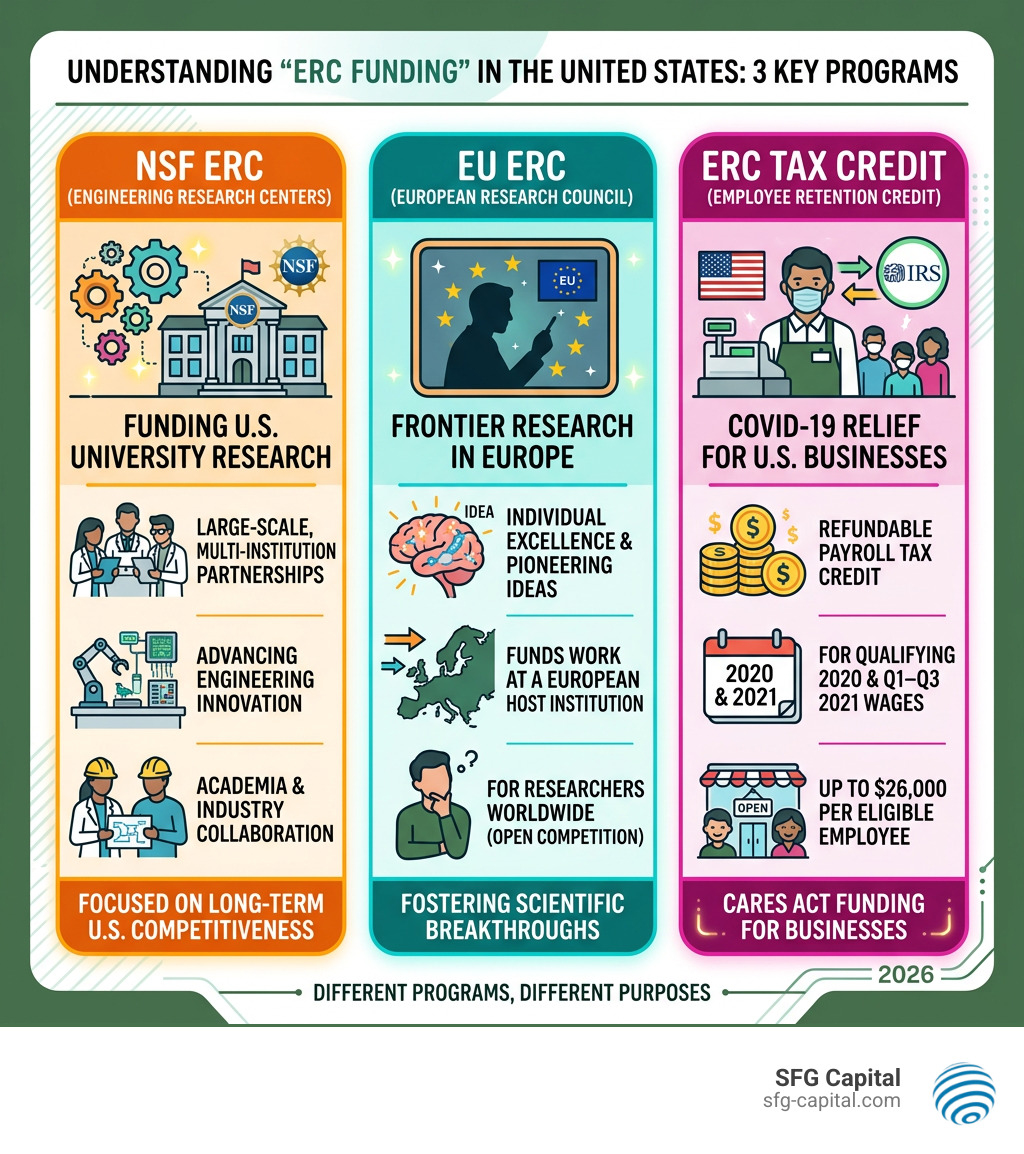
Here is a quick breakdown:
| Type | Full Name | Who It’s For | What It Does |
|---|---|---|---|
| NSF ERC | Engineering Research Centers | US universities & researchers | Funds large-scale, multi-institution engineering research |
| EU ERC | European Research Council | Individual researchers worldwide | Funds frontier research at European host institutions |
| ERC Tax Credit | Employee Retention Credit | US business owners | Refundable payroll tax credit from the CARES Act |
All three are commonly searched under “ERC funding.” All three are completely different programs.
If you are a business owner looking for COVID-19 relief funds, you are thinking of the Employee Retention Credit — a refundable tax credit worth up to $26,000 per employee for eligible businesses in 2020 and Q1–Q3 2021.
If you are a researcher, you may be looking at either the NSF Engineering Research Centers program or EU European Research Council grants — both of which are covered here too.
This guide walks through all three clearly, so you can find exactly what applies to you.
I’m Santino Battaglieri, founder of SFG Capital, a financial services firm that has purchased and funded over $500 million in ERC claims — giving me deep, hands-on expertise in navigating ERC funding United States for eligible businesses. I’ll help you cut through the complexity and understand your options with clarity and confidence.
Relevant articles related to erc funding United States:
Understanding NSF Engineering Research Centers (ERC) in the United States

When academic researchers in America talk about erc funding United States, they are usually referring to the National Science Foundation’s (NSF) Engineering Research Centers. Launched in 1985, this program was designed to shift the culture of academic engineering. Instead of researchers working in isolated “silos,” the NSF wanted to create massive, interdisciplinary hubs that solve real-world problems while boosting U.S. industrial competitiveness.
We are currently in the “Gen-4” era of these centers. The Gen-4 solicitation represents a pivot toward high-risk, high-payoff research that addresses complex societal challenges. These centers aren’t just about building better gadgets; they are about four foundational pillars:
- Convergent Research: Integrating disciplines to solve problems that no single field could handle alone.
- Engineering Workforce Development: Training the next generation of engineers from K-12 through the PhD level.
- Diversity and Culture of Inclusion: Ensuring that the engineering community reflects the diversity of the nation.
- Innovation Ecosystems: Building bridges between academia, industry, and government to move technology from the lab to the marketplace.
The NSF ERC Program homepage details how these centers target “engineered systems”—complex infrastructures like smart cities or quantum internets. If you are wondering What is ERC Funding? in a research context, it is essentially a long-term investment in the future of American technology.
Eligibility and Structure for erc funding United States
Securing an NSF ERC award is like winning the academic Olympics. The competition is fierce, and the ERC Funding Requirements are stringent.
- Who can apply? The lead institution must be a U.S. university or college that grants engineering degrees at the undergraduate, master’s, and doctoral levels.
- Partnerships: An ERC cannot be a solo act. It requires multi-institutional partnerships, typically involving 3 to 6 core university partners. Crucially, at least one of these partners must be a STEM-Minority Serving Institution (MSI).
- Duration and Budget: These are 10-year commitments. A new Gen-4 center can receive up to $3.5 million in its first year, $4.5 million in year two, and $6 million annually for years three through eight. Funding then phases down in years nine and ten as the center prepares to become self-sustaining.
- Cost-Sharing: This is a “skin in the game” program. Lead institutions and their partners must provide cost-sharing, demonstrating a commitment from the universities and their industrial partners to support the center’s vision.
Key Impact Areas and Success Stories
The impact of erc funding United States is measurable in both scientific breakthroughs and economic growth. Since 1985, these centers have produced over 14,000 graduates and nearly 1,000 patents.
Current centers are tackling some of the most ambitious projects in modern science:
- NSF ERC for Quantum Networks (CQN): Led by the University of Arizona, this center is laying the groundwork for a socially responsible quantum internet.
- ASPIRE: This center is revolutionizing transportation by developing electrified roadways that can charge semi-trailer trucks while they drive.
- CASFER: Focused on sustainable agriculture, CASFER is creating modular technology to capture and recycle nitrogen for decarbonized fertilizer.
- NSF ERC for Cell Manufacturing Technologies (CMaT): Based at Georgia Tech, CMaT is working to make high-quality therapeutic cells affordable and scalable, potentially curing chronic diseases.
The numbers back up the prestige. As of 2018, ERCs had formed 223 spinoff companies employing over 1,400 people. Furthermore, roughly 1.5% of all engineering doctoral degrees awarded annually in the U.S. go to students trained within an NSF ERC.
Comparing US NSF ERCs and the European Research Council
While they share an acronym, the NSF ERC and the EU’s European Research Council (ERC) operate on very different philosophies.
| Feature | NSF Engineering Research Centers (US) | European Research Council (EU) |
|---|---|---|
| Primary Focus | Large-scale, center-based engineering systems | Individual-led “frontier” research in any field |
| Funding Model | Multi-institutional teams & industry partners | Single Principal Investigator (PI) and their team |
| Duration | Up to 10 years | Usually 5 years (up to 7 for “Super Grants”) |
| Goal | Industrial competitiveness & workforce development | Excellence in basic scientific discovery |
| Industry Role | Required membership and cost-sharing | Not required; focus is on academic freedom |
The EU has recently stepped up its efforts to attract global talent through its “Choose Europe” initiative. This includes a €500 million package and the introduction of seven-year “super grants” designed to lure researchers who may be frustrated by domestic budget shifts. To make the move more enticing, the European Research Council has doubled its relocation funding—offering up to €2 million for scientists to set up new laboratories in Europe.
If you are a researcher looking for a ERC Credit Complete Guide, the European version is about the person, while the American version is about the partnership.
How US Researchers Can Access International erc funding United States
You don’t necessarily have to leave the United States to benefit from European erc funding United States. There are several pathways for international collaboration:
- Synergy Grants: These grants fund teams of 2 to 4 researchers. One of those Principal Investigators (PIs) can be based outside of Europe—frequently in the U.S. In fact, U.S. participation in Synergy Grants nearly doubled recently, with 21 projects involving U.S.-based grantees.
- NSF-EC Implementing Arrangement: There is a formal Implementing Arrangement between EC and NSF that allows NSF-funded researchers to spend time working with ERC-funded groups in Europe.
- Marie Skłodowska-Curie Actions: These fellowships support two-way exchanges, allowing U.S. researchers to spend up to two years in Europe or bringing European researchers to U.S. labs.
- Horizon Europe: U.S. entities can join collaborative research projects as “Associated Partners.” While they usually bring their own funding, they gain access to massive European research networks.
For those interested in these bridges, EURAXESS North America serves as a vital resource for finding job vacancies and funding opportunities across the Atlantic.
Navigating the “Other” ERC: The Employee Retention Credit
Now, let’s pivot to the version of erc funding United States that helps keep the lights on for businesses. If you aren’t an academic researcher but a business owner, the “ERC” you care about is the Employee Retention Credit.
This program was born out of the $2.2 trillion CARES Act to help businesses survive the COVID-19 pandemic. Unlike the PPP (Paycheck Protection Program), which was a loan that could be forgiven, the ERC is a refundable tax credit. This means it’s money you’ve already paid in payroll taxes that the government is giving back to you.
The IRS Tax Code for COVID Credits is notoriously complex—over 70,000 pages long—which is why many businesses haven’t claimed what they are owed. To see if you fit the ERC Qualifications, you generally need to show one of two things:
- A significant decline in gross receipts compared to 2019.
- A full or partial suspension of operations due to government orders (e.g., restricted capacity, supply chain disruptions, or canceled in-person meetings).
Distinguishing Research Grants from Business erc funding United States
It is vital to understand that the Employee Retention Credit is not a “grant” you apply for in competition with others. It is an entitlement based on your payroll history.
Key facts about the tax-based erc funding United States:
- Maximum Value: You can claim up to $5,000 per employee for 2020 and up to $7,000 per employee per quarter for the first three quarters of 2021. That totals a possible $26,000 per employee.
- IRS Processing Delays: Because of the program’s popularity and the need for fraud prevention, the IRS has a massive backlog. Many businesses wait 20 weeks or much longer for their checks.
- 941-X Amendments: To claim the credit, you must file amended quarterly payroll tax returns. This is where specialized expertise becomes critical.
At SFG Capital, we help businesses in Travis County and across the U.S. navigate these hurdles. We know that waiting nearly half a year for a refund isn’t an option for many. That’s why we offer Unlock Your ERC: Requirements and Advances to help you get your cash faster.
Frequently Asked Questions about ERC Funding
What is the difference between NSF ERC and EU ERC grants?
The NSF ERC (United States) focuses on center-based engineering and requires a group of universities to partner with industry to build a specific technology system over 10 years. The EU ERC (Europe) focuses on individual frontier research, giving a single brilliant researcher the freedom to explore any scientific topic for 5 to 7 years.
Can US-based researchers apply for European Research Council funding?
Yes! While most EU ERC grants require you to move to a European host institution, the Synergy Grants allow one Principal Investigator in a team to remain at their U.S. institution. Additionally, programs like the Marie Skłodowska Curie Actions facilitate shorter-term exchanges.
Is the Employee Retention Credit related to scientific research?
Generally, no. It is a business relief program under the CARES Act. However, if a research-based startup or a private laboratory kept employees on payroll during the pandemic and met the eligibility criteria, they could absolutely qualify for this version of erc funding United States. It is about business operations, not scientific merit. For more on this, see Demystifying ERC: Why It’s Not Your Typical Business Loan.
Conclusion
Whether you are an academic looking to build the next quantum internet or a business owner in Austin, TX trying to recover from pandemic-era disruptions, erc funding United States offers a pathway to success.
The NSF Engineering Research Centers provide the long-term capital needed for transformative engineering, while the Employee Retention Credit provides the immediate financial relief necessary for economic stability. Navigating these programs requires patience and, often, expert guidance.
At SFG Capital, we specialize in helping businesses bypass IRS delays and secure their funds quickly. If you are in Travis County and need help with your Employee Retention Credit claim, we are here to provide the expertise and advance funding you need to keep moving forward. More info about our services is just a click away. Let’s make sure you aren’t leaving money on the table.