
2025 ERC Deadlines and How to Beat the IRS Clock
Final ERC Deadlines (Updated for 2026): The Definitive Guide for US Businesses and EU Researchers
ERC deadlines 2025 refer to two very different things depending on who you are – and missing either one could cost you significantly.
Here’s a quick answer based on which ERC you’re dealing with:
| ERC Type | Who It’s For | Key 2025 Deadline |
|---|---|---|
| US Employee Retention Credit | Small business owners | April 15, 2025 (final deadline for 2021 claims) |
| EU Starting Grant (StG) | Academic researchers | October 15, 2025 |
| EU Consolidator Grant (CoG) | Academic researchers | January 14, 2025 |
| EU Advanced Grant (AdG) | Academic researchers | August 28, 2025 |
| EU Synergy Grant (SyG) | Academic researchers | November 6, 2024 |
For US business owners, the most critical date is April 15, 2025. This is the final day to file an amended payroll tax return (Form 941-X) and claim the Employee Retention Credit for 2021 wages. After this date, the statute of limitations closes – and unclaimed refunds are gone for good.
For European researchers, the deadlines above govern which ERC grant call you can still enter.
This guide focuses primarily on the US Employee Retention Credit deadline, because it represents the final opportunity for businesses to secure pandemic-era funding before the IRS clock runs out. (If you’re reading this in 2026 or later, this article still explains the rules and why that 2025 cutoff mattered, but new 2021 ERC claims are generally no longer available once the filing window closes.)
I’m Santino Battaglieri, founder of SFG Capital, a firm that has funded and purchased over $500 million in ERC claims with a compliance-first approach. My direct experience working with CPAs, tax counsel, and eligible businesses at scale gives me a detailed, ground-level view of exactly what’s at stake with erc deadlines 2025 – and what you needed to do before time ran out.
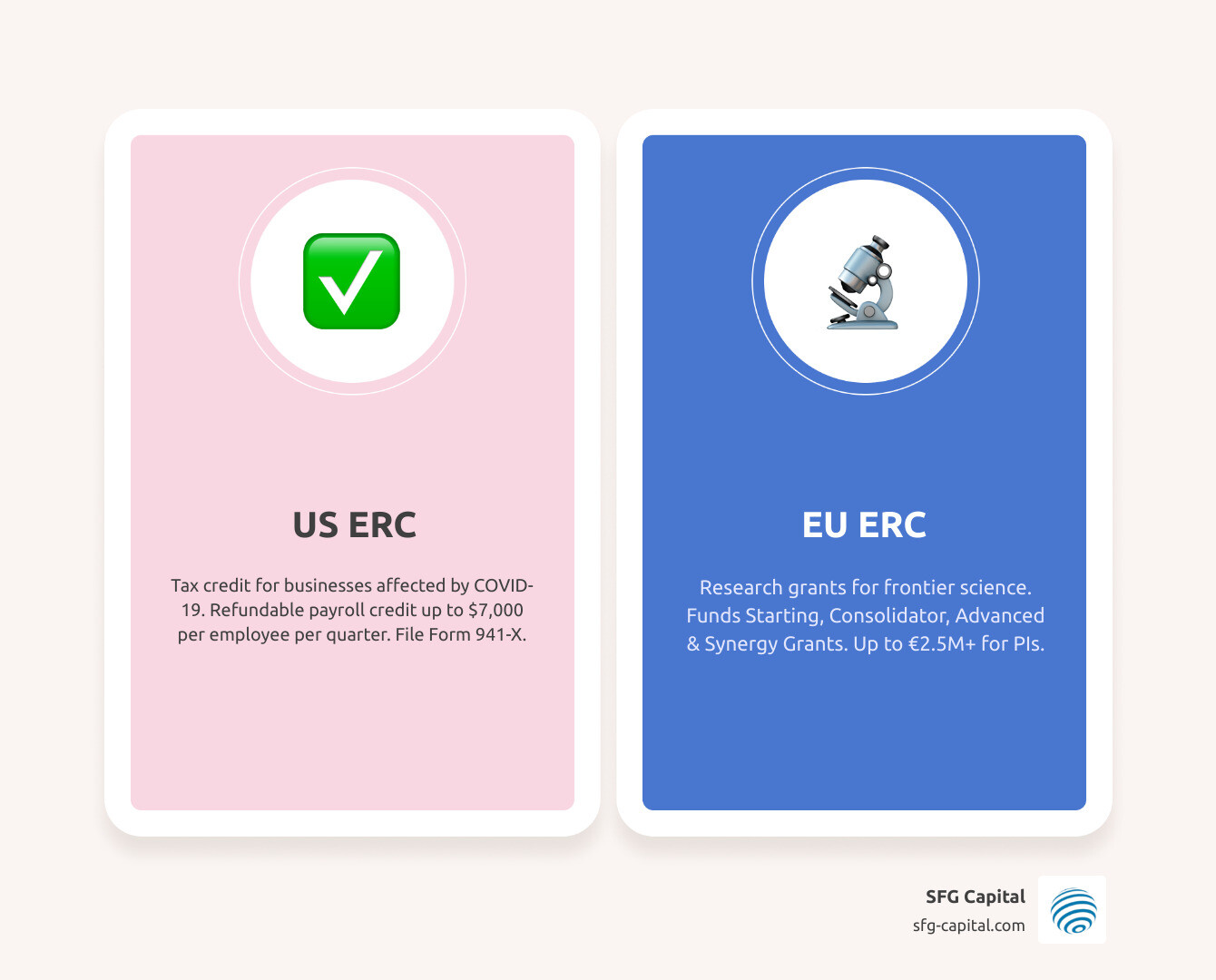
IRS vs. EU: Navigating the Critical erc deadlines 2025

The erc deadlines 2025 represent a major turning point for two massive government programs. On one side, the Internal Revenue Service (IRS) is managing the final phase of a pandemic-era relief program born from the Cares Act. On the other, the European Research Council (ERC) continues to operate under the Horizon Europe programme, which funds “frontier research” across the Atlantic.
While they share an acronym, their functions are worlds apart. For our clients here in Travis County, the IRS side is usually the priority. Understanding which “ERC” you are searching for is vital, especially as the IRS has issued several IRS news on ERC claim risks to warn businesses about “ERC mills” before the window shuts. Meanwhile, the EU counterpart remains a permanent fixture of the Official EU institutions and bodies.
Distinguishing the US Tax Credit from European Grants
The US Employee Retention Credit is a refundable payroll tax credit. It was designed to reward businesses that kept employees on the payroll during COVID-19 lockdowns. It isn’t a “grant” you apply for; it’s a credit you claim by amending your past tax returns.
Conversely, the European Research Council grants are for individual researchers—referred to as Principal Investigators (PIs)—who are hosted by a Host Institution in Europe. These are highly competitive academic awards, not small business relief. If you are looking for money because your Austin-based boutique was shut down in 2021, you are looking for the US tax credit.
Why the April 15, 2025 Date Matters for US Businesses
For US-based employers, the most significant of all erc deadlines 2025 is April 15, 2025. This is the hard cutoff for claiming credits based on qualified wages paid in 2021.
The IRS follows a three-year statute of limitations for payroll tax returns. Since the 2021 returns were technically “filed” on April 15, 2022 (for tax purposes), the window to amend them via Form 941-X expires exactly three years later. According to The IRS claim period status reported by the Taxpayer Advocate Service, once this date passes, the IRS will no longer accept new claims for the 2021 tax year. If you haven’t filed by then, that money—which can be up to $21,000 per employee—stays with the Treasury.
European Research Council: Grant Calendars and Evaluation Stages
If you happen to be a researcher looking for the academic version of erc deadlines 2025, the timeline is dictated by the ERC 2025 Work Programme official document. Unlike the US tax credit, which is a look-back at 2021, these grants are for future work.
The call identifiers (like ERC-2025-StG) refer to the budget year the funds come from, not necessarily the year the application is due. This can be confusing! For example, some “2025” calls actually had deadlines in late 2024.
Key Dates for erc deadlines 2025 Grant Cycles
The following table outlines the expected and confirmed deadlines for the various EU grant types.
| Grant Type | Identifier | Deadline | Estimated Grants | Budget |
|---|---|---|---|---|
| Starting Grant (StG) | ERC-2025-StG | Oct 15, 2024* | 483 | €751M |
| Consolidator Grant (CoG) | ERC-2025-CoG | Jan 14, 2025 | 354 | €719M |
| Advanced Grant (AdG) | ERC-2025-AdG | Aug 28, 2025 | 276 | €683M |
| Synergy Grant (SyG) | ERC-2025-SyG | Nov 6, 2024* | 48 | €500M |
| Proof of Concept (PoC) | ERC-2025-PoC | Multiple | ~200 | €30M |
*Note: While these are 2025 budget calls, the submission deadlines occurred in late 2024. For those looking ahead, the ERC-2026-StG is expected to have a deadline of October 14, 2025.
Post-Submission Timelines and Evaluation Steps
Applying is only the first step. The evaluation process is rigorous. For example, the Consolidator Grant 2025 evaluation timeframe shows a multi-step journey.
After you submit, your proposal goes through Step 1. If you pass, you’ll receive an invitation for an interview (typically around June 2025 for Life Sciences). The final Step 2 results aren’t usually announced until December of that year. This long lead time is why we always tell researchers to plan their careers at least 18 months in advance of needing the funding.
Eligibility, Funding Models, and PI Requirements
For the EU grants, eligibility is based on your “scientific age”—how long it has been since you defended your PhD. The Information for Applicants to Starting and Consolidator Grants specifies that Starting Grants are for those 2–7 years post-PhD, while Consolidator Grants are for those 7–12 years post-PhD.
Interestingly, the 2025 Advanced Grant is moving toward a lump sum pilot model. Instead of reporting every single “actual cost” (like a receipt for a beaker), the funding is based on completing the work described. This is a major shift in how the EU handles research money.
PI Criteria and erc deadlines 2025 Extensions
Life happens, and the ERC recognizes that. You can extend your eligibility window for several reasons:
- Maternity Leave: 18 months extension per child.
- Paternity Leave: The actual amount of leave taken.
- Long-term Illness: Over 90 days for the PI or close family members.
These extensions are vital because they allow researchers who took career breaks to still qualify for “Starting” or “Consolidator” status even if they are technically past the 7 or 12-year mark. If you’re looking for More info about ERC services related to business funding rather than academic grants, we can help clarify how these timelines differ from US tax law.
Budget Amounts and Project Durations
The “standard” ERC grants are quite large:
- Starting Grants: Up to €1.5 million for 5 years.
- Consolidator Grants: Up to €2 million for 5 years.
- Advanced Grants: Up to €2.5 million for 5 years.
However, there is a new, elite scheme known as the ERC Plus Grant. These grants are designed for “transformative research” that goes beyond the scope of any single existing program. They can reach up to €7 million and last up to 7 years. Only about 30 of these are awarded annually, making them significantly more competitive than the standard calls.
Beating the IRS Clock: Compliance and Fraud Prevention
Back in the US, the race against the IRS is reaching its final stage. Because of the flood of fraudulent claims, the IRS implemented a moratorium on processing new claims submitted after September 14, 2023. While they have recently resumed processing some of these, they remain under intense scrutiny.
To help businesses that may have been misled by “ERC mills,” the IRS launched the IRS Voluntary Disclosure Program details. This allowed businesses to pay back 80% (and later 85%) of the credit to avoid penalties if they realized they weren’t actually eligible.
Handling Disallowed Claims and Wage Expenses
If your ERC claim is disallowed, it creates a “tax math” problem. Usually, when you claim the ERC, you have to reduce your wage deduction on your income tax return by the amount of the credit. This is required by Notice 2021-49.
But what if the IRS says “no” to your credit after you’ve already paid higher income taxes? New IRS FAQs on handling credits suggest that you can increase your wage expense in the year the disallowance becomes final. This prevents you from being “double-taxed” on money you never actually received. It’s a complex maneuver, and we always recommend working with a pro to handle protective claims or AARs (Administrative Adjustment Requests).
Due Diligence for 2025 Filers
For those ensuring compliance with the erc deadlines 2025, the filing must be airtight. The IRS is looking for three main things:
- Gross Receipts Test: Did your revenue drop by more than 20% in a 2021 quarter compared to 2019? This is the “gold standard” for eligibility because it’s purely mathematical.
- Government Shutdown Order: Were you partially or fully suspended? To qualify here, the order must have had a “nominal impact” (usually defined as 10% of your business operations).
- Aggregation Rules: If you own multiple businesses, you likely have to group them together to see if you meet the tests.
The IRS announced that they are moving into a “high-risk” phase of auditing. Working with a firm that understands these nuances—like we do at SFG Capital—is the best way to ensure your claim doesn’t end up in the “unacceptable risk” pile.
Frequently Asked Questions about ERC Deadlines
What is the final deadline to claim the US ERC for 2021?
The final deadline is April 15, 2025. This applies to all quarters of 2021. The deadline for 2020 wages has already passed (it was April 15, 2024). If you miss the April 2025 date, the statute of limitations for amending your 941 returns will close.
How do I find official EU call details for 2025?
All official European Research Council calls are published on the EU Funding & Tenders Portal. You should look for the “Work Programme 2025” document for the most accurate calendar.
Can I apply for an ERC grant if I am based outside of Europe?
Yes, for the academic grants, researchers of any nationality can apply. However, you must perform the research at a Host Institution located in an EU Member State or an associated country. You are also generally required to spend at least 50% of your working time in Europe.
Conclusion
Whether you are a researcher chasing a €2 million grant or a Travis County business owner looking for a six-figure tax refund, the erc deadlines 2025 represent the final finish line.
At SFG Capital, we specialize in helping businesses navigate the IRS side of this equation. With the IRS backlog still stretching into the hundreds of thousands of claims, many businesses can’t afford to wait 12 to 18 months for their check. We provide refund advances and buyouts, allowing you to get your capital now while we take on the wait. Our performance-based fees mean we only succeed when you do.
Don’t let the April 15 clock run out on your 2021 wages. If you’re in Austin or the surrounding Travis County area, reach out to us for More info about ERC services and let’s get your refund moving.