
Don’t Panic: Understanding the Status of Your Employee Retention Credit
Why Understanding ERC Fund Availability Matters for Your Business
ERC funds running out is a common concern among business owners, but it’s largely based on misinformation. Here’s what you need to know right now:
Quick Facts About ERC Fund Status:
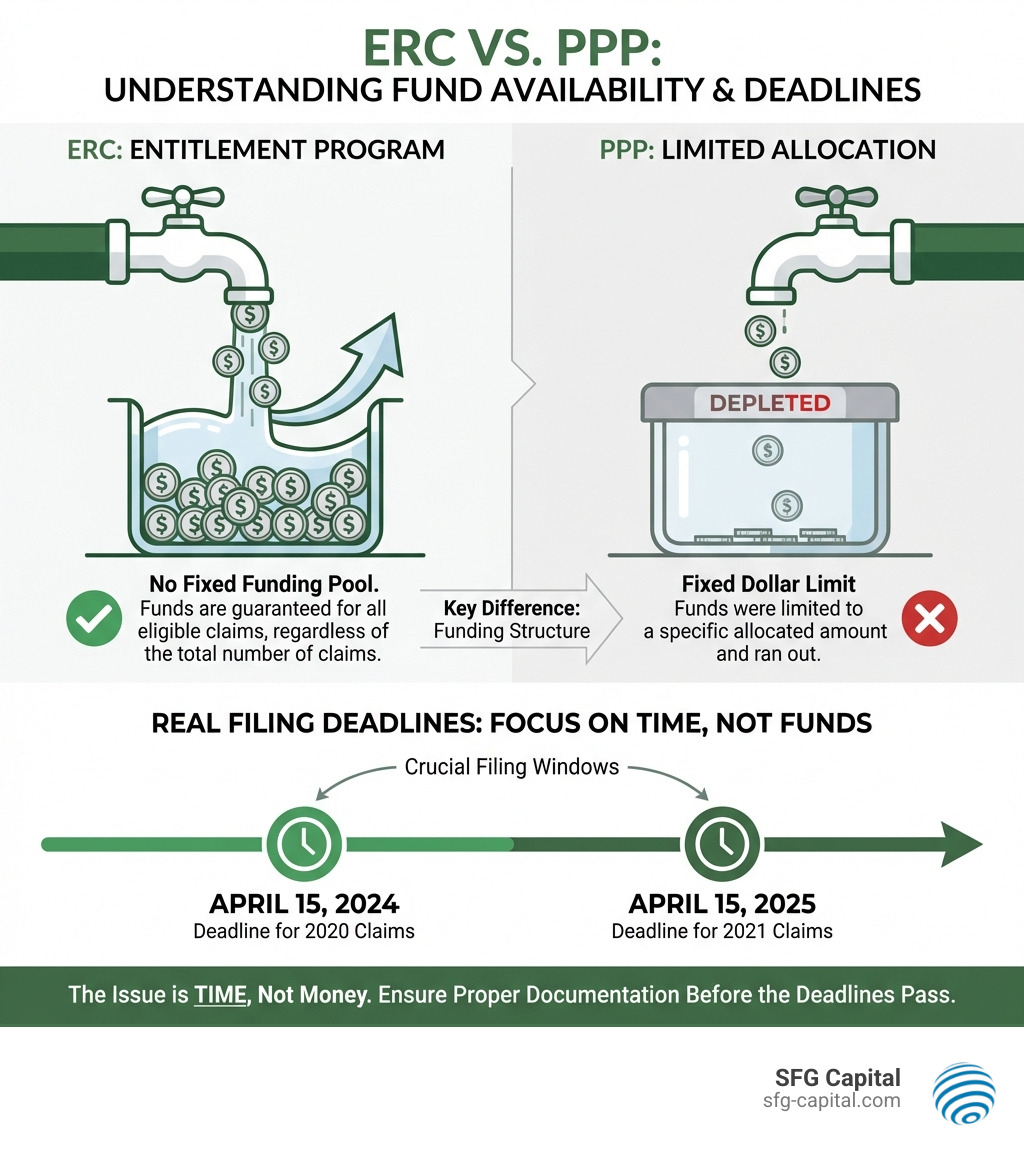
- The ERC is NOT running out of money – Unlike the Paycheck Protection Program (PPP), the ERC is an entitlement program with no fixed dollar limit
- What IS running out is TIME to file – Deadlines are April 15, 2024 for 2020 claims and April 15, 2025 for 2021 claims
- The IRS has placed a moratorium on NEW claims – Since September 2023, to combat fraud, but existing claims are still being processed
- Processing delays are real – But they’re due to increased scrutiny, not lack of funds
The confusion about “ERC funds running out” stems from aggressive marketing tactics by third-party promoters who create false urgency to pressure businesses into filing quickly. In reality, the Employee Retention Credit was designed as a refundable tax credit – an entitlement program where all eligible employers will receive their funds, regardless of how many other businesses claim it.
The real issues you should focus on are:
- Meeting the actual filing deadlines based on statute of limitations
- Ensuring your claim is properly documented and eligible
- Navigating IRS processing delays that can stretch 20+ weeks
- Avoiding penalties for improper claims
I’m Santino Battaglieri, and through my work at SFG Capital, I’ve helped businesses steer over $500 million in ERC claims while cutting through the noise and misinformation surrounding concerns like erc funds running out. My focus has always been on compliance-first strategies that protect businesses from the real risks – aggressive promoters and improperly filed claims.
Debunking the Myth: Are ERC Funds Running Out?
The idea that ERC funds running out is a pressing concern is a widespread misconception. Unlike the Paycheck Protection Program (PPP), which had a finite budget, the ERC program does not operate with a fixed dollar limit. The ERC was designed as a refundable tax credit—an entitlement program. If your business meets the eligibility criteria, you are entitled to receive the credit.
When the ERC was enacted under the CARES Act, the Congressional Budget Office (CBO) provided an estimate of the cost. This estimate is for legislative planning and does not represent a limited pool of funds. There is no dollar limit on the total amount of ERC funds that can be paid to taxpayers. Think of it like a standard tax deduction; the government doesn’t run out of money for those who qualify. This distinction is key to understanding why concerns about ERC funds running out are unfounded.
The IRS has provided comprehensive guidance, such as Notice 2021-20 guidance on ERC, which reinforces its nature as an entitlement. Our team at SFG Capital can help you understand the ERC Funding Requirements to ensure your claim is solid.

Why the “ERC funds running out” claim is a misconception
The claim that ERC funds running out is largely a product of aggressive marketing by third-party promoters. These promoters create a false sense of urgency to pressure businesses into submitting claims quickly. However, the ERC is a taxpayer entitlement. The government doesn’t cap the total payout for legitimate claims. For a deeper dive, check out our guide on What is ERC?.
The difference between funding availability and filing deadlines
While the funds aren’t running out, the filing deadlines are very real. Promoters often conflate “funds running out” with “time running out.” The deadlines are tied to the statute of limitations for amending payroll tax returns (Form 941-X):
- For wages paid in 2020: Deadline is April 15, 2024.
- For wages paid in 2021: Deadline is April 15, 2025.
Missing these deadlines means forfeiting the credit, not because the funds are gone, but because the filing window closed. Our guide on the ERC Funding Process can help you submit your claim correctly and on time.
Navigating the IRS Moratorium and Processing Delays
While ERC funds running out is a myth, IRS processing delays are a significant challenge. In September 2023, the IRS announced a moratorium on processing new ERC claims to combat a surge of questionable filings. This move protects taxpayers from scams while allowing the agency to implement fraud-prevention procedures.
The IRS continues to process claims submitted before the moratorium, but with increased scrutiny. These delays are not due to a lack of money; they are a consequence of ensuring program integrity. For a detailed look at these delays, see The Waiting Game: Understanding and Overcoming ERC Refund Delays.
Current IRS stance on new and existing claims
For claims submitted after September 2023, processing is paused with no clear resumption date. For claims submitted before the moratorium, the IRS is working through a backlog while referring thousands of cases for audit. The IRS is also developing a settlement program for businesses that may have been misled into claiming the credit erroneously. SFG Capital helps businesses steer this landscape with solutions like advances or buyouts. Learn more about Expediting Your ERC Refund: What You Need to Know.
How processing delays impact the statute of limitations
IRS delays mean many refunds are paid after the standard three-year statute of limitations for amending income tax returns has expired. For example, Congress extended the audit period for Q3 and Q4 2021 ERC claims to five years, as noted in Notice 2021-49 on ERC extensions.
This creates a dilemma: the ERC reduces deductible wage expenses on your income tax return. If you receive a refund after the amendment window closes, the IRS suggests you can include the ERC in income for the year of receipt, but this is complex. We advise consulting a tax professional. You can track your status using our guide: Is Your ERC Refund Here Yet? Ways to Track Your Employee Retention Credit.
How to Identify and Avoid Aggressive ERC Marketing
Aggressive marketing firms often use the false claim that ERC funds running out to reel in businesses. The IRS has placed these promotions on its “Dirty Dozen” list of tax scams. It’s crucial to distinguish between expert guidance and predatory marketing. For comprehensive assistance, see ERC Help: Everything You Need to Know About the Employee Retention Credit.
Red flags of predatory ERC promoters
Watch for these red flags in Austin and Travis County:
- Unsolicited Outreach: Be wary of cold calls or ads promising “easy applications.”
- Immediate Eligibility: Legitimate specialists require a thorough review of financial records and government orders before determining eligibility.
- Lack of Written Narrative: A specialist should provide a detailed explanation of how you qualify.
- Pressure Tactics: Claims that you must file before “funds run out” are false.
- “Nothing to Lose”: Improper claims can lead to severe penalties and interest.
- Vague Audit Support: Ensure any agreement clearly outlines who will represent you during an audit.
Use our ERC Eligibility Checklist: Don’t Miss Out to assess your situation.
Misrepresentations regarding “erc funds running out”
The most damaging misrepresentation is that ERC funds running out. This creates false urgency. Unlike the PPP, the ERC is an entitlement program with no predetermined cap. Promoters also invent false deadlines or misrepresent rule changes to pressure businesses. The ERC is a tax credit, not a loan. To understand this better, see Don’t Get Confused: Why the Employee Retention Credit Isn’t a Loan.
Understanding the Risks of Improper ERC Claims
The real risk isn’t ERC funds running out, but the consequences of improper claims. The IRS is increasing audits and investigations to combat fraud. Improperly receiving the ERC can lead to inaccuracy penalties (20%), erroneous refund penalties (20%), and fraud penalties (75% of the underpayment).
The IRS introduced a Voluntary Disclosure Program, outlined in IRS Announcement 2024-3 on Voluntary Disclosure, for businesses to repay improper credits and avoid some penalties. For more, see Navigating the ERC Program: Rules, Claims, and Your Business’s Big Win.
Income tax implications and wage deductions
The ERC is not taxable income, but it reduces your deductible wage expenses. If you claimed the ERC after filing your original returns, you generally must file an amended income tax return. Because of IRS delays, some employers receive refunds after the amendment window has closed. This is a complex area involving the “tax benefit rule.” Consult a qualified advisor in Travis County. Also, see Forgive and Forget: How PPP Loan Forgiveness Impacts Your Employee Retention Credit.
Substantiation requirements for a successful claim
A successful claim requires robust documentation. You must prove eligibility through:
- Suspension of Operations: You need the specific mandatory governmental order and proof of a “more than nominal impact” on operations.
- Significant Decline in Gross Receipts: Documented via financial statements comparing 2020/2021 to 2019.
- Recovery Startup Business: Specific criteria for businesses started after Feb 15, 2020.
Maintain records of governmental orders, payroll data, and a clear narrative of eligibility. Our ERC Funding Application: A Step-by-Step Guide to Claiming Your Credit provides more detail.
Frequently Asked Questions about ERC Funds
Is the rumor about erc funds running out actually true?
No, the rumor is false. The ERC is an entitlement program, meaning if you meet the requirements, you are legally entitled to the credit. Unlike the PPP, there is no fixed pool of money or dollar limit on total payouts. Budget estimates from the CBO were for planning, not a cap. For a full overview, see our ERC Credit Complete Guide.
What are the real deadlines before erc funds running out of time for filing?
While funds aren’t running out, the filing window is closing. The deadlines to file an amended Form 941-X are:
- For 2020 Claims: April 15, 2024.
- For 2021 Claims: April 15, 2025.
If you miss these dates, you lose the credit. Our team provides Employee Retention Credit Help to ensure you meet these deadlines.
What should I do if I received funds but am worried about eligibility?
If you’re concerned about a past claim, the IRS **Voluntary Disclosure Program** allows you to repay the credit and potentially avoid penalties. We recommend:
- Consult a Tax Professional: Get an independent review of your claim.
- Review Documentation: Gather all records and communications with promoters.
- Evaluate Disclosure: Determine if the Voluntary Disclosure Program is right for you.
Taking action now can prevent future financial repercussions. See Your Guide to Getting ERC Claim Assistance.
Conclusion
The narrative of ERC funds running out is a myth, but the urgency surrounding the Employee Retention Credit is undeniably real. It stems not from a depletion of funds, but from critical filing deadlines, the IRS’s moratorium on new claims, and heightened scrutiny on eligibility and documentation. For businesses in Austin and Travis County, understanding these nuances is paramount to both claiming the credit you’re entitled to and avoiding potential pitfalls.
We’ve seen how aggressive marketing tactics can misrepresent the program, creating false urgency and exposing businesses to significant risks. Our commitment at SFG Capital is to cut through this noise, providing clear, accurate information and expert assistance. We understand that navigating IRS delays can be frustrating, which is why we offer solutions like advances and buyouts to help eligible businesses access their funds more quickly, all while ensuring a compliance-first approach.
If you’re considering an ERC claim, or if you have concerns about a claim you’ve already filed, don’t wait. The deadlines are approaching, and the IRS’s focus on compliance is intensifying. Partner with trusted experts who prioritize accuracy and your business’s long-term financial health. Let us help you open up the full potential of your ERC claim and secure your rightful funds.
Find how SFG Capital can provide custom ERC Funding Solutions for your business in Travis County, ensuring you steer the complexities with confidence.