
Need for Speed: Your Guide to Getting a Tax Refund Expedited
Why Expediting Your Tax Refund Matters More Than Ever in 2026
Expediting a tax refund comes down to a few key actions you can take right now:
- E-file your return instead of mailing a paper form
- Choose direct deposit to receive funds in as little as 10 days
- File early and accurately to avoid processing holds
- Contact the IRS if financial hardship is causing serious harm
- Use the Taxpayer Advocate Service (TAS) if the IRS isn’t resolving your issue
- Explore advance funding options if you’re waiting on an ERC refund
About 70% of American taxpayers receive a federal refund each year. The average is over $2,500. That’s real money — and for business owners waiting on Employee Retention Credit (ERC) refunds, the stakes are even higher.
The problem? The IRS is under pressure. Staffing cuts, processing backlogs, and fraud-prevention holds mean refunds are taking longer than most people expect. Paper filers can wait up to six weeks. ERC claimants can wait over eight months.
Knowing how the system works — and where you can push back — makes a real difference.
I’m Santino Battaglieri, founder of SFG Capital, a firm that has purchased and funded over $500 million in ERC claims, giving us deep, hands-on experience with expediting tax refund processes for businesses navigating IRS delays. In the sections below, I’ll walk you through every legitimate option available to you.
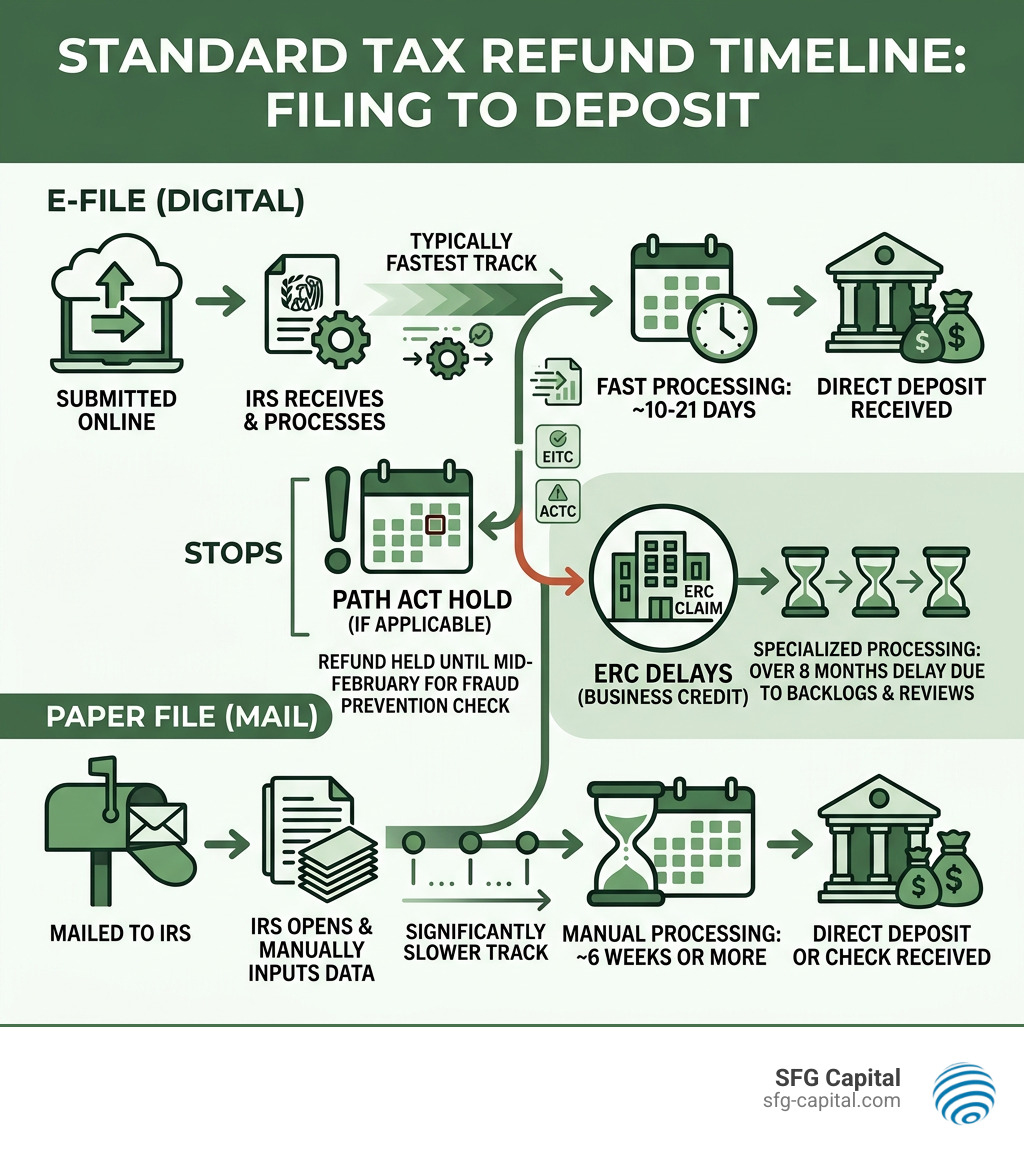
The Fastest Ways for expediting tax refund Processing
When we talk about speed, we have to talk about the method of delivery. The IRS is a massive bureaucracy that still relies heavily on physical mail for a surprising amount of its work. If you want to move to the front of the line, you have to meet them where they are most efficient: the digital world.

The absolute fastest way to receive your money is by combining electronic filing (e-filing) with direct deposit. According to the IRS, nine out of ten taxpayers who use this combination receive their refunds in less than 21 days. In many cases, we see accurate e-filed returns hitting bank accounts in as little as 10 to 14 days.
Compare that to the “snail mail” method. If you mail a paper return, you are looking at a minimum of six weeks—and that’s if everything goes perfectly. If there’s a backlog or a minor error on your form, a paper return can sit in a processing center for months.
| Filing Method | Estimated Refund Timeline | Risk of Delay |
|---|---|---|
| E-file + Direct Deposit | 10 to 21 Days | Low |
| E-file + Paper Check | 3 to 4 Weeks | Moderate |
| Paper Return + Direct Deposit | 6 to 8 Weeks | High |
| Paper Return + Paper Check | 8+ Weeks | Very High |
For more deep dives into these timelines, check out our guide on Speed Up Your Tax Refund: Strategies to Expedite IRS Processing.
Why E-Filing and Direct Deposit are Essential
Think of e-filing as an express lane. When you submit your return electronically, the IRS computers perform an immediate check for basic errors. If something is missing, the system rejects it instantly, allowing you to fix it and resubmit within minutes. With paper, you might not know there’s a mistake for two months.
Direct deposit is the second half of the speed equation. It eliminates the time it takes for a check to be printed, mailed, and cleared by your bank. It’s also significantly more secure. Every year, thousands of paper checks are lost in the mail or stolen from mailboxes.
If you’re worried about the cost of filing, the IRS Free File eligibility program is a lifesaver. For the 2025 tax year, if your Adjusted Gross Income (AGI) is $84,000 or less, you can use brand-name software to prepare and file your federal return for free.
Avoiding Common Mistakes for expediting tax refund Timelines
Nothing kills the momentum of expediting tax refund processing like a “math error” notice. When the IRS detects a discrepancy, they pull your return out of the automated system for a manual review. This can add weeks or months to your wait time.
To keep your refund on the fast track, ensure you have the following documents ready and double-checked:
- Social Security Numbers: Ensure every digit for you, your spouse, and your dependents is correct.
- Bank Account Details: A single typo in your routing or account number will result in the bank rejecting the deposit, forcing the IRS to mail a paper check instead.
- Income Forms: W-2s, 1099s, and any documentation for the “One Big Beautiful Bill” changes (like tips or senior deductions).
- Prior Year AGI: You’ll need this to “sign” your electronic return.
Navigating Delays: PATH Act and Financial Hardship
Even if you do everything right, some laws are designed to slow things down. The Protecting Americans from Tax Hikes (PATH) Act is a primary example. This law requires the IRS to hold all refunds that include the Earned Income Tax Credit (EITC) or the Additional Child Tax Credit (ACTC) until mid-February.
This hold exists to give the IRS time to verify that the wages reported on the return match what employers have sent in, helping to prevent identity theft and fraud. If you fall into this category, don’t expect your money until late February or even early March, regardless of how early you file.
If you find yourself in a dispute or a long-term delay that you can’t resolve, you might look into Publication 4134 for Low Income Taxpayer Clinics. These clinics are independent of the IRS and can help people with lower incomes resolve disputes or audits.
How the Taxpayer Advocate Service (TAS) Can Help
What happens when the IRS system simply breaks down? That’s where the Taxpayer Advocate Service (TAS) comes in. TAS is an independent organization within the IRS. Their job is to ensure that every taxpayer is treated fairly and knows their rights.
If you have tried to resolve your issue through normal channels and have hit a brick wall, or if the IRS’s delay is causing you significant financial distress, TAS can step in. They have the power to cut through the red tape and advocate for your case directly with IRS management.
For more information on how to reach them, see our resource on IRS Customer Service: Get the Help You Need.
Requesting an Expedited Refund Due to Hardship
In extreme cases, the IRS has the authority to “bypass” certain holds and manually process a refund. This is reserved for true financial hardships. If the lack of a refund is causing an immediate threat to your health or safety, you may qualify for an expedited manual refund.
Common examples of hardship that the IRS recognizes include:
- Eviction or Foreclosure: You have an official notice and no other way to pay your housing costs.
- Utility Shut-off: Your electricity, water, or gas is about to be disconnected.
- Medical Emergencies: You are unable to pay for life-saving medication or procedures.
To request this, you must contact the IRS directly and provide documentation—like a copy of the shut-off notice or eviction papers. While the IRS can expedite refunds held for backlogs or prior tax debts, they cannot release refunds being offset by the Bureau of the Fiscal Service (BFS) for things like unpaid student loans or child support.
Advanced Options: Accessing Funds Early for Business Credits
For business owners in Travis County, the conversation around expediting tax refund timelines often shifts from personal income tax to the Employee Retention Credit (ERC). The ERC has been a double-edged sword: it’s a massive financial boost, but the IRS processing of these claims has been plagued by moratoriums and delays.
Currently, the IRS has a significant backlog of ERC claims. Many businesses have been waiting over eight months, and some are being told it could take a year or more. For a small business in Austin, that kind of delay can be the difference between staying open and shutting down.
Strategies for expediting tax refund Claims for ERC
If your business is stuck in the ERC “waiting game,” you have a few options to speed things up. Some businesses choose to file a refund lawsuit if the IRS has failed to act on their claim within six months. Others turn to the Taxpayer Advocate Service if the delay is causing the business to fail.
However, the most direct way to get cash in hand is through a refund advance or buyout. At SFG Capital, we specialize in helping businesses bypass the IRS wait entirely. We provide the funds upfront, taking on the wait time ourselves so you can reinvest in your company today.
For a deeper look at your options, read Expediting Your ERC Refund: What You Need to Know.
Frequently Asked Questions about Tax Speed
We get a lot of questions about the 2026 tax season and how it differs from years past. Here are the most common concerns we hear from our clients in Austin and across the country.
Why is my refund delayed for EITC or ACTC?
As mentioned, the PATH Act mandates a hold until February 15th. Even if you file on the first day the IRS opens in January, they legally cannot release those funds early. This is a fraud-prevention measure. If you are in this boat, your “Where’s My Refund” status likely won’t update until late February.
Can the IRS expedite a refund for a business?
Yes, but it is difficult. For ERC claims, the IRS is performing much higher levels of scrutiny than they did in 2021 or 2022. If your business is facing a “settlement” or an audit (often signaled by Letter 6612), the process can take even longer. This is why many businesses choose to work with firms like ours to secure an advance rather than waiting on the IRS’s manual review.
How do IRS staffing changes affect my 2026 refund?
The 2026 tax season is unique. Recent administration policies have led to a reduction of approximately 7,000 IRS employees, including 5,000 in enforcement and collections. While the IRS is trying to automate more processes, fewer human “problem solvers” means that if your return gets flagged for a manual check, it will likely sit in a pile longer than it would have in previous years.
Conclusion
Navigating the IRS doesn’t have to be a nightmare, but it does require a strategy. Whether you are an individual taxpayer in Travis County looking for a fast $2,500 refund or a business owner in Austin waiting on a six-figure ERC check, the rules of the game are the same: file digitally, be accurate, and know when to call in the experts.
At SFG Capital, we live and breathe the complexities of the tax code. We help businesses in Travis County and throughout the United States navigate the ERC maze. If you are tired of checking the “Where’s My Refund” tool only to see “Still Processing,” we can help. We offer advances and buyouts that give you immediate access to your funds, backed by our expert claim assistance and performance-based fees.
Don’t let IRS delays hold your business back. More info about our services is just a click away. Let us take on the wait while you get back to building your business.