
Employee Retention Advance Buyout: Cash in Hand Today
Why the Employee Retention Advance Buyout Is the Fastest Way to Access Your ERC Funds
An employee retention advance buyout is a financial arrangement where a third-party buyer purchases your pending ERC (Employee Retention Credit) refund from you — giving you a lump sum of cash now, instead of waiting months or years for the IRS to process your claim.
Quick answer — here’s how the main options compare:
| Option | Repayment Required? | Typical Payout | Speed |
|---|---|---|---|
| ERC Buyout | No | 70–85% of claim | 1–4 weeks |
| ERC Advance/Loan | Yes | Up to 90% of claim | 3–7 days |
| ERC Bridge Loan | Yes (interest-based) | Up to 85% of claim | 1–2 weeks |
| Wait for IRS | N/A | 100% of claim | 6–18+ months |
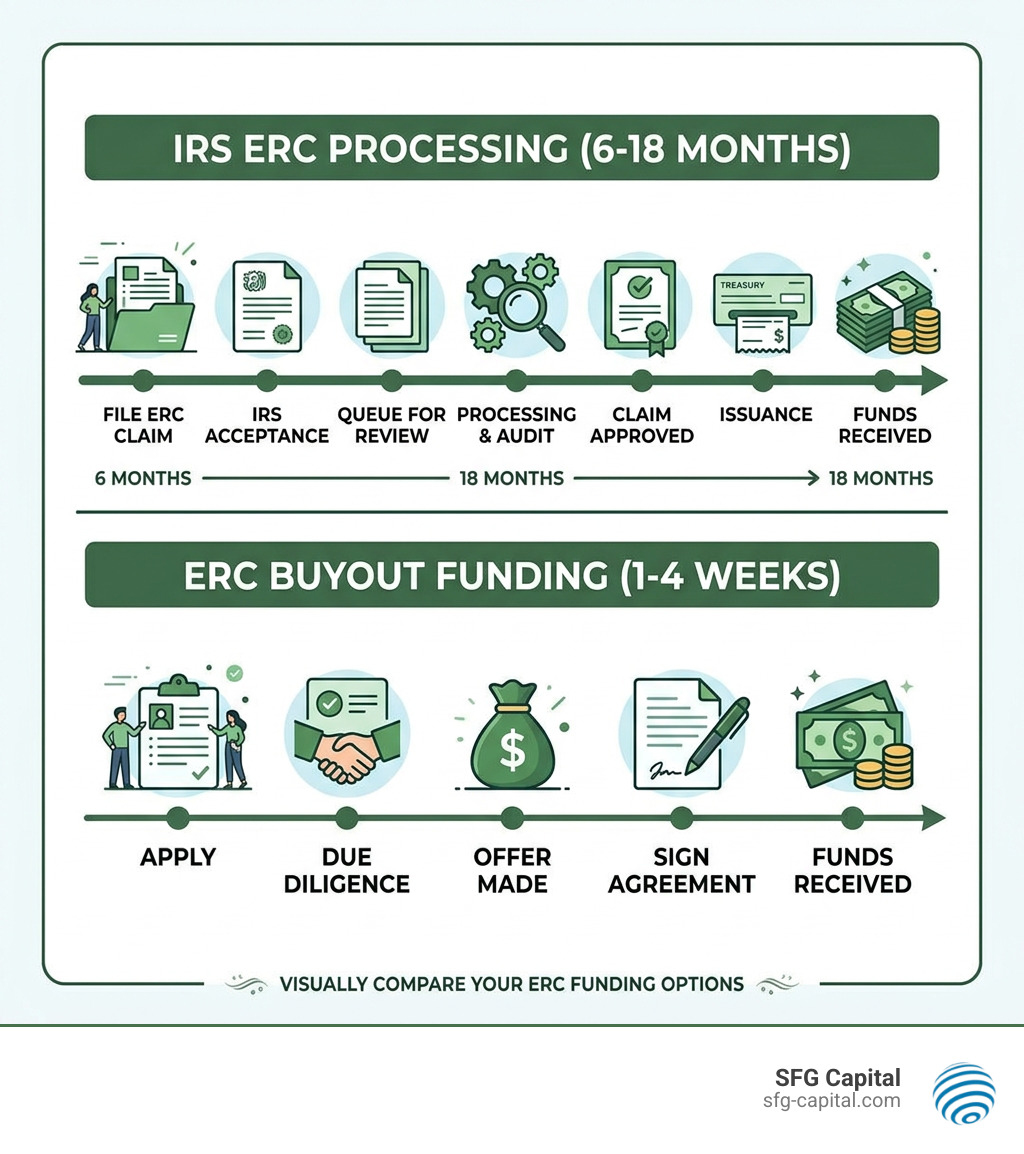
The IRS currently takes anywhere from 6 to 18 months — sometimes longer — to process ERC refund claims. For a business that needs working capital today, that wait can mean missed payroll, stalled growth, or worse.
That’s the core problem an employee retention advance buyout solves. Instead of watching a calendar, you sell your pending refund to a qualified buyer and walk away with cash in hand — no repayment, no monthly payments, no debt on your balance sheet.
I’m Santino Battaglieri, founder of SFG Capital, a firm that has purchased and funded over $500 million in ERC claims with a compliance-first approach to employee retention advance buyout transactions. In this guide, I’ll walk you through exactly how the process works, how it compares to other funding options, and how to decide what’s right for your business.
Understanding the Employee Retention Advance Buyout
For many business owners in Travis County, the Employee Retention Credit (ERC) feels like a mirage. You know the money is there—you’ve filed the paperwork, calculated the qualified wages, and received the confirmation—but the actual check remains stuck in a massive IRS backlog. As of recent reports, the Employee Retention Credit | Internal Revenue Service processing times have slowed to a crawl, leaving billions of dollars in limbo.
An employee retention advance buyout changes the math. Instead of waiting for the IRS to eventually issue a Treasury check, you treat your pending refund as an asset. You sell that asset to a specialized funding provider like us. This is structured as an asset purchase, meaning we buy the right to receive the future refund. Because it is non-recourse financing, if the IRS pays the claim as expected, the transaction is complete. You get immediate liquidity to reinvest in your business, pay down high-interest debt, or simply sleep better at night.
Defining the Employee Retention Advance Buyout
At its simplest, an employee retention advance buyout is a purchase agreement. We provide you with a lump-sum payment today in exchange for the rights to your future credit. This isn’t a loan where you make monthly payments; it’s a “set it and forget it” solution. Once the purchase agreement is signed and the funds are wired to your account, you no longer have to worry about the IRS timeline. The buyer takes on the wait time, and in exchange, they purchase the credit at a discount.
ERC Buyout vs. HR Voluntary Buyouts
It is important to clear up some common confusion. If you search for “employee buyout,” you might find information about Employee Buyout (EBO) Overview or Voluntary Separation Incentive Payments (VSIP). Those are HR strategies used for workforce restructuring—essentially paying an employee a severance package to voluntarily leave their job.
An employee retention advance buyout is entirely different. It has nothing to do with firing staff or severance pay. It is a financial transaction involving a federal tax credit. While HR buyouts focus on reducing payroll costs, an ERC buyout focuses on injecting capital into your business so you can keep your team and grow your operations here in Austin and beyond.
Comparing ERC Buyouts, Advances, and Bridge Loans
When you need cash against your tax credit, you’ll hear three terms: Buyouts, Advances, and Bridge Loans. While they all get you money faster than the IRS, the “fine print” varies significantly.
| Feature | ERC Buyout | ERC Advance | ERC Bridge Loan |
|---|---|---|---|
| Structure | Asset Purchase | Advance on Refund | Debt/Loan |
| Repayment | None (Buyer collects from IRS) | Typically none | Monthly or Balloon |
| Impact on Debt | Debt-Free | Usually Debt-Free | Adds Liability |
| Credit Score | Lower requirements (500+) | Moderate (600+) | Higher requirements |
| Speed | 1–4 Weeks | 3–7 Days | 1–2 Weeks |
Why Choose an Employee Retention Advance Buyout Over a Loan?
The biggest reason our clients choose a buyout is to keep their balance sheets clean. A bridge loan is a liability. It shows up as debt, which can complicate your ability to get other financing, such as equipment loans or mortgages.
With an employee retention advance buyout, the risk of the “wait time” is transferred to the buyer. Because it is not debt, there are no interest rates to track and no monthly payments to drain your cash flow. If you are looking for ERC advance funding, a buyout is often the most “frictionless” way to move forward without the burden of a traditional loan structure.
Percentage Payouts and Upfront Values
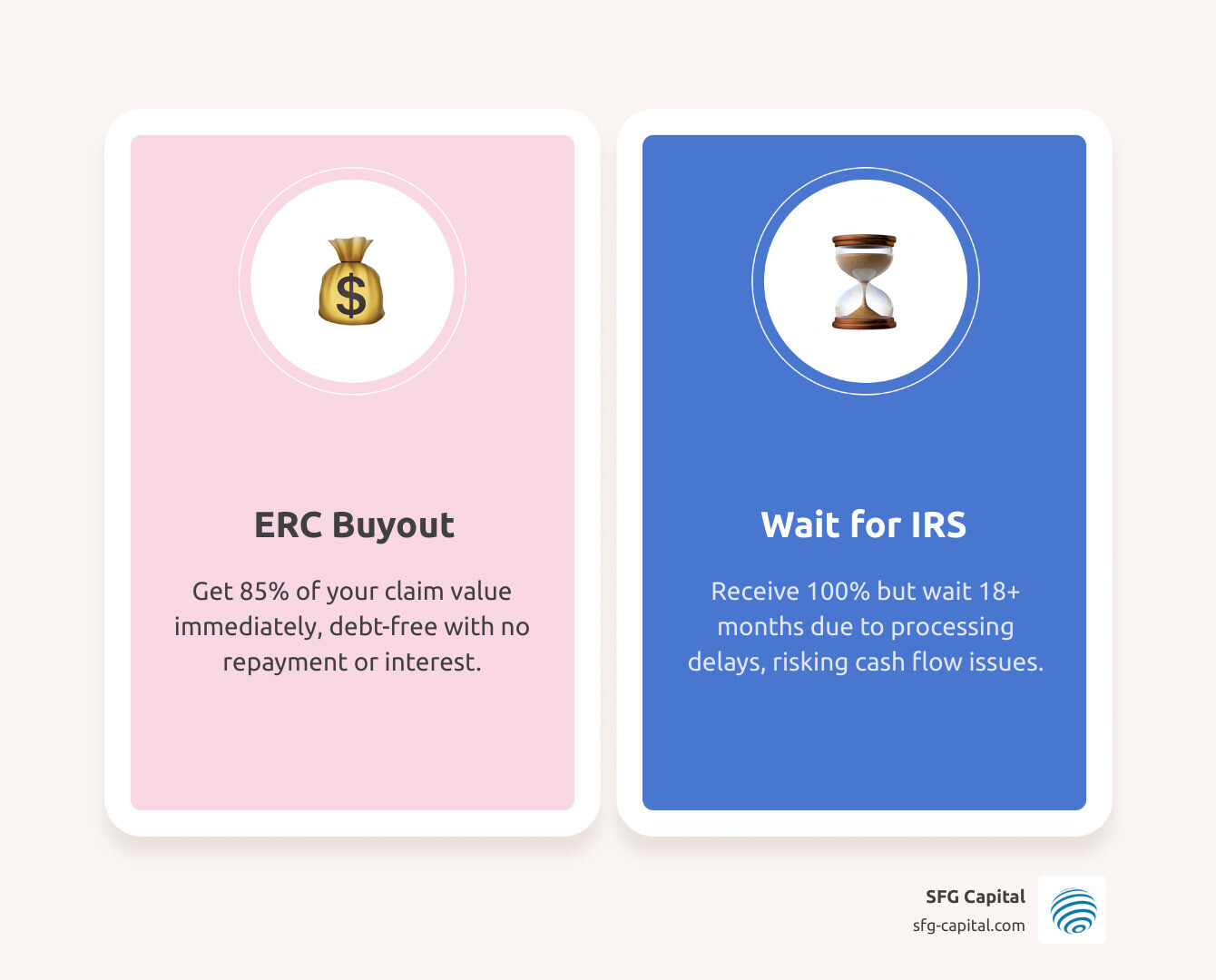
You won’t receive 100% of your claim value in a buyout—that’s the trade-off for speed. Typical payouts range from 70% to 90% of the total claim value. For example, if you have a $200,000 claim, you might receive $170,000 (85%) immediately.
The remaining 15% covers the buyer’s risk, the cost of capital, and the fact that they might be waiting two years to get paid by the government. Many businesses find that the “discount” is well worth it to bridge the gap and put that money to work today rather than letting it sit idle in an IRS queue.
Eligibility and Requirements for an Employee Retention Advance Buyout
Not every ERC claim qualifies for a buyout. Because the buyer is taking on the risk of the IRS paying out, they perform a deep dive into the credibility of the filing.
- Minimum Claim Amount: Most programs, including ours at SFG Capital, require a minimum claim of $100,000. Smaller claims often don’t justify the legal and underwriting costs involved in an asset purchase.
- Credit Score: While buyouts are more flexible than bank loans, most providers look for a minimum credit score between 500 and 600.
- Business Standing: Your business should be operational and free of active bankruptcies, major tax liens, or legal litigation that could jeopardize the refund.
Required Documentation for Approval
To get approved for an employee retention advance buyout, you need to have your “ducks in a row.” The more organized your paperwork, the faster the funding. You should prepare:
- Forms 941: Your original quarterly federal tax returns.
- Forms 941-X: The amended returns showing your ERC claim.
- Payroll Records: Documentation supporting the qualified wages claimed.
- Tax Returns & P&L Statements: Generally for 2019 through 2022 to show the impact on your business.
- Filing Proof: Confirmation that the IRS has received your 941-X (such as certified mail receipts).
Our Employee Retention Credit Advance Guide provides a detailed checklist to help you gather these items efficiently.
Verification and Claim Credibility
The biggest hurdle in an employee retention advance buyout is verification. We live in an era where the IRS has increased scrutiny on ERC claims. A reputable buyer will review your eligibility calculations to ensure they meet IRS standards. This includes verifying whether you qualified via a “significant decline in gross receipts” or a “full or partial suspension of operations” due to government orders.
Securing advance payments requires showing that your claim is audit-ready. If your original ERC mill used “aggressive” math, a buyout provider might ask you to re-file or adjust the claim before they will purchase it.
The Step-by-Step Process to Secure Your Funds
Getting your money doesn’t have to be a bureaucratic nightmare. Here is how we handle the process at SFG Capital for our Travis County neighbors:
- Initial Application: You provide basic details about your business and the size of your ERC claim.
- Document Submission: You upload the 941-X forms and supporting payroll data.
- Underwriting & Valuation: Our team reviews the claim’s validity and determines the buyout percentage (e.g., 80% or 85%).
- The Offer: We present a formal purchase agreement.
- Funding: Once signed, the funds are wired directly to your business account.
From Application to Funding Timeline
Speed is the primary reason businesses seek an employee retention advance buyout. While the IRS measures time in years, we measure it in days.
- Approval: Often within 24 to 48 hours of receiving a complete document package.
- Pre-Approval: Can happen in as little as 72 hours.
- Funding: Once the agreement is finalized, funds can be in your account in as little as 3 to 7 days.
In some complex cases, the full process might take up to 30 days, but it is still the fast track to your ERC cash compared to the alternative.
How the Buyout Finalization Works
When you finalize an employee retention advance buyout, you are signing a contract that legally transfers the rights of the refund to the buyer. You will typically need to notify the IRS (or provide the buyer with power of attorney for that specific tax period) so that when the check is finally cut, it goes to the correct party.
The financing process is designed to be transparent. You get your money upfront, and we take over the “waiting game” with the Treasury Department.
Is an Employee Retention Advance Buyout Right for Your Business?
Deciding whether to sell your claim at a discount is a strategic business decision. You have to weigh the “cost of waiting” against the “cost of the discount.”
Ask yourself:
- What is the opportunity cost of not having that money today?
- Could $150,000 today generate more than the $30,000 “discount” over the next 18 months?
- Do you have high-interest debt (like MCA loans) that is costing you 30-50% APR?
If the answer is yes, then an employee retention advance buyout is likely the right move. It provides immediate working capital to fuel growth initiatives that would otherwise be stalled.
Benefits: Immediate Cash and No Repayment
The most attractive feature of a buyout is that it is not a loan.
- Zero Monthly Payments: You don’t have to worry about cash leaving your business every month.
- No Personal Guarantee: In most buyout structures, you aren’t personally on the hook if the business fails, as long as the ERC claim itself was valid and filed in good faith.
- Operational Freedom: Use the funds for anything—inventory, marketing, rent, or expanding your Austin-based team.
An ERC refund advance gives you the liquidity of a loan with the “cleanliness” of a sale.
Risks: Discounted Payout and Tax Implications
No financial product is without downsides.
- Reduced Total Amount: You are intentionally taking less money than the IRS would eventually send you.
- Tax Implications: The ERC itself is not taxable income, but it does require you to reduce your wage deduction for the year the credit applies to. Selling the credit might have specific tax treatment for the “loss” on the sale. We always recommend a professional consultation with your CPA.
- Claim Denial: If the IRS denies your claim because of fraud or gross errors, the “non-recourse” nature of the buyout may be challenged. This is why we insist on rigorous due diligence upfront.
Frequently Asked Questions about ERC Buyouts
How long does it take to get approved for an ERC buyout?
Most businesses receive a pre-approval or initial offer within 24 to 72 hours. The full underwriting and funding process typically takes 1 to 3 weeks, depending on how quickly you can provide the required documentation.
What is the minimum ERC claim amount required for a buyout?
For most professional buyout programs, the minimum claim is $100,000. Some specialized bridge loan programs may go as low as $75,000, but for a true asset purchase (buyout), the $100k threshold is standard.
Is an ERC buyout considered a business loan?
No. An employee retention advance buyout is an asset purchase. You are selling a future receivable (the tax credit) for a lump sum today. Because there are no monthly payments and no interest rates, it does not function like a traditional loan and does not add debt to your balance sheet.
Conclusion
The IRS backlog shouldn’t be the reason your business stops growing. Whether you are a tech firm in downtown Austin or a hospitality business in Travis County, you’ve earned the Employee Retention Credit by keeping your people employed during the toughest of times.
At SFG Capital, we specialize in helping businesses bypass the federal red tape. Our employee retention advance buyout program is designed to be fast, transparent, and debt-free. We use a performance-based fee structure, meaning we only succeed when you get the funding you need.
Don’t let your capital sit in a government vault. If you’re ready to see how much your claim is worth today, Apply for ERC Advance Funding and let us help you get back to business.