
Everything You Need to Know About the Payroll Tax Credit
What Is a Payroll Tax Credit and Why Does It Matter for Your Business?
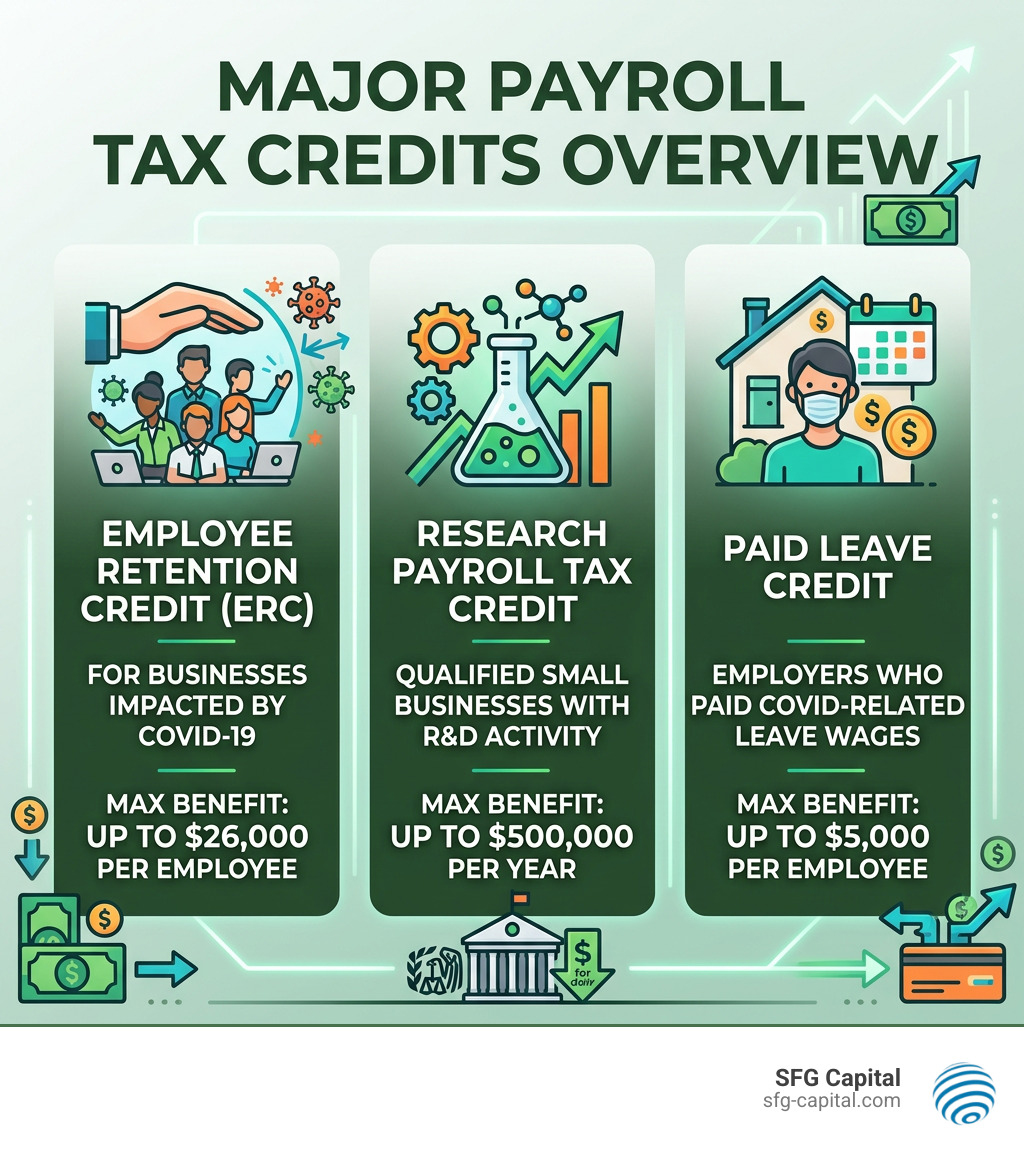
Payroll tax credit is a term that covers several IRS programs letting eligible businesses reduce — or even eliminate — what they owe in payroll taxes. Here’s a quick overview of the main credits:
| Credit | Who It’s For | Max Benefit |
|---|---|---|
| Employee Retention Credit (ERC) | Businesses impacted by COVID-19 | Up to $26,000 per employee |
| Research Payroll Tax Credit | Qualified small businesses with R&D activity | Up to $500,000 per year |
| Paid Leave Credit | Employers who paid COVID-related leave wages | Up to $5,000 per employee |
These aren’t deductions. They directly reduce your tax bill — dollar for dollar. And in many cases, if the credit exceeds what you owe, the IRS sends you a refund check.
For small business owners, that’s real money. The kind that keeps the lights on, covers payroll, and funds growth.
But the process is complicated. IRS backlogs are real — the agency is currently processing roughly 400,000 ERC claims worth about $10 billion. Scams are widespread. And claiming the wrong amount can trigger audits, penalties, and repayment demands.
That’s exactly why understanding your options matters before you file.
I’m Santino Battaglieri, and through SFG Capital I’ve helped businesses navigate the payroll tax credit landscape at scale — having purchased and funded over $500 million in ERC claims with a compliance-first approach. In the sections below, I’ll walk you through every major credit, how to claim it correctly, and how to protect your business along the way.
Understanding the Employee Retention Credit (ERC)

The Employee Retention Credit (ERC) has been a lifeline for many businesses in Travis County. Think of it as a “thank you” from the government for keeping your team on the payroll during the height of the pandemic. While the program technically ended for most wages in 2021, the IRS allows you to look back and claim it retroactively.
To qualify for the Employee Retention Credit | Internal Revenue Service, your business must have met one of two main criteria during the eligibility period:
- Government Suspension: Your operations were fully or partially suspended due to a government order (like the capacity limits we saw in Austin).
- Gross Receipts Decline: You experienced a significant decline in gross receipts compared to the same quarter in 2019.
The rules changed significantly between the two years the credit was active. We’ve put together a quick comparison to help you see the difference:
| Requirement | 2020 ERC | 2021 ERC |
|---|---|---|
| Credit Rate | 50% of qualified wages | 70% of qualified wages |
| Max Credit per Employee | $5,000 for the year | $7,000 per quarter |
| Gross Receipts Decline | > 50% vs 2019 | > 20% vs 2019 |
| Max Benefit | $5,000 total | $21,000 total (Q1-Q3) |
ERC Eligibility and PPP Interaction
One of the biggest questions we get at SFG Capital is: “Can I claim the ERC if I already got a PPP loan?” The answer is a resounding yes. Originally, the law said you had to pick one or the other, but that changed in late 2020.
However, there is a catch: you cannot “double-dip.” This means you can’t use the exact same dollar of wages to justify both PPP loan forgiveness and an ERC claim. Managing this requires a bit of “wage math” to ensure you’re maximizing both benefits without overlapping.
There is also a special category for “Recovery Startup Businesses.” If you started your business after February 15, 2020, and your annual gross receipts are under $1 million, you might be eligible for a credit of up to $50,000 per quarter for Q3 and Q4 of 2021, even if you didn’t experience a shutdown or revenue drop. Understanding these nuances is a key part of Finance management for new ventures.
Claiming the ERC for 2020 and 2021
Since the original deadlines for filing quarterly payroll tax returns have passed, you claim the ERC by filing Form 941-X, which is an adjusted employer’s quarterly federal tax return.
Be warned: the IRS is currently under a self-imposed moratorium on processing new claims to root out fraud, and they are scrutinizing every file. If you realize you’ve submitted an ineligible claim, the IRS offers a withdrawal program. This allows you to pull back your claim before it’s processed, helping you avoid potential penalties, interest, and the headache of an audit.
The Qualified Small Business Payroll Tax Credit for Research Activities
Not every payroll tax credit is related to the pandemic. For the innovators in the Austin tech scene, the Research and Development (R&D) credit is a game-changer. Historically, R&D credits only helped companies that were actually making a profit and paying income tax. For many startups, that wasn’t very helpful.
Enter the Qualified small business payroll tax credit for increasing research activities | Internal Revenue Service. This allows “Qualified Small Businesses” (QSBs) to apply their R&D tax credit against their payroll tax liability instead of their income tax.
To be a QSB, you generally need:
- Less than $5 million in gross receipts for the current tax year.
- No gross receipts for any tax year more than five years ago.
Impact of the Inflation Reduction Act of 2022
The Inflation Reduction Act (IRA) gave this credit a massive boost. For tax years beginning after December 31, 2022, the maximum amount you can elect to use against payroll taxes increased from $250,000 to $500,000.
This is huge for our local Taxes landscape. The first $250,000 of the credit is applied against the employer’s share of Social Security tax, and the additional $250,000 can now be applied against the employer’s share of Medicare tax. Any unused credit can be carried forward to future quarters.
Claiming the Payroll Tax Credit with Form 8974
To get this money, you first need to calculate your research credit on Form 6765 and file it with your income tax return. You must make the election on an originally filed return (including extensions); you generally cannot decide to do this later on an amended return.
Once you’ve made the election, you use Form 8974 to calculate the actual amount of the credit you can use against your payroll taxes for the quarter. You’ll attach this form to your Form 941. For a deep dive into the technicalities, you can check out the Instructions for Form 8974.
Other Essential Credits: Paid Leave and WOTC
Beyond the “Big Two” (ERC and R&D), there are other ways to lower your payroll tax burden.
Paid Leave Credit Requirements
The Families First Coronavirus Response Act (FFCRA) and the American Rescue Plan provided dollar-for-dollar tax credits to reimburse employers for the cost of providing paid sick and family leave related to COVID-19.
- 2020: Leave was mandatory for many employers.
- 2021: Leave became voluntary, but the tax credits remained available through September 30, 2021.
These credits covered 100% of the wages paid, up to certain daily limits (like $511 per day for an employee’s own health needs). If you paid out leave wages during these periods and didn’t claim the credit, you can still file an amended return to get that money back.
Maximizing the Payroll Tax Credit through WOTC
The Work Opportunity Tax Credit (WOTC) is a federal tax credit available to employers for hiring individuals from certain “targeted groups” who have consistently faced significant barriers to employment. This includes veterans, former felons, and the long-term unemployed.
In our neck of the woods, the Work Opportunity Tax Credit for Employers is administered through the Texas Workforce Commission (TWC). To claim this credit, you must submit Form 8850 to the TWC within 28 days of the eligible employee’s start date. It’s a great way to support the Travis County community while reducing your tax liability.
How to Claim Your Payroll Tax Credit and Avoid IRS Scams
With billions of dollars on the table, it’s no surprise that “ERC Mills” and scammers have come out of the woodwork. They often use aggressive marketing, promising that “every business qualifies” regardless of the actual facts.
We have seen promoters charging massive upfront fees or taking a percentage of the refund that is far above industry standards. Even the UK government has issued a HMRC tax fraud warning for employers regarding similar schemes, proving that payroll tax fraud is a global issue.
Employer Responsibilities and Penalties
At the end of the day, you are responsible for what is on your tax return. If a promoter talks you into a fraudulent claim, the IRS won’t go after the promoter first—they’ll come to you.
Incorrectly claiming a payroll tax credit can lead to:
- Repayment of the full credit amount.
- Hefty interest charges.
- Civil penalties.
- In extreme cases, criminal prosecution.
The HMRC criminal investigation policy serves as a stark reminder that tax authorities take these matters seriously. Always do your due diligence.
Identifying Payroll Tax Credit Fraud
How do you spot a scam? Look for these red flags:
- Unsolicited Calls or Ads: Reputable firms usually don’t need to cold-call you with “urgent” tax news.
- Instant Eligibility: If they say you qualify before even looking at your records, run.
- Percentage-Based Fees Only: While some performance fees are standard, be wary of those who only care about the size of the check and not the accuracy of the claim.
- Identity Theft Risks: Be careful about sharing sensitive payroll data with unverified third parties.
Global Perspectives: Multiple Income Sources and International Systems
While our focus is on Travis County, it’s interesting to see how the concept of a payroll tax credit works in other parts of the world. It helps put the complexity of our own system into perspective.
Managing the Payroll Tax Credit with Multiple Employers
In the Netherlands, for example, the “loonheffingskorting” (payroll tax credit) is a standard part of the tax system. However, a key rule is that an employee can only apply this credit to one source of income at a time.
If you have two jobs, you generally apply the credit to the job where you earn the most. If you apply it to both, you’ll end up underpaying your taxes and facing a big bill at the end of the year. This is similar to how we manage W-4 withholdings in the U.S. to avoid a surprise tax bill.
International Payroll Tax Credit Variations
In the UK, there have been warnings about “joint employment” models where organizations claim they can use tax credits to reduce National Insurance Contributions (NIC). Much like the ERC scams in the U.S., these are often fraudulent schemes that leave the employer liable for underpaid taxes.
Frequently Asked Questions about Payroll Tax Credits
Can I claim the ERC if I received a PPP loan?
Yes! You just can’t use the same payroll expenses for both. We recommend working with a professional to “segregate” your wages—using some for PPP forgiveness and the remainder for the ERC.
What is the maximum research payroll tax credit for 2024?
Thanks to the Inflation Reduction Act, qualified small businesses can now claim up to $500,000 per year to offset the employer portion of Social Security and Medicare taxes.
How do I withdraw an ineligible payroll tax credit claim?
The IRS has a specific “Claim Withdrawal Process.” If you haven’t received your refund yet, or if you received a check but haven’t cashed it, you can follow the IRS instructions to withdraw the claim and avoid future penalties.
Conclusion
Navigating the payroll tax credit can feel like trying to find your way through a maze in the dark. Whether it’s the massive potential of the ERC or the long-term benefits of the Research Credit, these programs offer a significant financial boost—but only if they are handled with precision.
At SFG Capital, we live and breathe this stuff. Based right here in Travis County, we help local businesses expedite their ERC refunds. We know that waiting on the IRS can be frustrating, which is why we offer advances and buyouts to get you the funds you need now. Our fees are performance-based, meaning we are just as invested in the success and compliance of your claim as you are.
Don’t let your hard-earned money sit in the IRS’s bank account. If you’re ready to see what your business is owed, check out Our Services and let’s get to work.