
Fast Cash from Uncle Sam and How to Get It
Why an Expedited Tax Return Matters More Than Ever in 2026
An expedited tax return means getting your IRS refund faster than the standard timeline — and here’s how to do it quickly:
- E-file your return — electronic filing is processed far faster than paper
- Choose direct deposit — 9 out of 10 refunds arrive in under 21 days this way
- File early — the IRS processes returns in the order it receives them
- Claim no EITC or ACTC — these credits trigger a mandatory hold until at least February 15
- Request hardship processing — if you face eviction, medical bills, or utility shutoffs, the IRS may manually expedite your refund
- Consider a refund advance loan — third-party programs can put money in your hands within minutes of IRS acceptance
The average refund in the 2025 filing season was $3,453. For a business owner waiting on working capital, that money sitting idle at the IRS isn’t just inconvenient — it’s a real problem.
And in 2026, the stakes are even higher. IRS workforce reductions of roughly 7% — including up to 5,000 employees in enforcement and processing — could push refund timelines longer than usual. Nearly half of taxpayers expecting a refund say it’s a critical resource for managing rising costs. Waiting weeks or months simply isn’t an option for everyone.
I’m Santino Battaglieri, and through my work at SFG Capital — where we’ve purchased and funded over $500 million in ERC claims — I’ve seen how IRS delays on an expedited tax return can stall business operations and strain cash flow. In this guide, I’ll walk you through every proven strategy to get your money faster, compliantly and without unnecessary risk.
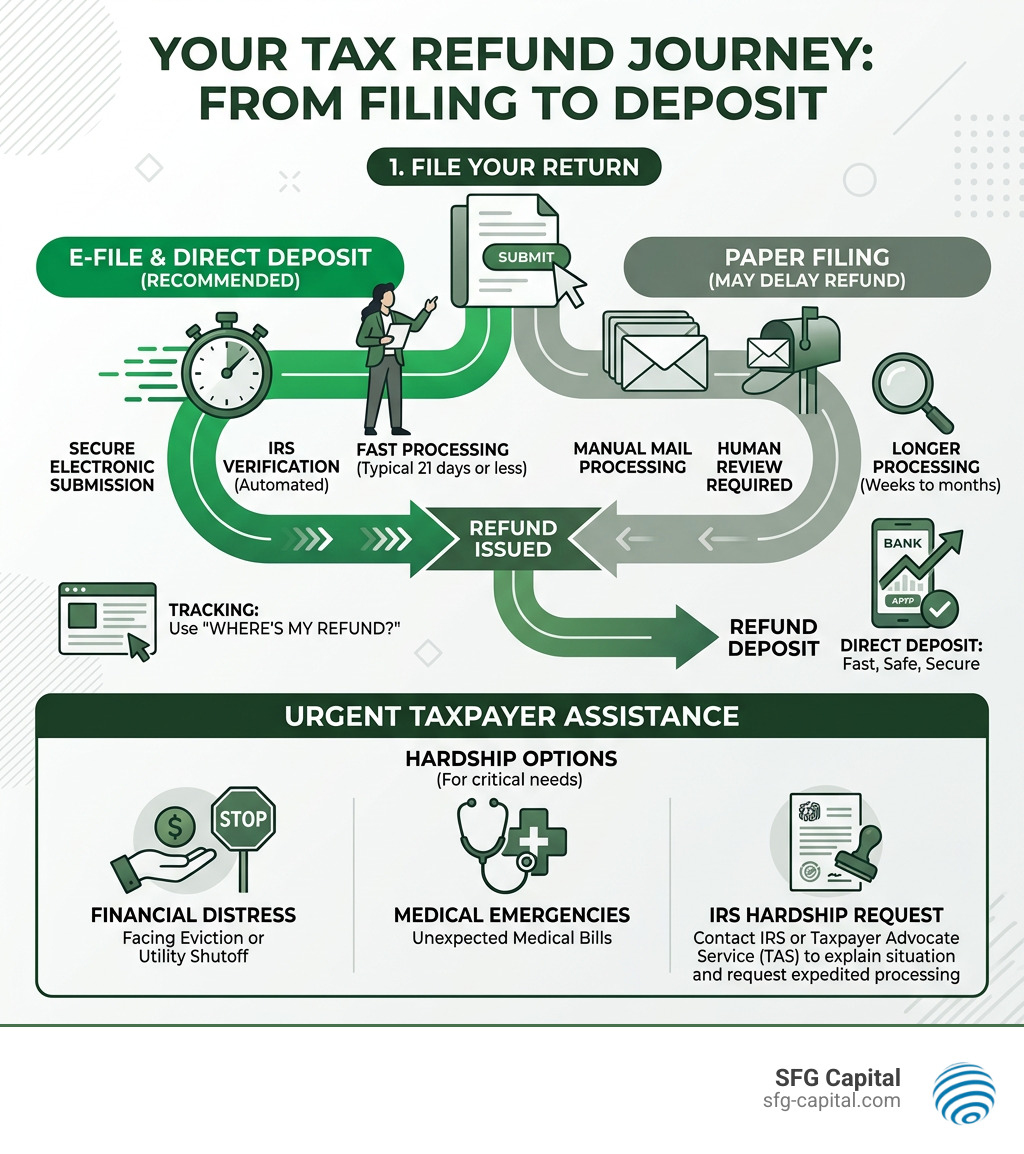
The Gold Standard for an Expedited Tax Return
When we talk about getting a refund quickly, there is a “Gold Standard” that the IRS itself promotes. If you want to ensure your money hits your account in the shortest time possible, you have to follow a specific path. Deviation from this path is the number one reason refunds get stuck in the “processing” limbo.
The most important statistic to remember is this: 9 out of 10 refunds are issued in less than 21 days when taxpayers combine electronic filing with direct deposit. Compared to the old days of mailing a stack of papers and waiting for a check in the mail, this is lightning fast.

However, speed requires accuracy. The IRS uses automated systems to flag returns that have math errors, mismatched Social Security numbers, or missing signatures. If your return is flagged, it moves from the automated “fast lane” to a manual review pile, which can add weeks or even months to your wait time. Checking your work—or using professional software—is the first step toward Taxes management that works for you rather than against you.
Why E-Filing is the Fastest Way to an Expedited Tax Return
Electronic filing, or e-filing, is the engine that drives an expedited tax return. When you submit a return electronically, the IRS receipt system acknowledges it almost instantly. In most cases, you’ll know within 24 to 48 hours if your return has been “Accepted.”
Paper returns, by contrast, are a logistical nightmare. They must be physically opened, sorted, and manually entered into the IRS system by an employee. With the current staffing shortages, this process is slower than ever. While an e-filed return might be processed in three weeks, a paper return can easily take six weeks or longer just to show up in the system. E-filing also includes built-in error checking; most tax software won’t let you submit if you’ve left a critical box empty, preventing the kind of simple mistakes that lead to long delays.
Choosing Direct Deposit Over Paper Checks
If e-filing is the engine, direct deposit is the fuel. Even if you e-file perfectly, choosing a paper check for your refund is like choosing to walk when you could take a jet.
The IRS is actively moving away from physical mail. In fact, paper checks are being phased out for most individual taxpayers starting with the 2026 filing season. This change is designed to curb the high rates of mail fraud and identity theft associated with physical checks, while also saving the government millions in postage and printing costs. By choosing direct deposit now, you are aligning yourself with the most secure and efficient Finance practices available. You can even split your refund into up to three different bank accounts, allowing you to send a portion directly to savings while using the rest for immediate needs.
Navigating Mandatory Delays and Hardship Claims
Sometimes, even if you do everything right, the law requires the IRS to slow down. This is most common for families claiming the Earned Income Tax Credit (EITC) or the Additional Child Tax Credit (ACTC).
Under the PATH Act, the IRS is legally prohibited from issuing refunds for returns claiming these credits until mid-February. This is a fraud prevention measure; it gives the agency time to verify that the income and withholdings reported on the return match what employers have reported. If you file in early January and claim these credits, your “Where’s My Refund?” status might not update for several weeks.
| Filing Method | Refund Delivery Method | Estimated Wait Time |
|---|---|---|
| E-file | Direct Deposit | Less than 21 days |
| E-file | Paper Check | 4 to 6 weeks |
| Paper Return | Direct Deposit | 6 to 8 weeks |
| Paper Return | Paper Check | 8 weeks or more |
Requesting an Expedited Tax Return for Financial Hardship
If you are facing a dire financial situation, the “21-day” rule might still be too slow. In cases of extreme hardship, the IRS has a mechanism to manually pull a return from the queue and process it faster. This is often handled through the Taxpayer Advocate Service (TAS).
To qualify for Expediting a Refund, you generally must demonstrate a “significant hardship.” This isn’t just a desire for the money; it means you are facing an immediate threat to your health, safety, or livelihood. Common reasons include:
- Receiving an eviction notice or foreclosure summons.
- Inability to pay for life-saving medication or medical treatment.
- Receiving a utility shut-off notice (electricity, water, or gas).
- An IRS error that has caused a delay resulting in financial distress.
If you fall into one of these categories, you may need to file Form 911 (Request for Taxpayer Advocate Service Assistance) to get a human being assigned to your case.
Documentation Needed for Hardship Claims
The IRS won’t take your word for it when it comes to hardship; you must provide “the receipts.” If you are claiming that a refund delay is preventing you from paying rent, you will need a copy of the formal eviction notice from your landlord. If it’s a medical issue, you’ll need copies of the unpaid bills or a letter from a doctor explaining the necessity of the treatment.
That while the IRS can expedite a refund held for processing, they cannot release an EITC or ACTC refund before the February 15 deadline set by law. Furthermore, if your refund is being “offset” (taken) to pay for non-IRS debts like student loans or child support, the IRS cannot expedite that portion. Those offsets are handled by the Bureau of the Fiscal Service (BFS), and the IRS has no authority to bypass them, even in a hardship scenario.
Advanced Strategies: Loans, Extensions, and Exemptions
For some, the fastest way to get an expedited tax return isn’t through the IRS at all, but through financial products designed to bridge the gap.
Refund Advance Loans Many large tax preparation firms offer what is known as a “Refund Advance.” These are essentially short-term loans given to you within minutes or hours of the IRS accepting your return. The loan is then paid back automatically when your actual refund arrives. While these can be 0% APR in some cases, always read the fine print regarding fees for the tax preparation itself.
Extensions and Special Rules If you aren’t ready to file by April 15, you can use Form 4868 to get an Automatic extension to October 15. However, a common misconception is that an extension to file is an extension to pay. If you owe money, you must still pay an estimate by April 15 to avoid interest.
Special rules apply to certain groups:
- Military Personnel: Those serving in combat zones typically get at least 180 days after leaving the zone to file and pay.
- Disaster Victims: Taxpayers in areas declared as federal disaster zones (including parts of Travis County during major weather events) often receive automatic extensions for both filing and payment.
- Expats: US citizens living abroad get an automatic two-month extension to June 15.
Expedited Tax-Exempt Status For non-profit organizations in Austin and beyond, waiting for tax-exempt status (Form 1023) can stall grants. The IRS allows organizations to request expedited processing if they have a “compelling reason,” such as a pending grant that will be forfeited if the status isn’t granted by a certain date, or if the organization is providing immediate disaster relief.
Avoiding 2026 Backlogs and Tracking Your Status
The 2026 tax season brings unique challenges. Recent reports indicate the IRS is facing a 7% reduction in workforce, which translates to roughly 7,000 employees. Significantly, 5,000 of these cuts are in enforcement and collection roles, but the ripple effect often hits the processing centers as well. When there are fewer people to handle “edge cases” or errors, the backlog grows.
To stay ahead of the curve, you must be proactive in tracking your status.
The best way to monitor your money is through the Where’s My Refund? tool on the IRS website or the IRS2Go app. These tools update once every 24 hours (usually overnight). You will see three stages:
- Return Received: The IRS has your data.
- Refund Approved: The IRS has finished processing and has a date for your payment.
- Refund Sent: The money is on its way to your bank or the post office.
If your status hasn’t moved past “Received” for more than 21 days, that is the signal to call the IRS or check for a letter in the mail requesting more information.
Frequently Asked Questions about Expedited Refunds
What documentation is needed for a hardship request?
To prove financial hardship, you need official third-party documents. This includes eviction or foreclosure notices, utility shut-off letters, or medical bills marked “past due” or “final notice.” If the hardship is related to a business, you may need to provide financial statements showing an inability to meet payroll or other essential operating costs.
Does a filing extension mean I can delay my payment?
No. This is the most expensive mistake a taxpayer can make. An extension only gives you more time to get your paperwork in order. If you expect to owe taxes, you must pay the estimated amount by the April deadline. If you don’t, the IRS will charge failure-to-pay penalties and interest, which can quickly eat into your future refunds.
Conclusion
Getting an expedited tax return requires a mix of technology, timing, and sometimes, a little bit of help. By e-filing and choosing direct deposit, you put yourself in the fastest possible lane. By understanding the mandatory delays for certain credits and the rules for hardship claims, you can manage your expectations and take action when things go sideways.
At SFG Capital, we understand that for business owners in Travis County and Austin, waiting for the IRS is more than just a nuisance—it’s a barrier to growth. While the IRS focuses on individual returns, we specialize in helping businesses navigate the massive backlogs associated with the Employee Retention Credit (ERC).
If your business is struggling with IRS delays on your ERC refund, we can help. We offer professional Our Services including ERC advances and buyouts, allowing you to bypass the federal wait times and get access to your capital immediately. Our expert team provides full claim assistance and works on a performance-based fee, so you only pay when we deliver results. Don’t let your business’s future sit in a government backlog—reach out to us today to see how we can expedite your path to funding.