
The 2025 Guide to Getting Your IRS Tax Refund Advance Early
Why the IRS Refund Anticipation Loan Still Matters in 2025-2026
An irs refund anticipation loan is a short-term loan based on your expected federal tax refund — giving you access to cash before the IRS actually processes your return.
Here’s a quick summary of what you need to know:
| Question | Quick Answer |
|---|---|
| What is it? | A short-term loan secured by your expected IRS refund |
| Who offers it? | Major national tax preparation providers |
| Typical loan amounts | $250 to $4,000 |
| Cost | Many modern versions are 0% APR with no fees |
| How is it repaid? | Automatically deducted from your IRS refund |
| Credit score impact? | No — most use a soft inquiry only |
| How fast? | Minutes to 24 hours after filing, in many cases |
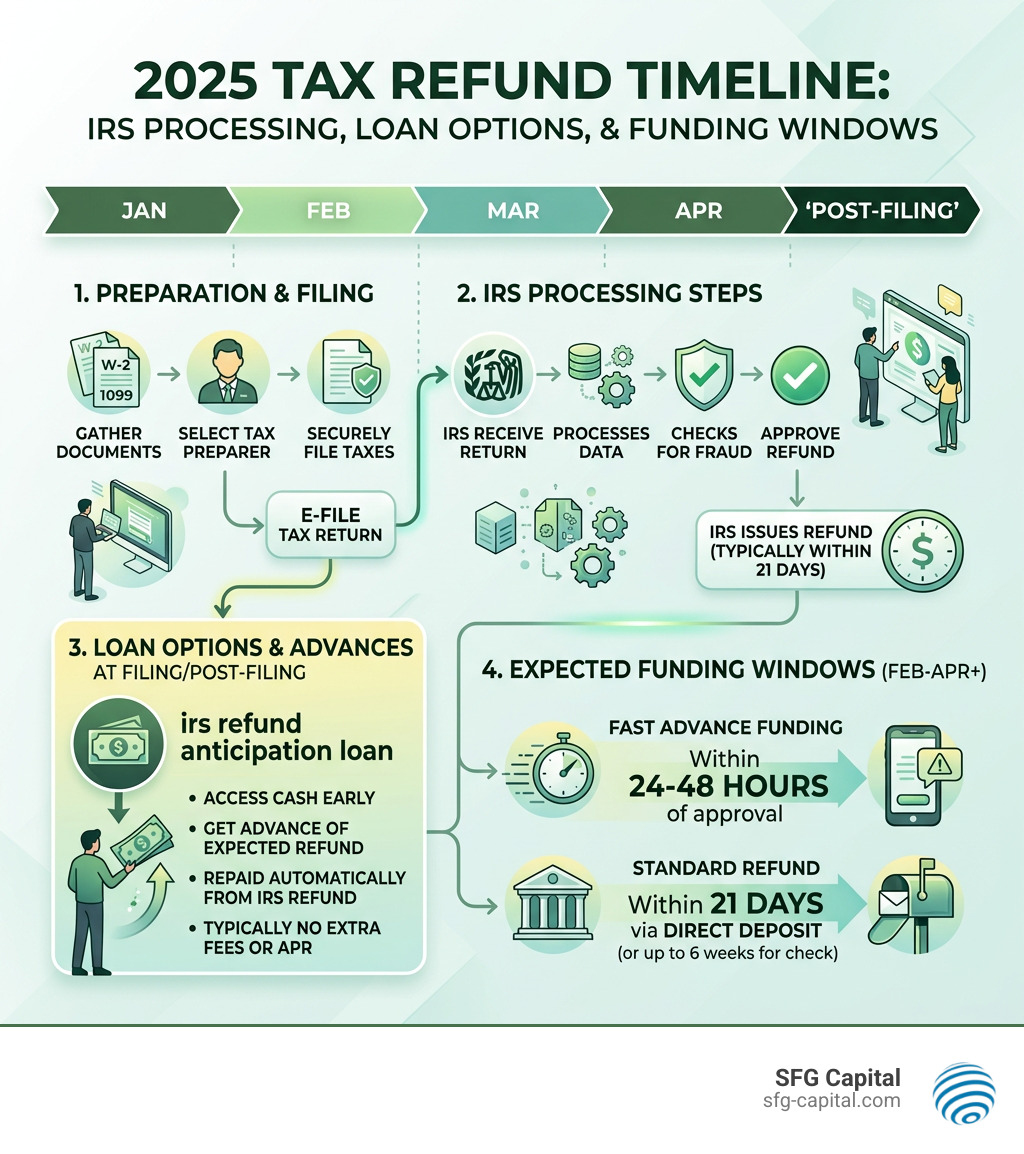
The IRS typically issues refunds within 21 days of e-filing with direct deposit. But for business owners waiting on working capital, three weeks can feel like three months — especially when bills aren’t waiting.
That’s exactly why refund anticipation products have stayed popular, even as the landscape has shifted significantly over the years.
I’m Santino Battaglieri, and through my work at SFG Capital — where we’ve purchased and funded over $500 million in IRS-related claims — I’ve seen how critical refund timing is for businesses navigating an irs refund anticipation loan or similar structured funding solutions. I’ll walk you through everything you need to make a smart, informed decision for 2025 and 2026.
Understanding the IRS Refund Anticipation Loan and How It Works
At its core, an irs refund anticipation loan (RAL) is a financial bridge. Think of it as the “express lane” for your money. When you file your taxes, the IRS doesn’t just hand over a check the next day. They have to process the data, check for fraud, and clear the funds. A RAL allows you to borrow a portion of that money from a private lender (usually a bank partnered with your tax preparer) before the IRS officially releases it.
According to the Tax refund tips: Understanding refund advance loans and checks, these products are secured by your expected refund. This means the loan isn’t based on your house or your car—it’s based on the money the government already owes you. Because it is a “secured” loan, the lender feels a bit more comfortable handing over the cash quickly.
Comparing the irs refund anticipation loan to modern advances
If you talked to someone about tax loans fifteen years ago, they might have warned you about “predatory” interest rates. Back then, RALs were notorious for high fees that could eat up 10% or more of your total refund.
Fast forward to 2025-2026, and the landscape has changed. Most major tax preparation companies now offer what they call a “Refund Advance.” These are technically still loans, but they are often marketed as 0% APR and $0 fee products.
How do they do this? The tax companies use these loans as a “loss leader” to get you to use their filing services. You pay for the tax preparation, and in exchange, they offer you the loan for free. It’s a win-win: you get your money faster, and they get a loyal customer. However, it is important to distinguish these from Refund Anticipation Checks (RACs), which aren’t loans but temporary accounts that can still carry fees of $30 to $50 just to handle the direct deposit.
Typical loan amounts and interest rates
Not all advances are created equal. Depending on which platform you use, the amount you can borrow varies significantly. Generally, you can expect to be offered between 50% and 75% of your total anticipated refund, capped at a specific dollar amount.
Here is a breakdown of common tiers we see in the market for 2025-2026:
- Entry-Level Advances: $250, $500, or $750. These are often approved almost instantly for simple tax returns.
- Mid-Tier Advances: $1,000 to $2,500. These usually require a slightly higher anticipated refund (often $2,000 or more).
- High-Tier Advances: $3,000 to $4,000. These are typically the maximum for standard consumers.
- Specialty/Full Service: Some providers offer up to $10,000 for “Expert Full Service” customers who have more complex tax situations.
While many of these are 0% APR, keep an eye out for “Early” advances. Some providers offer loans in December or early January before the IRS even opens. These “holiday loans” often carry high interest rates—sometimes as high as 35.96% APR—because the lender is taking a bigger risk by lending money before you’ve even finalized your tax forms.
Eligibility and Application Requirements for 2025-2026
Getting approved for an irs refund anticipation loan isn’t a guarantee. Lenders have to make sure they are actually going to get their money back from the IRS. As we discuss in our guide on tax-credits-in-advance-your-future-self-will-thank-you/, planning ahead for your tax credits is the best way to ensure you meet these requirements.
Eligibility requirements for an irs refund anticipation loan
To qualify for a refund advance in 2025-2026, you generally need to meet several criteria:
- Minimum Refund Amount: Most lenders require an anticipated federal refund of at least $500. If you only expect $200 back, the administrative cost of the loan isn’t worth it for the bank.
- E-File Status: You must file your return electronically. Paper returns take far too long for a bank to track.
- Income Verification: You typically need a valid W-2 or 1099-R. Lenders are wary of “self-declared” income that hasn’t been verified by an employer or payer.
- Identity Standards: You’ll need a physical US address (not a PO Box) and must pass standard “Know Your Customer” (KYC) identity checks.
- Prohibited Forms: If you are filing complex forms (like those for certain foreign income or specialized credits), you might be disqualified from the “instant” loan programs.
For our neighbors here in Travis County, it’s worth noting that while some states like Illinois or Connecticut have specific restrictions on these loans, Texas remains a primary market where these products are widely available.
Step-by-step: How to apply for an irs refund anticipation loan
The application process is usually baked right into the tax filing software. You don’t have to go to a separate bank website.
- Step 1: Prepare Your Return. You must finish your tax prep first. The lender needs to know exactly how much the IRS owes you before they can offer a loan amount.
- Step 2: Choose the Advance Option. At the end of the filing process, you’ll be asked how you want to receive your refund. Select the “Refund Advance” or “Loan” option.
- Step 3: Open the Required Account. Most providers require you to open a specific checking account or use a prepaid debit card or a digital banking account to receive the funds.
- Step 4: E-File. Once you hit “Submit,” your return goes to the IRS.
- Step 5: Wait for Acceptance. The lender usually waits until the IRS “accepts” the return (which means the SSNs match and there are no immediate errors). This usually happens within 24 to 48 hours.
- Step 6: Receive Funds. Once accepted, the money is often deposited into your new account within minutes or hours.
The deadline to apply is usually mid-March. If you wait until the April 15th deadline to file, many of the 0% APR loan pools may already be exhausted.
Pros, Cons, and Risks of Refund Products
Deciding to take an irs refund anticipation loan is a personal financial choice. While we at SFG Capital focus on helping Austin businesses with much larger IRS claims like the ERC, the logic is the same: Is the cost of waiting higher than the cost of the advance?
| Feature | Refund Advance Loan | Standard IRS Direct Deposit |
|---|---|---|
| Speed | Minutes to 48 hours | 8 to 21 days |
| Cost | Often $0 (if 0% APR) | $0 |
| Credit Impact | Soft inquiry only | None |
| Risk | High if refund is denied | Low |
| Repayment | Automatic from refund | N/A |
How the loan is repaid
Repayment is “invisible” to you, which is both a blessing and a curse. When you sign the loan agreement, you are authorizing the IRS to send your refund to a temporary bank account set up by the lender.
The lender takes the loan amount (plus any fees) out of that deposit first. Whatever is left over is then forwarded to your personal bank account or debit card.
The risk comes if your refund is smaller than expected. If the IRS intercepts your refund for unpaid child support, back taxes, or student loans, you are still legally responsible for paying back the loan to the bank. As noted in What To Know About Tax Refund Loans, you could end up in a situation where you owe a bank money with no refund coming in to cover it.
Impact on credit scores and financial health
One of the biggest myths is that these loans will “ruin” your credit. In reality, most tax prep lenders use a “soft” credit inquiry. This allows them to check your identity and look for major red flags without actually lowering your credit score.
However, relying on these loans every year can be a sign of financial strain. If you are using a RAL to pay for basic necessities because you can’t wait three weeks, it might be worth looking into long-term financial planning or more affordable alternatives. For business owners, this is why we emphasize navigating-erc-advance-payments-your-guide-to-employee-retention-credit-financing/—it’s about finding the most efficient way to manage cash flow without falling into a cycle of high-interest debt.
Affordable Alternatives to High-Cost Loans
If the idea of taking a loan against your taxes makes you nervous, you aren’t alone. There are several ways to get your money quickly—or even for free—without involving a bank loan.
Free tax preparation services
If you make less than a certain amount (usually around $64,000 for 2025/2026), you shouldn’t be paying for tax prep at all. Programs like Volunteer Income Tax Assistance (VITA) offer IRS-certified volunteers who will file your taxes for free.
In Austin and Travis County, there are numerous VITA sites located in libraries and community centers. These sites e-file your return just like the big companies do. While they don’t offer “instant” loans, they save you the $100-$300 in prep fees, which might actually be more money in your pocket than an advance would provide. You can also check out our resources on erc-refund-advance/ to see how similar logic applies to business credits.
Speeding up refunds without a loan
You can get your refund in as little as 8 to 10 days without a loan if you follow the “Golden Rule” of the IRS: E-file + Direct Deposit.
The IRS processes digital returns much faster than paper ones. If you skip the loan and just choose direct deposit to your existing bank account, you avoid all the “middleman” fees and temporary account headaches. You can track your progress using the “Where’s My Refund?” tool on the IRS website.
Frequently Asked Questions about Tax Advances
How quickly can I receive the loan funds after approval?
In most cases, once the IRS accepts your e-filed return, the funds are available within minutes to 24 hours. If you chose a physical debit card, it might take 7 to 14 days to arrive in the mail, but many providers give you a “virtual card” number immediately so you can start shopping online or add it to your mobile wallet.
What happens if my actual refund is smaller than expected?
This is the “uh-oh” scenario. If the IRS reduces your refund (perhaps due to a math error or an offset for an old debt), the bank will still take what they are owed from whatever remains. If the refund is completely wiped out, you are still on the hook for the loan. Most lenders will send you a bill or attempt to collect the balance. Failing to pay it back could result in a “hard” hit to your credit score later and will definitely disqualify you from getting a refund advance in future years.
Are there any states where these loans are not available?
Yes. Due to local lending laws and consumer protection regulations, some tax refund advance products are not available in Illinois, Connecticut, or North Carolina. Fortunately for us, Texas has no such restrictions, and residents of Travis County have full access to these products.
Conclusion
Navigating the irs refund anticipation loan doesn’t have to be stressful. In 2025-2026, these products have become much more consumer-friendly, offering 0% APR options that can provide a vital cash cushion during tax season. However, they are not a “one-size-fits-all” solution.
If you have a simple return and can wait 21 days, sticking with standard direct deposit is usually the safest and cheapest route. But if you’re facing an emergency or need to bridge a gap in your business’s cash flow, a refund advance can be a powerful tool.
At SFG Capital, we understand that waiting on the IRS is the hardest part of any tax process. Whether you are an individual waiting on a standard refund or a business owner in Austin looking to expedite a complex claim, we are here to help you get your money when you need it most. More info about our services is available if you’re ready to take the next step in securing your financial future.
Happy filing, and may your refund be larger than you expect!