
The Essential Guide to Employee Retention Credit Funding
What Is Employee Retention Credit Funding and How Does It Work?
Employee retention credit funding is a refundable payroll tax credit created under the CARES Act to help businesses keep employees on payroll during the COVID-19 pandemic — and eligible businesses can still claim it retroactively.
Here’s what you need to know at a glance:
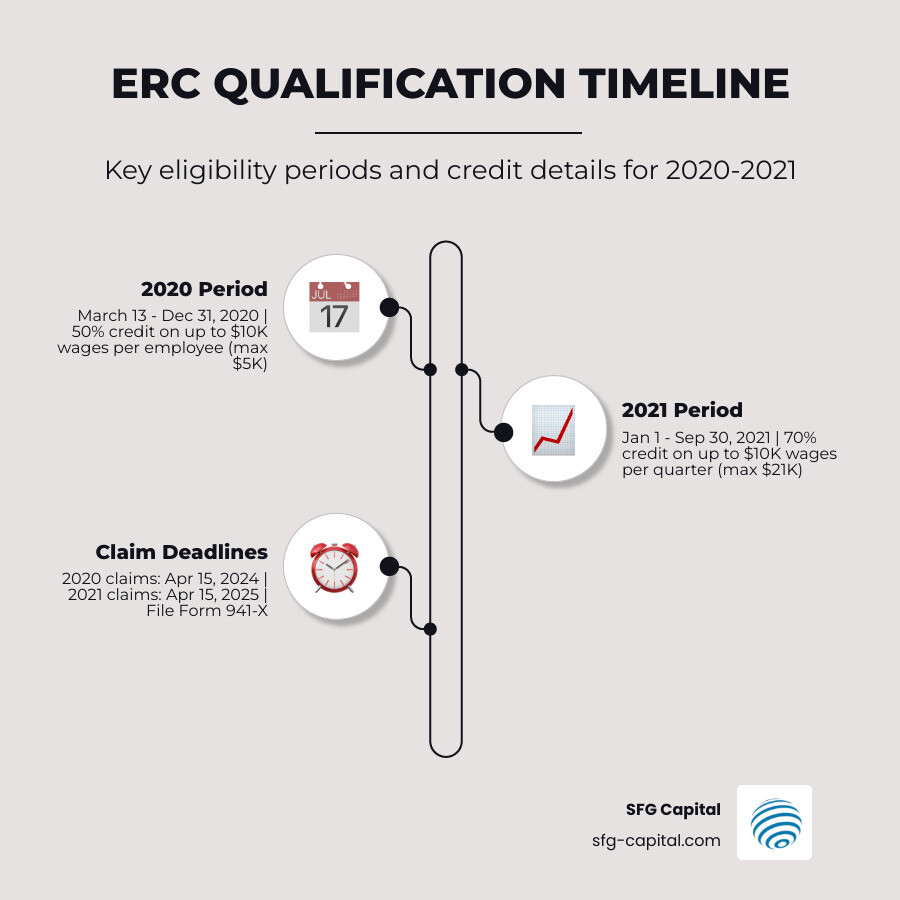
| Key Detail | 2020 | 2021 |
|---|---|---|
| Credit rate | 50% of qualified wages | 70% of qualified wages |
| Wage cap per employee | $10,000 per year | $10,000 per quarter |
| Max credit per employee | $5,000 | $7,000 per quarter (up to $21,000) |
| Combined max per employee | Up to $26,000 across both years | |
| Claim deadline (passed) | April 15, 2024 | April 15, 2025 |
| How to claim | Form 941-X (amended payroll return) | Form 941-X |
The credit is not a loan — you don’t pay it back. It’s a direct offset against payroll taxes, and if the credit exceeds what you owe, the IRS refunds the difference.
The challenge? The IRS is currently processing around 400,000 ERC claims worth approximately $10 billion, and wait times can stretch to a year or more. Many business owners who need that cash now are stuck waiting — or worse, they’ve been targeted by fraudulent ERC promoters making promises the IRS won’t honor.
This guide cuts through the noise. It covers eligibility, how the credit is calculated, how to claim it correctly, and how to access your funds faster — without putting your business at risk.
I’m Santino Battaglieri, founder of SFG Capital, a firm that has purchased and funded over $500 million in ERC claims with a compliance-first approach to employee retention credit funding. My background in structured financial services means I’ve seen what separates a clean, defensible claim from one that invites an audit — and I’ll share that perspective throughout this guide.
Understanding Employee Retention Credit Funding and Eligibility
Navigating employee retention credit funding starts with one word: eligibility. The IRS doesn’t just hand out these checks; you have to prove your business was “impacted” by the pandemic. There are three primary ways to qualify, and we often find that businesses in Travis County may qualify under more than one.
First, there is the Government Shutdown Test. If your operations were fully or partially suspended due to orders from an appropriate governmental authority limiting commerce, travel, or group meetings due to COVID-19, you might qualify. This isn’t just about being forced to close your doors. It includes businesses that had to reduce hours, limit indoor capacity (like many Austin restaurants), or had their supply chains disrupted because a key supplier was shut down by a government order.
Second is the Gross Receipts Test. This is a purely mathematical comparison. For 2020, you qualify if your gross receipts in a calendar quarter were less than 50% of your gross receipts for the same quarter in 2019. For 2021, the bar is lower: you qualify if your gross receipts were less than 80% of the same quarter in 2019 (a 20% decline).
Finally, there are Recovery Startup Businesses. These are companies that began carrying on a trade or business after February 15, 2020, and had average annual gross receipts of $1 million or less. These businesses have a special eligibility path for the third and fourth quarters of 2021, even if they didn’t experience a shutdown or a revenue decline.
For a deeper dive into these requirements, the Employee Retention Credit (ERC) Internal Revenue Service (IRS) provides the official framework we use to verify our clients’ claims.
Calculating Your Employee Retention Credit Funding Amount
Once we know you’re eligible, we have to do the math. The total employee retention credit funding available is a staggering $26,000 per full-time W-2 employee. However, the calculation changes depending on the year:
- For 2020: The credit is 50% of up to $10,000 in qualified wages paid to an employee for the entire year. This results in a maximum credit of $5,000 per employee.
- For 2021: The credit is 70% of up to $10,000 in qualified wages per quarter for the first three quarters (and Q4 for recovery startups). This means you could receive up to $7,000 per employee, per quarter, totaling $21,000 for the year.
“Qualified wages” generally include the gross wages paid to the employee plus the employer’s share of qualified health insurance costs. It’s important to note that for businesses with more than 100 employees in 2020 (or 500 in 2021), the rules on which wages qualify become much stricter, often limited only to wages paid to employees not providing services.
Interaction with PPP Loans and Other Relief Programs
In the early days of the CARES Act, you had to choose between a Paycheck Protection Program (PPP) loan and the ERC. Thankfully, Congress changed the rules, allowing businesses to claim both. However, you cannot “double-dip.”
This means you cannot use the same dollar of wages to justify PPP loan forgiveness and an ERC claim. We spend a lot of time with our Travis County clients coordinating these benefits to ensure every dollar is maximized without violating IRS rules. You also cannot claim the ERC on wages for which you received FFCRA (Families First Coronavirus Response Act) credits for paid sick or family leave.
How to Claim the ERC and Manage IRS Backlogs
To claim your employee retention credit funding retroactively, you must file Form 941-X, the Adjusted Employer’s Quarterly Federal Tax Return. Because the ERC is a payroll tax credit, you are essentially telling the IRS, “We overpaid our payroll taxes in 2020 or 2021, and we’d like that money back now.”
The deadlines for these filings are critical. For 2020 claims, the deadline was April 15, 2024. For 2021 claims, the deadline is April 15, 2025. If you haven’t filed for 2021 yet, the clock is ticking.
The biggest hurdle right now isn’t the paperwork—it’s the wait. In September 2023, the IRS issued a moratorium on processing new ERC claims to combat a surge in fraudulent filings. While they have resumed processing some claims, the backlog is massive. As noted by the National Taxpayer Advocate, the IRS is balancing the need to issue refunds with the need to protect the Treasury from “ERC mills.”
Options for Expedited Employee Retention Credit Funding
If your business is in Austin or anywhere in Travis County, you know that waiting 12 to 18 months for a six-figure refund can be the difference between expanding your operations or treading water. This is where SFG Capital steps in.
We provide employee retention credit funding solutions like refund buyouts and advances. Instead of waiting on the IRS, we can provide you with a significant portion of your expected refund in a matter of days. We take on the “IRS wait time” so you can get back to business. This isn’t a high-interest bridge loan; it’s a structured purchase of your credit. We perform our own rigorous due diligence to ensure the claim is valid, which also gives you an extra layer of confidence in your filing.
For those interested in how we can help your specific situation, you can find more info about our services on our website.
Preparing Documentation for ERC Audits
The IRS has significantly increased its audit staff specifically to look at ERC claims. They have already initiated hundreds of criminal investigations and issued tens of thousands of disallowance letters. To protect your employee retention credit funding, you must keep meticulous records.
The “four-year rule” is a good baseline, but for ERC, we recommend keeping documentation for at least six to seven years. This includes:
- Copies of all governmental orders that forced a full or partial suspension.
- Worksheets showing how you met the gross receipts test.
- Payroll records and records of health insurance costs.
- Documentation showing that you didn’t use the same wages for PPP forgiveness.
If you are audited, the IRS will likely issue an Information Document Request (IDR). Having this documentation ready to go—and having professional representation to handle the IRS revenue agents—is essential.
Navigating Disallowances, Scams, and Compliance
The IRS is on high alert. As of mid-2024, they have issued approximately 84,000 letters informing businesses that their claims were partially or fully disallowed. If you receive one of these letters, don’t panic, but do act quickly. You have the right to appeal, provided you can back up your eligibility with the facts.
One of the most complex parts of employee retention credit funding is the interaction with your income tax returns. Under Section 2301(e) of the CARES Act, you must reduce your wage deduction on your income tax return by the amount of the credit you received. This often means you need to file an amended income tax return for the year the wages were paid.
To help businesses stay on the right side of the law, the IRS has provided an IRS ERC Eligibility Checklist which we highly recommend reviewing before finalizing any claim.
Avoiding Scams and Withdrawing Ineligible Claims
You’ve probably seen the ads: “Qualify for $26,000 per employee in minutes!” These are often from “ERC mills”—promoters who charge large contingency fees and tell every business they qualify, regardless of the actual rules.
Warning signs of a scam include:
- Unsolicited calls or emails.
- Promises of “instant” eligibility.
- High upfront fees or percentage-based fees (contingency fees).
- Failure to ask for your actual payroll data or PPP loan details.
If you realize you’ve filed an ineligible claim, the IRS has a Withdraw an Employee Retention Credit (ERC) claim program. If your claim hasn’t been paid yet, or if you have a check you haven’t cashed, you can withdraw the claim to avoid future penalties and interest.
Impact on Income Tax Returns
Claiming employee retention credit funding is not “tax-free money” in the sense that it doesn’t affect your other taxes. Because you are getting a credit for wages paid, the IRS says you can’t also deduct those same wages as a business expense.
For pass-through entities (like S-Corps or Partnerships), this reduction in wage expenses increases the net income that flows through to the owners’ individual returns. This can also impact the Section 199A Qualified Business Income deduction. It’s a bit of a domino effect, which is why we always coordinate with our clients’ tax preparers during the funding process.
California-Specific Relief and State Programs
While the ERC is a federal program, businesses in Travis County and the broader Austin area often look for state-level support to complement their employee retention credit funding. Although our focus is on federal ERC, it’s worth noting that California-based entities (if you have operations there) have access to unique resources.
The California Rebuilding Fund is a public-private partnership offering loans to small businesses in underserved areas. Additionally, the California Grants Portal serves as a one-stop shop for state-funded grants. For startups, the California Dream Fund Program provides microgrants up to $10,000.
If your business has a footprint in California, you might also look into the Disaster Relief Loan Guarantee program, which helps small businesses that might not qualify for traditional financing.
Frequently Asked Questions about ERC Funding
Can I claim the ERC if my business was only partially suspended?
Yes. Many businesses think they need to have been completely shut down to qualify. In reality, a “partial suspension” is often enough. For example, if your Austin-based retail shop had to close its showroom but could still do curbside pickup, or if your restaurant had to limit indoor dining capacity by 50%, you likely meet the suspension test. The key is that the government order must have had a “more than nominal” impact on your business operations.
What happens if my ERC claim is audited by the IRS?
If you are audited, the IRS will ask for proof of eligibility and your wage calculations. They will look for “double-dipping” with PPP loans and verify that the governmental orders you cited actually applied to your business. This is why having a “compliance file” is so important. If the IRS disallows the claim, you have the right to appeal the decision through the IRS Independent Office of Appeals.
Is the Employee Retention Credit considered taxable income?
The credit itself is not included in your gross income for federal income tax purposes. However, as mentioned earlier, you must reduce your deductible wage expenses by the amount of the credit. This effectively increases your taxable income by the amount of the credit. It’s a “net-zero” for the credit amount, but you still end up with the cash from the refund.
Conclusion
The window for employee retention credit funding is closing. With the April 15, 2025, deadline for 2021 claims approaching and the IRS backlog showing no signs of disappearing overnight, the time to act is now.
At SFG Capital, we understand the unique challenges facing businesses in Travis County. We don’t just help you file; we help you get funded. By offering advances and buyouts on your ERC claims, we provide the liquidity you need to grow your business today, rather than waiting on a check from the Treasury that might be a year away. Our performance-based fees mean we only succeed when you do.
Ready to see how much your business is owed and how quickly you can access it? Get started with SFG Capital today and let us help you navigate the complexities of the ERC with confidence.