
Understanding the Employee Retention Credit: A Lifeline for Businesses
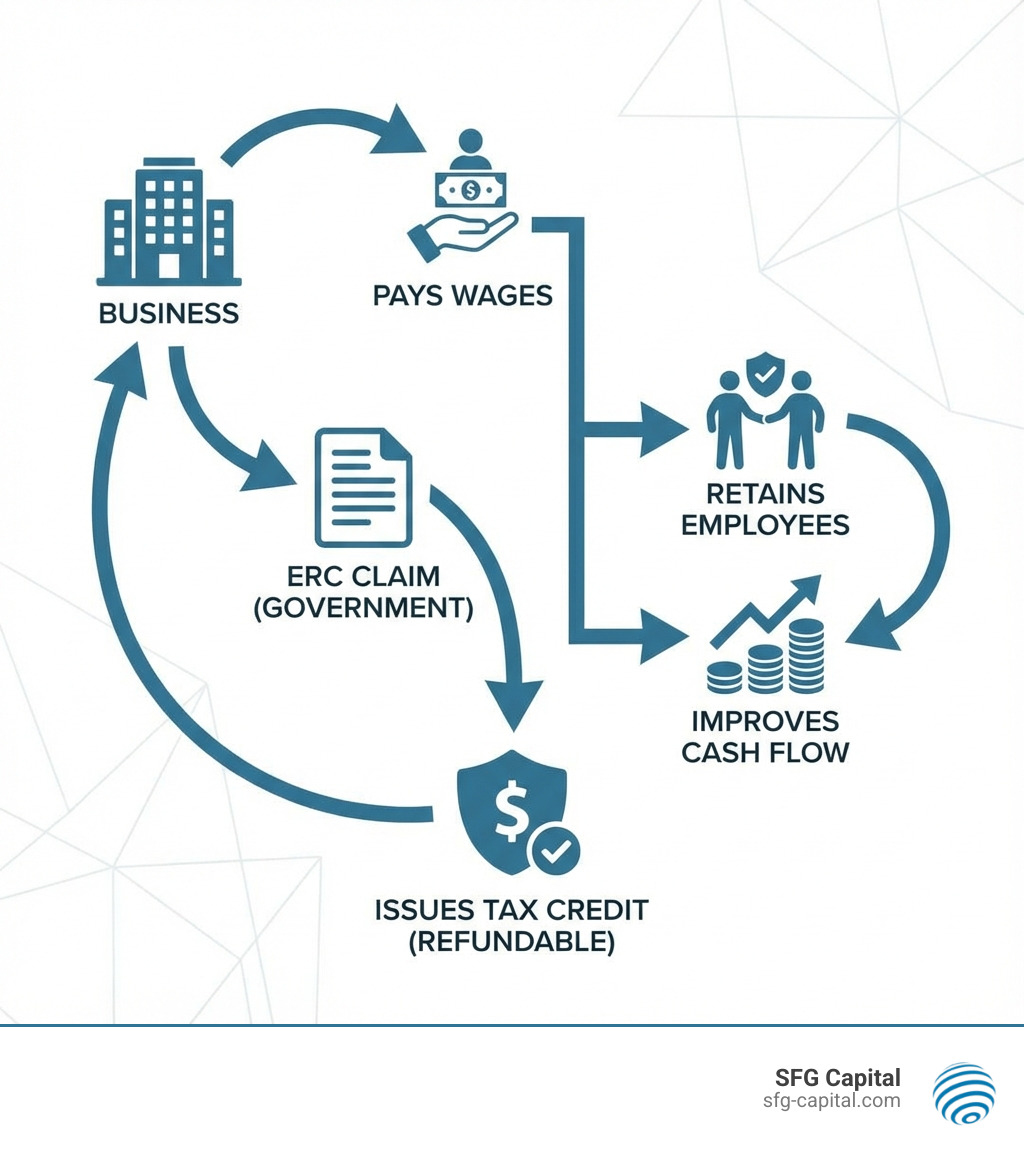
What is ERC credit? The Employee Retention Credit (ERC) is a refundable tax credit created under the CARES Act in March 2020 to help businesses keep employees on payroll during the COVID-19 pandemic. It’s not a loan and does not need to be repaid. Instead, it provides eligible employers with a credit of up to 50% of qualified wages in 2020 and up to 70% of qualified wages in 2021, effectively putting money back into your business.
Key Facts About the ERC:
- Available Period: March 13, 2020 through September 30, 2021
- Maximum Credit: Up to $5,000 per employee for 2020; up to $21,000 per employee for 2021
- Eligibility: Based on government-ordered business suspension OR significant decline in gross receipts
- Refundable: You can receive money even if you owe no payroll taxes
- Not a Loan: No repayment required
- Claim Deadline: April 15, 2025
The ERC was designed as an employee retention incentive during one of the most challenging economic periods in recent history. However, the program has become complicated by IRS scrutiny, processing delays, and widespread fraud concerns. As of September 2023, the IRS suspended processing new claims due to a surge in questionable submissions, and as of May 2025, approximately 84,000 businesses have received disallowance letters.
Despite these challenges, legitimate claims remain valid and valuable. The credit can provide critical working capital for businesses that genuinely qualified during the pandemic—but navigating the complex rules and lengthy IRS backlogs requires expertise and patience.
I’m Santino Battaglieri, and through SFG Capital, I’ve helped businesses steer what is ERC credit and access over $500 million in ERC claims through compliant, documentation-driven processes. My focus is on helping eligible businesses understand their rights while avoiding the pitfalls that have plagued this program.
What is the ERC Credit and How Does It Work?
At its heart, what is ERC credit? It’s a powerful payroll tax credit designed to encourage businesses to retain their workforce during the economic upheaval caused by the COVID-19 pandemic. Introduced as part of the Coronavirus Aid, Relief, and Economic Security (CARES) Act in March 2020, the Employee Retention Credit (ERC) was a direct lifeline for employers. Unlike a loan, it’s a credit against certain employment taxes, and crucially, it’s a refundable credit. This means that if the credit amount exceeds a business’s total employment tax liability, the IRS will send the difference as a direct refund. This makes the ERC a significant cash injection, rather than just a reduction in taxes owed.
The primary goal was simple: keep people employed. Businesses facing government-mandated shutdowns or significant revenue drops could receive financial support for continuing to pay their employees. This helped countless businesses, including many right here in Travis County, steer an unprecedented crisis.
ERC and Other COVID-19 Relief Programs
During the pandemic, many businesses sought relief from various government programs. Understanding how the ERC interacted with these, particularly the Paycheck Protection Program (PPP) loans, is crucial. Initially, businesses could not claim both ERC and a PPP loan. However, this changed with subsequent legislation. Businesses that received PPP loans could later become eligible for the ERC, but with a critical caveat: they could not “double-dip.” This means the same wages used to qualify for PPP loan forgiveness could not also be used to calculate the ERC. This “no double-dipping” rule also extended to other COVID-19 relief grants, such as Shutter Venue Operator Grants or Restaurant Revitalization Grants. The key was to ensure that each dollar of qualified wages was attributed to only one relief program.
Key Time Periods and Rule Changes
The ERC wasn’t a static program; it evolved significantly over its lifespan, leading to much of the complexity we see today. The credit applies to qualified wages paid between March 13, 2020, and September 30, 2021, with an exception for “recovery startup businesses” in Q4 2021.

Here’s a snapshot of how the rules changed:
| Feature | 2020 Rules (March 13 – Dec 31, 2020) | 2021 Rules (Jan 1 – Sept 30, 2021) |
|---|---|---|
| Credit Percentage | 50% of qualified wages | 70% of qualified wages |
| Maximum Qualified Wages | $10,000 per employee for the year | $10,000 per employee per quarter |
| Maximum Credit | $5,000 per employee for the year | $7,000 per employee per quarter |
| Gross Receipts Decline | 50% decline vs. same quarter in 2019 | 20% decline vs. same quarter in 2019 (or prior quarter in 2020) |
| Eligible Employer Size (for all wages) | 100 or fewer full-time employees in 2019 | 500 or fewer full-time employees in 2019 |
(Source: IRS Notice 2021-20, IRS Notice 2021-49, Forbes)
The program originally extended into Q4 2021, but Congress passed the Infrastructure Investment and Jobs Act in November 2021, which retroactively ended the ERC for most employers on September 30, 2021. The only exception was for “recovery startup businesses,” which could still claim the credit for wages paid in the fourth quarter of 2021. Despite this early termination, businesses can still retroactively claim ERC for up to three years from the date the original employment tax return was filed. The final deadline for most claims is April 15, 2025.
Who is Eligible? Unpacking the ERC Qualification Rules
Determining eligibility is often the most complex part of claiming the ERC. It’s not a one-size-fits-all credit; eligibility hinges on meeting specific criteria related to how your business was impacted by the pandemic. The good news is that businesses of all sizes and across all industries, including for-profit and tax-exempt organizations, can qualify for the ERC if they experienced one of two main triggers. However, state and local government entities, as well as household employers, are generally excluded.
We at SFG Capital understand the nuances of these rules and provide Our Services to help businesses in Travis County and beyond determine their eligibility accurately.
The “Government Order” Test
One primary way to qualify for the ERC is if your business experienced a full or partial suspension of operations due to a government order related to COVID-19. This means that a federal, state, or local governmental authority imposed restrictions on commerce, travel, or gatherings that impacted your ability to operate.
For example, if a restaurant in Austin was forced to close its dining room due to a Travis County health order, even if it could offer takeout, that could constitute a partial suspension. However, the IRS has clarified that not all government recommendations qualify. The order must have directly limited your business operations. Essential businesses or those that could keep their operations largely intact remotely typically don’t meet this qualification.
A crucial point here is that supply chain disruptions alone do not qualify an employer for the ERC. There must be a government order that caused the supplier to suspend operations, leading to your business’s suspension, and your business must have been unable to procure critical goods or services from an alternate supplier. It’s a tight needle to thread!
The “Gross Receipts” Test
The second pathway to eligibility is through a “significant decline in gross receipts.” This test measures your business’s revenue against pre-pandemic levels.
- For 2020: A significant decline began during any calendar quarter where your gross receipts decreased by at least 50% compared to the same calendar quarter in 2019. Once you met this 50% decline, you remained eligible until your gross receipts for a quarter exceeded 80% of the gross receipts for the corresponding 2019 quarter.
- For 2021: The threshold was lowered, making it easier to qualify. A significant decline began during any calendar quarter where your gross receipts decreased by at least 20% compared to the same calendar quarter in 2019. You could also elect to use the immediately preceding calendar quarter to determine if you met the 20% decline, comparing it to the corresponding quarter in 2019.
This test allowed businesses to qualify even if they weren’t directly shut down by a government order, but still felt the economic pinch of the pandemic.

Calculating and Claiming Your Employee Retention Credit
Once you’ve determined your eligibility, the next step is to accurately calculate the credit and then submit your claim. This process requires meticulous documentation, including payroll records, evidence of government orders, and detailed gross receipts comparisons. Our team at SFG Capital guides clients through Our Process to ensure all necessary documentation is in order.
How is the ERC Calculated?
The calculation varies depending on whether you’re claiming for 2020 or 2021:
- 2020 Credit: The ERC was equal to 50% of qualified wages paid to eligible employees between March 13, 2020, and December 31, 2020. There was an annual cap of $10,000 in qualified wages per employee, meaning the maximum credit a business could receive per employee for 2020 was $5,000.
- 2021 Credit: The credit became more generous. It was equal to 70% of qualified wages paid between January 1, 2021, and September 30, 2021. The cap also shifted to a quarterly basis: up to 7,000 dollars per employee per quarter. This means a business could claim up to $7,000 per employee for each of the first three quarters of 2021, potentially totaling $21,000 per employee for the year.
What are “qualified wages”? These include not just cash payments but also a portion of employer-provided health care costs. The definition of who counts as an “eligible employee” for the purpose of claiming the credit also changed based on your business size:
- For 2020 (employers with 100 or fewer full-time employees in 2019): Qualified wages included those paid to all employees, regardless of whether they were actively working or not.
- For 2020 (employers with more than 100 full-time employees in 2019): Qualified wages were limited to those paid to employees who were not providing services due to the suspension or decline in gross receipts.
- For 2021 (employers with 500 or fewer full-time employees in 2019): The employee limit for qualified wages was increased to 500 full-time employees, meaning any qualifying employer with 500 or fewer full-time employees could apply the wages of all employees when determining their credit, regardless of whether the employees actually worked.
- For 2021 (employers with more than 500 full-time employees in 2019): Qualified wages were still limited to those paid to employees who were not providing services.
What is the process for claiming the ERC credit?
Businesses claim the ERC by reporting their total qualified wages and the related health insurance costs for each quarter on their federal employment tax returns. For most employers, this is Form 941, Employer’s Quarterly Federal Tax Return.
Since the program’s initial periods have passed, most businesses claiming the ERC now do so retroactively by filing an amended employment tax return, specifically Form 941-X, Adjusted Employer’s Quarterly Federal Tax Return or Claim for Refund. The Form 941-X Instructions provide detailed guidance on this process.
It’s critical to remember that claiming the ERC impacts your income tax return. You must reduce your wage expense deduction on your business’s income tax return by the amount of the ERC claimed. This adjustment is necessary to prevent a double benefit.
The deadline to claim the ERC is April 15, 2025, for wages paid in 2020, and April 15, 2025, for wages paid in 2021. This gives businesses a limited window to file their amended returns.
The Current State of ERC: IRS Warnings, Scams, and Delays
The journey of the ERC has been a rollercoaster. What began as a vital relief measure has become fraught with challenges, primarily due to widespread fraud and a significant backlog at the IRS. The IRS has expressed grave concerns about improper ERC claims and is closely reviewing tax returns that claim the credit. As of July 2023, the IRS’s criminal investigation division had begun 252 investigations into over $2.8 billion of potentially fraudulent claims. This increased scrutiny means that while legitimate claims are still being processed, the path is longer and more complex than ever.
What is the current status of ERC credit claims?
On September 14, 2023, the IRS took a significant and unprecedented step: it suspended the acceptance of new ERC claims until at least December 31, 2023. This moratorium, announced via IR-2023-169: To protect taxpayers from scams, IRS orders immediate stop to new Employee Retention Credit processing, was a direct response to a “surge of questionable claims” and concerns from tax professionals about “ERC Mills” promoting ineligible claims.
The IRS explained that this pause was necessary to protect taxpayers from scams and to give them time to develop new processes to combat fraud. While new claims are paused, the IRS continues to process claims submitted before the moratorium, albeit with significant delays. We’ve seen processing times extend dramatically, with many businesses in Travis County and across the nation waiting months, if not over a year, for their refunds.
Furthermore, Congress passed a law giving the IRS five years to audit claims for the Employee Retention Credit, which is longer than the usual three years. This extended audit window underscores the IRS’s commitment to ensuring compliance and means businesses should maintain thorough documentation for years to come.
Navigating Disallowed Claims and Avoiding Scams
The IRS’s increased vigilance has led to a rise in disallowed claims. As of May 2025, the IRS has issued approximately 84,000 letters informing businesses that their ERC claims have been partially or fully disallowed. If your ERC claim is disallowed, and you had previously reduced your wage expense on your income tax return for the year the ERC was claimed, you may, in the year your claim disallowance is final, increase your wage expense on your income tax return by the amount it was reduced. Alternatively, you can file an amended return.
The IRS is also offering a Voluntary Disclosure Program for businesses that may have incorrectly claimed the ERC, allowing them to come forward and potentially mitigate penalties. This program is for those who realize they made an error and want to correct it before the IRS flags their claim.
Avoiding Scams: The IRS has issued numerous warnings about aggressive promoters who oversimplify eligibility rules or make false promises. The Employee Retention Credit Is a Great Deal–but Beware ‘ERC Mills’. We advise businesses to look for these warning signs:
- Unsolicited calls or advertisements: Be wary of unexpected outreach promising easy money.
- Large upfront fees or contingency fees: Promoters charging a percentage of your refund are often incentivized to inflate claims.
- Promises of guaranteed eligibility: No legitimate professional can guarantee eligibility without a thorough review of your specific situation.
- Minimal documentation required: If they say you don’t need extensive records, run the other way.
- Pressure to accept refund anticipation loans: These loans often come with high fees and are a red flag.
If something sounds too good to be true, it probably is. Always consult with a reputable tax professional who prioritizes compliance and understands the complexities of the ERC.
Conclusion: Secure Your ERC Funds with Confidence
The Employee Retention Credit represents a significant opportunity for businesses in Travis County and across the country that genuinely qualified during the COVID-19 pandemic. Understanding what is ERC credit, its eligibility requirements, and the intricacies of its calculation can open up substantial funds that don’t need to be repaid. However, the program’s evolution, combined with increased IRS scrutiny and pervasive fraud, means navigating the ERC landscape requires careful attention and expert guidance.
At SFG Capital, we believe that eligible businesses deserve to receive the funds they are entitled to without undue delay or risk. We specialize in helping Travis County businesses accurately assess their eligibility, carefully prepare their claims, and confidently pursue their ERC refunds. We know the IRS backlog can be frustrating, which is why we offer solutions like ERC advances to help bypass those delays, providing quicker access to your capital. Our performance-based fee structure ensures that our success is tied to yours.
Don’t let the complexity deter you from claiming what’s rightfully yours. Whether you’re just starting to explore the ERC or need assistance with an existing claim, we’re here to help. Learn more about About Us and how we can support your business.