
Why ERC Refund Delays Are Affecting Thousands of Businesses Right Now
ERC refund delays are affecting over a million businesses waiting for the IRS to process their Employee Retention Credit claims. If you’re among them, here’s what you need to know:
Quick Overview of ERC Refund Delays:
- Average Wait Time: Many businesses are waiting 12+ months (some over 2 years)
- Current Backlog: Over 1 million unprocessed claims
- Main Causes: IRS staffing shortages, fraud prevention measures, and a processing moratorium implemented in September 2023
- Claims Being Processed: The IRS continues to process claims, prioritizing the lowest-risk ones
- Your Options: Monitor your claim status, ensure documentation is ready, consider withdrawal if ineligible, or explore funding alternatives
For many businesses, the Employee Retention Credit was a crucial financial lifeline during the COVID-19 pandemic. Congress created this refundable tax credit to help companies keep employees on payroll during unprecedented economic disruption.
But what was designed as relief has turned into a waiting game.
Businesses that filed legitimate ERC claims months or even years ago are still waiting for refunds. Some face cash flow crises, others have taken out loans, and a few have even closed their doors while waiting for funds they rightfully earned.
The scope of the problem is staggering:
- Over 1 million claims remain unprocessed
- Processing times have stretched from under 120 days to over 380 days on average
- The IRS has sent tens of thousands of rejection letters totaling billions in disallowed claims
- Thousands of legitimate claims are caught in the backlog alongside questionable ones
You’re not alone in this frustration. The delays stem from a perfect storm of IRS challenges: a massive backlog, aggressive fraud prevention measures, and limited agency resources.
This guide will help you understand why these delays are happening, how they might impact your business, and what steps you can take to steer this challenging situation.
I’m Santino Battaglieri, and through SFG Capital, I’ve helped businesses steer ERC refund delays by purchasing and funding over $500 million in ERC claims. We work with tax professionals to ensure compliance while providing faster access to funds than the standard IRS timeline. My experience managing ERC transactions has given me deep insight into the patterns, pitfalls, and practical solutions for businesses caught in the IRS backlog.
The “Why” Behind the Wait: Unpacking the Reasons for ERC Refund Delays
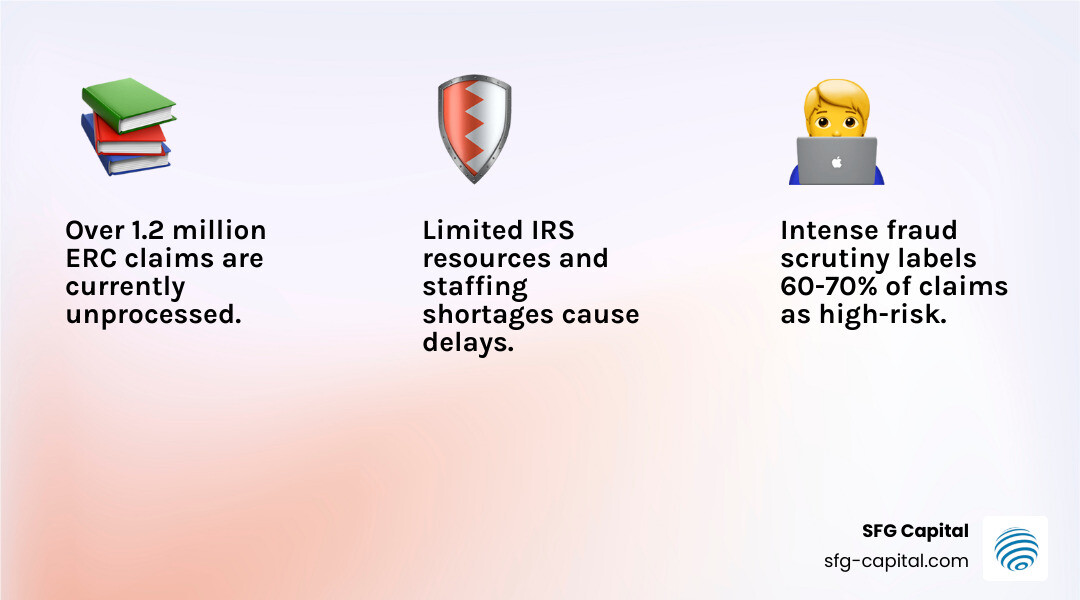
The journey of an ERC claim from submission to refund has become a long and winding road. The primary reasons for these significant ERC refund delays are a massive backlog, stringent fraud prevention measures, and resource limitations within the IRS. Understanding each piece can help clarify the overall picture.

The Massive IRS Backlog: A Mountain of Unprocessed Claims
Imagine a mountain of paperwork stretching as far as the eye can see. That’s essentially the IRS backlog for ERC claims. The IRS has reported a staggering backlog of over a million ERC claims. Many of these have been pending for more than a year, with some businesses waiting over two years for their refunds.
The sheer volume of claims, often filed on amended employment tax returns (Form 941-X), has overwhelmed the IRS’s processing capacity. While the IRS has worked to digitize claims since the September 2023 moratorium, a significant portion still requires manual, paper-based review, inevitably leading to extensive processing times.
Despite this, the IRS states it is processing hundreds of thousands of ERC claims, valued at billions of dollars. These are often the claims that fall into the lowest-risk categories. However, this still leaves over a million claims awaiting review with no clear timeline. For more details on the IRS’s current processing efforts, you can refer to their announcements on Current IRS processing timelines and priorities for ERC claims.
A Necessary Evil: How Fraud Prevention Contributes to ERC Refund Delays
While the backlog is a major factor, a significant contributor to ERC refund delays is the IRS’s intensified focus on fraud prevention. Early in the program, aggressive promoters, or “ERC mills,” pushed many businesses to claim the credit even if they were ineligible, leading to a surge of questionable claims.
In response, the IRS announced plans to deny tens of thousands of improper high-risk ERC claims. They’ve categorized claims into risk levels:
- High-risk claims: 10% to 20% of the total, often facing outright denial.
- Unacceptable level of risk: A substantial 60% to 70% of claims, which are subject to intense scrutiny.
- Low-risk claims: 10% to 20% of claims, which are processed more quickly.
This increased scrutiny culminated in a moratorium on new claims in September 2023. While crucial for tax system integrity, this measure has slowed down all claims, including legitimate ones, as the IRS works to separate valid from invalid filings. The IRS has also sent tens of thousands of rejection letters and initiated hundreds of criminal cases involving improper ERC claims. This broad approach has unfortunately caught many legitimate businesses in the crossfire of delays.
IRS Resource Gaps and Communication Challenges
Beyond volume and fraud concerns, the IRS faces internal challenges that contribute to ERC refund delays. These include:
- Limited Staffing and Outdated Technology: The IRS operates with limited staff and often relies on outdated technology. The National Taxpayer Advocate’s annual reports to Congress have highlighted persistent challenges, including delays in processing ERC claims. Only a small portion of the Inflation Reduction Act (IRA) funding was allocated to Taxpayer Services (4%) and Business Systems Modernization (6%), indicating that resource constraints remain a systemic issue.
- Competing Priorities: The IRS is a busy agency, and ERC claims are just one of many priorities. The agency is constantly preparing for upcoming filing seasons, which can divert resources away from processing older claims.
- Communication Gaps: One of the most frustrating aspects for business owners is the lack of clear communication from the IRS. Many find that customer service representatives have little helpful information on the status of outstanding ERC claims. We’ve heard countless stories from business owners in Travis County and beyond who struggle to get updates, leaving them in limbo. The Taxpayer Advocate Service, usually a reliable avenue for resolving issues, has also noted it hasn’t been a good option for moving stalled ERC claims. This vague communication exacerbates the challenges for business owners trying to plan their financial future.
The Ripple Effect: How Delays Impact Your Business’s Bottom Line
The long wait for ERC refunds isn’t just an inconvenience; it has profound financial and operational impacts on businesses, especially small businesses in communities like Travis County. These delays can create a domino effect, undermining stability and hindering growth.

Cash Flow Crunches and Operational Strain
For many businesses, the expected ERC refund was earmarked for critical operational needs. When these funds are delayed, it can trigger a severe cash flow crisis. Businesses might find themselves in a liquidity crunch, struggling to pay bills, cover payroll, or manage day-to-day expenses.
We’ve seen businesses forced to scale back operations, postpone investments, or delay hiring. In some cases, the absence of these anticipated funds has forced businesses to downsize or even close their doors. This isn’t just about financial numbers; it’s about livelihoods and the health of our local economy.
If your business in Travis County is experiencing a severe cash flow crunch due to ERC refund delays, we understand the urgency. Exploring solutions like More info about ERC Advance Funding can provide the immediate capital you need to bridge the gap and keep your operations running smoothly.
Navigating Financial Uncertainty and Stalled Growth
ERC refund delays introduce significant uncertainty into financial planning. Business owners rely on predictable cash flows to make informed decisions. When a substantial refund is pending indefinitely, accurate budgeting becomes a guessing game.
This uncertainty can lead to:
- Delayed Expansion Plans: Businesses might put off plans for expansion, such as opening new locations or developing new products.
- Missed Growth Opportunities: Without access to capital, businesses may miss out on timely market opportunities that could drive growth.
- Stalled Investments: Investing in new technology, employee training, or marketing often takes a back seat when a business is simply trying to stay afloat.
The impact of these delays on financial planning and growth is considerable, making it difficult for owners to plan, innovate, and contribute to the economy. We believe in helping businesses in Travis County overcome these problems and continue their growth trajectories. You can learn more about how ERC funds, when received promptly, can power your business forward by visiting Funding Growth: How ERC Can Power Your Business Forward.
Taking Control: Proactive Steps to Steer the ERC Waiting Game
While the IRS backlog and fraud prevention measures are largely out of your control, there are proactive steps business owners can take to manage ERC refund delays. The key is thorough preparation, diligent monitoring, and understanding how to respond to IRS communications.
The Power of Preparation: Assembling Your Crucial ERC Documentation
Impeccable documentation is the foundation of a successful ERC claim and your best defense against delays or denials. With the IRS scrutinizing claims intensely, having all your records in order can streamline the process and allow for quick responses to inquiries.
We recommend maintaining an easy-to-reference file with all supporting documents, including:
- Payroll Records: Detailed Forms 941 (Employer’s Quarterly Federal Tax Return) and 941-X (Adjusted Employer’s Quarterly Federal Tax Return or Claim for Refund) for all relevant quarters.
- Gross Receipts Tests: Documentation demonstrating a significant decline in gross receipts for eligible quarters compared to 2019. This might include financial statements or sales reports.
- Government Shutdown Orders: Official government orders (federal, state, or local) that fully or partially suspended your business operations due to COVID-19, with details on how the order impacted your business.
- PPP Loan Forgiveness Documents: If you received a Paycheck Protection Program (PPP) loan, documentation showing which wages were used for PPP loan forgiveness to ensure no double-dipping with ERC wages.
- Health Plan Expenses: Records of employer-sponsored health plan expenses paid on behalf of employees.
- Employee Records: Wage registers, timecards, and other documents that substantiate qualified wages paid to employees.
This organization is crucial for supporting your claim and responding effectively to IRS inquiries, potentially reducing further delays.
How to Proactively Monitor Your Claim and Respond to IRS Inquiries
Once your ERC claim is filed, the waiting game begins. However, “waiting” doesn’t mean being passive. Proactive monitoring can help you identify potential issues early.
While IRS communication can be vague, we encourage you to:
- Use Available IRS Resources: Keep an eye on IRS announcements regarding ERC processing. General updates can provide context, even if real-time status for individual claims is unavailable.
- Regular Follow-Up: While calls to IRS customer service may yield limited information, maintaining a record of your attempts to follow up can be useful.
- Respond Promptly to Notices: If you receive any correspondence from the IRS, respond promptly and thoroughly. Delays in responding can lead to further processing delays or claim disallowance.
- Keep Contact Information Updated: Ensure the IRS has your current mailing address to avoid missing critical notices.
We understand that navigating these processes can be daunting. At SFG Capital, we work with businesses in Travis County to help them understand their claims and prepare for potential IRS interactions. You can learn more about how we assist with the process by visiting More info about our process.
Decoding IRS Notices: What to Do When You Receive Letter 105-C
One of the most critical pieces of mail you might receive is Letter 105-C, a formal notice from the IRS stating that your ERC claim has been disallowed. It’s important not to panic but to understand what this letter means and your options.
Letter 105-C should outline the reason for the disallowance and information about your appeal rights. However, these letters can sometimes be vague, leading to frustration.
If you receive Letter 105-C:
- Review Thoroughly: Carefully examine the letter for the stated reasons for denial. Does it make sense? Is there missing information that could clarify the IRS’s position?
- Gather Supporting Documentation: If you disagree with the disallowance, prepare to submit an explanation and all substantiating documents that support your original claim.
- Understand Appeal Rights: The letter should detail your right to appeal. You typically have 30 days to respond to a denial letter and request that your case be referred to the IRS Independent Office of Appeals.
- Be Aware of Deadlines: If you choose to litigate, there is generally a two-year window from the date of the disallowance notice to file a refund suit in court.
For more information on what to do if you receive this notice, the IRS provides guidance on Understanding Letter 105-C from the IRS. We also recommend consulting with a qualified tax professional to help you interpret the notice and determine the best course of action.
Red Flags and Resolutions: Dealing with Problematic or Denied Claims
The IRS’s increased scrutiny means that legitimate businesses may find their claims caught in the dragnet alongside problematic ones. It’s crucial to understand the warning signs of ineligible claims and fraudulent promoters, as well as your options if your claim is denied or if you have second thoughts about its validity.
Warning Signs of an Ineligible Claim or Fraudulent ERC Promoter
The rise of ERC refund delays has coincided with a proliferation of aggressive and often fraudulent ERC promoters. These “ERC mills” often make unrealistic promises and can lead businesses down a path of non-compliance, resulting in future audits, penalties, and interest.
Be wary of any promoter or service that exhibits these warning signs:
- Unsolicited Calls or Emails: If you’re contacted out of the blue by someone you don’t know offering ERC services.
- Guaranteed Eligibility: Claims that you are “guaranteed” to be eligible for the ERC without a thorough review of your specific business circumstances.
- Large Upfront Fees or Percentage-Based Fees: Charging a significant upfront fee or a fee based on a percentage of your refund, rather than a fixed fee for services.
- Pressure Tactics: Pressuring you to sign agreements quickly or making claims that eligibility can be determined “in minutes.”
- No Discussion of Eligibility Details: A lack of inquiry into specific factors such as your gross receipts, government orders affecting your operations, or interaction with PPP loans.
- Misleading Information: Suggesting that “essential businesses” automatically qualify or that minimal impact from a government order is sufficient.
The IRS has explicitly warned against these schemes. If you suspect you’ve been misled, seek independent, professional advice. For more information on navigating the complexities of the ERC, you can find valuable resources at More info about Employee Retention Credit Help.
Your Options After a Denial: The ERC Appeal and Litigation Process
Receiving a denial letter (like Letter 105-C) is disheartening, but it’s not necessarily the end of the road. Businesses have several avenues to pursue if they believe their claim was legitimate and incorrectly denied.
- Administrative Appeal: Your first step is typically to file an administrative appeal with the IRS Independent Office of Appeals. This office is separate from the IRS division that initially denied your claim and offers an impartial review. You’ll need to submit a written protest outlining why you disagree with the IRS’s decision.
- Filing a Refund Suit: If the administrative appeal is unsuccessful, or if your claim has been pending for more than six months without a decision, you may have the option to file a refund suit in court. This can be done in either the U.S. Court of Federal Claims or a federal district court and typically requires legal counsel. Be aware of the two-year statute of limitations for filing such a suit, which generally begins from the date of the denial letter.
- Working with Tax Professionals: Navigating appeals and potential litigation requires specialized knowledge. Tax professionals, including tax attorneys, can play a crucial role in assisting businesses with ERC claims, especially when dealing with denials or audits.
Second Thoughts? How to Withdraw an Ineligible ERC Claim
Sometimes, a business owner might have second thoughts about their ERC claim’s validity, perhaps realizing they were misled by a promoter. The good news is that the IRS has provided mechanisms to withdraw an ineligible claim, which can help businesses avoid future audits, penalties, and interest.
The IRS’s guidance on withdrawing an ineligible ERC claim allows you to do so if:
- You have not yet received the refund.
- You received the refund check but have not cashed or deposited it.
If you’ve already received and cashed the refund, you might still have options. The IRS has provided programs like the Voluntary Disclosure Program (VDP) to help businesses correct improperly filed claims, often at a reduced penalty. While specific program deadlines may pass, it’s crucial to check the latest IRS announcements for any available options to come into compliance. You can find more information on the VDP through the IRS’s Voluntary Disclosure Program.
The key takeaway is that if you believe your claim was incorrect, addressing it proactively is far better than waiting for the IRS to initiate an audit.
Advanced Strategies for Complex ERC Refund Delays
For businesses in Travis County facing prolonged ERC refund delays or particularly complex situations, there are additional strategies to consider. These often involve engaging with specific IRS services or understanding the intricate tax implications of delayed refunds.
When and How the Taxpayer Advocate Service (TAS) Can Help
The Taxpayer Advocate Service (TAS) is an independent organization within the IRS designed to help taxpayers resolve problems they haven’t been able to fix through normal channels, especially when the problem is causing significant financial hardship. While TAS has faced its own challenges with the ERC backlog, it can be a valuable resource in certain situations.
You should consider contacting TAS if:
- Your ERC claim has been delayed for over six months, and you’ve tried to resolve it through regular IRS channels without success.
- The delay is causing significant financial hardship for your business, jeopardizing its operations.
TAS acts as a liaison, investigating your case and communicating with the IRS on your behalf. They can intervene to help expedite your claim, especially if hardship can be demonstrated. However, as the National Taxpayer Advocate has noted, TAS has not always been effective in moving stalled ERC claims. Still, it’s an option worth exploring. To learn more about how TAS operates, you can visit Learn more about the Taxpayer Advocate Service.
The Tax Implications of Receiving a Late ERC Refund
An often-overlooked aspect of ERC refund delays is their impact on income tax. The ERC itself is not taxable income. However, claiming the ERC requires you to reduce your business’s wage deductions on your income tax return for the corresponding tax year. If you claimed the ERC after filing your original income tax return, you were generally advised to file an amended return.
Here’s where the delays create a dilemma:
- Statute of Limitations Expiration: Due to processing delays, many businesses are receiving ERC refunds long after the statute of limitations for amending their 2020 or 2021 income tax returns has expired.
- Potential “Double Benefit”: If the statute of limitations has expired and you haven’t amended your income tax return, you might find yourself having received both the ERC refund and the full wage deduction. The IRS has acknowledged this, and their guidance suggests choices for employers in this situation:
- Include the ERC amount in income for the year the refund is received: This is the IRS’s suggested approach to correct the prior year’s deduction.
- Ignore the receipt and potentially obtain the “double benefit”: This carries audit risk, and the application of the “tax benefit rule” in this context is not entirely clear-cut, despite some IRS guidance.
We strongly encourage businesses in Travis County to consult with a tax professional to analyze their specific circumstances regarding these complex tax implications. The original guidance on the ERC provides foundational information, but the interaction with delayed payments requires expert interpretation.
Conclusion: Bypass the Wait and Secure Your Funds
Prolonged ERC refund delays have turned a vital relief measure into a source of financial strain for countless businesses, including many in Travis County. The combination of a massive IRS backlog, fraud prevention, and resource limitations means the waiting game is far from over for many legitimate claims.
We’ve explored the impacts of these delays on cash flow and growth, but business owners are not powerless. Proactively assembling documentation, monitoring claims, understanding IRS notices, and being vigilant against fraudulent promoters can improve your position.
For those facing denials, we’ve outlined the appeal process, and for those with second thoughts, the IRS offers withdrawal and disclosure programs. For complex cases, the Taxpayer Advocate Service and understanding the tax implications of late refunds are critical strategies.
While the IRS works through its backlog, your need for capital can’t always wait. For businesses in Travis County needing immediate access to their funds, an ERC buyout provides certainty. At SFG Capital, we help you bypass these IRS delays and secure the funds you’ve earned, so you can focus on running and growing your business.
Don’t let the IRS backlog dictate your business’s future. Take control of your financial destiny. Explore ERC Funding Solutions to bypass the IRS wait and ensure your business has the capital it needs, when it needs it.