
Why Finding the Right ERC Partner Matters for Your Business
ERC companies near me are specialized service providers that help businesses claim the Employee Retention Credit—a federal tax credit worth up to $26,000 per employee. If you’re searching for help claiming your ERC, here’s what you need to know:
Quick Answer: What ERC Companies Can Do for You
- Calculate your credit: Determine if you qualify and estimate your refund amount
- File your claim: Prepare and submit Form 941-X to the IRS on your behalf
- Maximize your refund: Identify all eligible wages and quarters you may have missed
- Provide audit support: Stand behind your claim if the IRS has questions
- Offer advance funding: Get cash now instead of waiting months for the IRS
How to Choose an ERC Provider
- Specialization: Look for companies focused exclusively on ERC, not general accountants
- Fee structure: Most charge 15-25% of your refund, only if you get paid
- Track record: Ask how much they’ve recovered and for how many businesses
- Audit protection: Ensure they’ll support you if the IRS audits your claim
- Funding options: Check if they offer bridge loans or advance funding to bypass IRS delays
The Employee Retention Credit is a refundable tax credit created by the CARES Act to help businesses that kept employees on payroll during COVID-19. The problem? The IRS is severely backlogged, and many businesses are waiting 12+ months for their refunds. Even worse, the ERC program’s complexity means many business owners either miss out on thousands of dollars or make costly mistakes that trigger audits.
I’m Santino Battaglieri. Through SFG Capital, I’ve helped businesses steer the ERC landscape, funding over $500 million in claims and assisting owners in evaluating erc companies near me. In this guide, I’ll break down what ERC companies do, how to spot the good from the bad, and what to expect from the claim process.
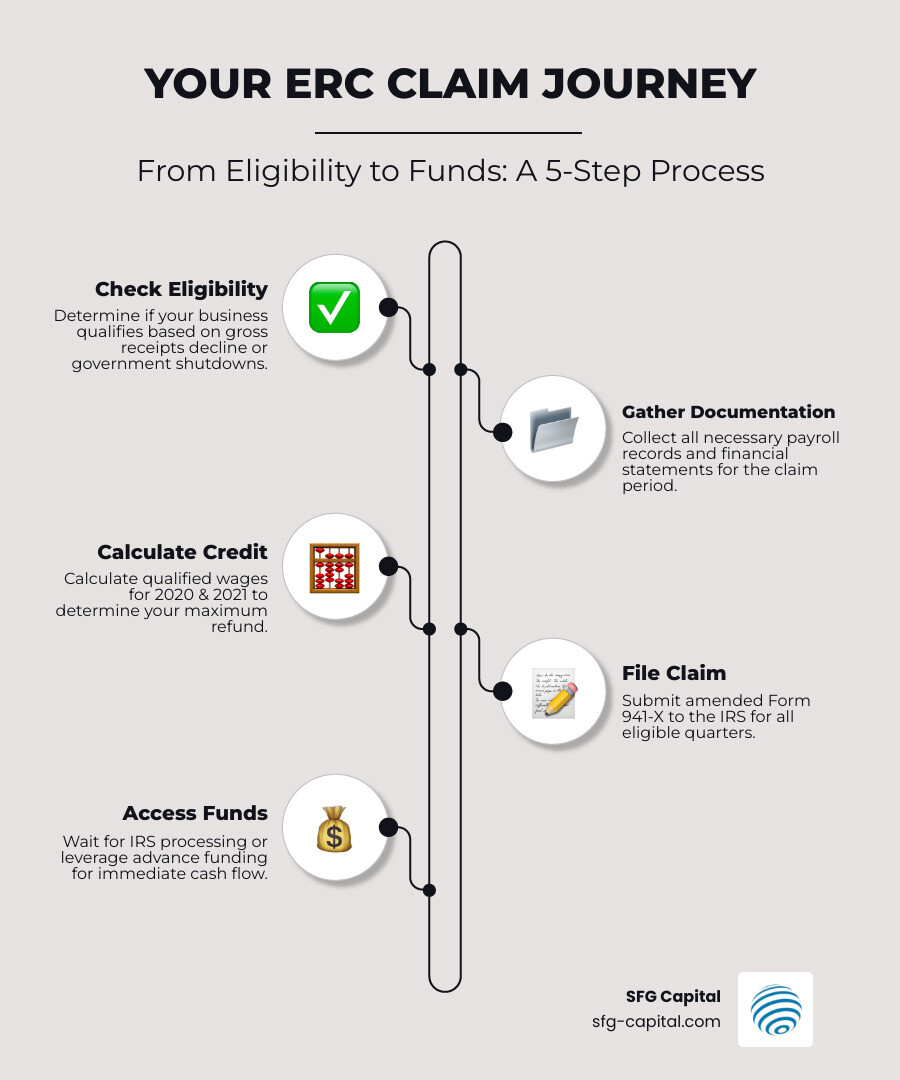
Quick erc companies near me terms:
What is the Employee Retention Credit (ERC) and Who Qualifies?
The Employee Retention Credit (ERC) is a lifeline for businesses that kept staff employed during the COVID-19 pandemic. At its core, the ERC is a refundable tax credit—a direct payment from the government, even if you owe no taxes, not just a deduction. It was designed as an economic stimulus to reward businesses for keeping employees on payroll. Crucially, this credit does not have to be repaid, offering a significant, non-dilutive source of capital for eligible businesses.
Initially part of the CARES Act in 2020, the ERC program evolved to allow businesses to retroactively claim credits for qualified wages paid between March 13, 2020, and September 30, 2021 (or December 31, 2021, for recovery startup businesses). This retroactive nature means it’s not too late to explore your options, even if you previously thought you weren’t eligible. Due to the program’s complexity, many businesses in Austin and Travis County might still be sitting on a substantial refund. To dive deeper into the nuances of this program, we recommend checking out our ERC Credit Complete Guide.
ERC Eligibility Requirements
So, who exactly is eligible for this fantastic opportunity? The IRS outlines several pathways to qualification, which primarily revolve around demonstrating how your business was impacted by the pandemic. You generally need to meet one of the following criteria for the specific quarters you’re claiming:
- Significant Decline in Gross Receipts: This is one of the most common ways businesses qualify.
- For 2020: Your business must have experienced at least a 50% decline in gross receipts during a calendar quarter when compared to the same quarter in 2019.
- For 2021: The threshold was lowered, requiring at least a 20% decline in gross receipts during a calendar quarter when compared to the same quarter in 2019. There’s also a “lookback” rule, allowing businesses to use the immediately preceding quarter to determine eligibility if they didn’t meet the 20% decline in the current quarter.
- Full or Partial Suspension of Operations Due to Government Order: If your business operations were fully or partially suspended due to a government order limiting commerce, travel, or group meetings due to COVID-19, you could be eligible. This doesn’t mean your business had to close entirely; even a partial shutdown, like reduced operating hours, capacity restrictions, or supply chain disruptions caused by government-mandated supplier shutdowns, could qualify you.
- Recovery Startup Business (for Q3 & Q4 2021 only): For businesses that started after February 15, 2020, and meet certain gross receipts thresholds, there’s a specific path to claim the ERC for the last two quarters of 2021, even without a decline in gross receipts or a government-mandated shutdown.
Understanding these criteria can be tricky, as the IRS guidance is extensive and nuanced. This is where the expertise of ERC companies near me becomes invaluable. To help you steer these complex rules, the IRS has provided an IRS eligibility checklist that we always encourage businesses to review.
Calculating Your Potential Credit
Once you’ve established eligibility, the next exciting step is figuring out just how much your business could receive. The potential refund amounts are substantial, designed to provide meaningful relief.
- For 2020: Employers can receive up to $5,000 per employee. This is calculated as 50% of the first $10,000 in qualified wages paid to an employee during an eligible quarter.
- For 2021: The credit became even more generous. For the first three quarters of 2021, employers can receive up to $7,000 per employee per quarter. This is based on 70% of the first $10,000 in qualified wages paid to an employee during an eligible quarter.
When we combine these periods, the total potential credit can reach an impressive up to $26,000 per employee retained. This figure represents the maximum amount a business could receive for a single employee across all eligible quarters in 2020 and 2021.
“Qualified wages” are a key component of this calculation. Generally, these include wages subject to FICA taxes and qualified health plan expenses. However, there are strict rules about which wages qualify, especially if you also received a Paycheck Protection Program (PPP) loan. The good news is that unlike PPP loans, the ERC does not have to be repaid, offering a pure cash infusion into your business. For a more detailed breakdown of how these funds work and what they mean for your business, explore our guide on What is ERC Funding?.
Finding Your Match: Types of ERC Service Providers

Navigating the complex ERC program is challenging due to the volume of information and IRS guidelines. That’s why many businesses in Austin and Travis County turn to professional assistance. When searching for ERC companies near me, you’ll encounter different types of service providers. Understanding these distinctions is crucial to choosing the right partner for your business.
Dedicated ERC Specialists
These are the companies that live and breathe ERC. Their entire business model is built around helping businesses like yours claim this specific tax credit. What does this mean for you?
- Specialized Knowledge: Their teams are deeply immersed in the ERC tax code, IRS guidance, and all the nuances that general accountants might miss. This focus allows them to stay abreast of the latest updates and interpretations, ensuring your claim is accurate and maximized.
- Maximizing Refunds: Research suggests that ERC specialists average higher refunds, often recovering 10-20% more than other companies. This isn’t magic; it’s the result of their singular focus, allowing them to identify every eligible quarter and every qualified wage.
- Streamlined Process: Because they handle ERC claims day in and day out, specialists often have highly efficient, proven processes for collecting documentation, calculating credits, and filing claims. This can significantly reduce the burden on your internal team.
- Contingency Fees: Many specialists operate on a contingency fee basis, meaning they only get paid a percentage of the refund you receive. This aligns their success with yours and often means no upfront costs, making it a financially attractive option.
For businesses seeking a comprehensive understanding of what a dedicated ERC specialist can offer, we’ve put together an Employee Retention Credit Specialist Guide.
General Accounting Professionals
Many businesses naturally turn to their existing CPA or accounting firm for ERC assistance. After all, they already know your books, right? While there’s comfort in an existing relationship and their general tax knowledge, there are important considerations:
- Existing Relationship: Trust and familiarity are big advantages. Your CPA already understands your business’s financial history.
- General Tax Knowledge: Your CPA is undoubtedly an expert in general tax law and accounting principles.
- May Lack ERC Specialization: However, the ERC is a highly specialized area of tax law. Many CPAs, while excellent at what they do, may not have the deep, day-to-day expertise in ERC to maximize your claim. They might not be payroll tax specialists (ERC is filed via amended payroll tax returns, Form 941-X), could be unfamiliar with recent program changes, and often calculate smaller refunds compared to dedicated ERC specialists. We’ve seen many instances where a business’s CPA initially advised they didn’t qualify, only for an ERC specialist to uncover a substantial credit. It’s not a slight against CPAs; it’s simply acknowledging that the ERC is a beast of its own.
The Do-It-Yourself (DIY) Route
For the truly intrepid business owner, the idea of doing it yourself might seem appealing, especially for the perceived cost savings. However, this path comes with significant risks:
- Cost Savings (Perceived): While you avoid professional fees, the actual cost in terms of time and potential missed credits can be far greater.
- High Risk of Errors: The ERC program is incredibly complex. It involves interpreting over 200 pages of tax code and applying it correctly to your specific business situation. Doing it yourself carries a much higher potential for mistakes, leading to audits, penalties, and the risk of under or over-claiming.
- IRS Audits: Incorrect claims are a red flag for the IRS. A botched DIY claim could trigger an audit, leading to substantial stress, legal fees, and potentially having to repay the credit with penalties and interest.
- Time Commitment: Preparing an accurate ERC claim requires a significant investment of time—time that most business owners would rather spend running their business.
Choosing the right partner to help with your ERC claim is a critical decision. For most businesses, especially those in dynamic markets like Austin, the expertise of dedicated ERC companies near me often proves to be the most beneficial and secure route.
How to Choose from ERC Companies Near Me: 5 Key Factors

When searching for ERC companies near me in Austin or Travis County, the number of options can be overwhelming. It requires due diligence to find a reliable and effective partner. Choosing the right ERC company isn’t just about getting a refund; it’s about securing your business’s financial future and avoiding pitfalls. Here are five key factors to consider:
1. Prioritize Specialization and a Proven Track Record
This is perhaps the most crucial factor. The ERC program is not a sideline; it’s a specialty. Look for companies that have an ERC-only focus. Their singular dedication means their teams are experts in the field, not generalists. This specialization allows them to:
- Identify Every Opportunity: A dedicated team will understand all the nuances of gross receipts, government orders, and qualified wages, ensuring no stone is left unturned in maximizing your refund. We’ve seen instances where specialized firms recover 10-20% more than general accountants.
- Demonstrate Expertise: Ask about their case studies, how many businesses they’ve helped, and the total amount of credits they’ve recovered. While we don’t name specific entities, some leading firms have recovered billions in credits to date, showcasing the scale of expertise possible.
- Employ In-House Experts: Do they have tax attorneys, CPAs, and payroll specialists on staff who are specifically trained in ERC? This in-house expertise is vital for navigating complex eligibility scenarios and defending claims if necessary.
Choosing a partner with a strong track record and specialized knowledge is essential for not only securing your credit but also for leveraging those funds to strengthen your business. Find more strategies in our guide, 5 Ways to Use ERC Funds to Strengthen Your Business.
2. Understand the Fee Structure and Ensure Transparency
Before signing any agreement, clearly understand how the ERC company charges for its services. Transparency in fees is paramount.
- Contingency Fees: The most common and generally preferred model is a contingency fee, where the company charges a percentage of the refund you actually receive. This means they only get paid if you do, aligning their incentives with yours.
- Percentage of Refund: Expect fees to range, typically, from 15% to 25% of the total refund amount. Be wary of companies charging significantly higher percentages or those with vague fee structures.
- No Upfront Costs: A reputable ERC specialist will typically not charge hefty upfront fees. Their payment is tied to your success. Our model at SFG Capital is performance-based, ensuring that our success is directly linked to yours.
Always get the fee structure in writing and ensure there are no hidden costs. A transparent company will clearly outline all potential charges before you commit.
3. Evaluate the Claim Process and Processing Speed
The ERC claim process involves several steps, from initial qualification to final submission. Understanding this process and how quickly a company can move is important, especially given current IRS backlogs.
- Application Process: A good ERC company will have a clear and efficient application process, typically starting with a qualification questionnaire to determine your eligibility.
- Document Submission: They will guide you on what documents are needed, usually including payroll records, 941s, and profit & loss statements. The easier they make this for you, the better.
- Filing Time: While the IRS processing time is outside any company’s control, how quickly the ERC company prepares and submits your claim to the IRS is within their control. Some efficient firms can submit claims in as little as one to two weeks after receiving all necessary documentation. The claim is filed by amending your payroll tax returns using Form 941-X.
- Communication: Look for a company that communicates clearly throughout the process, keeping you informed of every step and what to expect.
Speed and efficiency in filing can mean your claim gets into the IRS queue sooner. For a more comprehensive look at how these solutions can work for your business, visit our page on ERC Funding Solutions.
4. Inquire About Audit Protection
The IRS has increased its scrutiny of ERC claims to combat fraud. This means there’s a higher risk of audits, especially for claims prepared incorrectly or by “ERC mills” that make exaggerated promises. A legitimate ERC company will offer robust audit protection:
- IRS Scrutiny: The IRS is very clear that they are actively auditing ERC claims. This isn’t a program to take lightly.
- Avoiding ERC Mills: Be extremely cautious of companies that make unrealistic promises, guarantee specific refund amounts without proper analysis, or pressure you into signing up. These “ERC mills” often disappear after filing, leaving you to deal with the IRS alone.
- Audit Support Guarantee: A reputable ERC company will stand behind their work. This means they should offer to represent you and provide support if your claim is audited by the IRS, at no additional cost. This guarantee offers immense peace of mind.
To verify the legitimacy of any ERC companies near me, look for transparent operations, a physical presence (if applicable), and a clear track record. Avoid those that solely rely on unsolicited calls or high-pressure sales tactics. If it sounds too good to be true, it probably is.
5. Ask About Options to Access Funds Faster
One of the biggest frustrations for businesses claiming the ERC is the agonizing wait for their refund. The IRS is severely backlogged, and many businesses are waiting 12+ months, sometimes even longer, for their checks. This delay can cripple businesses that need cash flow now.
- IRS Processing Times: Understand that no ERC company can magically speed up the IRS. The processing time once a claim is submitted is entirely in the IRS’s hands.
- Refund Delays: These delays are a harsh reality for many.
- Bridge Loans and Advance Funding: This is where innovative solutions come into play. Many specialized ERC companies, including us at SFG Capital, offer ERC Bridge Loans or ERC Advance Funding. These options allow businesses to access a significant portion of their anticipated refund now, providing immediate cash flow while they wait for the IRS to process the official credit. This can be a game-changer for businesses needing capital to grow, cover expenses, or simply maintain operations.
If immediate cash flow is a concern for your business in Austin or Travis County, inquiring about these advance funding options is a must. They can bridge the gap between filing your claim and receiving your actual refund from the IRS, turning a long wait into immediate relief.
Frequently Asked Questions about the ERC Program
We understand that the ERC program can raise a lot of questions. Here, we address some of the most common inquiries we hear from businesses, particularly when they’re looking for ERC companies near me.
What should I look for in ERC companies near me?
When searching for ERC companies near me in Austin or Travis County, it’s important to differentiate between general service providers and true specialists. Here’s what we advise:
- Specialization: As we’ve emphasized, look for a firm that primarily focuses on ERC. Their expertise will be best compared to general accounting firms.
- Transparent Fees: Ensure the company’s fee structure is clear, preferably a contingency-based model where they only get paid when you do. Avoid upfront fees.
- Audit Support: A legitimate company will offer robust audit defense as part of their service, standing by your claim if the IRS has questions.
- Positive Reviews and Reputation: Check testimonials, case studies, and online reviews. While we don’t rely on external sources for our own services, a company’s reputation speaks volumes.
- Local Presence vs. National Expertise: For businesses in Travis County, a local presence can offer a more personalized touch. However, national expertise brought by specialized firms can also be highly beneficial. We at SFG Capital serve businesses in Travis County, offering both local understanding and deep specialized ERC knowledge.
How do I know if an ERC company near me is legitimate?
With the rise of ERC, unfortunately, there has also been an increase in fraudulent “ERC mills.” Protecting your business from scams is vital. Here are some key red flags and legitimacy checks:
- Unsolicited Calls or Emails: Be wary of companies that cold-call or email you out of the blue, especially those promising guaranteed large refunds.
- Promises of Specific Amounts: No legitimate ERC company can guarantee a specific refund amount without first conducting a thorough analysis of your business’s financials and eligibility. If a company claims they can get you X amount without reviewing your documents, run!
- High-Pressure Sales Tactics: If you feel pressured to sign up immediately, or if the company refuses to answer your questions thoroughly, it’s a major red flag.
- Lack of Transparency: Legitimate companies will be transparent about their process, fees, and the credentials of their team members. They should be able to explain the “why” behind their calculations.
- No Audit Protection: As discussed, a trustworthy firm will offer to support you in the event of an IRS audit.
- Check Credentials: Ensure the individuals involved have relevant tax or accounting credentials.
For more guidance on spotting fraudsters and ensuring you get legitimate help, refer to our page on Employee Retention Credit Help.
Can I still claim the ERC if I also received a PPP loan?
Yes, absolutely! This is one of the most common misconceptions about the ERC program, and we’re glad you asked. Initially, businesses couldn’t claim both the ERC and a Paycheck Protection Program (PPP) loan. However, the law was changed by the Consolidated Appropriations Act of 2021.
Here’s the key takeaway:
- CARES Act Changes: The update to the CARES Act explicitly allowed businesses to claim both PPP and ERC.
- No Double-Dipping Wages: The crucial caveat is that you cannot use the same wages to qualify for both PPP loan forgiveness and the ERC. This is known as “no double-dipping.” For example, if you used certain wages to get your PPP loan forgiven, you cannot then use those same wages to calculate your ERC.
- Coordination is Key: This requires careful calculation and coordination to ensure that the wages you claim for ERC are distinct from those used for PPP forgiveness. An experienced ERC specialist will be adept at navigating this overlap, strategically allocating wages to maximize both benefits without violating IRS rules.
Many businesses initially thought they were ineligible for ERC because they received a PPP loan, potentially leaving thousands of dollars on the table. If this sounds like your situation, it’s definitely worth revisiting your eligibility with an ERC expert.
Conclusion: Secure Your Credit with the Right Partner
The Employee Retention Credit is a significant opportunity for businesses in Austin and Travis County to strengthen their financial position post-pandemic. With up to $26,000 per employee available, this non-repayable tax credit can be a game-changer, allowing you to reinvest in your operations, reward your team, or secure your future.
However, the path to claiming your ERC is fraught with complexities. From intricate eligibility rules and detailed wage calculations to the daunting prospect of IRS audits and frustrating refund delays, navigating the ERC program successfully demands specialized expertise. This is why the importance of choosing the right partner, one of the dedicated ERC companies near me, cannot be overstated. A true ERC specialist will not only help you maximize your refund but also ensure your claim is fully compliant, providing invaluable audit protection.
We’ve seen how crucial these funds can be for businesses. At SFG Capital, we understand that waiting 12+ months for an IRS refund can be detrimental to cash flow. That’s why, for businesses that can’t wait for the IRS, we offer ERC advance funding to provide immediate access to your credit. We help businesses in Travis County expedite Employee Retention Credit (ERC) refunds, offering advances/buyouts to bypass IRS delays, with a performance-based fee, ensuring quick access to funds and expert claim assistance.
Don’t let the complexity or the waiting game deter you from claiming what your business rightfully deserves. Avoiding “ERC mills” and partnering with a reputable, specialized firm is the smartest move you can make. Let us help you open up the full potential of your ERC.