
Why Checking Your ERC Refund Status Matters
ERC refund status check is one of the most common concerns for businesses that filed for the Employee Retention Credit. If you’ve submitted Form 941-X and are wondering where your refund is, you’re not alone—thousands of businesses are in the same position.
Here’s how to check your ERC refund status:
- Call the IRS Business and Specialty Tax Line at 800-829-4933 (or 267-941-1000 from outside the U.S.)
- Have your information ready: EIN, business name, quarters filed, submission dates, and expected refund amount
- Be prepared for long wait times and understand there is no online tool for ERC refunds
- Consider working with a tax professional who has access to IRS practitioner lines for faster service
The reality is harsh: while the IRS initially estimated 6-8 weeks for processing, businesses now report waiting 4 to 12 months or longer. As of August 2023, the IRS had approximately 511,000 unprocessed Forms 941-X, with an average claim age of 548 days. As of October 2024, the IRS is processing about 400,000 claims worth $10 billion, but the backlog remains significant.
For many businesses, this wait isn’t just frustrating—it’s financially damaging. The refund you’re owed represents real working capital that could be keeping your business running smoothly.
I’m Santino Battaglieri, and through SFG Capital, I’ve helped businesses steer the ERC refund status check process while managing over $500 million in ERC claims and transactions. My experience has shown me that understanding the system—and knowing your options—can make all the difference when you need access to your funds.
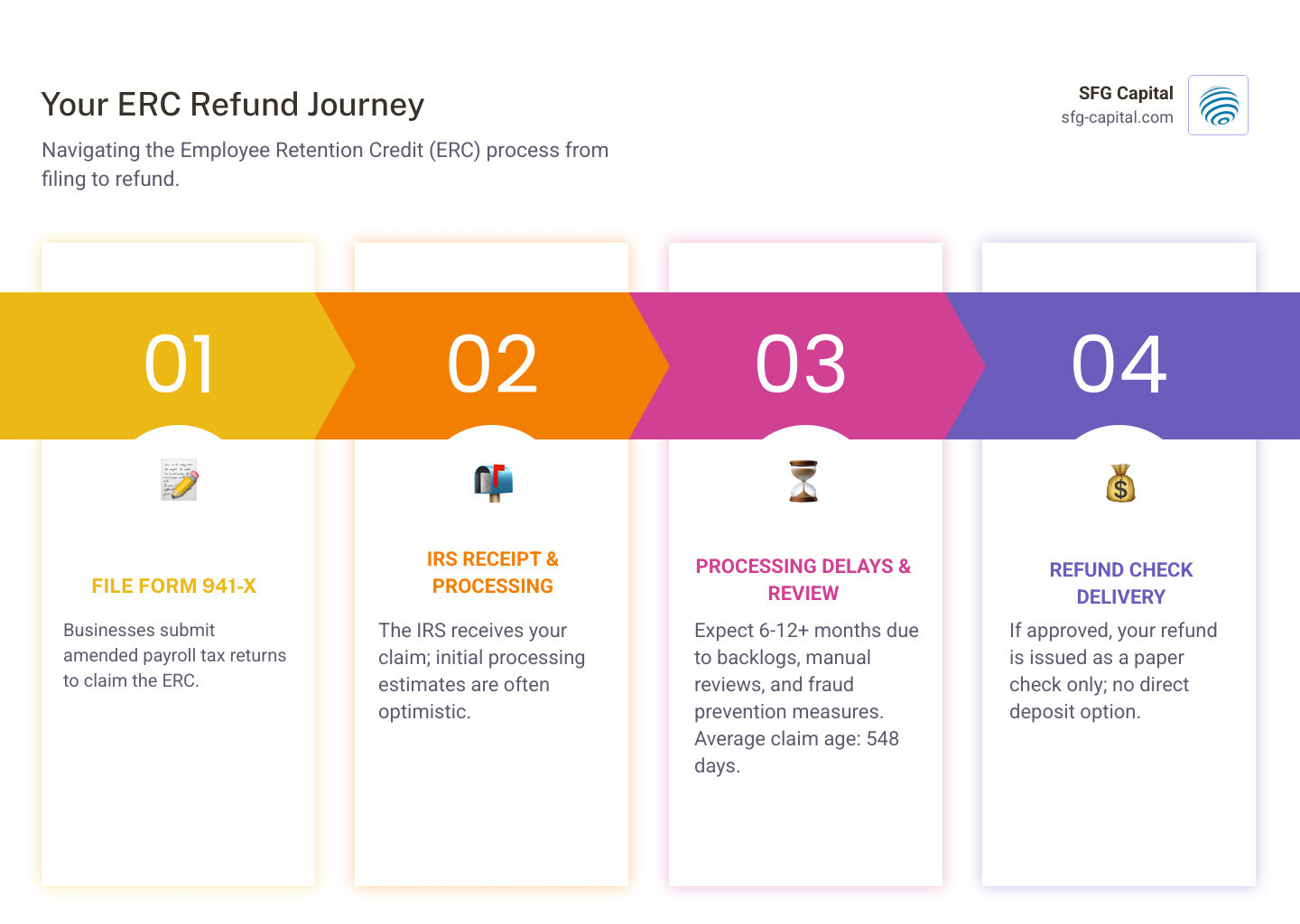
How to Perform an ERC Refund Status Check
The Employee Retention Credit (ERC) was a lifeline for many businesses in Travis County, Austin TX, and across the United States, helping them retain employees during the unprecedented challenges of the COVID-19 pandemic. However, after filing your amended payroll tax return, Form 941-X, the waiting game for your refund can feel endless. The IRS is struggling with an enormous backlog, and the process of ERC refund status check is far from straightforward. We understand that patience is a virtue, but when it comes to your business’s finances, you need answers.

Contacting the IRS Directly
For most businesses, the primary method for an ERC refund status check involves picking up the phone and calling the IRS directly. The dedicated line for business and specialty taxes is 800-829-4933. If you’re calling from outside the U.S., you can use 267-941-1000.
Now, let’s be honest, calling the IRS can sometimes feel like preparing for an Olympic event. Expect potentially long wait times. The IRS business helpline operates Monday through Friday, typically from 7 a.m. to 7 p.m. local time. While there’s no magic hour, calling early in the morning or later in the afternoon might slightly reduce your hold time.
When you finally connect with an agent, they will be able to provide you with limited updates on your tax credit status. They can confirm if your Form 941-X has been received and entered into their system, and sometimes offer a general idea of where it is in the processing queue. However, it’s important to set expectations: calling the IRS for a status update, while necessary, will not typically accelerate the refund process itself. Their role is to inform, not to expedite.
Information Needed for Your ERC Refund Status Check
Before you make that call, gather your documents. This isn’t a casual chat; you’ll need specific information to allow the IRS agent to access your business’s tax records. Having everything at your fingertips will save you time and frustration.
Here’s a list of what you’ll need:
- Employer Identification Number (EIN): This is your business’s unique tax ID number.
- Business Name and Address: Ensure these match the records the IRS has on file.
- Tax Form Filed: Specifically, Form 941-X, Adjusted Employer’s Quarterly Federal Tax Return or Claim for Refund.
- Specific Quarters Filed: List the exact tax quarters (e.g., Q2 2020, Q3 2021) for which you submitted ERC claims.
- Date of Submission: The date you mailed your Form 941-X for each quarter. If you sent it via certified mail, have your tracking information ready as well to confirm delivery to the IRS.
- Expected Refund Amount: The exact amount you claimed for each quarter.
Having this information readily available will make the ERC refund status check process smoother and increase the chances of getting a meaningful update from the IRS agent.
Can I Use Online Tools for an ERC Refund Status Check?
This is a common question, and unfortunately, the answer is a bit of a bummer: No, there is no dedicated online tool for checking your ERC refund status.
Many taxpayers are familiar with the IRS’s “Where’s My Refund?” tool or the “Where’s My Amended Return?” tool for individual income tax refunds. These tools are incredibly convenient, allowing you to track your refund’s progress with just a few clicks. However, they are designed for individual income tax returns (Form 1040) and amended individual returns (Form 1040-X), not for amended business payroll tax returns like Form 941-X.
The IRS has not developed an equivalent online portal for businesses to track their ERC refunds. This means the digital convenience we’ve come to expect for personal tax matters simply doesn’t exist for ERC. Our only option for an official ERC refund status check without involving a professional remains the phone call. This lack of an online tool is one of the many reasons why the process feels like such a black box for business owners.
The Role of a Tax Professional
Given the complexities and the lack of online resources, many businesses find immense value in leveraging a tax professional for their ERC refund status check. We, at SFG Capital, understand these challenges deeply.
Tax professionals, especially those specializing in ERC, often have access to dedicated IRS practitioner phone lines. While these lines don’t necessarily guarantee an immediate refund, they can sometimes lead to shorter wait times and agents who are more familiar with the nuances of business tax returns and the ERC program.
Moreover, if you’ve granted a tax professional Power of Attorney (Form 2848), they can contact the IRS on your behalf. This saves you the time and frustration of navigating the phone maze yourself. An experienced professional can also interpret the subtle cues from IRS agents, understand the IRS transcript system, and provide a more accurate assessment of your refund’s status. They can help you understand if your claim has been flagged for further review or if there are any discrepancies that need to be addressed.
For businesses in Travis County, Austin TX, seeking clarity on their ERC refund, SFG Capital offers expert assistance. We not only help with the initial claim but also guide our clients through the arduous ERC refund status check process, leveraging our experience to keep you informed and explore solutions to access your funds faster.
Understanding the Long Wait: Why Are ERC Refunds Delayed?
If you’re still waiting for your ERC refund, you’re likely wondering, “Why is this taking so long?” You’re not alone in that thought. The delays are widespread and often perplexing. The truth is, a confluence of factors has created a perfect storm, leading to unprecedented processing times for these crucial funds.

The ERC Processing Timeline and Backlog
When the ERC was first introduced, the initial estimates for refund processing were typically 6-8 weeks. Sounds reasonable, right? Well, that initial estimate has proven to be as accurate as a weather forecast from last year. Businesses are now reporting waits of four to twelve months, or even longer, with some delays stretching into years.
The IRS itself provides stark statistics that paint a clear picture of the backlog:
- As of August 2, 2023, the agency listed its total inventory of unprocessed Forms 941-X at approximately 511,000.
- The average age of claims in their inventory was a staggering 548 days!
- As of October 2024, the IRS was processing about 400,000 claims worth $10 billion, but this is a fraction of the total.
Why such a massive delay? The IRS received millions of amended returns for the ERC. Unlike many other tax forms that can be processed electronically, Form 941-X often requires manual review. Imagine the sheer volume of paper and the need for human eyes on each one. This manual processing, combined with additional verification steps to prevent fraud and staffing shortages, has created a massive bottleneck. The IRS’s capacity simply couldn’t keep up with the overwhelming demand.
Common Reasons Your Claim Might Be Delayed
While the IRS backlog is a universal issue, specific reasons might be holding up your individual ERC refund status check. It’s not always just a matter of waiting in line; sometimes, your claim might have hit a snag.
Here are some common culprits for delays:
- Incomplete or Inaccurate Forms: Even small errors or missing information on your Form 941-X can cause significant delays. The IRS will often flag these for manual review or send a request for additional information, which adds weeks or months to the process.
- Large Refund Amount Triggering Review: The IRS is highly cautious about large refund amounts due to concerns about fraudulent claims. Larger ERC claims are often subjected to additional scrutiny and may be reviewed multiple times, leading to extended delays.
- Missing Signatures: A forgotten signature can send your form right back to the bottom of the pile.
- Incorrect Mailing Address: If your business’s mailing address on file with the IRS isn’t current, any correspondence or, more importantly, your refund check, could be delayed or lost.
- Flagged for Review: Due to the high volume of improper claims, the IRS has implemented more rigorous compliance screening. If your claim raises any red flags, it will be pulled for further examination.
- IRS Moratorium: While the IRS resumed processing claims filed before September 14, 2023, there was a temporary moratorium on new claims to implement fraud safeguards. This period created additional uncertainty and delays.
Understanding these potential pitfalls can help us anticipate why your ERC refund status check might be stuck in limbo.
Can I Expedite My ERC Refund?
The short answer is: generally, no, not through standard IRS channels. As frustrating as it is, speaking with an IRS agent will not typically move your refund to the front of the line. They are bound by their processing protocols.
However, there are very limited circumstances where you might be able to get some assistance:
- Contacting the Taxpayer Advocate Service (TAS): The Taxpayer Advocate Service (TAS) is an independent organization within the IRS that helps taxpayers who are experiencing significant hardship because of an IRS problem. If the delay in your ERC refund is causing “undue hardship”—meaning you face an immediate threat of adverse action (like eviction, foreclosure, or inability to meet payroll)—you might be able to get their help. You can contact them if you have experienced an undue hardship. They can intervene on your behalf, but their criteria for “hardship” are quite strict.
- Responding to IRS Requests Promptly: If the IRS sends you a letter requesting additional information or clarification, respond immediately and thoroughly. Delays in responding will only prolong your wait.
For businesses in Travis County, Austin TX, that simply cannot afford to wait for their ERC funds, SFG Capital offers solutions. We understand that waiting months or even years for a refund can cripple a business. That’s why we provide ERC advance funding and ERC bridge loans, allowing you to access your capital now, bypassing the IRS’s extended processing times. We empower you to use your funds when you need them most, rather than being at the mercy of the IRS backlog.
You’ve Received a Notice or Check: What’s Next?
After what feels like an eternity, the moment finally arrives: you receive something from the IRS regarding your ERC. Whether it’s a notice or, even better, a check, understanding what you’re holding is crucial. Let’s explain what these documents mean for your business.
ERC refunds are typically mailed as a physical check. We know, in this digital age, it feels a bit archaic, but the IRS generally does not electronically deposit ERC refunds. So, keep a close eye on your mailbox!
Decoding Your Refund: Notice CP210
Often, when you receive your ERC refund check, it will be accompanied by an IRS Notice CP210, “Change in Tax.” This document is designed to explain the adjustments made to your tax account and the calculation of your refund. However, it can sometimes be a source of confusion, especially if the check amount doesn’t seem to match the credit you calculated on your Form 941-X.
The key to understanding Notice CP210 lies in how the ERC is structured and how the IRS categorizes it:
- Non-Refundable Portion (“Tax-Decrease”): The ERC is first applied against your employer’s share of Social Security tax. This portion reduces your tax liability directly. On Notice CP210, this will typically be categorized as a “Tax-Decrease.”
- Refundable Portion (“Credits – Increase”): Once your Social Security tax liability is reduced to zero, any remaining credit becomes the refundable portion. This is the part that generates your actual cash refund. On Notice CP210, this will be categorized as “Credits – Increase.”
The check amount you receive is the combined total of these two portions, plus any applicable interest. The IRS pays interest on overpayments, so your refund check might be slightly higher than the credit amount you initially calculated, thanks to the long processing times.
If you receive a check without a Notice CP210, don’t panic. The bottom of the check itself will include memos detailing the processing center, the specific tax period it applies to, the tax form (941-X), and any interest paid. If there was no outstanding tax liability, the check amount should essentially be your Form 941-X, Line 27 amount, plus any noted interest.
What to Do If Your ERC Check is Lost or Never Arrived
You’ve checked your ERC refund status check, the IRS says your check was mailed, but it’s nowhere to be found. This can be incredibly frustrating, but there’s a process to follow.
If your ERC refund check is lost, stolen, or simply never arrived, you’ll need to initiate a refund trace with the IRS. This is done by filing Form 3911, Taxpayer Statement Regarding Refund.
Here’s a general overview of the process:
- Wait: Give it a reasonable amount of time after the IRS indicates the check was mailed. Mail can sometimes be slow.
- Contact the IRS: If the check doesn’t arrive within a few weeks of the mailed date, call the IRS Business and Specialty Tax Line (800-829-4933) to confirm the mailing date and address.
- File Form 3911: You can request this form from the IRS, or your tax professional can help you complete and submit it. This form allows the IRS to investigate the whereabouts of your refund.
- Be Patient (Again!): The IRS processing time for a refund trace can take several months. Once the trace is complete and if the check is confirmed lost or never cashed, the IRS will typically cancel the original check and issue a replacement.
It’s a hassle, we know, but following these steps is crucial to eventually receive your funds.
How the ERC Affects Your Income Tax Return
Receiving your ERC refund isn’t the final step in the tax journey. The ERC is a payroll tax credit, but it has a significant impact on your business’s income tax return. This is a critical point that many businesses overlook, potentially leading to future IRS issues if not addressed correctly.
The rule is this: the deduction for qualified wages must be reduced by the amount of the ERC in the tax year the wages were paid or incurred. This means you cannot “double-dip” by claiming both the wage deduction and the ERC for the same wages.
For example, if you claimed ERC for wages paid in 2020, you must reduce your wage expense deduction on your 2020 income tax return (e.g., Form 1120 for corporations, Form 1065 for partnerships, Schedule C for sole proprietors) by the amount of the ERC received for those wages. This adjustment needs to be made in the tax year the wages were paid, not the year you actually receive the ERC refund.
This often means that businesses need to file an amended federal income tax return (or an Administrative Adjustment Request, AAR, for certain entities) for the relevant tax year(s). Failure to do so can result in underreported income and potential penalties and interest from the IRS.
We strongly recommend consulting with a tax professional to ensure this adjustment is made correctly for your business in Travis County, Austin TX. At SFG Capital, we guide our clients through not only the ERC refund status check and funding process but also provide insights into these crucial post-refund tax compliance steps, ensuring you remain in good standing with the IRS.
Navigating Potential Problems and Ensuring Compliance
The Employee Retention Credit has been a tremendous benefit for many businesses, but its popularity also attracted opportunistic promoters and unscrupulous actors. Navigating the ERC landscape requires vigilance, not just for your refund status, but also for ensuring your claim was legitimate and compliant with IRS rules.
Warning Signs of ERC Scams and Improper Claims
The IRS has been very vocal about the proliferation of ERC scams and improper claims, even issuing press releases warning employers to be wary of third parties promoting the ERC when they might not qualify. While we, at SFG Capital, believe in the legitimate benefits of the ERC, we also emphasize the importance of due diligence.
Here are some red flags that should make you pause:
- Upfront Fees or Percentage-Based Fees: Be cautious of promoters who demand large upfront fees or charge a fee based on a percentage of the refund amount, especially if they haven’t thoroughly reviewed your eligibility. While legitimate professionals charge fees, their structure should be transparent and tied to the work performed, not just the outcome.
- Guarantees of Eligibility: No legitimate professional can guarantee you’re eligible for the ERC without a comprehensive review of your specific business circumstances. Beware of “ERC mills” that promise eligibility to everyone.
- Lack of Documentation Review: If a promoter doesn’t ask for detailed financial records, payroll data, and specifics about government orders or revenue declines, they’re likely not performing proper due diligence.
- Aggressive Marketing Tactics: Unsolicited calls, emails, or social media messages pushing you to claim the ERC without understanding your business’s unique situation are warning signs.
- “Too Good to Be True” Promises: If it sounds like free money with no effort, it probably is. The ERC has specific eligibility criteria that require careful analysis.
We, at SFG Capital, are committed to ethical and compliant ERC practices. For our clients in Travis County, Austin TX, we ensure a rigorous eligibility assessment and maintain transparency throughout the process, safeguarding them against improper claims and potential IRS scrutiny.
Consequences of an Ineligible Claim
Filing an ineligible ERC claim, whether intentionally or unintentionally, can lead to serious repercussions. The IRS is actively increasing its enforcement efforts to combat fraudulent claims. As of October 2024, the IRS reported that 28,000 claims totaling $5 billion have received disallowance letters, primarily based on the probability of significant errors.
The potential consequences for an ineligible ERC claim include:
- IRS Audits: Your business could face an IRS audit, which can be a time-consuming and stressful process.
- Repayment of the Credit: If the IRS determines your claim was ineligible, you will be required to repay the entire credit amount.
- Penalties and Interest: In addition to repaying the credit, you will likely be assessed penalties and interest on the improperly claimed amount. These can accumulate quickly.
- Civil or Criminal Charges: In cases of willful fraud or egregious misrepresentation, businesses and individuals could face civil or even criminal charges.
It’s clear: avoiding an ineligible claim is paramount. We always advise businesses to work with reputable professionals who prioritize compliance and thoroughly vet eligibility before filing.
How to Withdraw an Incorrect ERC Claim
What if you’ve done your due diligence and realized your previously filed ERC claim might have been incorrect or ineligible? The good news is that the IRS has provided a specific process to withdraw an ERC claim, which can help you avoid future penalties and interest.
You can ask to withdraw an ERC claim if:
- You filed it on an adjusted employment tax return (Forms 941-X, 943-X, 944-X, CT-1X).
- You filed the return solely to claim the ERC with no other adjustments.
- You want to withdraw the entire claim amount.
- The IRS has not yet paid the claim, or you have received a refund check but have not yet cashed or deposited it.
The Withdrawal Process:
- If the claim hasn’t been paid and isn’t under audit: Make a copy of your adjusted return, write “Withdrawn.” in the left margin, have an authorized person sign and date it, and fax it to the IRS ERC claim withdrawal fax line (855-738-7609).
- If the claim hasn’t been paid but is under audit: Prepare the withdrawal request as above but submit it directly to your assigned IRS examiner.
- If you received a refund check but haven’t cashed it: Prepare the withdrawal request, write “Void” on the back of the check, include a note stating “ERC Withdrawal,” and mail the voided check with your request to the IRS Cincinnati Refund Inquiry Unit.
If your withdrawal is accepted, the claim will be treated as if it were never filed, and no penalties or interest will be imposed on that specific ERC claim. You may then need to amend your income tax return to reflect this change.
For our clients in Travis County, Austin TX, who find themselves in this situation, SFG Capital provides comprehensive support. We help assess the validity of past claims and guide you through the withdrawal process if necessary, ensuring you take the correct steps to rectify any errors and stay compliant.
Conclusion
Waiting for your Employee Retention Credit refund can be incredibly frustrating, changing a promised relief into a source of anxiety. As we’ve explored, checking your ERC refund status check is challenging, primarily due to the IRS’s significant backlog, manual processing, and the absence of a dedicated online tracking tool. Delays are not just common; they are the norm, with businesses often waiting many months or even years for their funds.
Understanding the intricacies of the process—from knowing what information you need when calling the IRS to decoding notices like CP210 and addressing the income tax implications—is key. Equally important is being vigilant against scams and understanding the consequences of improper claims, as well as knowing how to withdraw an incorrect claim if necessary.
For businesses in Travis County, Austin TX, and across the United States, that simply cannot afford to wait for their ERC funds to steer the IRS’s extended timelines, SFG Capital offers vital solutions. We understand that time is money, and we believe you shouldn’t have to put your business’s growth on hold.
If you’re tired of the waiting game and need immediate access to your rightful ERC funds, let us help you bridge the gap. Explore our custom solutions to get the capital you deserve, when you need it most.