
Why Understanding the True Nature of ERC Matters for Your Business
While ERC business loan is a popular search term, the Employee Retention Credit (ERC) is not a loan. It is a refundable tax credit designed to reward businesses that kept employees on payroll during the COVID-19 pandemic. Understanding this difference is crucial for any business owner waiting on their ERC refund from the IRS.
Quick Answer: ERC vs. Business Loan
| Feature | Employee Retention Credit (ERC) | Traditional Business Loan |
|---|---|---|
| Type | Refundable tax credit | Debt financing |
| Repayment Required | No | Yes, with interest |
| Creates Debt | No | Yes |
| Based On | Eligible wages paid during COVID-19 | Creditworthiness and revenue |
| Application | IRS Form 941-X | Bank or lender application |
| Use of Funds | Unrestricted | Often restricted by lender |
The ERC allows eligible employers to claim up to $26,000 per employee. It requires no repayment and creates no debt. However, with IRS processing delays stretching 12-24 months or more, many businesses face a significant cash flow problem. This has led to the rise of ERC funding solutions like advances and buyouts, which help businesses access their pending refunds quickly.
Many search for an “ERC business loan” because they need working capital now. They aren’t looking to borrow against future earnings; they’re looking to access money the government already owes them. I’m Santino Battaglieri of SFG Capital, and my team specializes in navigating the ERC business loan funding landscape. We’ve funded over $500 million in ERC claims, helping businesses access their capital with speed and compliance.
What is the Employee Retention Credit (ERC) and How Does It Work?
Let’s clarify what the Employee Retention Credit (ERC) is. The ERC is a refundable tax credit created to encourage employers to keep employees on their payroll during the COVID-19 pandemic. It was a key part of the CARES Act and was later expanded, offering a significant financial boost to businesses that retained their workforce despite operational disruptions.

The potential credit is substantial: up to $5,000 per employee for 2020 and up to $21,000 per employee for the first three quarters of 2021, totaling a potential $26,000 per employee. To claim the credit, businesses file amended payroll tax returns (Form 941-X) for the eligible past quarters.
The purpose was simple: keep people employed. The credit reimburses a portion of wages paid to employees, rewarding employers for supporting their staff and the economy during a crisis.
Key Differences: ERC vs. Traditional Business Loans
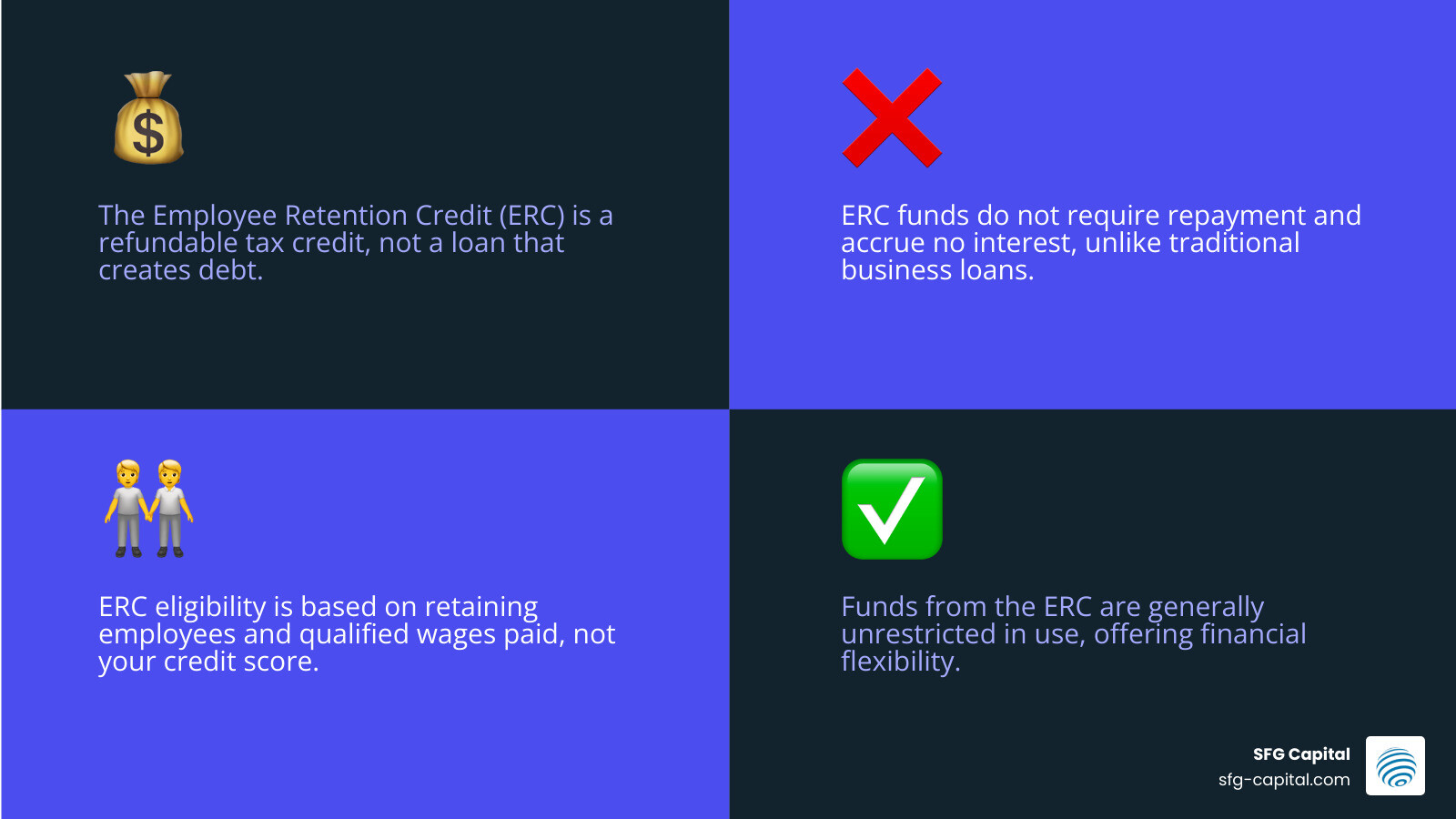
It’s crucial to understand why the ERC is fundamentally different from a loan, as the term “ERC business loan” causes confusion. A loan is a debt that must be repaid with interest. The ERC is a credit you’ve earned; once received, the money is yours with no repayment obligation, no interest, and no debt added to your balance sheet. Furthermore, ERC funds are unrestricted, whereas traditional loan funds often come with lender-imposed restrictions.
ERC Eligibility Essentials: Do You Qualify?
Eligibility for the ERC is complex and varies between 2020 and 2021. Qualification generally depends on one of two main criteria, with a special category for newer businesses.
-
Significant Decline in Gross Receipts:
- For 2020: A calendar quarter’s gross receipts were less than 50% of the same quarter in 2019.
- For 2021: A calendar quarter’s gross receipts were less than 80% of the same quarter in 2019.
-
Full or Partial Suspension of Operations Due to a Government Order:
- Your business was fully or partially suspended due to a government order limiting commerce, travel, or group meetings. This includes capacity restrictions, closures, or supply chain disruptions caused by government mandates.
-
Recovery Startup Business (Q3 & Q4 2021 only):
- Your business began after February 15, 2020, had average annual gross receipts under $1 million, and had at least one employee.
It’s also important to note that businesses with Paycheck Protection Program (PPP) loans can still qualify for the ERC, but the same wages cannot be used for both programs. Navigating these rules can be challenging, but the IRS provides an Employee Retention Credit Eligibility Checklist as a starting point. Our team can also help assess your specific situation to confirm eligibility.
The “ERC Business Loan” Misconception: Why Businesses Need Cash Now
We’ve established the ERC is a credit, not a loan. So why the search for an “ERC business loan“? The answer is the frustrating IRS processing backlog.

The IRS is inundated with claims, leading to wait times of 12-24 months or longer. For a business owed hundreds of thousands or even millions of dollars, this delay creates a massive cash flow gap. In an uncertain economy, businesses need capital now to survive and thrive. Waiting for the IRS is a luxury many cannot afford.
This is where ERC funding solutions come in. Businesses aren’t seeking a traditional loan; they’re looking for a bridge to access their own money tied up in the IRS backlog. These financial products provide immediate working capital.
Understanding Your ERC Funding Options: Advance vs. Buyout vs. Bridge Loan
A market has emerged to give businesses faster access to their ERC funds. These are often what people mean when searching for an “ERC business loan.”
-
ERC Advance: A funder provides an upfront lump sum, typically 70-90% of your pending ERC claim. In return, you assign the rights to your future refund to the funder. When the IRS check arrives, it goes to the funder to settle the transaction. This is structured as a sale of a future receivable, not a loan.
-
ERC Buyout: Similar to an advance, a buyout involves selling your entire ERC claim to a funder. The funder assumes all risk, including potential IRS audits, and collects the full refund. This option offers maximum speed and simplicity for businesses that want a clean break.
-
ERC Bridge Loan: This is a short-term loan collateralized by your pending ERC refund. As detailed in our guide to ERC Bridge Loans, you receive upfront capital and are typically responsible for repaying the loan with interest, using the eventual IRS refund to do so.
Each option serves to open up your capital sooner, but they have different structures and risk profiles.
Key Risks and Considerations for an ERC business loan advance
While ERC funding is a lifeline, understand the risks.
-
Discounted Payment: You won’t receive 100% of your refund upfront. Funders charge a fee for providing immediate capital and assuming the risk of waiting for the IRS. This discount is the cost of accessing your money now.
-
Eligibility and Audit Risk: The IRS is heavily scrutinizing ERC claims and has extended its audit period. If your claim is later deemed ineligible, you may be required to return the advanced funds. A reputable partner will perform thorough due diligence to minimize this risk, but the business owner is ultimately responsible for the claim’s accuracy.
-
Tax Implications: The ERC itself is not taxable income, but you must reduce your wage expense deduction by the amount of the credit. This can increase your taxable income for prior years and may require filing amended income tax returns. Always consult a tax advisor.
-
Choosing a Reputable Partner: The ERC space has attracted many new players. It’s essential to partner with an experienced, transparent firm. Look for clear fees, a proven track record, and a focus on compliance to avoid predatory “ERC mills.”
How to Secure an ERC Advance or Buyout
If you’ve decided an ERC advance or buyout is right for your business, the process is designed to be straightforward and fast. Here’s how you can secure your funds.
The Step-by-Step Process for ERC Funding
At SFG Capital, we’ve streamlined the journey from application to funding. Here’s a typical breakdown of how we facilitate an ERC business loan advance or buyout:
-
File Your Form 941-X: First, ensure your ERC claim is properly calculated and filed with the IRS. This form is the official proof of your claim.
-
Apply with a Funder: With your 941-X forms filed, you can start the simple application with an ERC funding partner like us.
-
Submit Documentation: We’ll request documents to verify your claim, such as your filed 941-X forms, payroll reports, and ERC calculation worksheets.
-
Underwriting and Offer: Our team performs due diligence on your claim’s validity and amount. We then provide a clear offer detailing the advance amount and terms.
-
Agreement and Transfer: Upon acceptance, you’ll sign agreements that transfer the right to the ERC refund to the funding partner.
-
Get Funded: Once agreements are finalized, funds are wired directly to your business bank account, often within days or a few weeks.
-
Refund Collection: The funder then waits for the IRS. When the refund is issued, the check goes directly to the funder to complete the transaction.
Learn more about Our Process on our website, where we prioritize transparency and efficiency.
What Documentation is Required for an ERC business loan advance?
Having your documents organized is the key to a fast process. Here’s a typical list of what we need for an ERC business loan advance:
- Signed Form 941-X: Your amended payroll tax returns for each eligible quarter.
- Original Form 941s: The initial payroll tax filings for comparison.
- Detailed Payroll Reports: Data for eligible quarters to verify qualified wages and health costs.
- Profit & Loss Statements: P&L statements for 2019, 2020, and 2021 to verify a gross receipts decline, if applicable.
- ERC Calculation Worksheet: The document from your CPA or ERC specialist detailing how the credit amount was calculated.
- Evidence of Government Orders: If eligibility is based on a business suspension, documentation of the specific government orders is needed.
Having these documents ready will significantly expedite the underwriting process.
Leveraging Your ERC Funds for Business Growth
Securing an ERC advance or buyout provides a powerful opportunity. Unlike equity financing, ERC funds are non-dilutive capital, meaning you get a cash infusion without sacrificing ownership or control. It’s your money, ready to be put to work strategically.
Accessing this capital quickly provides a competitive advantage, allowing you to invest in growth while others may be pulling back. An ERC business loan advance transforms a delayed credit into immediate, actionable capital. As our article on Funding Growth: How ERC Can Power Your Business Forward explains, you can take control of your business’s future instead of letting IRS delays dictate it.
Strategic Ways to Use Your ERC Funds
The beauty of ERC funds is their unrestricted nature. Here are some strategic ways businesses are using their advances:
- Pay Down High-Interest Debt: Improve cash flow and financial stability by eliminating costly loans or credit card balances.
- Invest in Marketing: Launch new campaigns or improve your online presence to attract customers while competitors cut back.
- Hire Key Talent: Use the funds to hire essential staff, offer competitive wages, and improve benefits to attract and retain top employees.
- Upgrade Technology: Invest in new software, hardware, or operational systems to streamline processes and boost productivity.
- Strengthen Working Capital: Build a cash reserve to manage daily operations, cover unexpected expenses, and seize new opportunities.
- Launch New Products or Services: Fund the research, development, and launch of innovative offerings.
- Customer Acquisition: Fuel sustainable growth by investing in sales processes, loyalty programs, or improved customer service.
For more ideas, see our guide on 5 Ways to Use ERC Funds to Strengthen Your Business.
Choosing the Right Partner for Your ERC Funding
Choosing the right partner for your ERC business loan advance is critical. Here’s what to look for:
- Transparency: Insist on clear, upfront terms with no hidden fees.
- Experience: Partner with a firm that has a deep understanding of ERC regulations and a proven track record.
- Speed: Your partner should have a streamlined process designed for rapid funding.
- Customer Support: Look for responsive communication and a team that makes you feel valued.
- Compliance Focus: Your partner should emphasize thorough due diligence to minimize your risk of future IRS issues.
At SFG Capital, we embody these qualities. Learn more About Us and our commitment to building relationships based on trust.
Frequently Asked Questions about ERC and Funding
Let’s tackle some of the most common questions about the ERC and its funding options.
Can I get the ERC if I already received a PPP loan?
Yes. Initial rules prevented this, but the Taxpayer Certainty and Disaster Tax Relief Act of 2020 changed that. You can claim both, but you cannot use the same wage dollars for both PPP loan forgiveness and the ERC calculation. Careful wage allocation is required to maximize both benefits, ensuring there is no “double-dipping.”
What are the tax implications of receiving an ERC refund or advance?
This is a key area where the ERC differs from a traditional ERC business loan. The ERC credit itself is not considered taxable income. However, you must reduce your deductible wage expenses on your income tax return by the amount of the credit. This effectively increases your taxable income for the year the wages were paid (2020 or 2021). This may require filing an amended income tax return. Receiving an advance does not change this underlying tax treatment. We strongly recommend consulting a CPA to understand the specific impact on your business.
What is the current deadline to apply for the ERC?
While the ERC program itself is over, the window to file a retroactive claim is still open for some periods.
- For 2020 claims: The deadline was April 15, 2024.
- For 2021 claims: The deadline to file amended returns (Form 941-X) is April 15, 2025.
The clock is ticking for 2021 claims. After this final deadline passes, the opportunity to file for the credit will be gone. However, the need for funding solutions will persist for businesses that have already filed but are still stuck in the long IRS processing queue, making an advance a valuable tool for years to come.
Conclusion: Open up Your ERC Capital Without the Wait
We’ve clarified that the Employee Retention Credit is a valuable tax credit, not an ERC business loan. We’ve also dug into why so many businesses seek funding solutions: to bypass the significant IRS processing delays that tie up capital for years.
The ERC offers up to $26,000 per employee in non-dilutive capital, but waiting for the IRS can stall your business’s momentum. An ERC advance or buyout bridges that gap, turning a future refund into immediate working capital.
For businesses in Travis County looking to bypass these delays, SFG Capital provides expert assistance and funding to get your cash now. We understand the nuances of ERC and the importance of quick, transparent access to your money.
Don’t let the IRS dictate your business’s timeline. Explore our ERC Funding Solutions today and open up the capital you’ve earned to power your growth. We’re here to help you steer this landscape and get the funds you deserve, when you need them most.