
Why the ERC Deadlines Still Matter for Your Business
The ERC claim deadlines were critical dates for businesses seeking to recover payroll tax credits from the COVID-19 pandemic. While the final deadlines to submit new claims have now passed, the ERC story is far from over for thousands of businesses.
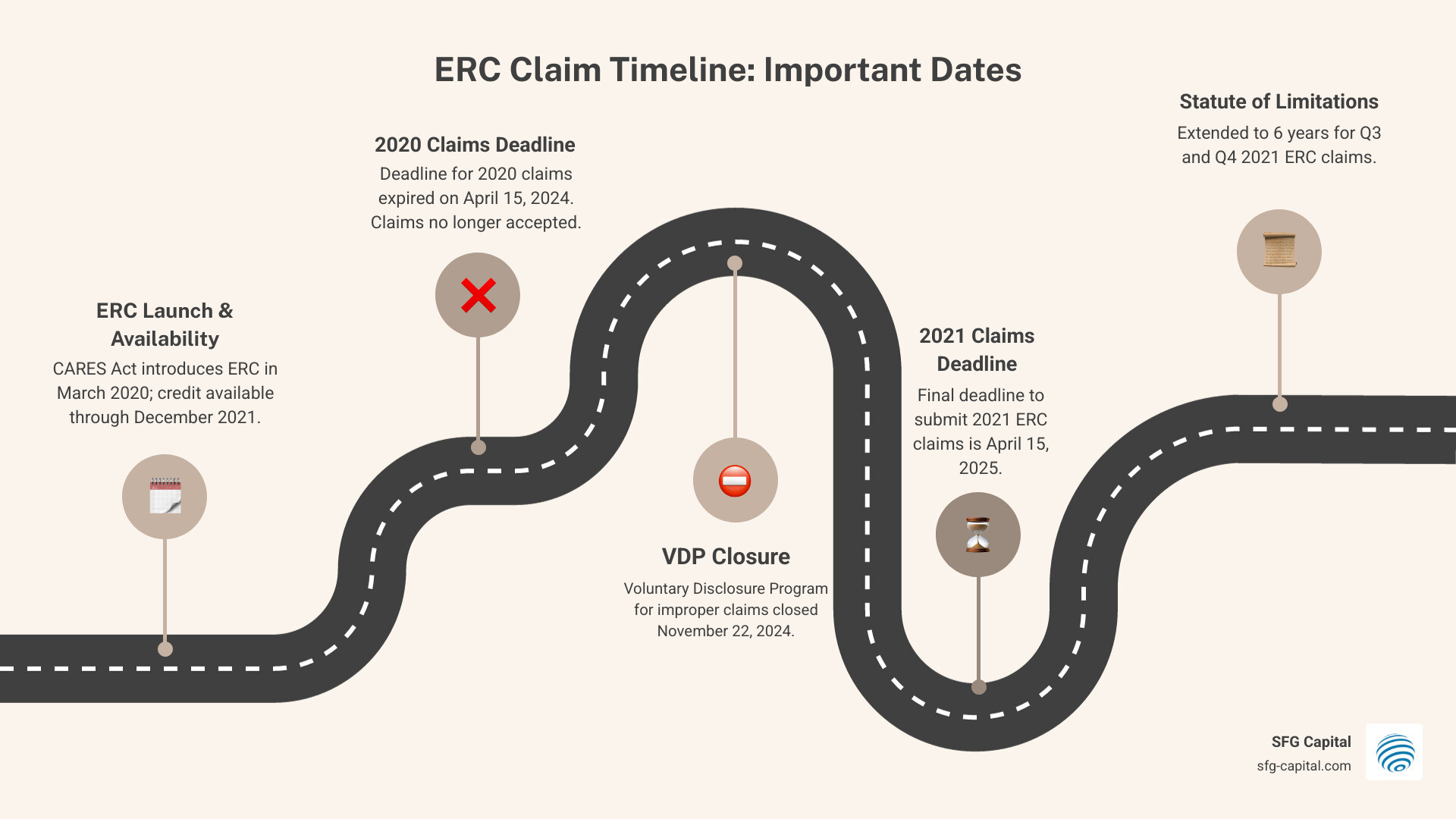
Key ERC Deadlines Have Expired:
- 2020 Claims: The deadline expired on April 15, 2024.
- 2021 Claims: The final deadline expired on April 15, 2025.
What This Means: If you have already filed, your focus must now shift to compliance, audit readiness, and managing the long wait for your refund. The Employee Retention Credit, created under the CARES Act, was a refundable tax credit worth up to $5,000 per employee for 2020 and $7,000 per employee per quarter for the first three quarters of 2021.
However, the timeline for receiving these funds has been complicated. The IRS placed a moratorium on processing new claims in September 2023 due to widespread fraud concerns. This has created a massive backlog, with many businesses still waiting for refunds on claims filed years ago. Furthermore, the IRS has an extended statute of limitations—up to six years for some claims—to conduct audits.
Missing the filing deadlines means a lost opportunity, but an incorrectly filed claim can trigger audits, penalties, and repayment demands. The IRS is aggressively pursuing improper claims, with potential civil penalties ranging from 20% to 75%, plus criminal prosecution for fraud.
I’m Santino Battaglieri, and I’ve helped SFG Capital purchase and fund over $500 million in ERC claims. This gives me direct experience with the complexities and risks of the ERC. Through this work, I’ve seen how critical proper documentation and compliance are to protecting your business, especially in this post-deadline environment.
Understanding the Employee Retention Credit (ERC)
The Employee Retention Credit (ERC) was a vital lifeline for businesses struggling with the economic fallout of the COVID-19 pandemic. Enacted as part of the Coronavirus Aid, Relief, and Economic Security (CARES) Act, it was designed to encourage businesses to retain employees. It was a fully refundable payroll tax credit, meaning it could result in a direct payment back to eligible employers.
For businesses in places like Travis County, understanding the nuances of the ERC remains crucial, even after the deadlines. We’ve seen many businesses benefit, but we’ve also witnessed the challenges of navigating its complex rules. Proper documentation is paramount, not just for claiming the credit, but for defending it if the IRS comes calling. To dive deeper into the ERC’s fundamentals, we encourage you to explore our ERC Credit Complete Guide.
What was the ERC and Who Qualified?
At its core, the ERC was a credit against certain employment taxes, available to eligible businesses and tax-exempt organizations that paid qualified wages to their employees. The eligibility criteria were specific and depended heavily on a business’s situation during 2020 and 2021.
Generally, a business could qualify in one of two ways:
-
Full or Partial Suspension of Operations Due to Government Order: If business operations were fully or partially suspended due to a governmental order limiting commerce, travel, or group meetings because of COVID-19. For instance, IRS Notice 2021-20 clarifies that the order must have limited the organization’s ability to provide goods and services by more than a nominal amount (at least 10% compared to the same period in 2019).
-
Significant Decline in Gross Receipts: If a business experienced a significant decline in gross receipts during a calendar quarter compared to the same quarter in 2019.
- For 2020, this meant gross receipts were less than 50% of what they were in the same 2019 quarter.
- For 2021, the threshold was 80% of gross receipts compared to the same 2019 quarter.
There was also a special category for “Recovery Startup Businesses” for the third and fourth quarters of 2021. Understanding these eligibility factors is paramount, as many businesses were aggressively marketed the ERC by promoters who promised easy qualification. To understand if your business truly qualified, our resource on What is ERC Funding? can provide further clarification.
ERC Interaction with PPP and Claiming Procedures
One common area of confusion was how the ERC interacted with other pandemic relief programs, particularly the Paycheck Protection Program (PPP) loans. Businesses could qualify for both, but they could not “double-dip.” This means the same wages used for PPP loan forgiveness could not also be used to calculate the ERC.
For businesses that didn’t claim the ERC on their original employment tax returns, the process involved filing an adjusted return, Form 941-X. It’s important to remember that claiming the ERC reduces your deductible wage expense, which requires amending your federal income tax return for that same year. As IRS Notice 2021-49 specifies, if a Form 941-X was amended for both 2020 and 2021, then both the 2020 and 2021 federal income tax returns must be amended.
The claiming process required meticulous attention to detail. Once you’ve secured your ERC funds, there are smart ways to reinvest them. Find how in our article, 5 Ways to Use ERC Funds to Strengthen Your Business.
The ERC Claim Deadlines Have Passed: What’s Next?
Navigating the ERC landscape now means looking back at key dates and understanding their implications for your filed claim. The IRS made it clear: the deadlines were firm, and missing them meant forfeiting the opportunity. The IRS’s concern over fraudulent claims led to a moratorium on processing new ERC claims in September 2023, which has caused significant delays and anxiety for legitimate businesses still waiting for their refunds.

Legislative changes also introduced new complexities, particularly regarding the statute of limitations. While the general statute of limitations for employment tax returns is three years, it was extended for the ERC. This means the IRS has a longer window to audit and assess claims, making accurate initial filing even more critical for those who submitted before the deadline.
The Passed ERC Claim Deadlines for 2020 and 2021
Here are the key dates for the ERC claim deadline that have now passed:
- For 2020 Claims: The deadline to file an amended return (Form 941-X) to claim the ERC for wages paid in 2020 expired on April 15, 2024.
- For 2021 Claims: The final deadline to file an amended return (Form 941-X) to claim the ERC for wages paid in 2021 expired on April 15, 2025.
The implications of these deadlines are straightforward: the window to file new claims is closed. For businesses in Travis County that were eligible and filed, the focus now shifts to compliance and audit-proofing your claim while you await processing.
How Legislation and the Statute of Limitations Affect Your Filed Claim
The ERC landscape has been a moving target, particularly concerning the statute of limitations. While the general rule for amending payroll tax returns is three years, the rules for ERC are different.
For most ERC claims, the IRS has a five-year window to audit, examine, or assess the credit. However, legislation extended the statute of limitations for Q3 and Q4 2021 ERC claims to six years. This means the IRS has even more time to scrutinize claims for these periods, heightening the risk for businesses with pending claims.
This extended review period underscores the importance of maintaining meticulous records. The takeaway is clear: while the filing deadlines have passed, the rules governing those claims—and the IRS’s ability to review them—have become more stringent.
Navigating Ineligible Claims and IRS Resolution Programs
The IRS’s increased scrutiny of ERC claims stems from a surge in fraudulent submissions. Some promoters encouraged businesses to claim the credit even when they didn’t qualify, leading to a significant crackdown. This has turned the ERC into a high-stakes game where ineligible claims can lead to severe consequences.
Businesses that filed claims based on misleading advice now face tough decisions. The IRS introduced programs to help, but ignoring the problem is not an option. For those in Travis County facing delays or questions about their refunds, we understand it can feel like The Waiting Game: Understanding and Overcoming ERC Refund Delays.
Consequences of an Ineligible or Disallowed Claim
Filing an ineligible ERC claim can lead to a cascade of consequences. The IRS is actively pursuing businesses that claimed credits they weren’t entitled to.
Here’s what businesses could face:
- IRS Audits and Repayment: If an audit determines your claim was ineligible, you must repay the entire credit amount, plus interest.
- Civil Penalties: The IRS can impose substantial penalties, including accuracy-related penalties (20% of the underpayment) or civil fraud penalties (up to 75%).
- Criminal Investigation: For cases involving willful fraud, the IRS Criminal Investigation division may get involved, leading to potential criminal charges and heavy fines.
- Wage Expense Deduction Adjustment: If your ERC claim is disallowed, you’ll need to adjust your income tax return. As per IRS Notice 2021-49, you may increase your wage expense on your income tax return for the year the disallowance is final, which is a practical alternative to amending past returns.
Past IRS Programs for Resolving Improper Claims
Recognizing the widespread issues, the IRS offered programs to help businesses come into compliance. While these programs are now closed, they highlight the seriousness of the issue.
-
Claim Withdrawal Program: This program is for businesses that filed a claim but haven’t received or cashed the refund. Withdrawing treats the claim as if it was never filed, avoiding penalties and interest. This may still be an option for some. Our guide on Withdraw an Employee Retention Credit (ERC) claim provides detailed steps.
-
Voluntary Disclosure Program (VDP): The IRS launched VDPs for businesses that received and cashed an improper ERC refund. These programs, which closed in 2024, allowed businesses to repay a reduced amount of the credit to avoid penalties and interest. Their existence underscores the IRS’s commitment to addressing incorrect claims. If you missed these programs and believe your claim was ineligible, it’s crucial to consult with a trusted tax professional to understand your remaining options.
Staying Compliant and Finding Reliable ERC Help
The ERC program, while beneficial, became a magnet for unscrupulous promoters and “ERC mills.” These entities often preyed on businesses, promising large refunds without proper due diligence. This has led to the current environment of heightened IRS scrutiny. For businesses in Travis County, the key is to stay informed, exercise caution, and prioritize compliance for any claims already filed.
We believe in empowering businesses with accurate information. If you need help navigating the complexities of a filed ERC claim, reliable assistance is out there. Our dedicated page on Employee Retention Credit Help is a good starting point.
Red Flags: How to Spot ERC Scams and Aggressive Promoters
Identifying predatory scams is a critical skill, as the fallout from bad advice can last for years. Here are some red flags to watch out for, based on IRS warnings:
- Unsolicited Calls or Emails: Be wary of anyone reaching out of the blue claiming to specialize in ERC.
- Promises of Guaranteed Eligibility: No legitimate professional can guarantee eligibility without a thorough review of your business’s specific facts.
- Large Upfront Fees or High Contingency Fees: Promoters often base their fees on a percentage of the refund, incentivizing them to inflate the credit amount, regardless of accuracy.
- Lack of Documentation Support: If a promoter didn’t ask for detailed payroll records, tax returns, or evidence of government orders, they likely cut corners.
- Pressure to Sign Documents Quickly: A reputable advisor will give you time to review documents and ask questions.
If you encountered any of these warning signs with your filer, it may be wise to seek a second opinion from a trusted, independent tax professional.
Where to Find Trustworthy Information and Assistance
When it comes to something as financially significant as the ERC, reliable information is invaluable. We always recommend starting with the official source:
- The Internal Revenue Service (IRS): The IRS website is the ultimate authority. Their dedicated page, Employee Retention Credit | Internal Revenue Service , provides comprehensive information and updates.
Beyond the IRS, seeking help from qualified, ethical professionals is crucial:
- Trusted Tax Professionals: This includes Certified Public Accountants (CPAs), Enrolled Agents (EAs), and tax attorneys. They are bound by ethical standards and can help you prepare for a potential audit.
- ERC Specialist Guides: Resources like our Employee Retention Credit Specialist Guide are designed to offer in-depth, reliable information to help businesses and their advisors steer the complexities of the ERC.
When choosing a professional for a second look at your claim, look for someone who has a strong reputation, asks detailed questions, and will stand by you in the event of an IRS audit. Don’t let the fear of an audit push you into making a hasty decision with another unreliable promoter. Take your time and choose wisely.
Frequently Asked Questions about the ERC Claim Deadline
We understand that the ERC program can be confusing, especially with all the deadlines and IRS updates. Here are some of the most common questions we hear, along with our answers, to help you clarify your understanding.
What happens if I miss the ERC claim deadline?
If you miss the ERC claim deadline for a specific period, you forfeit the opportunity to claim the credit for that period permanently. For 2020 claims, that deadline was April 15, 2024, and it has passed. For 2021 claims, the final deadline is April 15, 2025. There are no extensions available for these retroactive claims.
Once the deadline passes, the IRS will no longer accept amended employment tax returns (Form 941-X) seeking to claim the ERC for that period. This means that if your business was eligible but failed to file by the respective deadlines, you will unfortunately lose out on any potential refundable credits. For businesses that have already filed, the focus now shifts entirely to ensuring compliance, maintaining meticulous documentation, and preparing for any potential IRS inquiries or audits within the extended statute of limitations.
Can I still withdraw an ERC claim I think is incorrect?
Yes, under certain circumstances, you may still withdraw an ERC claim if you believe it was incorrect or ineligible. The IRS offers a Claim Withdrawal Program specifically for this purpose.
You can typically withdraw an ERC claim if:
- You filed an adjusted employment tax return (e.g., Form 941-X) solely to claim the ERC.
- You have not yet received a refund for that claim, or you received a refund check but have not cashed or deposited it.
- Your claim is not currently under audit (though there are provisions for withdrawing under audit by contacting your examiner).
Withdrawing an incorrect claim is highly advisable, as it treats the claim as if it was never filed, preventing future IRS audits, penalties, and interest. This is a proactive step to avoid potentially significant financial liabilities. For detailed instructions on how to proceed, please refer to the IRS’s page on Withdraw an Employee Retention Credit (ERC) claim. It’s a smart move to rectify errors before the IRS finds them.
My ERC refund is taking forever. What can I do?
We hear this question often from businesses in Travis County, and we understand the frustration. The IRS processing backlog for ERC claims has been significant, exacerbated by the moratorium on new claims and the increased scrutiny of existing ones. As of early 2024, hundreds of thousands of claims were still waiting to be processed, leading to delays that can stretch for months or even over a year.
The reasons for delays can vary:
- IRS Moratorium: The processing pause on new claims has naturally slowed everything down.
- Claim Complexity: The more complex your claim, or if it has any red flags, the longer it might take for the IRS to review it.
- IRS Workload: The sheer volume of claims, coupled with the IRS’s efforts to combat fraud, has created a bottleneck.
While you wait, ensure your documentation is impeccable and readily available. If your business needs access to those funds sooner, there are solutions. At SFG Capital, we help businesses like yours in Travis County bridge this gap by offering advances or buyouts on pending ERC refunds. This allows you to bypass the lengthy IRS delays and get the capital you need now. For more information on navigating these delays and accessing your funds, check out Expediting Your ERC Refund: What You Need to Know.
Conclusion: Navigating the Post-Deadline ERC Landscape
As we’ve explored, the ERC claim deadlines have passed. For businesses in Travis County and across the nation, the final opportunity to file for this significant refundable payroll tax credit has closed. However, for those with claims already submitted, the journey is not over.
The focus now shifts to compliance and patience. The IRS’s increased enforcement, extended statutes of limitations, and ongoing vigilance against fraud mean that accurate documentation and audit readiness are more critical than ever. While you wait for your refund, ensuring your claim is defensible is paramount.
The ERC represents a substantial opportunity for businesses to secure funds that can be reinvested in growth, as highlighted in Funding Growth: How ERC Can Power Your Business Forward. But the wait can be a major roadblock.
At SFG Capital, we specialize in helping businesses in Travis County expedite their Employee Retention Credit refunds. We understand the complexities, the IRS delays, and the urgency of accessing your capital. With our expertise, we can help you bypass the lengthy IRS processing times by offering advances or buyouts on your pending ERC claim. Our performance-based fee structure ensures we’re aligned with your success, providing quick access to the funds you’ve earned.
Don’t let IRS delays hinder your business’s potential. We’re here to provide the expert assistance and funding solutions you need to secure your pending ERC funds faster.