
Why European Research Council Funding Matters for Frontier Research
ERC funding opportunities represent some of the most prestigious grants available to researchers globally. The European Research Council (ERC) provides competitive funding for frontier research—investigator-driven projects at the cutting edge of science. Whether you are an early-career researcher or an established leader, the ERC offers pathways to secure significant funding for ambitious, high-risk research.
Quick Overview: Main ERC Grant Types
- Starting Grant: €1.5 million for researchers 2-7 years post-PhD
- Consolidator Grant: €2 million for researchers 7-12 years post-PhD
- Advanced Grant: €2.5 million for established research leaders
- Synergy Grant: €10 million for collaborative teams of 2-4 researchers
- ERC Plus Grant: €7 million for transformative research beyond existing programs
- Proof of Concept: €150,000 to explore innovation potential
All grants are open to researchers of any nationality, provided the research takes place at a host institution in an EU Member State or associated country. The sole selection criterion is scientific excellence, evaluated through rigorous peer review by international experts.
The ERC operates under Horizon Europe’s Pillar I—”Excellent Science”—supporting high-quality research with budgets ranging from €1.5 million to €10 million. These grants cover 5-7 years, providing the resources to pursue transformative goals.
I’m Santino Battaglieri. While my primary expertise lies in financial services and Employee Retention Credit (ERC) advisory through SFG Capital, I understand the importance of navigating complex funding landscapes—principles that apply whether you’re pursuing European Research Council grants or other ERC funding opportunities. This guide provides clear, actionable information for researchers seeking European funding.
Main Schemes: Starting, Consolidator, and Advanced Grants
The European Research Council (ERC) supports investigator-driven frontier research across all fields. Its commitment to scientific excellence is evident in its core grant schemes, custom to researchers at different career stages.

These ERC funding opportunities support individual Principal Investigators (PIs) in pursuing groundbreaking research:
- Starting Grant (StG): For promising early-career researchers (2-7 years post-PhD) building their own research team.
- Consolidator Grant (CoG): For researchers (7-12 years post-PhD) consolidating their independence and research program.
- Advanced Grant (AdG): For established leaders with a track record of significant achievements in the last 10 years.
Researchers of any nationality can apply, provided they work at a host institution in an EU Member State or associated country. Selection is based solely on scientific excellence, evaluating the project’s ambition and the PI’s creativity.
For more information, visit the official ERC page. While SFG Capital focuses on the Employee Retention Credit, we understand the universal need for clear funding information. For context on different programs, see our insights on What is ERC Funding?.
Core Grant Comparison
| Grant Scheme | Eligibility (Post-PhD) | Max Grant (EUR) | Max Duration | PI Commitment |
|---|---|---|---|---|
| Starting Grant | 2-7 years | €1.5 million | 5 years | 50% |
| Consolidator Grant | 7-12 years | €2 million | 5 years | 40% |
| Advanced Grant | 12+ years | €2.5 million | 5 years | 30% |
Note: Additional funding up to €1-2 million may be available for start-up costs or relocation.
Specialized Grants: Synergy, Proof of Concept, and ERC Plus
Beyond individual grants, the ERC offers specialized ERC funding opportunities for collaborative and transformative research.
- Synergy Grant (SyG): Supports groups of 2-4 PIs addressing research questions that require combined expertise. It provides up to €10 million for up to 6 years.
- Proof of Concept Grant (PoC): Available to active ERC grantees to explore the innovation potential of their results. It awards a €150,000 lump sum for 18 months.
- ERC Plus Grant: A highly ambitious scheme for transformative research that goes beyond existing ERC programs. It targets projects that aim to fundamentally change a field. More information is available on the ERC Plus Grant page.
Understanding unique criteria is essential. For general guidance on funding requirements, see our resource on ERC Funding Requirements.
The Impact of the ERC Plus Grant
The ERC Plus Grant is a unique ERC funding opportunity for visionary research:
- Size and Duration: Maximum €7 million for 4 to 7 years.
- Lump-sum Contribution: Awarded as a single contribution to simplify financial reporting.
- Statement of Vision: Requires a clear explanation of the project’s transformative potential.
- High-Risk, High-Reward: Targets pioneering ideas rather than incremental advances.
- Competitiveness: Extremely exclusive, with approximately 30 grants awarded annually across all fields.
Eligibility and Application Process for ERC funding opportunities
Applying for ERC funding opportunities requires careful attention to eligibility and a compelling proposal.
Who is Eligible to Apply?
- Nationality: Open to researchers of any nationality.
- Career Stage: Based on years post-PhD (2-7 for Starting, 7-12 for Consolidator).
- Host Institution: Research must be conducted at an eligible organization in an EU Member State or associated country.
- Portability: Grants are generally portable if a PI moves to a new eligible host institution.
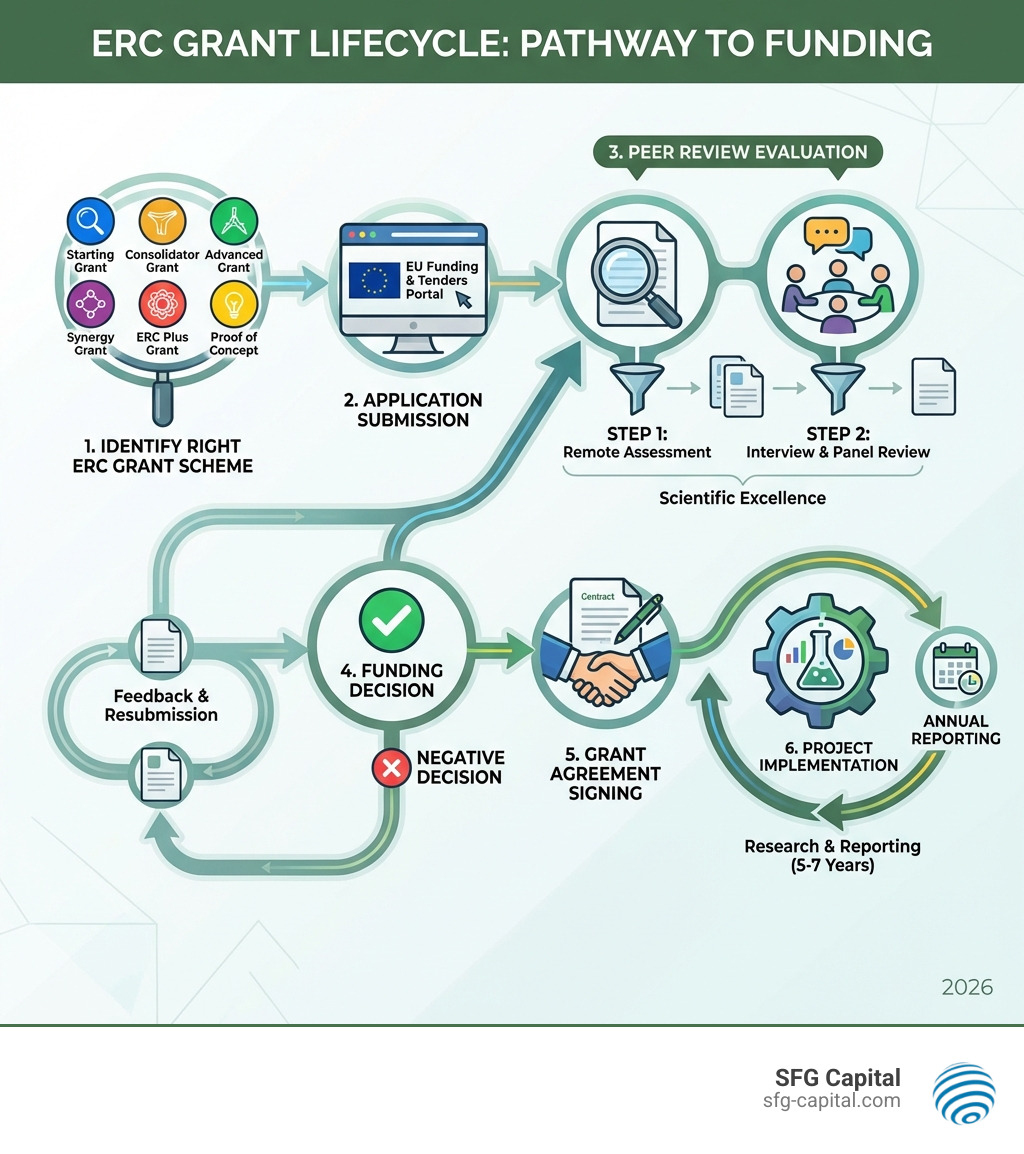
The Application Process
- Find the Right Grant: Match the scheme to your career stage.
- Identify a Host Institution: Secure a commitment from an eligible European institution.
- Consult the Work Programme: Review the current Work Programme for deadlines and requirements.
- Contact Your NCP: National Contact Points provide invaluable guidance.
- Prepare and Submit: Submit your scientific proposal and CV through the EU Funding & Tenders Portal.
Global Access
Researchers from non-EU countries (e.g., Austin, TX) are encouraged to apply. The ERC offers relocation incentives, including up to €2 million in additional funding for start-up costs. For visual insights, watch the ERC grants explained video series.
Evaluation and Selection: The Excellence Criterion
ERC funding opportunities are awarded based solely on scientific excellence through a rigorous peer-review process.
How Proposals are Evaluated
Managed by the ERCEA, the evaluation involves:
- Peer Review Panels: 28 panels covering Life Sciences, Physical Sciences, and Humanities.
- Two-Step Evaluation: Step 1 assesses the synopsis and CV. Step 2 involves a full proposal review and an interview.
- Assessment Criteria: Excellence is applied to both the research project (ambition, methodology) and the PI (creativity, track record).
- Ethics and Compliance: All funded projects undergo an ethics review to ensure alignment with EU and international law.
Maximizing Success
- Ground-breaking Nature: Focus on projects that push the boundaries of knowledge.
- Methodology: Present a sound, feasible approach to high-risk goals.
- Intellectual Capacity: Your track record must demonstrate leadership potential.
- Open Science: Adhere to FAIR principles and ensure open access to publications.
- Resubmission Rules: Be aware of restrictions following ‘B’ or ‘C’ scores in previous calls.
Frequently Asked Questions about ERC Grants
What are the resubmission restrictions for ERC applications?
Resubmission rules manage application volume. Generally, a ‘B’ score in Step 1 prevents applying the following year. A ‘B’ or ‘C’ in Step 2 may result in a two-year restriction. The 2026 Work Programme includes specific restrictions for Synergy Grant applicants who received a ‘B’ in 2025.
A practical way to handle this is to treat the evaluation as structured feedback rather than a binary outcome. If you receive a restriction, you can still use the time productively by strengthening the scientific rationale, collecting preliminary results that de-risk key aims, and building a clearer narrative around what is truly frontier in your approach. It also helps to map your next submission to the correct panel and keywords, because panel fit can influence how quickly evaluators grasp the core contribution.
Always verify the exact rules and timing in the call text for your target scheme, since restrictions can vary by year and grant type.
How does the ERC support researchers from non-EU countries?
All ERC funding opportunities are open to any nationality. PIs moving to Europe from non-associated countries can request additional funding (up to 2 million) for start-up costs. International agreements also facilitate collaboration with agencies in the US, South Korea, and China.
In practice, the biggest non-EU hurdle is not citizenship but logistics: choosing the right host institution, aligning with its internal submission process, and planning the move early enough to meet the ERC’s commitment requirements. Many host institutions have dedicated grant support offices that can help with budgeting, ethics documentation, and the administrative pieces that often surprise first-time applicants.
If you are applying from the United States (including Austin and Travis County), it is worth starting conversations with potential European hosts well in advance of the deadline, since the host’s formal commitment is a core part of the application.
What are the key novelties in the ERC Work Programme 2026?
- ERC Plus Grant: A new scheme for transformative research up to 7 million.
- Revised Structure: Streamlined scientific proposals (Part I and II).
- Violence Victim Extensions: New eligibility extensions for victims of gender-based or other violence.
- Lump Sum Funding: Advanced and ERC Plus Grants now use lump-sum contributions to simplify financial management.
From an applicant’s perspective, these changes reinforce a consistent theme across ERC funding opportunities: evaluators want a bold scientific vision presented with clarity. Streamlining can work in your favor if you use the limited space to (1) state the breakthrough, (2) explain why existing approaches cannot get there, and (3) outline a credible path to results despite the risk.
Because the Work Programme defines the authoritative rules for each call, check the final published version for your target year and scheme before you submit.
Conclusion
The European Research Council (ERC) is a guide for frontier research, offering unparalleled ERC funding opportunities to global talent. Guided by the Scientific Council and ERCEA, these grants prioritize high-risk, high-gain projects across all fields. Whether you are in Travis County, TX, or elsewhere, securing a European host institution opens the door to these prestigious awards.
Navigating grant applications requires diligence and planning. At SFG Capital, while we focus on ERC Funding Solutions for business tax credits, we recognize that the principles of securing significant funding are universal. We hope this guide empowers you to pursue your most ambitious scientific visions.