
Why Employee Retention Programs Are Critical for Business Success
An Employee retention program is a structured set of strategies and initiatives designed to keep your best employees engaged, satisfied, and committed to your organization. These programs typically include:
- Competitive compensation and benefits packages that reflect market value
- Career development opportunities including training, mentorship, and clear advancement paths
- Recognition and rewards systems that acknowledge employee contributions
- Flexible work arrangements and support for work-life balance
- Strong leadership and positive workplace culture that fosters trust and belonging
- Regular feedback and communication to address concerns before they lead to departures
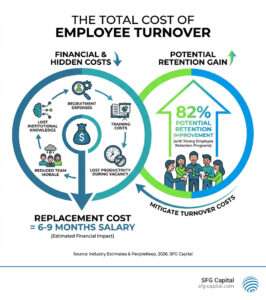
The business case for employee retention is clear and urgent. Replacing an employee can cost between six to nine months of that person’s salary, and some estimates place it even higher at three to four times their annual salary. For a business owner managing cash flow and working capital—especially while waiting on funds from programs like the Employee Retention Credit—these costs can be devastating. Beyond the financial hit, turnover disrupts productivity, strains remaining team members, and erodes institutional knowledge that took years to build.
Think about a top performer who resigns unexpectedly. Your remaining team scrambles to cover their workload while you steer the expensive and time-consuming hiring process. This scenario plays out in businesses across the country, but it doesn’t have to be inevitable.
I’m Santino Battaglieri, and through my work at SFG Capital helping businesses access over $500 million in ERC funding, I’ve seen how strategic investments in Employee retention programs can transform organizational stability and growth. Smart business owners use available capital—whether from operations, funding programs, or ERC refunds—to build workplaces where talented people choose to stay.
The Cornerstones of an Effective Employee Retention Program
Understanding why employees leave is the first step toward building an effective Employee retention program. Employees often seek new opportunities due to a range of factors, including inadequate salary, uncompetitive perks and benefits, feeling overworked or unsupported, limited career advancement, a need for better work-life balance, lack of recognition, boredom, unhappiness with management, concerns about the company’s direction or financial health, dissatisfaction with company culture, or simply the desire for a change or more compelling opportunities elsewhere.
It’s a stark reality that almost half of employees have left their jobs because of a bad manager. This highlights that retention isn’t just about paychecks; it’s deeply rooted in the daily experience and the relationships employees have within the organization. The shift to strategic retention means moving beyond reactive measures and proactively building an environment where people thrive.

Designing a Competitive Compensation and Benefits Package
Let’s face it, money talks. Workers who believe they’re underpaid are significantly more likely to look for another job. Therefore, an Employee retention program must start with offering fair, competitive pay. We must regularly review salaries against market rates and from a diversity, equity, and inclusion (DE&I) perspective to ensure everyone is compensated fairly. With inflation impacting household budgets, employees who don’t receive cost-of-living increases often feel like they’re getting a pay cut, leading to dissatisfaction. To stay competitive in the Austin and Travis County job market, we need to regularly assess our compensation structure. We encourage you to View our free Salary Guide for current market insights.
Beyond base salary, a comprehensive perks and benefits package is crucial. While health, dental, and vision insurance are standard, today’s employees expect more. We’ve seen organizations expand their offerings to include fertility support, elder care, tuition reimbursement, and vital mental health support. The key is to understand what truly matters to our workforce. A survey of our employees can reveal the specific types of support they value most.
Implementing these robust compensation and benefits strategies requires foresight and often, significant capital. This is where strategic funding comes into play. For businesses in Travis County, utilizing resources like the Employee Retention Credit (ERC) can free up capital to invest in these critical areas. We’ve seen how 5 Ways to Use ERC Funds to Strengthen Your Business can directly support enhancing compensation, expanding benefits, and ultimately, fortifying your Employee retention program.
Investing in Career Growth and Professional Development
Employees are not just looking for a job; they’re seeking a career path. The majority of employees (more than 55%) consider opportunities for career growth within a company more important than salary. If our team members don’t see a future with us, they’ll likely look elsewhere. This means our Employee retention program must actively support career advancement through clear career pathing and opportunities for internal mobility. When we don’t promote from within, we risk losing talented individuals who feel they must leave to reach a higher level.
Investing in Upskilling your employees and reskilling is not just good for our employees; it’s essential for our business’s future. Employees who get professional development opportunities are 15% more engaged and have 34% higher retention rates than those who don’t. A survey directly tied high-quality employee learning to higher employee retention rates and job satisfaction. We can support this through tuition reimbursement, sponsoring conference attendance, and providing access to continuing education.
Mentorship programs are another powerful tool. They help eager employees learn new skills, steer their career paths, and strengthen their bonds with our organization. More seasoned employees also gain satisfaction from teaching emerging leaders, giving them added motivation to stay. Finally, don’t overlook succession planning as a highly effective method for advancing professional development and demonstrating a long-term commitment to our team members.
Fostering a Positive Culture with Strong Leadership and Recognition
The impact of leadership and management style on employee retention cannot be overstated. Managers play a crucial role; almost half of employees have left their jobs because of a bad manager. Conversely, great managers are linked with a 72% reduction in attrition risk and a 3.2X increase in employee retention. Google spent a decade researching what makes a great manager and found that characteristics like inclusivity, open communication, and commitment to employee well-being are paramount. We must invest in training our managers to be supportive, effective leaders who can build trust and foster open communication.
Every person wants to feel appreciated for their work. Compelling recognition programs are vital to a strong Employee retention program. Companies that recognize staff members multiple times a month are 41% more likely to retain employees. Employees who are recognized weekly are 9x more likely to recommend their company and 6x more likely to see a long-term future there. Recognition doesn’t always have to be monetary; it can include public praise, peer-to-peer rewards, or even a simple handwritten note. Over 40% of employees feel points-based rewards make them feel appreciated, and nearly 70% say rewards are a motivating factor at work. We should also make it a point to celebrate milestones, both big and small, from project completions to work anniversaries.

Promoting Flexibility and Healthy Work-Life Balance
In today’s dynamic work environment, flexible work arrangements and support for work-life balance are no longer perks; they’re expectations. A Robert Half survey found that 53% of employees working from home will find a new job if forced to return to the office full-time. This highlights the critical role that remote and hybrid options play in modern Employee retention programs. We must offer genuine flexibility, not just a bullet point in a policy document.
Long hours and constant connectivity lead to employee burnout, which is a significant driver of turnover. The World Health Organization defines burnout as chronic workplace stress that hasn’t been successfully managed. Burned-out employees are exhausted, develop negative feelings toward their jobs, and often leave. Our Employee retention program should actively work to prevent burnout by encouraging our team members to take their paid time off (PTO), setting clear boundaries between work and personal life, and promoting self-care. Mental health support, whether through wellness programs or counseling access, is also crucial for holistic employee well-being. By fostering a culture that respects personal time and encourages rest, we demonstrate our commitment to our employees’ long-term health and happiness, which directly translates to improved retention.
Building and Measuring Your Retention Strategy
Even with the best intentions, employers can make common mistakes that inadvertently lead to high employee turnover. One significant misstep is micromanagement, which 73% of workers identify as the #1 sign of a toxic workplace. Other pitfalls include ignoring employee feedback, having inconsistent policies, and failing to recognize contributions. These mistakes erode trust, dampen morale, and ultimately push valuable team members out the door.
How to Structure a Winning Employee Retention Program
A truly effective Employee retention program begins even before an employee’s first day. A strong onboarding process can improve employee retention by as much as 82% and productivity by 70%. When new hires feel welcomed, understand their roles, and are equipped with the tools to succeed, they are far more likely to stay. This is why a comprehensive onboarding program can increase employee retention by as much as 82%. For remote or hybrid teams, specific strategies are needed to ensure new hires feel connected and supported from afar. We can find valuable guidance in resources such as Check out the tips in this post for onboarding remote employees.
Setting clear goals for our Employee retention program is paramount. What specific improvements do we aim to see? Reduced turnover rates? Higher engagement scores? Increased internal promotions? Once goals are set, regular feedback loops become our compass. Many employers are abandoning the annual performance review in favor of more frequent, informal check-ins. These one-on-one meetings allow for continuous feedback, discussion of professional goals, and proactive problem-solving. When delivering feedback, the ideal positive to negative ratio for employee feedback is 5.6:1. This means for every corrective comment, we should aim for five or more positive or growth-oriented remarks. This approach fosters a supportive environment where employees feel valued and understood.
Key Metrics for Tracking Success
To truly understand the effectiveness of our Employee retention program, we must consistently measure its impact. The most fundamental metric is the employee turnover rate. We can calculate our employee turnover rate with a simple formula: (Number of employees who left x 100) / Total number of employees. For a deeper dive, we can use the formula: (# of employees at the beginning of the year – # of employees who left during the year) / # of employees at the beginning of the year = our employee retention rate for the year. This helps us track trends and identify areas for improvement.
Beyond raw numbers, we should implement employee satisfaction surveys (like eNPS), track engagement levels, and monitor absenteeism rates. These qualitative and quantitative data points provide a holistic view of our workforce’s well-being and commitment. Finally, don’t underestimate the power of conducting effective Exit interviews. These conversations offer invaluable insight into why employees leave, directly informing our retention strategies and helping us refine our programs to better meet employee needs.
Frequently Asked Questions about Employee Retention
What are the key components of a successful retention program?
A successful Employee retention program takes a holistic approach, addressing multiple facets of the employee experience. Its key components include:
- Competitive compensation and benefits: Fair pay and comprehensive benefits that meet diverse employee needs.
- Growth opportunities: Clear career paths, professional development, and internal mobility.
- Positive workplace culture: An environment built on trust, respect, psychological safety, and inclusivity.
- Strong leadership: Managers who are supportive, communicative, and invested in their team’s success.
- Work-life balance: Flexible arrangements, encouragement of PTO, and support for employee well-being.
- Recognition and feedback: Regular appreciation for contributions and constructive, balanced feedback.
How does leadership style impact employee retention?
Leadership style profoundly impacts employee retention. Managers are often the primary reason employees stay or leave. A supportive, empathetic, and communicative manager can significantly reduce attrition risk and increase retention. Conversely, almost half of employees have left their jobs because of a bad manager. Great managers foster trust and autonomy, provide guidance, and advocate for their team’s professional development. They listen to feedback, offer constructive support, and create an environment where employees feel respected and empowered to do their best work. When managers lead by example and prioritize employee well-being, they build stronger, more loyal teams.
What is the most common mistake employers make that leads to high turnover?
While many factors contribute to turnover, a pervasive mistake employers make is a lack of recognition and feeling undervalued. Employees want to be seen and appreciated for their contributions. When their hard work goes unnoticed, or they receive low-quality or insufficient feedback, they become disengaged. In fact, 40% of employees who received low-quality feedback were planning to leave. Coupled with this is poor communication, uncompetitive compensation, ignoring employee feedback, and micromanagement (the #1 sign of a toxic workplace). These issues collectively create an environment where employees feel their efforts are not reciprocated, leading them to seek opportunities where they feel more respected and valued.
Conclusion
Building an effective Employee retention program is not a one-time project; it’s an ongoing, strategic endeavor that requires continuous effort, adaptation, and investment. For businesses in Austin and Travis County, the value of a loyal, engaged workforce is immeasurable. It reduces costly turnover, preserves institutional knowledge, boosts productivity, and creates a positive company culture that attracts top talent. Our goal is to build a workplace where people don’t just work, but where they genuinely want to stay.
At SFG Capital, we understand that investing in your team is investing in your future. By helping businesses access crucial funds, such as the Employee Retention Credit, we empower you to implement the robust Employee retention programs needed to secure your most valuable asset: your people. To learn more about how we can support your business initiatives and help you thrive, please visit Our Services.