
Why Timing Matters for Your Employee Retention Credit Refund
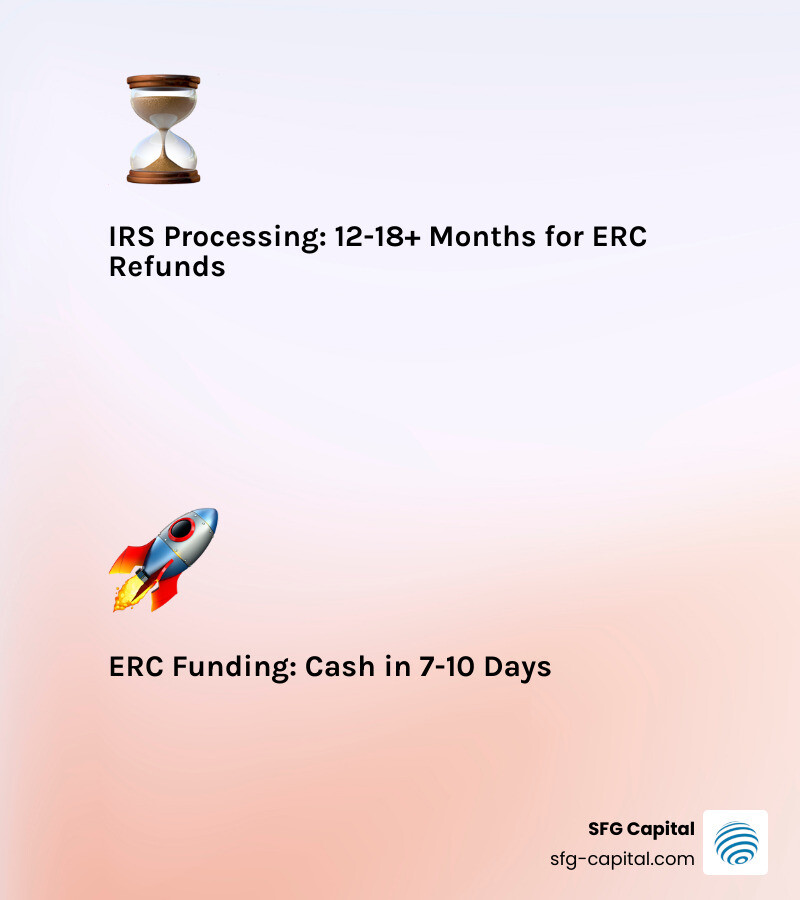
ERC funding solutions provide businesses with immediate access to their Employee Retention Credit refunds without waiting 12-18 months for IRS processing. Here’s what you need to know:
Three Main ERC Funding Options:
- ERC Advances – Receive 70-90% of your claim as a loan, repay when the IRS pays
- ERC Buyouts – Sell your refund for 70-85% upfront, buyer assumes all risk
- ERC Bridge Loans – Short-term financing using your ERC as collateral
Key Considerations:
- Get funded in 7-10 days vs. waiting 12-18+ months
- Minimum claim typically $75,000+
- Trade full refund amount for immediate liquidity
- No credit score requirements
The Employee Retention Credit was designed to help businesses that kept employees on payroll during the COVID-19 pandemic. Eligible employers could claim up to $26,000 per W-2 employee as a refundable tax credit.
But there’s a problem.
The IRS has a massive backlog of ERC claims. Processing times have stretched to 12-18 months or longer. For many businesses, this creates a painful cash flow gap. You’re entitled to the money, you’ve already filed Form 941-X, but the check isn’t coming anytime soon.
As one business owner put it: “I got my money fast. I couldn’t believe it. It helped keep my business afloat.” This is the reality that ERC funding solutions address—turning a distant promise into immediate working capital.
Many small businesses are struggling to expand or even stay afloat while awaiting their ERC payments. They need the money now for payroll, debt payments, inventory, or growth opportunities. Waiting isn’t always an option.
That’s where ERC funding solutions come in. These specialized financial services allow you to access your refund in days or weeks instead of waiting over a year. You receive a lump sum upfront—typically 70% to 90% of your total claim—in exchange for selling or borrowing against your pending refund.
I’m Santino Battaglieri, and I’ve led SFG Capital through over $500 million in ERC transactions, helping businesses steer ERC funding solutions with a focus on compliance and risk management. My experience in structured funding has taught me that the right timing and the right partner can transform a pending tax credit into a strategic business advantage.
Understanding the Types of ERC Funding Solutions
When the IRS’s processing delays leave your business in a lurch, specialized ERC funding solutions offer a lifeline. These options allow you to convert your pending Employee Retention Credit into usable cash, bridging the gap between filing your claim and receiving the official refund. Let’s break down the primary ways businesses in Travis County and across the U.S. can access their funds without waiting for the IRS.
How ERC Advances Work
An ERC advance is essentially a loan against your anticipated ERC refund. Think of it as getting a portion of your money early, with your pending IRS refund serving as collateral. Here’s how it typically works:
- Upfront Payment: We or other funding providers will offer you a lump sum, usually ranging from 70% to 90% of your total estimated ERC claim.
- Repayment: Once the IRS processes and sends your official ERC refund check, you use those funds to repay the advance, plus any agreed-upon fees or interest.
- Recourse Risk: ERC advances typically carry recourse risk. This means that if for any reason the IRS reduces or denies your claim, or if the refund is less than anticipated, you, the business owner, are generally responsible for repaying the difference to the funding provider. This is why thorough eligibility verification is so important before accepting an advance.
For businesses that need immediate capital but anticipate their IRS refund will eventually come through, an ERC advance can be a viable option. It allows you to put that money to work now, rather than letting it sit in a government queue. To learn more about expediting your refund, check out our guide on Expediting Your ERC Refund: What You Need to Know.
How ERC Buyouts Work
An ERC buyout is a different beast entirely. Instead of a loan, you are effectively selling your ERC refund to a funding provider. This transaction transfers the risk and the waiting game from your shoulders to theirs.
- Lump-Sum Payment: You receive a single, upfront payment, often a slightly lower percentage than an advance (e.g., up to 70% or 85% of your total claim).
- Non-Recourse: The key difference here is that buyouts are typically non-recourse. Once the funding provider buys your claim, they assume all the risk associated with collecting the full refund from the IRS. If the IRS delays, reduces, or even denies the claim, it’s the buyer’s problem, not yours. You are not obligated to repay anything.
- Discounted Amount: Because the funding provider takes on all the risk and the burden of waiting, the percentage of your claim you receive upfront is generally lower than with an advance. You trade a portion of your potential refund for certainty and immediate, non-recourse cash.
For business owners who want to completely wash their hands of the ERC process and its uncertainties, an ERC buyout offers peace of mind and immediate capital. It’s a clean break.
How ERC Bridge Loans Differ
While ERC advances and buyouts are specifically custom to the Employee Retention Credit, ERC bridge loans are a broader category of short-term financing that businesses might consider, often with their pending ERC refund as an expected repayment source.
- Traditional Loan Structure: Unlike advances or buyouts, bridge loans function more like conventional short-term loans. They come with an interest rate and a defined repayment schedule.
- Interest Payments: You’ll make regular payments (daily, weekly, or monthly) on the loan, including interest, until it’s fully repaid.
- Repayment Source: While your pending ERC refund might be the intended source of repayment, the loan itself is not solely reliant on the refund’s arrival. You’re responsible for repayment regardless of IRS timing.
- Flexibility: Bridge loans can be more flexible in terms of how much you borrow and how you use the funds, as they’re not always tied directly to the ERC amount. However, they are distinct from ERC funding solutions that directly leverage the credit itself.
We focus on solutions directly tied to your ERC, offering specialized options that account for the unique nature of this government credit.
Weighing Your Options: Funding Now vs. Waiting for the IRS
Deciding whether to use an ERC funding solution requires a careful cost-benefit analysis for your business’s specific financial situation. It’s a trade-off: immediate access to capital versus receiving the full amount later.

Pros and Cons of ERC Funding
Let’s lay out the advantages and disadvantages of each primary option to help you make an informed decision for your business in Austin, Travis County, or elsewhere in the U.S.
| Feature | ERC Advance | ERC Buyout | Waiting for IRS Refund |
|---|---|---|---|
| Pros | Immediate liquidity (70-90% upfront) | Immediate liquidity (70-85% upfront) | Receive 100% of entitled credit |
| Put capital to work for growth | No repayment obligation (non-recourse) | No fees or discounts | |
| Can cover operational costs, debt | Buyer assumes IRS risk | ||
| Cons | Recourse risk (you repay if IRS denies/reduces) | Discounted payout (less than 100%) | Extremely long wait times (12-18+ months) |
| Fees/interest on the advance | Cash flow strain, missed opportunities | ||
| Still involved in IRS process | Uncertainty of exact IRS processing timeline |
Pros of ERC Funding (Advances & Buyouts):
- Immediate Liquidity: The most compelling advantage. You can receive funds within days or weeks, allowing you to address urgent needs or seize growth opportunities. This is especially critical with IRS processing times stretching to 12-18 months or more.
- Business Growth & Reinvestment: With immediate capital, you can invest in new equipment, expand operations, hire staff, or launch new marketing initiatives. For ideas on how to use these funds strategically, read our article 5 Ways to Use ERC Funds to Strengthen Your Business.
- Debt Payment & Cash Flow Management: Use the funds to pay down high-interest debt, cover payroll, or simply improve your working capital, reducing financial stress during uncertain times.
- Reduced Uncertainty (Buyouts): With a buyout, you offload the risk of IRS delays, potential audits, or claim reductions to the funding provider.
Cons of ERC Funding (Advances & Buyouts):
- Discounted Payout: You will receive less than 100% of your total ERC claim. This is the cost of immediate access and, in the case of buyouts, risk transfer.
- Fees/Interest: Advances typically involve fees or interest on the borrowed amount.
- Recourse Risk (Advances): If your claim is ultimately denied or reduced by the IRS, you are still on the hook for repaying the advance.
We understand that for many businesses, waiting 12-18 months for a refund simply isn’t an option. The value of immediate capital often outweighs the discount, especially when it means keeping your business thriving or enabling crucial growth.
Key Risks and Tax Considerations
While ERC funding solutions offer significant benefits, be aware of potential risks and tax implications.
- Eligibility Verification Risk: The IRS has recently increased scrutiny on ERC claims. If your original ERC claim was not properly calculated or if your business did not genuinely qualify, you could face issues. Reputable funding providers will conduct their own due diligence, which can act as a secondary check on your claim’s validity. However, ultimately, the responsibility for an accurate claim rests with the business.
- Audit Risk: All tax claims, including ERC, are subject to potential IRS audits. If your ERC claim is audited and reduced or denied, the implications vary based on whether you chose an advance (recourse) or a buyout (non-recourse). This is why ensuring your initial ERC calculation and filing were performed correctly by experts is paramount.
- Potential Tax Implications: The tax treatment of receiving an ERC advance or buyout can be complex. The ERC itself reduces your deductible wage expenses in the year the wages were paid, not the year you receive the refund. This means your taxable income for those prior years might increase. Separately, the transaction with the funding provider (advance vs. buyout) can have its own tax implications. It is absolutely crucial to consult with your CPA or a qualified tax advisor to understand the specific impact on your business’s tax situation. Our expertise can help you steer these waters.
For a deeper dive into how these funds can strategically benefit your business, explore Funding Growth: How ERC Can Power Your Business Forward.
How ERC Funding Differs from Traditional Financing
ERC funding solutions stand apart from conventional business loans or lines of credit in several key ways.
- Asset-Based Funding: Unlike traditional loans that often require extensive collateral or rely heavily on your business’s credit history and profitability, ERC funding is asset-based. The “asset” is your pending, government-backed tax credit. This unique structure makes it accessible to a wider range of businesses.
- Not Based on Credit Score: While some basic financial health checks are performed, the primary driver for approval is the validity and amount of your ERC claim, not your business’s credit score. This can be a huge advantage for businesses that might not qualify for traditional bank financing.
- Faster Approval & Funding: Traditional business loans can be a lengthy process. ERC funding, by contrast, is designed for speed. We’ve seen funding delivered in as little as 24 hours, and typically within 7-10 days, compared to weeks or months for conventional financing.
- Specific Purpose: While the cash is unrestricted once you receive it, the source of the funding is specifically your ERC refund. This differentiates it from general-purpose business loans.
- Less Stringent Requirements (often): Due to the nature of the underlying asset (the government credit), the requirements can be less stringent than for traditional bank loans, which typically demand a long operating history, strong cash flow, and significant collateral.
At SFG Capital, we offer specialized ERC funding solutions as part of Our Services, understanding the unique needs of businesses waiting on these critical funds.
The Process: Applying for and Securing ERC Funding
Once you decide to pursue ERC funding solutions, the process is typically straightforward, provided you have the correct documentation and choose a reputable partner. Our goal is to make it as smooth and efficient as possible for businesses in Travis County and beyond.

Eligibility and Required Documentation for ERC funding solutions
To qualify for ERC funding solutions, businesses generally need to meet certain criteria and provide specific documents. While the exact requirements can vary slightly between providers, here’s a common list:
- Filed Form 941-X: You must have already filed your amended payroll tax returns (Form 941-X) with the IRS for the quarters in which you are claiming the ERC. This is the official claim that the funding provider will be advancing or buying.
- Original Form 941s: Copies of your original quarterly Form 941s for the relevant periods.
- Payroll Data Reports: Detailed payroll records for the periods in question, including employee wages, hours, and benefits.
- Profit & Loss Statements: Your business’s Profit & Loss statements for the relevant years (2019, 2020, and 2021) to help verify your financial situation during the pandemic.
- ERC Eligibility Calculation Summary: A detailed calculation demonstrating how your business qualified for the ERC and the methodology used to arrive at your claimed amount. This often includes documentation of government-mandated shutdowns or significant decline in gross receipts.
- Minimum Claim Size: Many funding providers, including us, typically require a minimum ERC claim size, often upwards of $75,000. This ensures the transaction is economically viable for both parties.
- Business Financials: Recent bank statements and potentially business tax returns may be requested to assess overall financial health.
We work with you to ensure all necessary documentation is in order, streamlining the application process.
How to Choose the Right Provider and Avoid Scams
The ERC landscape has unfortunately attracted some bad actors. When seeking ERC funding solutions, it’s crucial to choose a legitimate and trustworthy partner. Here’s how to protect your business:
- Transparency: A reputable provider will be completely transparent about their fees, the percentage of your claim they offer, and all terms and conditions. There should be no hidden costs or surprises.
- Clear Fee Structure: Understand exactly how the provider makes money. Is it an interest rate, a flat fee, or a discount on your refund? Our approach, for instance, involves a performance-based fee, meaning we succeed when you do.
- ERC Expertise: Choose a provider with deep knowledge of the ERC program itself. They should be able to explain the nuances of eligibility, the IRS process, and potential audit risks. This expertise is vital for proper due diligence on your claim.
- Avoiding Upfront Fees: Be wary of any provider asking for large upfront fees simply to apply for funding. Legitimate providers typically get paid when the funding is successfully delivered.
- Red Flags: Watch out for aggressive sales tactics, guaranteed approvals without proper vetting, or claims that sound too good to be true.
- Verifying Legitimacy: Look for providers with a solid track record, positive testimonials, and a clear physical presence. Check their online reviews and business registrations. As a Travis County-based firm, we pride ourselves on our local reputation and commitment to our community.
Our rigorous Our Process ensures that we only move forward with claims we believe are legitimate, protecting both your business and ours.
Typical Timeline for Receiving Your ERC funding solutions
One of the primary reasons businesses seek ERC funding solutions is speed. While the IRS can take well over a year, private funding options are designed to deliver cash quickly.
- Application Submission: Once you gather all the required documentation, submitting your application can be done swiftly, often online.
- Underwriting Process: The funding provider will then perform their due diligence, reviewing your ERC claim documentation and financial information. This typically takes a few days.
- Offer and Agreement: If your claim is approved, you’ll receive an offer outlining the funding amount, terms, and fees. Once you review and accept this agreement, the process moves to funding.
- Funding Timeline: The most exciting part! Depending on the provider and the completeness of your documentation, you could receive your funds within days. Some providers boast funding in as little as 24 hours, while a typical timeline is 7-10 days. This is a stark contrast to the 12-18+ months you might wait for the IRS refund directly.
This expedited timeline allows businesses to respond to financial needs and opportunities without being held hostage by government backlogs.
Frequently Asked Questions about ERC Funding
We often hear similar questions from businesses exploring ERC funding solutions. Let’s address some of the most common ones.
What is the main difference between an ERC advance and a buyout?
The main difference lies in who bears the risk and the nature of the transaction. An ERC advance is a loan against your future refund, meaning you must repay it. If the IRS reduces or denies your claim, the risk remains with you, and you are generally responsible for repaying the advance. A buyout, on the other hand, is a sale of your refund. The buyer assumes all risk of collection from the IRS, meaning if the IRS doesn’t pay, it’s their loss, not yours. However, because the buyer takes on this risk, you typically receive a slightly lower percentage of the total credit upfront compared to an advance.
Is the money from an ERC advance or buyout taxable?
The tax implications can be complex and depend on how the transaction is structured and your specific business situation. The original ERC refund itself affects your taxable income by reducing deductible wage expenses in the year the qualified wages were paid (2020 or 2021), not when you receive the refund. This means your taxable income for those prior years might increase, potentially requiring an amended tax return for those years.
Regarding the advance or buyout transaction itself, it’s crucial to consult with your tax advisor. Generally, an advance (loan) is not considered taxable income, but the fees or interest paid on it might be deductible. A buyout (sale) could potentially have different tax treatments depending on how it’s categorized. We cannot provide tax advice, but we strongly recommend that you consult with your CPA or a qualified tax professional to understand the specific impact on your business.
How do funding partners assist with the ERC process?
Funding partners, like us, assist with ERC funding solutions in several critical ways beyond just providing capital:
- Expediting Liquidity: Our primary role is to provide immediate access to your entitled ERC funds, bypassing the lengthy IRS delays.
- Due Diligence & Claim Review: Reputable partners have in-house experts who conduct thorough due diligence on your ERC claim before offering funding. This process can help identify potential issues or weaknesses in your claim before the IRS does, adding a valuable layer of security and confidence to your filing.
- Expert Guidance: We can guide you through the funding application process, ensuring you understand your options and the terms involved.
- Risk Management (for Buyouts): In the case of a buyout, we absorb the risk associated with IRS processing delays or potential claim reductions, freeing your business from that uncertainty.
While we don’t file the initial ERC claim, we partner with businesses in Travis County and throughout the U.S. to ensure they can leverage their approved credits when they need them most.
Conclusion: Open uping Your ERC Capital When You Need It Most
Waiting for the IRS can stall growth and create unnecessary financial strain. The Employee Retention Credit was a lifeline for many businesses during unprecedented times, but the protracted refund timeline means that lifeline can feel miles away. ERC funding solutions provide a powerful strategic tool for businesses to open up their entitled capital now, turning a pending credit into immediate working cash.
By understanding the options—whether an advance, buyout, or bridge loan—and partnering with a trusted expert like SFG Capital, you can bypass the delay and put your money to work today. Imagine what your business in Austin or Travis County could achieve with that capital in hand: paying down debt, investing in expansion, or simply fortifying your cash reserves. We’re here to help you turn that waiting game into a winning strategy. Ready to explore your options? Learn more about our services.