
Why Understanding the ERC Funding Timeline Matters for European Researchers
The erc funding timeline is a carefully orchestrated annual cycle that determines when researchers can apply for grants, when evaluations occur, and when funding decisions are announced. For anyone pursuing European Research Council (ERC) grants, understanding this timeline is essential to planning your research career and securing the resources you need.
Quick Overview: ERC Funding Timeline for 2025-2026
| Grant Type | Call Opens | Submission Deadline | Results Expected |
|---|---|---|---|
| Starting Grant (StG) 2025 | July 10, 2024 | October 15, 2025 | August 2025 |
| Consolidator Grant (CoG) 2025 | September 26, 2024 | January 14, 2025 | December 2025 |
| Advanced Grant (AdG) 2025 | May 22, 2025 | August 28, 2025 | June 2026 |
| Synergy Grant (SyG) 2025 | July 11, 2024 | November 6, 2024 | October 2025 |
| Starting Grant (StG) 2026 | July 9, 2025 | October 14, 2025 | August 2026 |
The ERC operates under the Horizon Europe Framework Programme, with a budget exceeding EUR 16 billion from 2021 to 2027. This represents 17% of the entire Horizon Europe budget and funds over 17,000 projects supporting more than 10,000 researchers since 2007.
The funding process follows a structured path: calls open on specific dates, researchers submit proposals electronically through the EU Funding & Tenders Portal, peer review panels evaluate submissions based solely on scientific excellence, and successful applicants receive grants ranging from EUR 1.5 million to EUR 10 million depending on the grant type.
For the 2026 cycle, the ERC has introduced important changes including a new two-part proposal structure (Part I for overall research idea, Part II for detailed implementation) and increased funding of up to EUR 2 million for researchers relocating to EU Member States or Associated Countries.
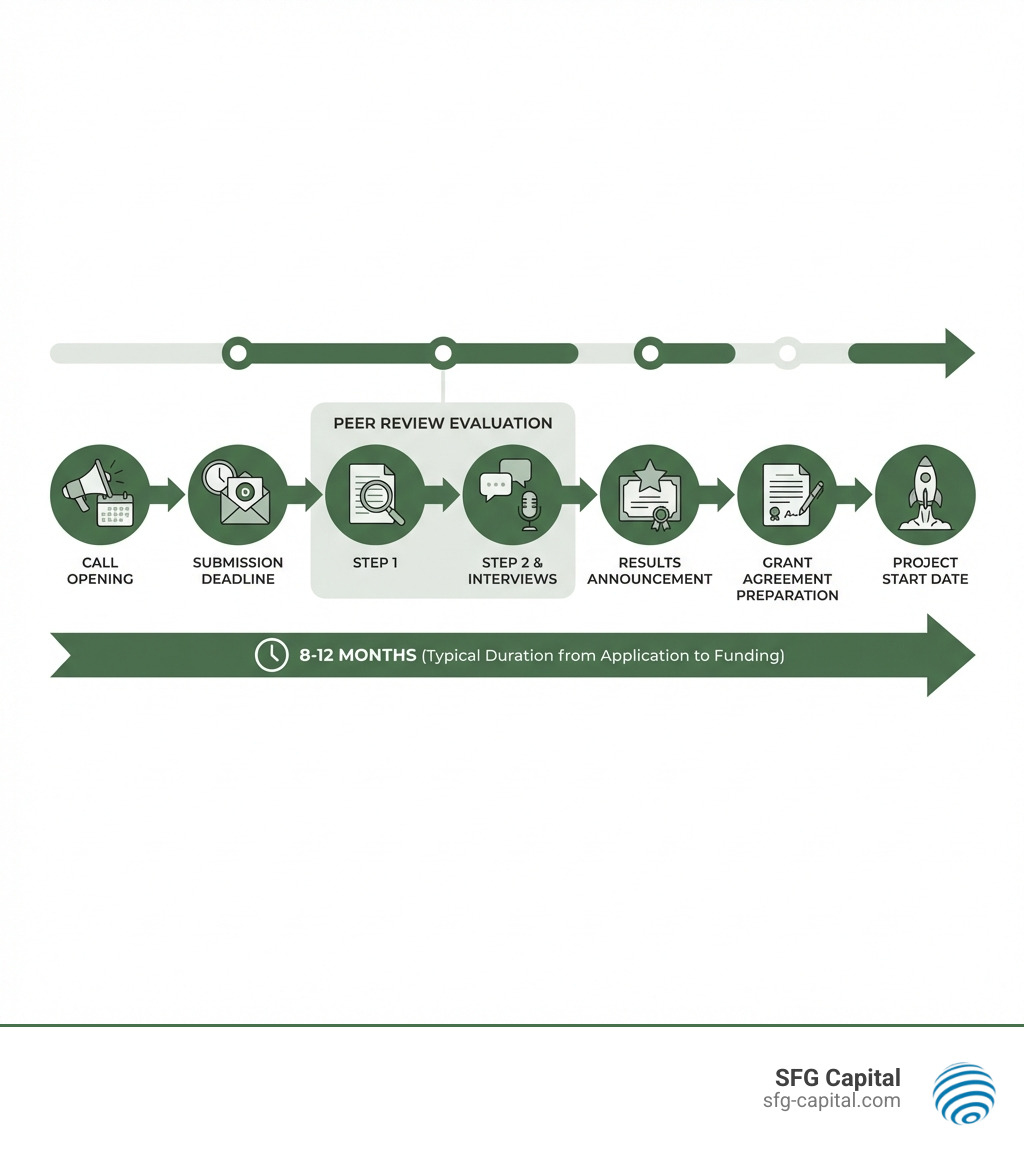
Timeline from application to funding typically spans 8-12 months, with interviews for shortlisted candidates occurring roughly 6-8 months after submission deadlines. Grant agreements are then prepared and signed, with projects usually starting within a year of the results announcement.
Understanding these timelines allows researchers to plan strategically, prepare thorough applications, and align their career development with funding opportunities. Whether you’re an early-career researcher pursuing a Starting Grant or an established leader applying for an Advanced Grant, knowing when to apply and what to expect at each stage is crucial for success.
I’m Santino Battaglieri, and while my primary expertise lies in helping U.S. businesses steer the Employee Retention Credit (ERC) funding timeline through SFG Capital, I understand the importance of clear timelines and structured processes in securing critical funding. Whether you’re pursuing European research grants or U.S. tax credits, understanding the erc funding timeline is essential for effective financial planning and resource allocation.
Understanding the Core ERC Grant Schemes and Eligibility
The European Research Council (ERC) is the premier European funding organization for excellent frontier research, established by the European Union in 2007. Its mission is to encourage the highest quality research in Europe by supporting investigator-driven frontier research across all fields, based on scientific excellence. This means researchers get to propose their own ideas, rather than responding to predefined themes. We’re talking about groundbreaking, high-risk, high-gain projects that push the boundaries of knowledge.
The ERC offers a portfolio of core grant schemes, each custom to support researchers at different career stages. Think of it like a ladder, with each rung designed to foster scientific independence and leadership. These grants are open to researchers of any nationality, provided they intend to conduct their research activity in an EU Member State or an Associated Country.

To truly grasp the ERC funding landscape, explore past projects and understand what kind of research the ERC has championed. You can Explore past projects in the ERC database to see if your project fits the scale and ambition. For more general information on funding requirements, which can often be complex, we also offer More info about ERC funding requirements.
Starting vs. Consolidator vs. Advanced Grants
Let’s break down the main individual grant schemes and their unique focuses:
- Starting Grants (StG): These are designed for promising early-career researchers who are ready to establish their own independent research team or program. They target Principal Investigators (PIs) who have between 2 and 7 years of experience since defending their first PhD degree. The funding can go up to EUR 1.5 million for a period of up to 5 years, with potential additional funding for start-up costs or relocation. This is where brilliant minds take their first big leap into independent research leadership.
- Consolidator Grants (CoG): Aimed at researchers who are consolidating their independence, these grants support PIs with 7 to 12 years of experience post-PhD. The idea is to help them strengthen their research team, develop their career, and prove their potential for research leadership. Consolidator Grants can provide up to EUR 2 million for a period of up to 5 years.
- Advanced Grants (AdG): These are for established, leading researchers with a significant track record of research achievements over the last 10 years. We’re talking about exceptional scientific leaders who want to pursue ambitious, high-risk projects that open new directions in their field. Advanced Grants offer up to EUR 2.5 million for up to 5 years.
- Synergy Grants (SyG): A bit different from the individual grants, Synergy Grants support a group of two to four Principal Investigators working together on a single, ambitious research problem that they couldn’t address alone. This fosters interdisciplinary collaboration and tackles complex challenges. These grants can be substantial, up to EUR 10 million for up to 6 years.
- Proof of Concept (PoC) Grants: These are complementary grants available only to existing ERC grant holders. They provide up to EUR 150,000 for 18 months to explore the commercial or societal innovation potential of their ERC-funded research. It’s about bridging the gap between groundbreaking findings and real-world application.
Eligibility Criteria and Extensions
The eligibility for each grant scheme is primarily determined by the years passed since the successful defense of your first PhD degree. This is often referred to as the “PhD window.” For instance, for the 2025 round of Starting Grants, eligibility dates are for researchers who defended their PhD > 2 and <= 7 years ago on 1 January 2026.
However, the ERC is also very understanding of diverse career paths and life events. They offer extensions to these eligibility windows for various documented circumstances, including:
- Maternity leave: Typically, an extension of 18 months per child born before or during the eligibility period.
- Paternity leave: Equivalent extensions are also available.
- Clinical training: Time spent on clinical training beyond the PhD can be taken into account.
- Long-term illness or special needs: Documented periods of illness, military service, or caring for a dependent family member can also lead to extensions.
- National service or asylum seeking: Other specific situations like national service or seeking asylum also have provisions for extensions.
It’s crucial to consult the ERC Work Programme for the specific call you’re interested in, as these details can be refined. The goal is to ensure fair access for all excellent researchers, regardless of career interruptions.
Navigating the ERC Funding Timeline for 2025 and 2026
Understanding the specific dates for ERC calls is like knowing the tide schedule for a sailor – it’s essential for a smooth journey! The erc funding timeline is carefully planned, with distinct phases from call opening to results announcement.
Key Milestones in the ERC Funding Timeline
The journey from application to funding typically spans 8-12 months, a significant period requiring careful planning. Here’s a general breakdown of the key milestones:
- Call Opening: This is when the official call for proposals is published on the EU Funding & Tenders Portal. Researchers can then access all the necessary documents and begin their application.
- Submission Deadline: The hard deadline for submitting your proposal electronically. Missing this deadline means waiting for the next annual cycle, so mark your calendars!
- Step 1 Evaluation: An initial peer review where proposals are assessed based on the Principal Investigator’s profile and the research project’s groundbreaking nature. Applicants receive feedback, and some are invited to the next stage.
- Step 2 Interviews: Shortlisted candidates for individual grants (Starting, Consolidator, Advanced) are typically invited for an interview with the evaluation panel. This is your chance to shine and personally present your vision. Synergy Grant evaluations usually involve a three-step process, which may also include interviews.
- Results Announcement: After the evaluation is complete, applicants are informed of the outcome. For successful proposals, this is a moment of triumph!
- Grant Agreement Preparation: If successful, the grant agreement is prepared between the ERC Executive Agency (ERCEA) and the host institution.
- Project Start: Once the grant agreement is signed, the project can officially begin.
Important Deadlines for the 2026 Grant Cycle
We’ve already seen the quick overview in the introduction, but let’s dig a bit deeper into the expected deadlines for the 2026 grant cycle, as outlined in the Official ERC Work Programme 2026 details:
| Grant Type | Call Opens (Expected) | Submission Deadline (Expected) | Results Expected (Expected) | Earmarked Budget (2026) | Estimated Grants (2026) |
|---|---|---|---|---|---|
| Starting Grant (StG) 2026 | July 9, 2025 | October 14, 2025 | August 2026 | €705 million | 450 |
| Consolidator Grant (CoG) 2026 | September 25, 2025 | January 13, 2026 | December 2026 | €673 million | 328 |
| Advanced Grant (AdG) 2026 | May 28, 2026 | August 27, 2026 | June 2027 | €747 million | 294 |
| Synergy Grant (SyG) 2026 | Expected 2025 | October/November 2025 | November 2026 | €500 million | 49 |
These dates are crucial for planning your application strategy. The call identifier year (e.g., ERC-2026-StG) refers to the year the budget is allocated, not necessarily the year the deadline falls. For example, the deadline for ERC-2026-StG is in October 2025. It’s a bit like buying next year’s model car in the fall of the current year!
The ERC Work Programme 2026 has earmarked significant funds, such as €705 million for an estimated 450 Starting Grants. These are substantial investments in Europe’s research talent.
While we’re discussing timelines, it’s worth noting that delays can sometimes occur in large-scale funding processes. For businesses in Travis County, understanding and navigating delays is a common challenge, especially when dealing with the U.S. tax system. If you’re a business owner facing such delays, you might find some parallels in The Waiting Game: Understanding Your ERC Claims Journey Through the IRS.
The Evaluation Process and 2026 Structural Changes
The ERC’s evaluation process is renowned for its rigor and commitment to scientific excellence. It’s a thorough peer-review system designed to identify and fund the most ambitious and groundbreaking research proposals.
How the Evaluation Process Works
At the heart of the ERC is its independent Scientific Council, which defines the scientific strategy and evaluation methodology. The day-to-day implementation and grant administration are handled by the ERC Executive Agency (ERCEA). Together, they ensure a fair and transparent process.
The sole criterion for evaluation is excellence. This isn’t just a buzzword; it’s a fundamental principle. Proposals are judged on two main aspects:
- Excellence of the Principal Investigator(s): This includes their intellectual capacity, creativity, and track record. For early-career grants, it’s about demonstrated potential.
- Excellence of the Research Project: This assesses the groundbreaking nature, ambition, and feasibility of the proposed research. Is it high-risk, high-gain? Does it open new avenues?
The evaluation typically involves panels of distinguished international scientists and scholars (around 900 panel members) complemented by external reviewers (around 2,000). Proposals are scored (often A, B, C), and only those receiving the highest scores proceed. For individual grants, successful Step 1 applicants are invited for interviews.
Resubmission restrictions are in place to manage the volume of applications and encourage applicants to improve their proposals. For instance, if you receive a low score, you might have to wait a year or two before reapplying to the same grant scheme. This encourages applicants to take feedback seriously and refine their ideas.
The ERC also champions open access policy, requiring all peer-reviewed publications from funded projects to be deposited in accessible repositories within six months of publication. This ensures that the fruits of publicly funded research are available to all, fostering broader scientific progress.
For businesses dealing with complex financial processes, the importance of efficiency and clear procedures cannot be overstated. Just as researchers value a streamlined ERC evaluation, businesses look for ways to Speed Up Your Tax Refund: Strategies to Expedite IRS Processing.
Major Updates for the 2026 Calls
The ERC is always evolving to better serve the research community. For the 2026 calls, several important changes have been introduced:
- New proposal structure: The scientific proposal will now be divided into two parts:
- Part I: Focuses on the overall idea, background, objectives, and strategy (typically limited to 5 pages).
- Part II: Digs into the detailed implementation, methodology, and risk assessment (typically limited to 7 pages).
This aims to streamline the initial evaluation and ensure clarity in presenting both the grand vision and the practical execution.
- Increased relocation funding: Recognizing the challenges of moving, the ERC has increased the additional funding available for researchers moving to an EU Member State or an Associated Country from a non-associated third country. This funding can now go up to EUR 2 million, a substantial boost to support talented individuals in making Europe their research home.
- Vision statements for ERC Plus (new grant scheme): While not explicitly covered in the main research, the Work Programme 2026 introduces an “ERC Plus Grant” scheme, which requires a compelling “Statement of Vision” explaining how the project goes beyond regular ERC grants and aims to transform a field. This highlights the ERC’s continuous push for truly transformative research.
- Gender Equality Plans (GEP): Public bodies, research organizations, and higher education institutions applying for ERC funding must now have a Gender Equality Plan in place. This emphasizes the ERC’s commitment to promoting equal opportunities and gender balance within the research landscape.
These updates reflect the ERC’s dynamic approach to fostering excellence, supporting researchers, and ensuring the continued integrity and impact of its funding schemes.
Strategic Support and Success Statistics
Securing an ERC grant is highly competitive, but the rewards are immense: intellectual independence, significant funding, international recognition, and the chance to make a real impact. Understanding the statistics and available support can significantly boost your chances.
Success Rates and Application Trends
The average success rate for ERC grants is around 12%, making them some of the most prestigious and sought-after awards in Europe. This rate can vary slightly by scheme and scientific domain. For instance, the ERC Work Programme 2026 earmarked €705 million for an estimated 450 Starting Grants, indicating a highly competitive environment.
Recent application statistics highlight the growing interest in ERC funding:
- The ERC received 4,807 applications for the Starting Grants 2026 call.
- This marked a 22.4% increase compared to the previous call, which itself saw a 13% increase from the year before. This trend indicates the increasing appeal and recognition of ERC grants.
- Applications are distributed across three main scientific domains:
- Physical Sciences and Engineering (PE): Received the highest number of submissions, at 1,980 (41%).
- Social Sciences and Humanities (SH): Accounted for 1,568 submissions (33%).
- Life Sciences (LS): Received 1,257 submissions (26%).
- Encouragingly, nearly 43% of proposals were submitted by women, the highest rate since the ERC’s inception in 2007. This demonstrates positive progress in promoting gender equality in research leadership.
To improve your application, various support mechanisms are in place. National Contact Points (NCPs), established by national governments, are invaluable resources. They provide free information, advice, and often host webinars and events about ERC calls. Leveraging these resources can provide crucial insights and guidance. For those looking to apply for an ERC grant, a detailed guide on the process can be found at ERC Funding Application: A Step-by-Step Guide to Claiming Your Credit.
How the IRS Impacts the ERC Funding Timeline
Now, we need to shift gears slightly. While the bulk of this article focuses on the European Research Council (ERC) grants, it’s important to acknowledge another significant “ERC” that impacts businesses, particularly in the United States: the Employee Retention Credit (ERC).
For businesses in Travis County, Austin TX, and across the United States, the Employee Retention Credit (ERC) was a vital tax credit designed to help businesses retain employees during the COVID-19 pandemic. However, the erc funding timeline for receiving these refunds from the IRS has become notoriously long.
Many businesses have faced significant IRS delays in processing their 941-X amended tax returns, leading to frustratingly long waits for their much-needed funds. These refund backlogs can stretch for months, sometimes even years, creating financial strain for companies. Understanding these delays is critical for businesses relying on these funds. To get a better grasp of these specific processing times, you might want to read How Long Until Your ERC Refund Arrives? A 2026 Update.
This distinction is important because while both are referred to as “ERC,” one pertains to European research funding, and the other to a U.S. tax credit. Our expertise at SFG Capital is specifically in helping Travis County businesses steer the complexities and delays associated with the Employee Retention Credit.
Frequently Asked Questions about ERC Funding
Here, we address some common questions about the European Research Council (ERC) funding to clarify key aspects of its timeline and processes.
What is the typical success rate for an ERC grant?
The typical success rate for an ERC grant is around 12%. This figure underscores the highly competitive nature of ERC funding, which is why a strong, well-prepared application is absolutely crucial. Success rates can vary by grant scheme and scientific domain, but the overall average reflects the ERC’s commitment to funding only the most excellent and groundbreaking research.
How has the ERC proposal structure changed for 2026?
For the 2026 calls, the ERC has introduced a significant change to the scientific proposal structure. It will now be divided into two distinct parts:
- Part I: This section is dedicated to presenting the overall research idea, its background, main objectives, and the general strategy you plan to employ. It’s typically concise, often limited to around 5 pages, and aims to give the evaluators a clear, compelling overview of your project’s vision.
- Part II: This part digs into the detailed implementation of your research. Here, you’ll outline your methodology, work plan, resources, and a thorough risk assessment. This section is usually longer, limited to about 7 pages, providing the specifics of how you intend to achieve your ambitious goals.
This new structure is designed to streamline the evaluation process, ensuring that both the broad vision and the practical execution of a project are clearly articulated and assessed.
Can I move my ERC grant to a different host institution?
Yes, ERC grants are designed to be portable. This means that if you, as the Principal Investigator, decide to move to another eligible host institution within an EU Member State or Associated Country, you can, under specific conditions, request to transfer your entire grant (or part of it) to your new institution. This flexibility is a key feature of ERC funding, empowering researchers and promoting scientific mobility. The ERC aims to support the researcher, not just the institution, recognizing that talent often moves.
Conclusion
Navigating any funding landscape, whether it’s the prestigious European Research Council (ERC) grants for groundbreaking research or the Employee Retention Credit (ERC) for your business, demands a clear understanding of the erc funding timeline and associated processes. For European researchers, meticulous planning around call openings, submission deadlines, and evaluation stages is paramount to open uping transformative research potential. The ERC’s commitment to excellence, coupled with its evolving structures and support systems, continues to drive scientific advancement across the continent.
However, we understand that for businesses, particularly those in Travis County, Austin TX, the term “ERC” often brings to mind the Employee Retention Credit. If your business is one of the many that qualified for this crucial tax relief during the pandemic, you might be experiencing significant delays in receiving your refund from the IRS. These backlogs can create unforeseen financial challenges, impacting cash flow and growth opportunities.
This is precisely where SFG Capital steps in. We specialize in helping Travis County businesses like yours expedite their Employee Retention Credit (ERC) refunds. We offer innovative solutions like advance funding and buyouts, designed to help you bypass those frustrating IRS delays and access your capital sooner. Our process is transparent, efficient, and comes with a performance-based fee, meaning we only succeed when you do. With our expert claim assistance, we ensure your application is robust and your path to funds is as smooth as possible.
Don’t let the waiting game hinder your business’s potential. If you’re a Travis County business owner with a pending Employee Retention Credit refund, let us help you open up those funds. We’re here to provide the clarity and financial solutions you need.
To learn more about how we can help you with your Employee Retention Credit, visit Unlock your funds with the ERC Funding Process.