
What the ERC Funding Program Means for Research and Business Innovation
The ERC funding program refers to the European Research Council’s grant schemes supporting frontier research based on excellence. For researchers and institutions, this program provides substantial funding—ranging from €1.5 million to €10 million—for groundbreaking projects.
Quick Overview of ERC Funding:
- Who runs it: Independent Scientific Council and ERC Executive Agency (ERCEA)
- Total budget: Over €16 billion (2021-2027)
- Main grant types: Starting, Consolidator, Advanced, Synergy, and Proof of Concept
- Eligibility: Researchers of any nationality working in EU Member States or Associated Countries
- Evaluation: Based solely on scientific excellence through peer review
Established in 2007, the ERC has funded over 17,000 projects, leading to 15 Nobel Prizes and over 400 start-ups. Unlike traditional funding, the ERC supports investigator-driven research, allowing individuals to propose high-risk projects without predetermined themes. This approach has enabled breakthroughs in AI, clean energy, and medicine.
Operating under Horizon Europe, the program offers five core grant schemes for different career stages. Each provides long-term funding (typically 5 years) with no co-financing requirements.
I’m Santino Battaglieri. While my expertise lies in U.S. Employee Retention Credit advisory and structured funding through SFG Capital, I recognize the importance of accessing capital efficiently—whether through research grants or business tax credits. Both require navigating complex eligibility to open up financial resources.
Understanding the ERC Funding Program: Mission and Impact
The ERC funding program is a cornerstone of European scientific advancement. Its mission is to encourage high-quality research through competitive funding for investigator-driven frontier research. By empowering researchers to pursue ambitious ideas, the ERC pushes the boundaries of knowledge, leading to significant societal impact.
Operating under the Horizon Europe framework, the ERC has a budget exceeding €16 billion for 2021-2027. This investment ensures Europe remains a global leader in innovation. Learn more on the European Research Council website.

The Role of the Scientific Council and ERCEA
The program’s integrity is upheld by two pillars: the Scientific Council and the ERCEA.
The Scientific Council is the governing body of eminent scholars responsible for the scientific strategy, defining grant types and evaluation methods. Their independence ensures scientific excellence remains the sole funding criterion.
The ERC Executive Agency (ERCEA) handles daily operations, including managing calls, organizing peer reviews, and administering grants. For more on EU bodies, see See all EU institutions and bodies.
How the ERC Funding Program Drives Scientific Excellence
The ERC’s impact is evidenced by impressive achievements since 2007:
- Prestigious Awards: Grantees have won 15 Nobel Prizes and 7 Fields Medals.
- Innovation: Projects have led to over 2,200 patents and 400+ start-ups.
- Knowledge: Over 200,000 scientific articles have been published by grantees.
- Talent: Currently, over 75,000 postdocs and PhD students work in ERC teams.
- Global Reach: Grantees represent over 97 nationalities.
Explore more data via the Go to the ERC dashboard.
Navigating the Main ERC Grant Schemes
The ERC funding program supports researchers at various career stages, ensuring excellence is nurtured from early-career to established leadership.
Comparing Career Stages in the ERC Funding Program
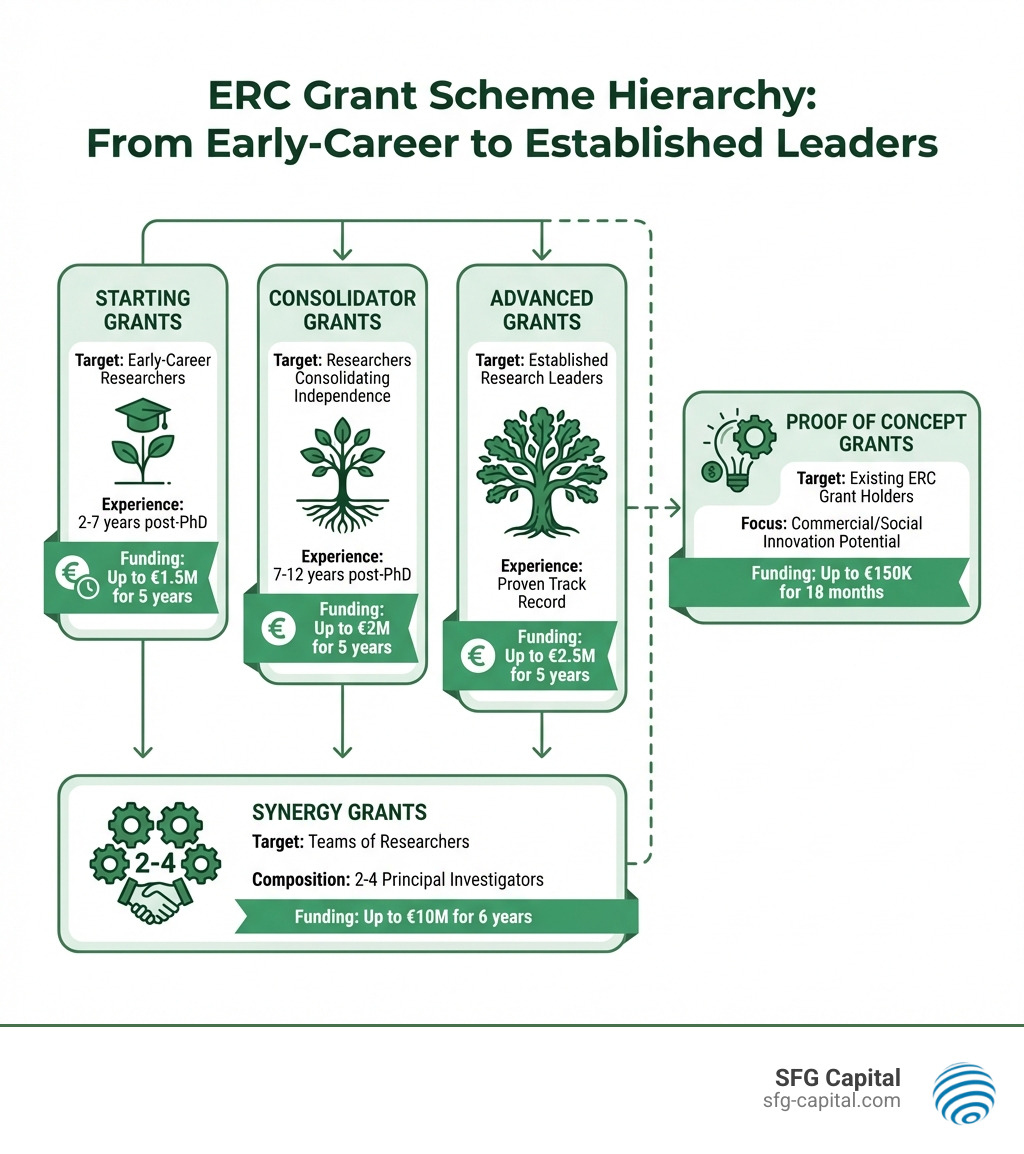
- Starting Grants (StG): For early-career researchers (2-7 years post-PhD) to establish independent teams.
- Consolidator Grants (CoG): For researchers (7-12 years post-PhD) to consolidate their research identity.
- Advanced Grants (AdG): For established leaders with a track record of significant achievements.
- Synergy Grants (SyG): For groups of 2-4 PIs addressing complex, interdisciplinary questions.
- Proof of Concept Grants (PoC): For existing ERC holders to explore the innovation potential of their results.
For a visual guide, see ERC grants explained: From application to evaluation.
Funding Amounts and Project Durations
- Starting Grants: Up to €1.5 million for 5 years.
- Consolidator Grants: Up to €2 million for 5 years.
- Advanced Grants: Up to €2.5 million for 5 years.
- Synergy Grants: Up to €10 million for 6 years.
- Proof of Concept Grants: Up to €150,000 for 18 months.
Additional funding (up to €1M, or €4M for Synergy) can cover start-up costs or major equipment. Details are in the ERC Work Programme 2025.
Eligibility and the Application Process
Securing an ERC funding program grant requires understanding detailed eligibility and a rigorous application process.
Step-by-Step Guide to the ERC Funding Program Application
- Identify the Grant: Choose the scheme matching your career stage.
- Review Rules: Consult the ERC Work Programme 2025 and ERC Rules of Submission.
- Prepare the Proposal:
- Part A: Administrative forms and budget.
- Part B1: 5-page synopsis, CV, and track record.
- Part B2: 14-page scientific proposal detailing methodology.
- Support Documents: Host Institution statement and equipment table.
- Submission: Use the EU Funding & Tenders Portal.
- Checks: Proposals undergo admissibility and eligibility reviews.
For more on requirements, see our guide on ERC Funding Requirements.
Evaluation Steps and Selection Criteria
Evaluation is based solely on scientific excellence through several steps:
- Remote Evaluation: International peer reviewers in 25 scientific panels assess proposals.
- Panel Meetings: Panels score and shortlist proposals.
- Interviews: PIs for Starting, Consolidator, and Advanced grants are typically interviewed in Brussels.
- Final Ranking: Funding decisions are based on combined scores.
Key Criteria: The ERC assesses the Excellence of the PI (intellectual capacity and track record) and the Excellence of the Project (ground-breaking nature and feasibility). High-risk/high-gain projects are favored. See Q&A on ERC grant competitions for more.
Specialized Opportunities and Global Reach
The ERC funding program extends support to specific groups and translates research into real-world impact.
Support for Researchers Impacted by Conflict
The ERC supports researchers impacted by global conflicts, such as the war in Ukraine. Initiatives like “ERC for Ukraine” help displaced scientists continue their work in EU Member States. These programs include fellowships and mentoring to prevent brain drain. Data processing for these initiatives follows strict privacy rules; see Data Protection information.
Bridging the Gap to Marketable Innovation
Proof of Concept (PoC) Grants help transition frontier research into societal benefits. Available to existing ERC grantees, these €150,000 grants fund:
- IPR applications: Protecting findings through patents.
- Market analysis: Assessing demand for new solutions.
- Technical validation: Demonstrating practical applicability.
- Business cases: Planning for commercialization.
This funding bridges the “valley of death” between research and the market. For business owners, our guide on 5 Ways to Use ERC Funds to Strengthen Your Business offers insights into leveraging capital.
Financing and Advancing Your ERC Claims
While the European Research Council supports scientific research, the acronym “ERC” also refers to the U.S. Employee Retention Credit, a vital tax credit for businesses.
Many businesses in Travis County, Texas, relied on the ERC during the pandemic. However, IRS delays have often stalled these refunds. Just as researchers need grant funding, businesses need timely access to tax credits to maintain cash flow.
Bypassing Delays with ERC Credit Financing
For Austin businesses facing IRS delays, SFG Capital offers solutions for immediate liquidity. We provide advance payments and claim buyouts for the Employee Retention Credit, allowing you to bypass the wait and access working capital for operations or growth.
Our performance-based approach includes expert claim assistance. While the ERC funding program drives scientific breakthroughs, we empower businesses by open uping their tax credits. See our ERC Advance Funding: Complete Guide or learn about ERC Funding Solutions and how to Sell Your ERC Claim.
Frequently Asked Questions about the ERC Funding Program
Here, we address some common questions that arise regarding the European Research Council’s ERC funding program.
What is the primary difference between Starting and Consolidator grants?
The primary difference between ERC Starting Grants and Consolidator Grants lies in the career stage of the Principal Investigator (PI) and the level of experience required since obtaining their PhD. Starting Grants are for early-career researchers, typically 2-7 years post-PhD, aiming to establish their first independent research team. Consolidator Grants are for researchers with 7-12 years of post-PhD experience, designed to help them consolidate their existing research team and strengthen their independent research career. Both aim to foster independence, but at different points in a researcher’s professional development, with Consolidator Grants generally offering a slightly higher funding ceiling.
Can researchers from outside the European Union apply for ERC funding?
Yes, researchers of any nationality are eligible to apply for ERC funding program grants. The crucial requirement is that they must intend to conduct their research activity in an EU Member State or an Associated Country for the entire duration of the grant. The ERC actively encourages top talent from around the globe to come to Europe. In some cases, additional funding may even be available to cover start-up costs for PIs moving from non-associated countries.
What are the time commitment requirements for Principal Investigators?
Principal Investigators awarded an ERC grant are expected to dedicate a significant portion of their working time to the ERC project and to reside in an EU Member State or Associated Country. While exact percentages can vary slightly by grant scheme and work programme, typically, PIs must spend a minimum of 50% of their total working time in an EU Member State or Associated Country, and a minimum of 30% to 50% of their working time specifically on the ERC project itself. These requirements ensure that the PI is fully committed to the success of the project and integrated into the European research landscape.
Conclusion
The European Research Council’s ERC funding program stands as a guide for frontier research, driving scientific breakthroughs and fostering an ecosystem of excellence across Europe. From supporting budding scientists with Starting Grants to empowering established leaders with Advanced Grants, and facilitating ambitious collaborations through Synergy Grants, the ERC provides the vital financial backing needed to push the boundaries of knowledge. Its impact is undeniable, measured in Nobel Prizes, patents, start-ups, and the training of tens of thousands of researchers.
Understanding the nuances of these grant schemes, the rigorous application process, and the steadfast commitment to scientific excellence as the sole evaluation criterion is key for any researcher aspiring to join the ranks of ERC grantees.
Here in the United States, particularly for businesses in Travis County, the acronym “ERC” resonates differently, referring to the Employee Retention Credit. While distinct from the European Research Council, both programs share a common thread: providing crucial funding that, when accessed efficiently, can be truly transformative. Just as the ERC funding program accelerates scientific findy, prompt access to the Employee Retention Credit can fuel business growth and stability.
At SFG Capital, we specialize in helping businesses in Austin and Travis County steer the complexities of their Employee Retention Credit claims. We understand the frustration of IRS delays and offer performance-based financing solutions, including advance payments and buyouts, to ensure you get your rightful funds without the long wait. Whether it’s groundbreaking scientific research or essential business capital, accessing funding efficiently is paramount.
For more information on how we can help your business secure your Employee Retention Credit funds quickly and efficiently, please visit More info about our services.