
Why Understanding ERC Tax Credit Loan Options Matters Now
ERC tax credit loan options help eligible businesses access their Employee Retention Credit refunds faster while waiting for IRS processing. Here’s what you need to know:
Quick Answer: ERC Tax Credit Loan Basics
- Not actually a loan: The ERC is a refundable tax credit, not borrowed money.
- What people mean: Advance funding or buyout services that purchase your future ERC refund.
- Typical rates: 80-90% of your claim value, delivered in 1-3 weeks.
- IRS timeline: Standard processing takes 6-12 months or longer.
- Key benefit: Immediate working capital without waiting for the IRS.
The Employee Retention Credit was created under the CARES Act in March 2020 to help businesses keep employees on payroll during the COVID-19 pandemic. It covers up to 70% of qualified wages paid between March 13, 2020, and September 30, 2021—potentially worth up to $26,000 per employee.
The Problem: IRS Backlogs
The IRS faces massive backlogs, with hundreds of thousands of claims still being reviewed. This delay has created a market for ERC advance funding—services that buy your future refund at a discount so you get cash now. These aren’t technically loans; you’re selling your claim to a funding company.
I’m Santino Battaglieri, and I’ve led SFG Capital through over $500 million in ERC transactions. Our methodical approach helps companies access their credits responsibly while avoiding compliance traps.
Understanding the ERC Tax Credit Loan and Advance Options

The Employee Retention Credit (ERC) is a refundable tax credit, not a loan. The IRS explicitly states, “The Employee Retention Credit isn’t a loan, so it doesn’t need to be repaid.”
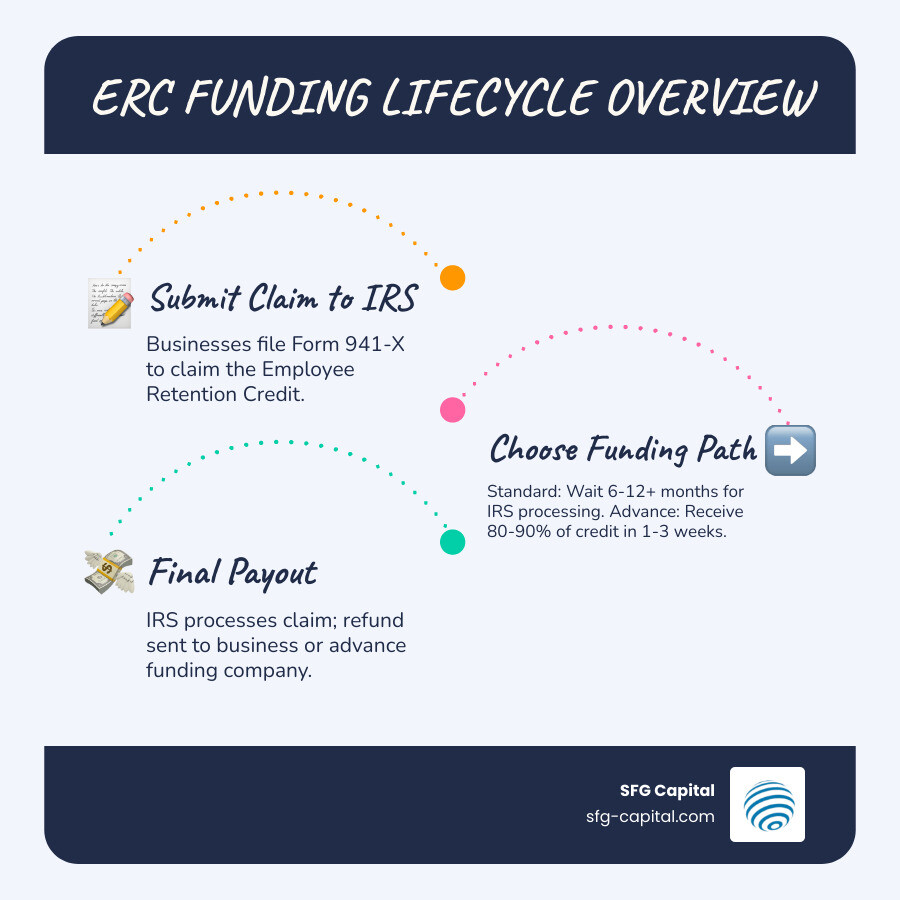
When we discuss an ERC tax credit loan, we’re referring to advance funding solutions that allow businesses to access their anticipated refund before the IRS processes the claim. At SFG Capital, our buyout service can provide up to 90% of your claim value within 1 to 3 weeks, bridging the 6-12 month gap typical of IRS processing. For more details, explore More info about ERC bridge loans.
| Method of Receiving ERC Funds | Estimated Timeline |
|---|---|
| IRS Direct Processing | 6 to 12+ months |
| Private ERC Advance/Buyout | 1 to 3 weeks |
How an ERC Tax Credit Loan Provides Immediate Liquidity
For many businesses, waiting months for a refund isn’t feasible. An ERC tax credit loan (advance or buyout) provides immediate cash flow, converting a future asset into current working capital. This is a debt-free solution; you’re simply accelerating access to money that is already yours. To understand more, check out Unlock Your ERC Requirements: Advances and What You Need to Know.
The Difference Between ERC and PPP Programs
The PPP, established under the CARES Act and The Consolidated Appropriations Act, provided forgivable loans. The ERC is a tax credit claimed by filing or amending employment tax returns (Form 941-X). While businesses can claim both, you cannot use the same wages for both PPP loan forgiveness and the ERC, a rule designed to avoid “double-dipping.”
Eligibility and Legislative Impact on Your Claim
The ERC was created by the CARES Act and modified by the Consolidated Appropriations Act of 2021, The American Rescue Plan Act (ARPA), and the Infrastructure Investment and Jobs Act (IIJA).
Generally, to qualify for the ERC, businesses must have experienced:
- Full or Partial Suspension of Operations: Due to a governmental order limiting commerce, travel, or group meetings.
- Significant Decline in Gross Receipts:
- 2020: A drop of at least 50% compared to the same quarter in 2019.
- 2021: A drop of at least 20% compared to the same quarter in 2019.
A third category, “recovery startup businesses,” applies to certain new businesses in late 2021. For accelerated funding options, Need Cash Now? Top ERC Lenders to Finance Your Credit is a helpful resource.
Qualifying for the ERC
- Suspension of Operations: This requires a specific governmental order that directly impacted your ability to operate. An “essential business” that could keep their operations largely intact via remote work generally wouldn’t qualify under this test.
- Gross Receipts Test: For 2020, the credit is 50% of qualified wages (max $5,000 per employee). For 2021, it’s 70% of qualified wages (max $7,000 per employee per quarter). For a step-by-step guide, see ERC Funding Application: A Step-by-Step Guide to Claiming Your Credit.
Legislative Timeline and Deadlines
While the program has ended for new wages, businesses can still retroactively claim the ERC. The statute of limitations for amending returns is up to three years:
- 2020 claims: Deadline is typically April 15, 2024.
- 2021 claims: Deadline is typically April 15, 2025.
Navigating IRS Enforcement and the Voluntary Disclosure Program
In September 2023, the IRS announced a moratorium on processing new ERC claims to combat fraud. To help businesses correct erroneous claims, the IRS introduced the ERC Voluntary Disclosure Program (ERC-VDP).
- First ERC-VDP: Required repayment of 80% of the credit received.
- Second ERC-VDP: Open through November 22, 2024, for 2021 tax periods. Participants must remit 85% of the claimed ERC.
Participation can waive penalties and interest. For details, see Frequently asked questions about the Employee Retention Credit Voluntary Disclosure Program.
Withdrawing or Amending Ineligible Claims
If you realize your claim was ineligible, you can withdraw it (if unpaid) or amend it using Form 941-X. The IRS urges taxpayers to resolve incorrect claims quickly to avoid repayment demands, interest, and penalties (up to 75% for fraud). For guidance, consult the Frequently asked questions about the Employee Retention Credit.
Warning Signs of ERC Scams
Be wary of “ERC mills” that exhibit these red flags:
- Unsolicited Ads: Cold calls or emails promising “guaranteed” refunds.
- Quick Eligibility: Promoters who don’t review detailed financial records.
- Large Upfront Fees: Reputable professionals rarely demand high fees before work begins.
- Percentage-Based Fees: While common, these can incentivize inflated claims.
- Lack of Documentation: If a promoter doesn’t ask for government orders or wage data, run.
For more information, see IRS frequently asked questions (FAQs) address Employee Retention Credits under ERC compliance provisions.
Accounting and Tax Implications of the ERC Tax Credit Loan
Claiming the ERC impacts your wage expense deductions and income tax. Under Section 280C, businesses must reduce their wage expense deduction by the amount of the ERC received. For example, a $50,000 ERC requires a $50,000 reduction in deductible wages, increasing taxable income. The IRS has detailed how the ERC was adjusted by subsequent legislation.
Impact on Wage Expense Deductions
If you claim the ERC on an amended return (Form 941-X), you must also amend your income tax return for that year. If a claim is later disallowed, the IRS allows you to increase your wage expense in the year the disallowance becomes final, rather than re-amending the original return. For guidance, see Addressing Wage Expense Adjustments After ERC Claim Disallowance.
Financial Reporting and Recognition
Under GAAP and IFRS, the ERC is generally treated as a government grant. Recognition as income requires “reasonable assurance” that eligibility criteria are met. Given the IRS moratorium, businesses should be cautious about recognizing the full amount until payment is received or eligibility is firmly established. For more on the ERC Funding Process and accounting frameworks, refer to the Application of accounting frameworks to the ERC.
Frequently Asked Questions about ERC Financing
How long does it take to receive ERC funds?
The IRS typically takes 6 to 12 months or longer due to backlogs. However, services like our ERC advanced buyout can provide up to 90% of your refund within 1 to 3 weeks. Learn more in The Fast Track to Your ERC Cash: A Guide to Advance Funding.
What are the consequences of claiming an ineligible ERC?
Ineligible claims can lead to full repayment, interest, and penalties ranging from 20% to 75%. Egregious fraud can result in criminal investigation. For tips on avoiding these risks, see Don’t Wait for the IRS: How to Get an ERC Loan or Advance Today.
Can I still file for the ERC in 2024?
The window for new 2021 Q3/Q4 claims effectively closed on January 31, 2024, under the “One, Big, Beautiful Bill.” While you may still amend 2020 claims (until April 15, 2024) or 2021 Q1/Q2 claims (until April 15, 2025), you should consult a professional immediately. See the IRS FAQ for more details.
Conclusion
Navigating ERC tax credit loan options doesn’t have to be difficult. While the IRS faces long delays, SFG Capital helps businesses in Austin and Travis County access up to 90% of their claim value within 1 to 3 weeks. Our advanced buyout service provides immediate working capital while ensuring expert compliance with IRS regulations. Don’t let your credit stay stuck in a backlog. To learn more, visit ERC Funding Solutions.