
Why the IRS Backlog is Forcing Businesses to Seek ERC Lenders
ERC lenders provide immediate funding to businesses waiting on their Employee Retention Credit refunds from the IRS. Here’s what you need to know:
Quick Overview of ERC Lenders:
- What they offer: Access to 60-85% of your expected ERC refund in days, not months
- Two main options: ERC Buyouts (sell your credit, no repayment) or Bridge Loans (borrow against it with interest)
- Minimum requirements: Typically $75,000-$100,000 filed claim, 500-600 credit score, filed 941-X forms
- Typical timeline: Pre-approval in 24-72 hours, funding in 7-10 days
- Cost range: 15-30% discount fee for buyouts, or 2%+ interest for bridge loans
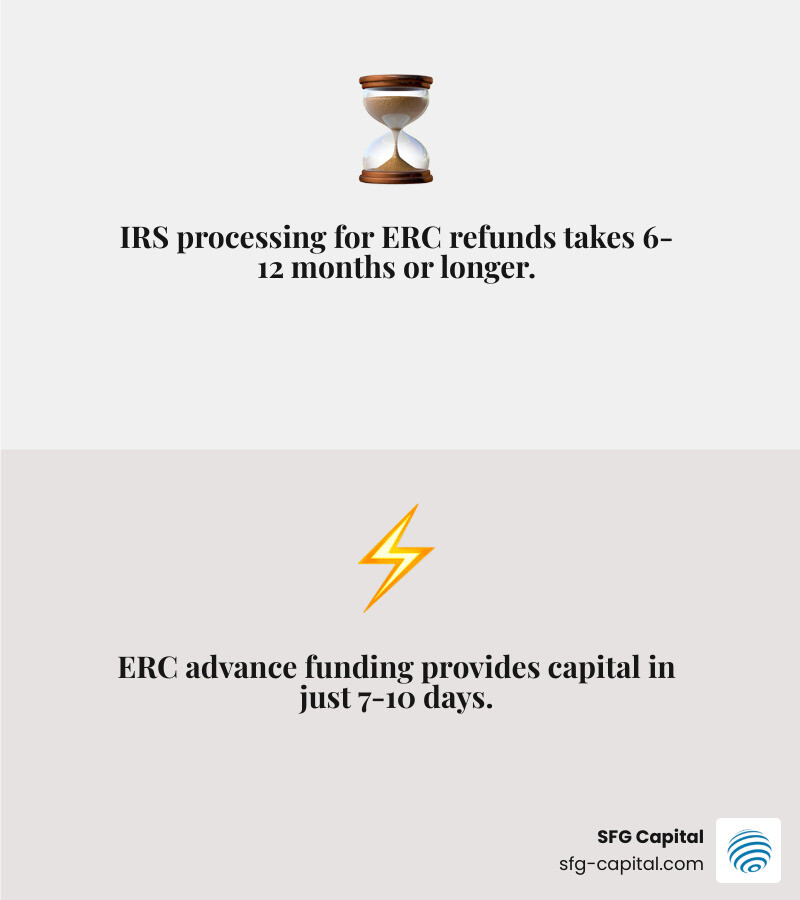
The IRS is taking 6 to 12 months or longer to process Employee Retention Credit claims. For many businesses, that’s too long to wait.
The Employee Retention Credit was created under the CARES Act to help businesses that kept employees on payroll during COVID-19. Eligible companies can receive up to $26,000 per employee—a significant sum that could transform cash flow, fund growth, or simply keep operations stable.
But there’s a problem. The IRS implemented a moratorium on ERC processing in 2023 and introduced improved compliance reviews. The backlog grew massive. Businesses that filed correctly are still waiting months for refunds they desperately need.
That’s where ERC lenders come in. These specialized financing companies purchase your ERC claim outright or provide a loan secured by your expected refund. You get most of your money now—typically within 7-10 days—instead of waiting indefinitely for the IRS.
The cash flow gap created by IRS delays has real consequences. Businesses miss growth opportunities, struggle with payroll, delay vendor payments, and pass on strategic investments. Some even face operational strain that threatens their viability.
I’m Santino Battaglieri, founder of SFG Capital, where we’ve purchased and funded over $500 million in ERC claims, helping businesses steer the ERC lenders landscape with a compliance-driven, transparent approach. This guide will help you understand your financing options, evaluate potential partners, and make an informed decision about accessing your ERC funds now rather than waiting on the IRS.
Erc lenders terms to remember:
The ERC Waiting Game: Why Businesses Need Financing
When the COVID-19 pandemic hit, businesses across the United States faced unprecedented challenges. Many struggled to keep their doors open and their employees paid. In response, Congress passed the Coronavirus Aid, Relief, and Economic Security Act (CARES Act) in 2020, which included a vital provision: the Employee Retention Credit (ERC). This refundable tax credit was designed to incentivize employers to retain their workforce during the economic downturn.
The ERC offered a lifeline, allowing eligible businesses to claim significant credits against qualified wages and healthcare costs. For 2020, the maximum ERC was capped at $5,000 per employee. This was later expanded for 2021, offering up to $7,000 per employee for the first three quarters, leading to a potential total of $21,000 per employee for that year. Combined, a business could receive up to $26,000 per employee over both periods. Imagine the impact of such a substantial refund on your business!
However, accessing these funds has become a frustrating exercise in patience. The IRS, struggling with an overwhelming volume of ERC claims, announced a moratorium on processing new claims in September 2023, along with an “improved compliance review” procedure. This has led to extensive delays, pushing refund wait times to anywhere from 6 to 12 months, or even longer. For many businesses, waiting this long isn’t just an inconvenience; it’s a critical threat to their operations.

These prolonged delays create significant cash flow challenges. Businesses that were counting on their ERC refunds to cover operational expenses, reinvest in growth, or simply maintain financial stability are now stuck in a holding pattern. This waiting game can lead to:
- Operational Strain: Without the expected funds, businesses may struggle to meet payroll, pay rent, or cover other essential overhead expenses. This can lead to difficult decisions, like delaying necessary purchases or even considering layoffs, directly undermining the original intent of the ERC.
- Missed Growth Opportunities: Imagine needing to expand, invest in new technology, or launch a crucial marketing campaign. Waiting a year or more for your refund means missing out on timely opportunities that could propel your business forward. In today’s market, a delay of this magnitude can be a competitive disadvantage.
- Financial Uncertainty: The inability to predict when funds will arrive makes financial planning a nightmare. Businesses need stability to make strategic decisions, and the current IRS backlog introduces a layer of uncertainty that no one wants.
At SFG Capital, we understand this frustration. We’ve seen how the IRS backlog impacts hardworking business owners in Austin, TX, and across the United States. That’s why specialized ERC lenders have emerged as a crucial solution, helping businesses bridge this gap and access their much-needed funds without the agonizing wait. We believe you shouldn’t have to put your business’s future on hold while the IRS catches up. For more on this, explore our insights on The Waiting Game: Understanding and Overcoming ERC Refund Delays.
Comparing Your Options: ERC Advances vs. Bridge Loans
When you’re looking to access your Employee Retention Credit funds sooner, you’ll generally encounter two main paths offered by ERC lenders: an ERC Advance (often called a Buyout) or an ERC Bridge Loan. While both aim to provide quick access to cash, they differ significantly in their structure, cost, and impact on your balance sheet. Let’s break them down.
| Feature | ERC Advance/Buyout | ERC Bridge Loan |
|---|---|---|
| Structure | Purchase of your future ERC refund at a discount. Not a loan. | Secured loan against your anticipated ERC refund. |
| Cost | Discount percentage (e.g., 15-30% of the purchased amount). No interest. | Interest rate (e.g., as low as 2% per month). |
| Repayment | No repayment. The lender receives the refund directly from the IRS. | Monthly interest-only payments until the IRS refund arrives, then full repayment. |
| Balance Sheet Impact | No debt added to your balance sheet, as it’s an asset sale. | Adds debt to your balance sheet. |
| Funding Speed | Pre-approval 1-2 weeks; funding 7-10 days, sometimes same day after acceptance. | Pre-approval 72 hours; funding 7-10 days, sometimes same day after acceptance. |
What is an ERC Advance or Buyout?
An ERC Advance, or Buyout, is a straightforward way to get your money quickly without taking on new debt. Essentially, instead of waiting for the IRS, you sell a portion of your future Employee Retention Credit refund to an ERC lender at a discount. Think of it like selling a valuable asset today for immediate cash, rather than waiting for its future market value.
Here’s how it works:
- Asset Purchase, Not a Loan: This is the key differentiator. Our funders are purchasing your anticipated ERC Credits for a discounted price. This means there are no interest or principal payments after the purchase is completed. You’re not borrowing; you’re selling.
- No Monthly Payments: Because it’s not a loan, you won’t have any weekly or monthly interest payments. This can be a huge relief for businesses already managing tight cash flow.
- Discount Fee: The cost comes in the form of a discount percentage applied to the portion of the ERC you sell. This typically ranges from 15% to 30%, though we normally advance between 60% to 70% of the purchase price based on your approval rating. For example, if your total ERC claim is $1,000,000 and you only want an advance on $250,000 of that claim, a 15% discount fee would be $37,500, netting you $212,500. The remaining tax credit IRS payments would then be sent to you.
- Up to 85% of Your Claim: Reputable ERC lenders can provide up to 85% of your expected ERC refund upfront, giving you substantial immediate capital.
- No Debt Added: Since it’s a sale, an ERC buyout doesn’t add new debt to your balance sheet. This is a significant advantage for businesses looking to maintain a strong financial position for future lending or investment opportunities.
- Simple Repayment (for the lender): The ERC lender receives the refund directly from the IRS when it’s finally processed. You simply redirect the IRS payments to the buyer. The IRS does not allow for different quarters to be sent to different addresses, so you typically have to sell all of your ERCs to one buyer.
An ERC Advance is an excellent option for businesses that prioritize immediate cash flow, want to avoid new debt, and are comfortable with the discount in exchange for speed and simplicity. Learn more about how we facilitate ERC Advance Funding.
How Do ERC Bridge Loans Work?
In contrast to an ERC Advance, an ERC Bridge Loan is a more traditional form of financing. It’s a loan specifically designed to “bridge” the gap between when you need your ERC funds and when the IRS actually delivers them.
Here’s a closer look:
- Secured Loan: An ERC Bridge Loan is secured against your anticipated ERC refund amount. This means your future refund acts as collateral for the loan. Depending on your business’s viability and creditworthiness, personal guarantees may also apply.
- Interest Rates: Unlike a buyout, a bridge loan incurs interest. These rates can be quite competitive, with some ERC lenders offering rates as low as 2% (though this often refers to monthly rates, so always clarify the annual percentage rate). You’ll typically make monthly interest-only remittances until the IRS refund is received, at which point the principal of the loan is repaid.
- Repayment Schedule: You will have a defined repayment schedule, usually involving monthly interest payments. Once the IRS refund arrives, it’s used to pay off the principal of the loan.
- Adds Debt: A bridge loan is a debt product, meaning it will appear as a liability on your balance sheet. While it’s short-term, this is a consideration for businesses that are cautious about their debt-to-equity ratios.
- Potentially Lower Cost: If the IRS processes your refund quickly (a big “if” these days!) or if you secure a very low interest rate, a bridge loan could end up being less expensive than a buyout’s discount fee. However, with current IRS delays, the cumulative interest can sometimes approach or exceed buyout discounts.
An ERC Bridge Loan is suitable for businesses that are comfortable with taking on short-term debt, prefer to retain full ownership of their ERC claim, and are confident in their ability to manage interest payments until the refund arrives. Explore our solutions for ERC Bridge Loans.
Qualifying for ERC Financing: What Top ERC Lenders Look For
Securing financing for your Employee Retention Credit isn’t quite as simple as waving your hand and declaring “I have a refund!” ERC lenders need to ensure your claim is valid and that you meet certain financial criteria. This protects both you and the lender.

Typical Eligibility Requirements for ERC Lenders
While specific requirements can vary between ERC lenders, there are common benchmarks we look for:
- Minimum Claim Amount: This is often one of the first problems. For an ERC buyout, you’ll typically need a minimum ERC refund of $75,000. For an ERC advance loan, some lenders require a minimum of $100,000. These thresholds ensure the transaction is economically viable for the lender.
- Filed 941-X Forms: You must have already filed your IRS Form 941-X (Adjusted Employer’s Quarterly Federal Tax Return or Claim for Refund) for each quarter you’re claiming the ERC. This is proof that your claim is officially submitted to the IRS. We can’t advance funds on a claim that hasn’t been filed.
- Minimum FICO Score: While not as stringent as traditional bank loans, most ERC lenders will look at your creditworthiness. A minimum credit score of 500 is generally required for an ERC buyout, and 600 for an ERC advance loan. This helps us assess the overall financial health of your business and its principals.
- Business Solvency: ERC lenders want to see that your business is financially solvent and operational. This typically means you should be free of recent bankruptcies or felony convictions for the business owners. We’ll also look for the absence of tax liens or judgments against your business. If you have existing tax liens or past due unpaid taxes, you might still be eligible to borrow against your remaining balance once these amounts are deducted from your ERC Refund Claim.
Documentation You’ll Need to Apply
To streamline the application process, it’s wise to have your documents ready. The more organized you are, the faster we can process your request. Here’s a general list of what most ERC lenders will ask for:
- ERC Provider’s Report: This is the detailed report from the tax professional or service that prepared your ERC claim, outlining the calculation and eligibility.
- IRS Forms 941 and 941-X: Copies of your original IRS Form 941s (Employer’s Quarterly Federal Tax Return) and the filed IRS Form 941-Xs for each quarter claimed. These are crucial proofs of your claim submission.
- P&L Statements: Profit and Loss statements for the relevant periods (e.g., 2019-2021) to assess your business’s financial performance.
- Business Tax Returns: Copies of your business income tax returns for the previous two to three years (e.g., 2019-2021).
- Bank Statements: Your previous three months’ bank statements to understand your cash flow.
- Identification: Identification (like a Driver’s License or Passport) for all shareholders with 20% or greater ownership.
- Business Formation Documents: Copies of your Articles of Incorporation and Bylaws, or Operating Agreement.
- Voided Check: For setting up ACH transfers.
- IRS Form W-9: A W-9 for the authorized signer.
- Consent Forms: You’ll also need to provide IRS Form 8821 and 7216 consent forms, which allow the lender to communicate with the IRS on your behalf and receive the refund directly.
How Quickly Can You Get Funded?
One of the primary reasons businesses turn to ERC lenders is speed. We know you need your funds now, not in a year. The timeline can vary slightly depending on the type of financing and the lender’s efficiency, but generally, it’s much faster than waiting for the IRS:
- Application Process: The initial application can often be completed online in minutes.
- Pre-Approval Time: Many ERC lenders offer pre-approval decisions in as little as 24 to 72 hours for ERC Bridge Loans. For ERC Buyouts, pre-approval might take 1 to 2 weeks, as it often involves a deeper review of the claim’s validity.
- Funding Speed: Once your offer is accepted, funding can be remarkably quick. Some businesses receive funds within 7 to 10 days. In many cases, we can even provide same-day funding upon acceptance of your financing offer, with funds deposited via ACH within 24 hours or less. The overall process, from initial application to funds in your account, typically takes about two weeks once all required documents are received and approved.
This rapid turnaround is a game-changer for businesses facing urgent financial needs, allowing you to quickly deploy capital for payroll, inventory, marketing, or other critical operational expenses.
The Fine Print: Understanding Costs and Risks
While the allure of quick cash from your Employee Retention Credit is strong, it’s crucial to understand the financial implications and potential risks involved. Transparency is key, and reputable ERC lenders will ensure you have a clear picture before you commit.
Breaking Down the Costs of ERC Financing
The cost of ERC financing isn’t a one-size-fits-all number; it depends heavily on whether you choose an advance/buyout or a bridge loan.
- Buyout Discount Percentage: If you opt for an ERC buyout, the primary cost is the discount percentage applied to your claim. This is how the ERC lender makes their profit. We often advance between 60% to 70% of the purchase price, and this discount can effectively range from 15% to 30% of the total amount advanced. For example, if you sell $100,000 of your claim at a 20% discount, you’d receive $80,000 upfront. It’s a fee for immediate access to capital, and it’s not interest-bearing.
- Bridge Loan Interest Rates: For an ERC bridge loan, the cost is an interest rate. Some lenders advertise rates as low as 2%. It’s critical to clarify if this is a monthly or annual rate and understand the total interest you’ll pay until the IRS refund arrives. While bridge loans might seem cheaper on paper, the cumulative interest over several months (given the IRS delays) can add up, potentially rivaling or even exceeding the discount of a buyout.
- One-Time Fees: Reputable ERC lenders should be transparent about any additional fees. Many pride themselves on having no upfront costs or application fees. Our goal is to make it easy to get started, so you won’t encounter hidden charges just to apply. If you have an ERC preparer, their fee can often be deducted directly from your advance, without any extra charges from us for making that deduction.
Key Risks and How Reputable ERC Lenders Mitigate Them
No financial transaction is entirely without risk, and ERC financing is no exception. However, good ERC lenders work to mitigate these for both parties.
- IRS Claim Denial or Reduction: This is arguably the biggest risk. What happens if the IRS denies your ERC claim entirely or reduces the amount you were expecting? If your claim is ultimately disallowed after you’ve received an advance, the funds advanced will need to be paid back on negotiated terms. This is why thorough due diligence by the lender on your claim is so important. We work with you to ensure your claim is valid from the start, following the guidance in our Employee Retention Credit Specialist Guide.
- Lender Payment Process: For a buyout, the ERC lender gets paid directly by the IRS. This is facilitated through IRS Form 8821 and 7216 consent forms, which authorize the IRS to send the refund check directly to the lender’s lockbox. This ensures a smooth process for the lender to recover their funds.
- Importance of a Valid Claim: The best defense against denial is a properly prepared and eligible claim. We emphasize that you must satisfy the IRS’s ERC eligibility criteria and have proof of your IRS Form 941-X report submission(s). We only provide financing for valid ERC Refund Claims that have already been filed. Our expertise in ERC allows us to vet claims rigorously, giving both of us confidence in the process.
We understand that navigating these details can feel like walking through a minefield. That’s why transparency and expert guidance are non-negotiable when choosing an ERC lender.
Choosing the Right Partner: How to Vet ERC Lenders
With the surge in demand for ERC financing, many companies have entered the market. But not all ERC lenders are created equal. Choosing the right partner is crucial for a smooth, transparent, and successful experience. You want a team that not only offers quick funding but also understands the intricacies of the ERC program and prioritizes your business’s long-term health.
Key Differentiators to Look For
As you evaluate potential ERC lenders, keep these differentiators in mind:
- Transparency: Look for a partner who is upfront about all costs, terms, and potential risks. There should be no hidden fees or confusing jargon. They should clearly explain the discount percentage for a buyout or the interest rate and repayment schedule for a bridge loan.
- Lending Experience: Experience matters, especially in a specialized area like ERC financing. Seek out ERC lenders with a long track record in commercial lending. For example, our team at SFG Capital brings 25 years of commercial lending experience, having funded over half a billion in transactions. This deep expertise means we understand the nuances of business finance and the ERC landscape. You want a partner who has been around the block, not a fly-by-night operation. Read more about About Us.
- Customer Support: The process of getting your ERC financed should be as easy and stress-free as possible. Look for ERC lenders that offer dedicated customer support, clear communication, and a willingness to answer all your questions. A good partner will offer free consultations and be responsive to your needs.
- Process Efficiency: Speed is often a top priority. A reputable ERC lender will have a streamlined application process, clear documentation requirements, and a track record of fast pre-approvals and funding. They should make the process feel “EASY, ECONOMICAL, FAST,” not like pulling teeth.
Questions to Ask a Potential Financing Partner
Don’t be shy about asking direct questions. A trustworthy ERC lender will welcome them. Here are some critical questions to pose:
- What is your exact fee structure? For buyouts, clarify the discount percentage. For bridge loans, ask for the annual percentage rate (APR) and any other associated fees. Ensure there are no application fees or hidden costs.
- What happens if my ERC claim is denied or reduced by the IRS? Understand their policy. Will you have to repay the full advance immediately, or are there negotiated terms? This is a crucial aspect of risk mitigation.
- Can I see a sample contract or terms and conditions? Always review the fine print. Understand the legal obligations, especially regarding how the IRS refund is handled and what happens in various scenarios.
- How do you ensure my claim is valid? Inquire about their due diligence process. Do they have tax experts who review your documentation? This indicates a commitment to mitigating risks for both parties.
- What are your communication protocols? How will you be kept informed throughout the process? Who is your point of contact?
For additional clarity, you can always refer to the Frequently asked questions about the Employee Retention Credit directly from the IRS. When you’re ready to explore your options and get clear answers, don’t hesitate to Contact Us at SFG Capital. We’re here to help businesses in Travis County and beyond steer their ERC financing needs with confidence and ease.
Conclusion: Open up Your ERC Funds and Move Your Business Forward
The Employee Retention Credit was designed to be a powerful aid for businesses recovering from the pandemic, but the ongoing IRS delays have turned it into a source of frustration and financial uncertainty. We’ve seen how these delays can stifle growth, strain operations, and leave businesses in Austin, TX, and across the United States, in a difficult holding pattern.
Fortunately, ERC lenders offer a viable and much-needed solution. Whether through an ERC advance/buyout or an ERC bridge loan, these financing options provide a lifeline, allowing you to access a significant portion of your anticipated refund in days, not months or even years. This immediate infusion of capital can be transformative, enabling you to meet payroll, invest in expansion, seize new opportunities, and restore confidence in your financial future.
Choosing the right ERC lender is paramount. Look for transparency, extensive experience, excellent customer support, and a streamlined process. Ask the tough questions about costs and risks, and ensure your partner is committed to your success.
At SFG Capital, we pride ourselves on being a trusted partner for businesses seeking to open up their ERC funds. Our expertise, transparent processes, and commitment to client success mean you can steer the complexities of ERC financing with peace of mind. Don’t let the IRS backlog dictate your business’s trajectory. Take control of your cash flow and propel your business forward. Explore our comprehensive Our Services today and find how we can help you turn your pending ERC refund into immediate working capital.