
A Step-by-Step Guide to the ERC Application Process
What the ERC Application Process Actually Involves (And Why It Matters)
The erc application process is a multi-step procedure that lets eligible businesses claim a refundable payroll tax credit for wages paid to W-2 employees during 2020 and 2021 — and for many owners, it represents tens of thousands of dollars in recoverable funds.
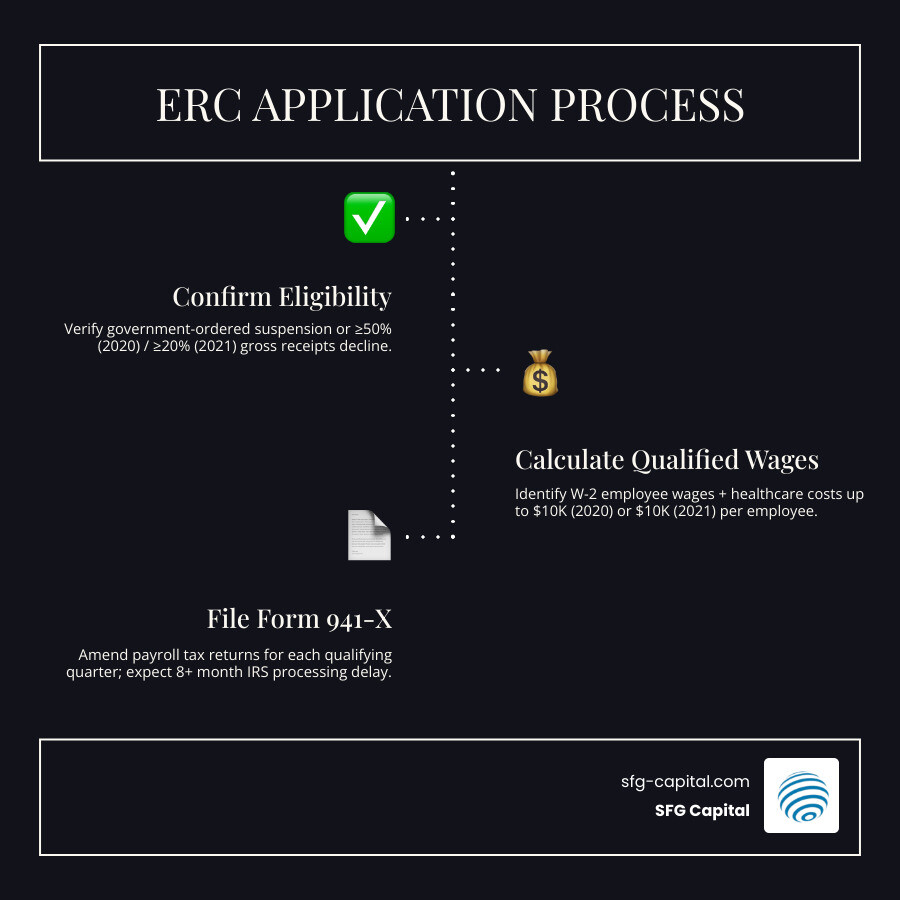
Here is a quick overview of the core steps:
- Confirm eligibility — Your business must have experienced a government-ordered suspension or a significant drop in gross receipts during 2020 or 2021.
- Calculate qualified wages — Identify which employee wages (and healthcare costs) count toward the credit for each qualifying quarter.
- File Form 941-X — Submit an amended quarterly payroll tax return for each period you qualify.
- Adjust your income tax return — Reduce your wage expense deduction to reflect the credit claimed.
- Wait for IRS processing — Refunds are currently taking over 8 months due to IRS backlogs and compliance reviews.
The IRS has received approximately 3.6 million ERC claims since the program launched. Right now, around 400,000 claims worth roughly $10 billion are still being processed. That means delays are real — and getting every step right the first time matters more than ever.
Many business owners find the process confusing, time-consuming, and full of risk. Errors can trigger audits, penalties, or outright disallowance of your claim.
I’m Santino Battaglieri, and through SFG Capital I have helped evaluate and fund over $500 million in ERC claims, giving me deep, hands-on experience with every stage of the erc application process. In this guide, I’ll walk you through each step clearly so you can move forward with confidence.
Understanding Eligibility for the ERC Application Process

The most critical part of the erc application process is making sure you actually qualify. We see a lot of excitement around the potential “big check,” but the IRS is currently under a magnifying glass looking for improper claims. To qualify, your business generally needs to meet one of two main tests for the 2020 or 2021 tax years.
First, there is the Government Order Test. This applies if your business operations were fully or partially suspended due to orders from an appropriate governmental authority. This includes federal, state, or local orders that restricted travel, commerce, or group meetings due to COVID-19. For example, if you are a restaurant in Austin and were forced to close your dining room or operate at limited capacity, you likely meet this criteria for that period.
Second, there is the Gross Receipts Test. This is a purely mathematical check. You compare your gross receipts for a specific quarter in 2020 or 2021 to the same quarter in 2019. If the decline is significant enough, you qualify regardless of whether you were shut down by the government.
To keep your records straight, you should have your 941 payroll tax forms handy for every quarter you intend to claim. If you need a deeper dive into how these credits interact with your overall tax strategy, you can find more info about taxes on our blog.
Revenue Decline Thresholds
The “significant decline” mentioned above has two different definitions depending on the year:
- For 2020: Your gross receipts for a quarter must have declined by more than 50% compared to the same quarter in 2019.
- For 2021: The threshold is much lower. You only need a 20% decline in gross receipts compared to the same quarter in 2019 (or, in some cases, the immediately preceding quarter).
There is also a special category called a Recovery Startup Business. If you started your business after February 15, 2020, and your average annual gross receipts are under $1 million, you might qualify for the credit in the third and fourth quarters of 2021, even without a revenue decline or a shutdown order.
Impact of Government Mandates
When we talk about “partial shutdowns,” it’s not always as simple as a locked door. The IRS looks for a “more than nominal” impact on your business. This could include:
- Reductions in capacity (e.g., a gym that could only allow 25% occupancy).
- Inability to travel for essential business meetings.
- Disruptions to your supply chain because your primary suppliers were shut down by their own local government orders.
If you have specific questions about your unique situation, the Frequently asked questions about the Employee Retention Credit – IRS page is a great resource to bookmark.
Calculating Qualified Wages and Gathering Documentation
Once you know you’re eligible, the next step in the erc application process is the math. You need to determine which wages count as “qualified.” Generally, these are wages and compensation paid to W-2 employees during the periods your business met the eligibility criteria.
One of the biggest mistakes we see is including everyone. You must exclude wages paid to majority owners (those owning more than 50%) and their relatives. Yes, even if your brother-in-law is your hardest worker, his wages usually won’t count for the ERC.
| Feature | 2020 ERC | 2021 ERC |
|---|---|---|
| Credit Rate | 50% of qualified wages | 70% of qualified wages |
| Annual/Quarterly Cap | $10,000 per year | $10,000 per quarter |
| Max Credit per Employee | $5,000 total | $7,000 per quarter ($21,000 – $28,000 total) |
| Eligibility Period | March 13 – Dec 31 | Jan 1 – Sept 30 (Dec 31 for Startups) |
We have refined Our Process to help businesses navigate these complex calculations without leaving money on the table or over-claiming.
Identifying Qualified Wages
The definition of qualified wages also changes based on your business size in 2019:
- Small Employers: For 2020, this meant having 100 or fewer full-time employees (FTEs). For 2021, the cap jumped to 500 or fewer FTEs. If you are a small employer, all wages paid to employees during the eligible period count, whether they were working or not.
- Large Employers: If you were above those FTE caps, you can only claim the credit for wages paid to employees not to work (i.e., you kept paying them while they were at home during a shutdown).
“Full-time employee” for ERC purposes means someone who averaged at least 30 hours of service per week or 130 hours per month.
Essential Paperwork for the ERC Application Process
Do not hit “send” on your application without a mountain of backup data. The IRS is auditing these claims heavily, and you need to be able to substantiate every penny. We recommend gathering:
- Payroll Summary Reports: Detailed by employee for each quarter.
- Profit and Loss Statements: To prove those 20% or 50% revenue declines.
- Healthcare Expenses: Monthly statements showing the employer-paid portion of health insurance, as these costs can often be added to the qualified wage amount.
- PPP Loan Records: You cannot “double-dip.” Wages paid with forgiven PPP loan funds cannot be used to claim the ERC. You’ll need your PPP forgiveness application to show which wages were already covered.
How to File Form 941-X: The Core ERC Application Process
Since the original deadlines for filing quarterly returns have passed, the only way to claim the credit now is by filing Form 941-X, Adjusted Employer’s Quarterly Federal Tax Return or Claim for Refund. You must file a separate Form 941-X for each quarter you are amending.
This is the “technical” heart of the erc application process. It’s not just about putting a number in a box; it’s about explaining to the IRS exactly why that number has changed. For more background on how these amendments fit into your broader business strategy, check out our more info about finance section.
Step-by-Step Form Completion
Filling out the Form 941-X requires precision. Here is the general flow:
- Part 1: Select whether you are filing an “Adjusted Employment Tax Return” or a “Claim.” Most businesses filing for a refund will check the box for a claim.
- Part 2: Complete the certifications. You’ll need to confirm that you’ve informed employees (if applicable) and that you aren’t claiming wages that were already used for other credits.
- Part 3: This is where the math happens. You will enter the corrected amounts for your qualified wages and the resulting credit. You’ll compare the “Original Amount” from your first 941 to the “Corrected Amount.”
- Part 4: This is the explanation section. You must provide a detailed narrative of why you are amending the return. Don’t just say “ERC.” Explain that you met the gross receipts test or were subject to specific government orders.
- Part 5: Sign and date. An unsigned form is a one-way ticket to the rejection pile.
For the nitty-gritty details, always refer to the Official IRS 941 X instructions.
Mailing and Submission Guidelines
Unlike your standard tax returns, you cannot e-file Form 941-X. You must mail it. The IRS has two primary processing centers for these forms: one in Ogden, Utah, and one in Cincinnati, Ohio.
The correct address depends on the state where your business is located and whether you are including a payment (which you won’t be if you’re claiming a refund). We strongly suggest using Certified Mail with a Return Receipt. This provides you with proof that the IRS actually received your application, which is vital given the current 8-month-plus wait times. You can find the specific Form 941x mailing instructions on the IRS website to ensure your packet goes to the right building.
Navigating IRS Delays, Audits, and the Moratorium
If you have been following the news, you know the erc application process has hit a few speed bumps lately. In September 2023, the IRS announced a moratorium on processing new ERC claims. While they have since begun processing claims again, they are doing so with extreme caution and much slower timelines.
Currently, the IRS is processing about 400,000 claims, but they are prioritizing the oldest ones and those that appear most legitimate. If you receive Letter 6612, don’t panic—but do pay attention. This letter typically indicates that your claim is being audited or held for additional review. It means your refund will be delayed until the IRS finishes its investigation.
For the latest official updates, the Employee Retention Credit | Internal Revenue Service landing page is the best place to check for moratorium news.
Recognizing ERC Scams and Promoters
The IRS Commissioner has repeatedly warned about “ERC Mills”—unscrupulous promoters who charge massive contingency fees (sometimes 20-30%) and promise that every business qualifies. Here are some red flags to watch for:
- Unsolicited calls or emails: Reputable tax professionals don’t usually cold-call you to tell you that you’re “pre-qualified.”
- Lack of documentation: If a promoter says you don’t need to prove your revenue decline or government shutdown, run away.
- Contingency fees only: While some legitimate firms work this way, be wary of those who don’t offer any hourly or flat-fee options for the due diligence phase.
- Pressure to file fast: They might tell you the money is “running out” to get you to sign a contract before you’ve done your research.
Managing an IRS Audit
If your claim is selected for an audit, the IRS will ask for the documentation we discussed earlier: payroll records, P&Ls, and proof of government orders. You have a right to professional representation during an audit, and we highly recommend it.
If the IRS disallows your claim, you generally have 30 days to file an appeal. The audit process can be stressful, but if your records are organized and your eligibility was determined correctly, you should be able to substantiate your claim.
Correcting Errors: Withdrawals and Disallowance Appeals
What if you realized you made a mistake? Maybe you worked with a promoter who was a little too aggressive, and now you’re worried your claim won’t stand up to an audit. The IRS has created a Withdrawal Program for exactly this reason.
If you filed a Form 941x but the IRS hasn’t paid it yet—or if they sent a check but you haven’t cashed it—you can withdraw the claim. This allows you to avoid potential penalties and interest that would come with an audit of an improper claim.
The Withdrawal Procedure
To withdraw an unprocessed claim, you typically need to:
- Make a copy of the Form 941-X you submitted.
- Write “Withdrawn” in the left margin of the first page.
- Have an authorized person sign and date the right margin.
- Fax the request to the IRS at 855-738-7609.
If you received a check but haven’t deposited it, you must void the check and mail it back with a withdrawal request to the Cincinnati Refund Inquiry Unit. This process treats the claim as if it were never filed, which can protect you from many civil penalties, though it doesn’t necessarily stop a criminal investigation if fraud was intended.
Adjusting Income Tax Returns
One often-overlooked step in the erc application process is the impact on your income taxes. Under Section 2301(e) of the CARES Act, you cannot “double-deduct.” This means you must reduce your wage expense deduction on your income tax return by the amount of the ERC you received.
If you already filed your income tax return for 2020 or 2021 and then claimed the ERC, you generally need to file an amended income tax return for that year. However, if your ERC claim is eventually disallowed by the IRS, you can typically increase your wage expense in the year the disallowance becomes final to make things right.
Frequently Asked Questions about the ERC Application Process
What are the current filing deadlines for 2020 and 2021?
This is a “good news, bad news” situation.
- 2020 Claims: The deadline was April 15, 2024. For most businesses, the window to claim wages paid in 2020 has now closed.
- 2021 Claims: You still have time! The deadline to file for 2021 qualified wages is April 15, 2025.
These deadlines are based on the three-year statute of limitations for amending payroll tax returns. If you haven’t filed for 2021 yet, we recommend moving quickly, as the erc application process takes time to document correctly.
Can I claim the ERC if I received a PPP loan?
Yes! Originally, you had to pick one or the other, but Congress changed the law in late 2020 to allow businesses to claim both. The catch is that you cannot use the same dollar of wages for both programs.
For example, if you used $100,000 of PPP funds to pay your staff, those specific wages are “used up.” You can only use the wages paid in excess of that $100,000 to qualify for the ERC. Coordination between your PPP forgiveness application and your ERC claim is one of the most complex parts of the process.
How long does it take to receive an ERC refund?
In the early days of the program, refunds took 2 to 4 months. Today, due to the IRS backlog of 400,000 pending claims and the heightened compliance reviews, most businesses are waiting 8 to 12 months—sometimes longer.
If you are facing an extreme financial hardship, you can reach out to the Taxpayer Advocate Service, but they are also overwhelmed. This is why many businesses in Travis County look for alternative ways to access their funds sooner.
Conclusion
The erc application process is an incredible opportunity for businesses that survived the challenges of 2020 and 2021, but it is not a “set it and forget it” tax form. From confirming eligibility and navigating the 500-employee cap to filing the 941-X and waiting out the IRS moratorium, every step requires diligence.
At SFG Capital, we understand that waiting 12 months for a refund isn’t always an option for a growing business in Austin or anywhere else in Travis County. That’s why we offer ERC refund advances and buyout options. We provide the capital you’ve already earned, allowing you to bypass the IRS delays and put that money back to work in your business immediately.
Our fee structure is performance-based, meaning we only succeed when you do. If you’re tired of checking the mailbox and want expert assistance in finalizing your claim or accessing your funds today, explore Our Services to see how we can help you cross the finish line of the erc application process.