
Why Understanding Business Tax Credits Can Save Your Business Thousands
Business tax credit opportunities can reduce your tax bill dollar-for-dollar, making them one of the most powerful financial tools available to American businesses. Here’s what you need to know:
What is a Business Tax Credit?
- A direct reduction of your tax liability (not just your taxable income)
- Worth the full amount claimed (a $5,000 credit saves you $5,000)
- Offered by the IRS to encourage specific business activities
- Different from tax deductions, which only reduce taxable income by a percentage
Key Business Tax Credits Available:
- Employee Retention Credit (ERC): Up to $28,000 per employee for COVID-19 impacts
- Work Opportunity Tax Credit (WOTC): Up to $9,600 per eligible new hire
- R&D Tax Credit: 20% of qualified research expenses
- Small Employer Health Insurance Credit: Up to 50% of premium costs
- Clean Energy Credits: Various incentives for green technology investments
For many businesses, navigating the complex world of tax credits feels overwhelming. The forms are complicated, the eligibility rules are dense, and the potential money left on the table is significant. But understanding these credits—especially if your business was impacted by COVID-19—can mean the difference between struggling with cash flow and having the working capital you need to grow.
I’m Santino Battaglieri, and through SFG Capital, I’ve helped businesses access over $500 million in ERC claims and other business tax credit opportunities, focusing on compliant, documentation-driven approaches that protect your business while maximizing your refund. This guide breaks down the most valuable credits available to you and shows you exactly how to claim them.
What is a Business Tax Credit and How Does It Work?
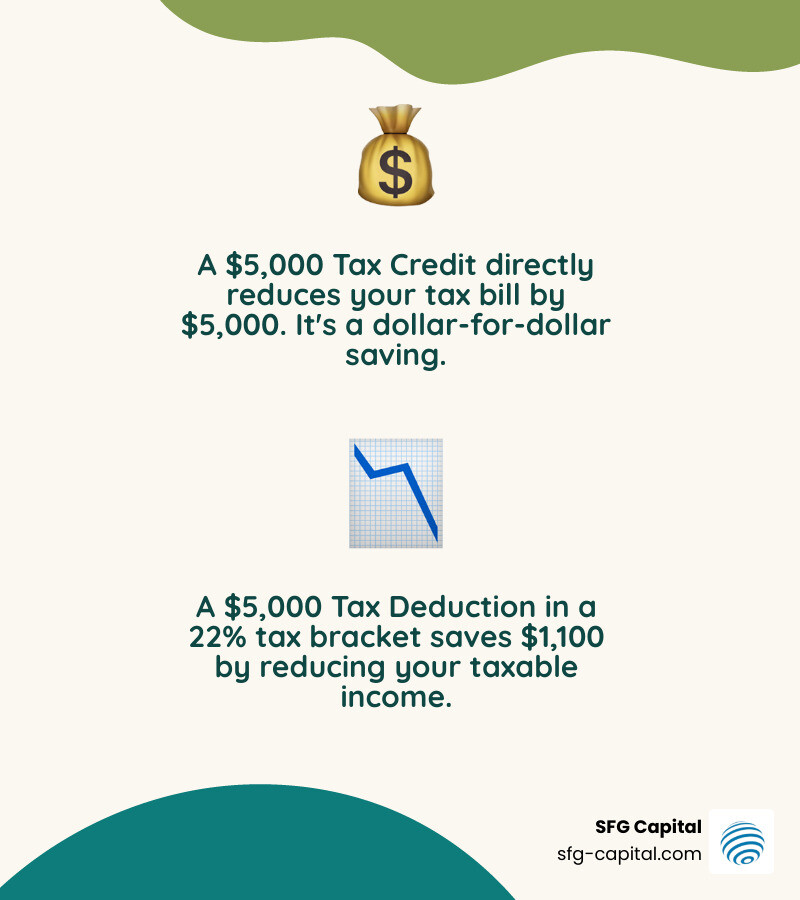
Let’s start with the basics. A business tax credit is a direct reduction of the amount of tax you owe. Think of it as a coupon you can apply directly to your tax bill. If you owe $10,000 in taxes and qualify for a $5,000 tax credit, your tax bill immediately drops to $5,000. It’s a dollar-for-dollar reduction, making it an incredibly powerful tool for boosting your bottom line.
This is where it fundamentally differs from a tax deduction. A tax deduction reduces your taxable income, not your actual tax bill. The amount you save from a deduction depends on your tax bracket. For example, if your business is in a 22% tax bracket and you claim a $5,000 tax deduction, you’re reducing your taxable income by $5,000, which in turn reduces your tax bill by $1,100 (22% of $5,000). While still beneficial, it’s not the same direct impact as a credit.
Here’s a quick comparison to illustrate the difference:
| Feature | Tax Credit | Tax Deduction |
|---|---|---|
| Impact | Reduces tax liability dollar-for-dollar | Reduces taxable income |
| Value | Direct reduction of tax owed | Reduces tax owed by a percentage of the deduction (based on tax bracket) |
| Example ($5,000) | Reduces tax bill by $5,000 | Reduces tax bill by $1,100 (for a business in a 22% bracket) |
The main purpose of business tax credit programs is to encourage businesses to engage in activities that the government deems beneficial for the economy or society. This could include hiring certain types of workers, investing in research and development, promoting clean energy, or providing employee benefits. These credits act as incentives, making these activities more financially attractive.
Many individual business tax credit opportunities are grouped under what the IRS calls the “General Business Credit” (GBC). This isn’t one single credit, but rather a collection of numerous specific credits that businesses can claim. To claim these credits, you’ll generally file individual forms for each specific credit you qualify for, and then aggregate them all on IRS Form 3800, General Business Credit. This form helps you calculate your total allowable credit for the year. Unused portions of the GBC can often be carried back one year to recover past taxes or carried forward for up to 20 years to reduce future tax liabilities.
For a comprehensive overview and to find a list of current business credits, we recommend visiting the official IRS website. You can also explore a guide to federal income tax brackets to better understand how deductions impact your specific situation.
Major Employee-Based Tax Credits for Businesses

Our employees are the backbone of our businesses, and the government offers several business tax credit programs to incentivize employers for supporting their workforce, especially through challenging times. These credits can provide significant payroll tax offsets and encourage hiring and retention.
Employee Retention Credit (ERC) and Paid Leave Credit
The Employee Retention Credit (ERC) was a lifeline for many businesses during the COVID-19 pandemic. It’s a refundable tax credit designed to encourage businesses to keep employees on their payrolls. While the program has largely ended for most businesses, many are still eligible to claim it retroactively, and we specialize in helping businesses in Travis County and beyond steer this complex process.
ERC Eligibility and Credit Amounts:
- For 2020: Businesses could claim 50% of qualified wages paid, up to $10,000 per employee, resulting in a maximum credit of $5,000 per employee. Eligibility required either a significant decline in gross receipts (50% reduction compared to the same quarter in 2019) or a full or partial suspension of operations due to a government order.
- For 2021: The credit became even more generous, allowing businesses to claim 70% of qualified wages, up to $10,000 per employee per quarter. This meant a potential maximum of $7,000 per employee per quarter, totaling up to $28,000 per employee for the entire year. Eligibility for 2021 was met with a 20% decline in gross receipts (compared to the same quarter in 2019 or the immediately preceding quarter).
A common question we hear is, “Can businesses that received PPP loans still claim the ERC?” The answer is yes! While you couldn’t use the same wages for both PPP loan forgiveness and the ERC, many businesses can still claim the ERC for eligible payroll costs not used for PPP. This is a crucial point many businesses miss.
We understand that navigating the ERC can be complex, especially with recent changes and ongoing processing delays. For more in-depth information, you can explore our resources on What is ERC Funding? and The Waiting Game: Understanding and Overcoming ERC Refund Delays.
Alongside the ERC, the Paid Leave Credit was also introduced to support businesses offering paid leave due to COVID-19 related reasons. This credit provided dollar-for-dollar tax credits for wages paid for qualifying sick or family leave.
- For FY2020 (Paid Sick Leave): Businesses could claim up to 80 hours of paid leave at either the employee’s regular wage (capped at $511/day or $5,110 total) for direct illness/quarantine, or two-thirds of the regular wage (capped at $200/day or $2,000 total) for caregiving.
- For FY2020 (Paid Family Leave): Businesses could provide up to ten additional weeks of leave at two-thirds of regular wages, capped at $200/day or $10,000 total.
These credits provided essential relief, ensuring employees could take necessary time off without undue financial burden, and employers were compensated for it.
Work Opportunity Tax Credit (WOTC)
The Work Opportunity Tax Credit (WOTC) is another fantastic business tax credit that rewards employers for hiring individuals from certain target groups who face significant barriers to employment. It’s a federal credit designed to help these individuals transition from welfare to work and gain sustainable employment.
We can save up to $9,600 per eligible new hire, depending on the target group and the wages paid. The WOTC program covers 10 worker categories including:
- Qualified veterans
- Recipients of Temporary Assistance for Needy Families (TANF)
- Recipients of Supplemental Nutrition Assistance Program (SNAP) benefits
- Long-term unemployment recipients
- Ex-felons
- Vocational rehabilitation referrals
To claim the WOTC, employers must first complete Form 8850, Pre-Screening Notice and Certification Request for the Work Opportunity Credit, to prescreen the new hire and request certification from their state workforce agency. Once the employee is certified, employers can then claim the credit using Form 5884, Work Opportunity Credit. This credit can be a win-win, helping individuals find meaningful employment while providing a valuable tax break for your business.
Employer Credit for Paid Family and Medical Leave
Beyond the COVID-19 specific paid leave credits, a more general business tax credit exists to encourage employers to offer paid family and medical leave: the Employer Credit for Paid Family and Medical Leave (Section 45S). This credit rewards businesses that voluntarily provide qualifying paid leave to their employees.
To be eligible, your business must have a written policy that offers:
- At least two weeks of paid family and medical leave annually.
- A minimum of 50% wage replacement for the duration of the leave.
- The leave must be available to all qualifying employees.
The credit amount ranges from 12.5% to 25% of the wages paid, depending on the wage-replacement percentage provided, for up to 12 weeks per eligible employee. For example, if you offer 100% wage replacement, you’d qualify for the higher 25% credit. This credit was made permanent by the One Big Beautiful Bill Act (OBBBA), ensuring its long-term availability for businesses committed to supporting their employees’ work-life balance.
We can find more details and frequently asked questions on the IRS FAQs on the Paid Family and Medical Leave Credit and claim this credit using Form 8994, Employer Credit for Paid Family and Medical Leave.
A Guide to Common Types of Business Tax Credit Opportunities
Beyond employee-centric benefits, business tax credit programs also target innovation, growth, and sustainable practices across various industries. These incentives cover everything from cutting-edge research to green energy investments and community development.
A Business Tax Credit for Innovation and Growth
Innovation is the engine of our economy, and the government recognizes this with the Credit for Increasing Research Activities, more commonly known as the R&D tax credit. This credit incentivizes businesses for engaging in qualified research and development activities aimed at developing new products, processes, software, or significantly improving existing ones.
To qualify, your activities generally need to pass a “four-part test”:
- Qualified Purpose: The activity must intend to create a new or improved function, performance, reliability, or quality.
- Technological in Nature: The activity must rely on principles of physical, biological, engineering, or computer sciences.
- Elimination of Uncertainty: The activity must involve attempts to eliminate uncertainty about the development or improvement of a product or process.
- Process of Experimentation: The activity must involve a process of experimentation, such as evaluating alternatives or testing hypotheses.
The R&D tax credit can be incredibly valuable. For eligible small businesses, it can offset up to $500,000 of their payroll tax liability. To claim this credit, you’ll need to file Form 6765, Credit for Increasing Research Activities, with your federal tax return. Small businesses don’t claim this credit directly against income tax; instead, they file Form 8974, which offsets up to $250,000 of that small business’ share of Social Security taxes for that year.
Another significant business tax credit designed to foster growth in underserved areas is the New Markets Tax Credit (NMTC). This program helps revitalize struggling economies by offering a 39% tax credit over seven years to private investors who fund Community Development Entities (CDEs) in low-income communities. These investments typically support businesses that create jobs and provide goods and services in areas that need them most. The NMTC was also made permanent as part of the OBBBA, reflecting its ongoing importance in community development.
Finally, we have Opportunity Zones, which function as an economic development tool rather than a direct tax credit, but offer substantial tax deferral benefits. These are designated U.S. distressed areas where companies and individuals can invest to support economic development and growth. The primary benefit for businesses and investors is the ability to defer or even reduce capital gains taxes when they reinvest those gains into qualified Opportunity Funds that then invest in these zones. It’s a powerful way to spur investment in areas that historically have lacked capital.
A Business Tax Credit for Supporting Your Workforce
Investing in your workforce goes beyond just wages; it includes benefits, retirement planning, and accessibility. Several business tax credit programs are designed to support these efforts.
The Small Employer Pension Plan Startup Credit helps small businesses establish retirement plans for their employees. The SECURE 2.0 Act of 2022 significantly expanded this credit. Under SECURE 2.0, eligible employers with 50 or fewer employees can now receive a credit up to 100% of qualified startup costs for the first three years of a new retirement plan. This is a substantial increase from previous limits. Additionally, businesses that add automatic enrollment to a new or existing retirement plan can receive an extra $500 tax credit per year, for up to three years. You can learn more about these changes and other impacts of the SECURE 2.0 Act.
For businesses committed to supporting working parents, the Employer-Provided Child Care Tax Credit is a valuable incentive. This credit offers 25% of your qualified child care expenses, plus 10% of your qualified child care resource and referral expenditures, with a maximum credit of $150,000. This helps offset the costs of providing on-site child care facilities or assisting employees with external child care services. You’ll use Form 8882 to claim this credit.
Providing health insurance is a major expense for many small businesses, which is why the Credit for Small Employer Health Insurance Premiums exists. This credit is designed to help small businesses afford employee health insurance. To qualify, your business must have fewer than 25 full-time equivalent (FTE) employees, pay average wages below an annual inflation-adjusted limit, and offer a qualifying health care plan through a Small Business Health Options Program (SHOP) Marketplace. If you meet these criteria, you could receive a credit of up to 50% of the employee health insurance premiums you pay (or 35% for tax-exempt employers). We claim this on Form 8941.
Making your business accessible to everyone is not only good practice but can also earn you a business tax credit. The Disabled Access Tax Credit is available for small businesses that incur expenses to make their premises or services accessible to individuals with disabilities. This includes things like installing ramps, widening doorways, providing accessible restrooms, or offering auxiliary aids and services. The credit covers 50% of eligible access expenditures between $250 and $10,250, resulting in a maximum tax credit of $5,000. You’ll claim this on Form 8826.
Finally, the Empowerment Zone Employment Credit encourages job creation and retention in economically distressed areas. If your business is located in a designated Empowerment Zone and you hire and retain employees who also live in that zone, you could claim a credit of up to $3,000 per eligible employee. These zone designations have been extended through December 31, 2025, meaning this credit remains available for the 2025 tax year. You can find out if your business is located in an Empowerment Zone by visiting HUD’s website and claim this credit using Form 8844.
Green Energy and Manufacturing Credits
In an era of increasing focus on sustainability and domestic production, several business tax credit programs are designed to incentivize green energy adoption and advanced manufacturing.
While the original Alternative Motor Vehicle Credit expired for vehicles purchased after December 31, 2021, the federal government now offers the Clean Vehicle Credit for new, qualified plug-in electric vehicles (EVs) and fuel cell electric vehicles (FCEVs) purchased in 2023 or after. This credit can be up to $7,500, depending on the vehicle’s battery capacity and meeting strict requirements related to critical minerals and battery components being sourced from North America. What’s even better, since January 1, 2024, the credit can often be transferred to dealers at the point of sale, providing an immediate discount. You can find more details on the Clean Vehicle Credit.
The Advanced Manufacturing Production Credit was established by the Inflation Reduction Act of 2022 (IRA) to boost domestic production of clean energy components. This credit is equal to a specific rate based on “Eligible Components” produced by a manufacturer in the United States and sold within the taxable year. Eligible components include:
- Solar energy components (e.g., solar cells, wafers, modules)
- Wind energy components (e.g., blades, nacelles, towers)
- Inverters
- Electrode active materials
- Qualifying battery components
- Applicable critical minerals
This credit also offers options for elective payment or transferability, allowing businesses to monetize the credit even if they don’t have sufficient tax liability. You can explore the full details of the Advanced Manufacturing Production Credit on the IRS website.
Replacing older, less efficient incentives, the Clean Electricity Production Credit is a newly established, tech-neutral, and emissions-based production tax credit. It applies to facilities placed in service after December 31, 2024, and is flexible across various clean electricity technologies. The credit starts at a base rate of 0.3 cents per kilowatt-hour of electricity produced and sold. However, for small facilities (less than 1 megawatt), this rate jumps to 1.5 cents per kilowatt-hour if they meet prevailing wage and apprenticeship requirements. Bonus credits are also available for meeting domestic content requirements and for facilities located in “energy communities.”
Speaking of prevailing wage requirements, these are becoming increasingly important for maximizing many green energy business tax credit opportunities. For example, the Alternative Fuel Vehicle Refueling Property Tax Credit (for EV chargers and clean fuel stations) offers a significantly higher credit (30% of cost up to $100,000 per item) if prevailing wage and apprenticeship requirements are met, compared to a lower rate (6% of cost) if they are not. Always check the specific requirements for each credit to ensure you’re maximizing your potential benefit.
How to Claim General Business Tax Credits
Claiming business tax credit opportunities might seem daunting, but once you understand the process, it becomes much clearer. As we’ve mentioned, many individual business tax credit programs are consolidated under the umbrella of the General Business Credit (GBC).
Here’s a general overview of how we typically approach claiming these credits:
- Identify Eligible Credits: First, we help you determine which specific business tax credit programs your business qualifies for based on your activities, investments, and hiring practices.
- Calculate Individual Credits: Each specific credit has its own IRS form (e.g., Form 5884 for WOTC, Form 6765 for R&D, Form 8941 for Small Employer Health Insurance Premiums). We accurately calculate the amount of each individual credit on its respective form.
- Consolidate on Form 3800: Once the individual credits are calculated, we then transfer those amounts to Form 3800, General Business Credit. This form aggregates all your current year business credits and helps determine your total allowable GBC.
- Apply the Credit: The GBC is then applied directly against your business’s tax liability.
What if your total business tax credit exceeds your tax liability for the current year? That’s where the carryback and carryforward rules come in handy. Unused portions of the GBC can often be carried back one year to offset taxes you paid in the previous year, potentially resulting in a refund. Alternatively, you can carry the unused credit forward for up to 20 years to reduce future tax liabilities. This flexibility ensures that the value of the credits isn’t lost, even if you have a low tax year.
Staying informed about official IRS forms and publications is crucial, as rules and forms can change annually. We always rely on the most current information available from the IRS Forms and Instructions portal to ensure compliance and accuracy for our clients.
Frequently Asked Questions about Business Tax Credits
We often hear similar questions from business owners navigating tax credits. Let’s address some of the most common ones.
What’s the most valuable tax incentive: a credit or a deduction?
A tax credit is almost always more valuable because it reduces your tax bill on a dollar-for-dollar basis. A deduction only reduces your taxable income, so its value is a percentage of the deduction amount based on your tax bracket. For example, a $1,000 tax credit saves you $1,000 in taxes, while a $1,000 tax deduction might only save you $220 if your business is in a 22% tax bracket. This direct impact makes credits significantly more powerful for your bottom line.
Can I claim multiple business tax credits in the same year?
Yes, absolutely! In fact, many businesses qualify for and claim multiple business tax credit programs in a single year. As we’ve discussed, many individual business credits are grouped under the General Business Credit. We calculate each credit on its specific form and then summarize them on Form 3800 to determine your total allowable credit for the year. This aggregation simplifies the process of applying multiple credits against your tax liability.
Are business tax credits only available at the federal level?
No. While this guide primarily focuses on federal credits, many states also offer their own business tax credit programs. These state-level incentives are designed to encourage activities like job creation, investment, research and development, or specific industry growth within the state. For businesses operating in our area, for example, Texas offers programs like the Texas Enterprise Zone Program, which can provide significant tax benefits for businesses that create jobs and make capital investments in designated economically distressed areas. Always check with your state’s tax authority for local opportunities that can complement federal credits.
Conclusion: Key Takeaways for Your Business
Navigating the landscape of business tax credit opportunities can feel like a complex puzzle, but the rewards for solving it are substantial. These credits are not just government handouts; they are strategic incentives designed to encourage specific behaviors that benefit our economy, our communities, and our workforce.
Here are our key takeaways for your business:
- Proactive Planning is Key: Don’t wait until tax season to think about credits. Understanding what’s available throughout the year allows us to plan activities that can maximize our eligibility.
- Documentation is Crucial: For every credit, meticulous record-keeping is non-negotiable. We need to be able to substantiate all claims with clear, organized documentation.
- Professional Guidance is Invaluable: Tax laws are constantly changing, and eligibility requirements can be complex. Working with tax professionals who specialize in business tax credit programs ensures we’re identifying all opportunities and claiming them correctly.
- The ERC Remains a Significant Opportunity: For businesses impacted by COVID-19, the Employee Retention Credit (ERC) still represents a substantial opportunity for retroactive claims. Even with IRS delays, the funds can be transformative.
At SFG Capital, we understand the challenges businesses face, especially when waiting for substantial refunds like the ERC. That’s why we help businesses in Travis County and beyond access their ERC funds faster without waiting on the IRS, offering solutions like ERC bridge loans and refund advances. Our goal is to ensure you have the capital you need to thrive, without the undue stress of long processing times.
Don’t leave money on the table. Take the time to understand these powerful incentives. Explore ERC Funding Solutions and find how business tax credit opportunities can boost your bottom line and fuel your growth.