
Bridge the Gap: Advance Your ERC Refund Today
Why Business Owners Are Turning to ERC Loan Advances

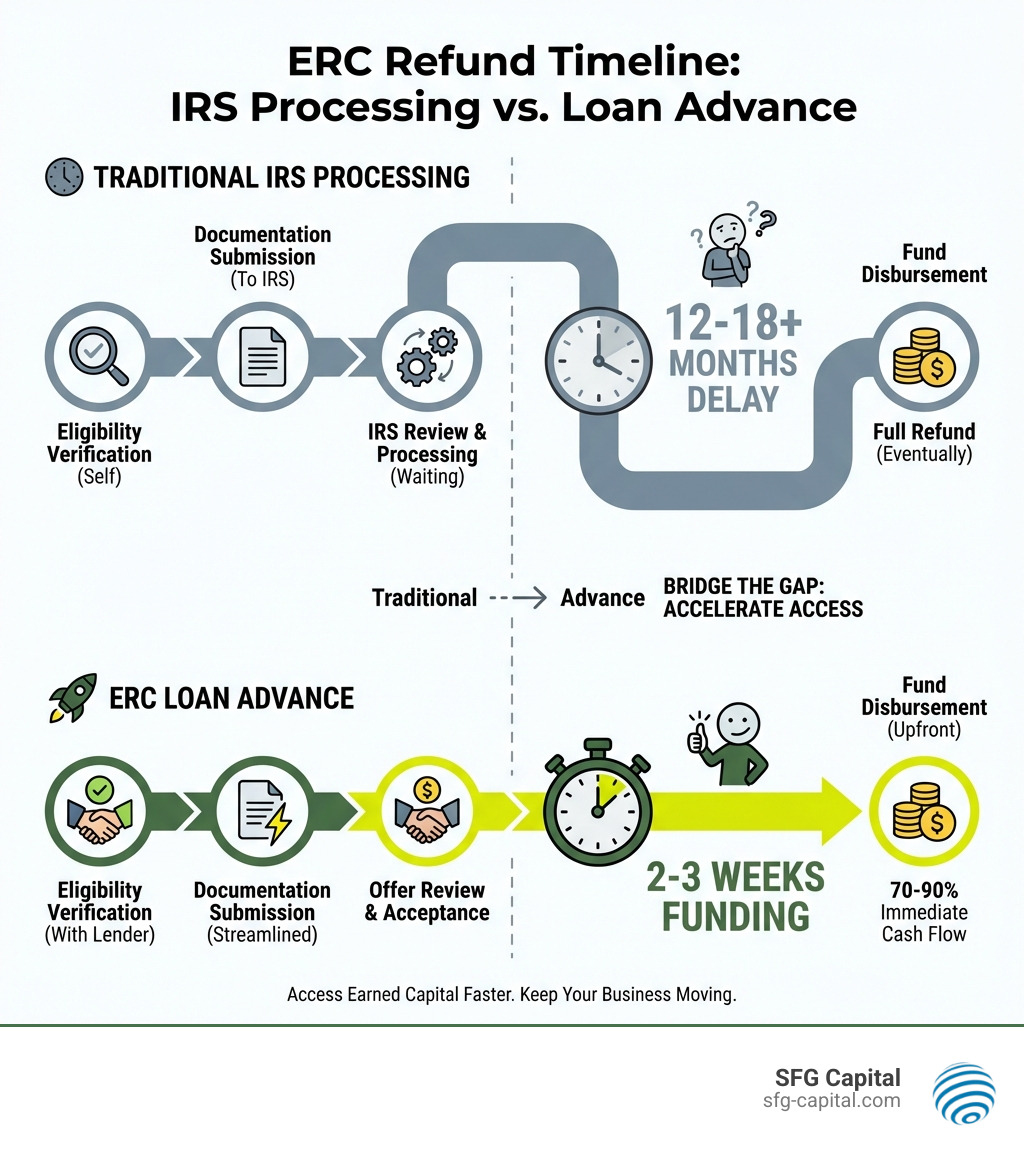
An ERC loan advance provides immediate cash flow by allowing eligible businesses to access their Employee Retention Credit refund before the IRS processes their claim. In many cases, funding can arrive in weeks instead of waiting many months.
Quick Answer: How an ERC Loan Advance Works
- You qualify for the ERC – Your business meets eligibility criteria (government suspension, gross receipts decline, or recovery startup status)
- You apply for an advance – Submit your ERC claim documentation to a private lender or buyer
- Receive a portion upfront – Get immediate cash, often a percentage of your expected refund
- The provider is repaid from the refund – When the IRS refund arrives, it is used to settle the advance under your agreement
The reality for many businesses is that IRS processing can be slow, and waiting for funds you’ve already earned can strain payroll, growth plans, and day-to-day operations.
ERC advance funding bridges the gap. Instead of waiting for the IRS to process your refund, you can sell or borrow against your pending claim to access capital now. The trade-off is straightforward: you receive less than the full refund amount, but you get money when you can use it.
Three common structures:
- ERC Buyouts – Sell your claim for a discounted amount; typically no repayment obligation
- ERC Bridge Loans – Short-term loans that are repaid when your refund arrives
- ERC Advances – A hybrid structure; terms vary by provider and may include timing-related repayment requirements
I’m Santino Battaglieri, and through SFG Capital, I’ve helped businesses access over $500 million in ERC claims through structured funding and ERC loan advance solutions. My focus is on compliance-driven, transparent approaches that help businesses access their earned credits efficiently while maintaining full regulatory alignment.
Understanding the ERC loan advance and How It Works
The Employee Retention Credit (ERC) helped many businesses in Travis County and across the United States keep employees on payroll during the COVID-19 pandemic in 2020 and 2021. This refundable tax credit can be worth up to $26,000 per employee for eligible employers. However, receiving the refund can take a long time, which can create a cash flow crunch.
This is where an ERC loan advance can help. It allows a business to access a portion of its anticipated ERC refund now rather than waiting for the IRS to issue payment. A provider pays a lump sum upfront (often a percentage of the expected refund) in exchange for the right to be repaid from the ERC refund when it arrives.
For businesses in Austin, TX, that want to keep operations moving, an ERC loan advance can convert a pending refund into usable working capital. For more information, explore our More info about ERC funding solutions. You can also review official guidance from the IRS: Employee Retention Credit | Internal Revenue Service.
How an ERC loan advance differs from traditional financing
It’s easy to confuse an ERC loan advance with a traditional loan, but there are important differences.
A traditional loan typically involves:
- Collateral: Often requires physical assets, real estate, or inventory as security.
- Credit Score: Heavily dependent on your business’s credit history and personal credit score.
- Debt-to-income: Adds to your business’s overall debt, impacting future borrowing capacity.
- Repayment Structure: Fixed monthly payments with interest.
An ERC loan advance, on the other hand, operates differently:
- Collateral: The anticipated ERC tax refund itself serves as the primary collateral.
- Credit Score: Many providers focus more on the validity and size of your ERC claim than on credit alone.
- Debt-to-income: Depending on structure (for example, a buyout), it may not function like conventional debt.
- Repayment Structure: The advance is typically settled from the IRS refund under the terms of the agreement.
An ERC loan advance leverages an earned tax credit to create near-term liquidity. To see how advance funding is commonly structured, visit The Fast Track to Your ERC Cash: A Guide to Advance Funding.
The mechanics of ERC advance funding
While terms vary by provider, ERC advance funding is usually designed to be straightforward:
- Claim Verification: The provider reviews your ERC claim and supporting documentation.
- Agreement/Assignment: You enter into a purchase agreement (buyout) or a loan/advance agreement that ties repayment to the refund.
- Lump Sum Payment: The provider disburses a lump sum, typically a percentage of the expected refund.
- Fee Structure: Costs are reflected as a discount (buyout) or as fees/interest (loan/advance), depending on structure.
- Refund Collection: When the IRS issues the refund, it is applied to repay the provider pursuant to the agreement.
The core idea is that you’re trading some of the future refund value for immediate access to capital. For a deeper walkthrough, see our ERC Advance Funding Complete Guide.
Step-by-Step Guide to Obtaining Your Advance
Securing an ERC loan advance can feel complex, so the goal is to keep the process clear and documentation-driven. Funding timelines vary based on whether your claim is already filed and how quickly documents can be verified. In many cases, once a claim is verified and approved, funds can be disbursed within a few weeks.

Initial eligibility assessment
Before considering an ERC loan advance, confirm your eligibility for the ERC. Eligibility generally falls into three categories:
- Significant Decline in Gross Receipts: For 2020, generally a 50% decline in gross receipts compared to the same calendar quarter in 2019. For 2021, generally a 20% decline compared to the same calendar quarter in 2019.
- Full or Partial Suspension of Operations: Operations were fully or partially suspended due to a government order limiting commerce, travel, or group meetings due to COVID-19.
- Recovery Startup Business: For the third and fourth quarters of 2021, some businesses that started after February 15, 2020 may qualify if they meet the applicable requirements.
The ERC applies to qualifying wages paid in 2020 and 2021. The statute of limitations for the 2020 ERC claims is April 15, 2024, and for 2021 claims, it’s April 15, 2025. Even if you’ve already filed, confirming eligibility is essential before pursuing funding. To learn more, visit Unlock Your ERC Requirements: Advances and What You Need to Know.
Qualifying for an ERC loan advance
Once you’ve confirmed ERC eligibility, advance providers typically focus on the strength and supportability of your claim.
Key factors providers often review include:
- Valid ERC Claim: A properly calculated claim, usually filed (or ready to file) via amended employment tax returns (Form 941-X) for eligible quarters.
- Documentation Quality: Forms 941/941-X, payroll data, financial statements, and clear ERC calculations.
- No Unresolved Issues That Could Disrupt Payment: For example, significant unresolved tax issues or liens that may complicate how refunds are issued.
- Third-Party Prepared Claims: If another firm prepared your ERC claim, the provider will typically verify it before funding.
Our team at SFG Capital helps businesses in Travis County and Austin, TX gather and organize documentation, and we emphasize due diligence and compliance-first review. For a detailed checklist, visit ERC Funding Requirements.
Comparing Funding Options: Buyouts vs. Bridge Loans
When you’re waiting for your ERC refund, you essentially have a choice between three main ways to get cash sooner: an ERC loan advance, an ERC bridge loan, or an ERC advanced buyout. While they all aim to solve the same problem—the IRS’s slow processing times—they operate with different structures, risks, and benefits.
| Feature | ERC Advanced Buyout | ERC Bridge Loan | ERC Loan Advance (Hybrid) |
|---|---|---|---|
| Nature | Sale of your future refund | Short-term loan | Loan secured by future refund |
| Repayment | None (buyer assumes risk) | Monthly interest payments, principal repaid by refund | Potential repayment if IRS doesn’t pay within timeframe |
| Ownership | Transfers to buyer | Retained by business | Retained by business (collateralized) |
| Cash Upfront | Up to 90% of claim | Up to 60-70% LTV of claim | Up to 60-70% LTV of claim |
| Interest/Fees | Discount rate (implicit in purchase price) | Monthly interest rates | One-time fee or monthly interest, depending on provider |
| Risk to Business | Minimal (claim validity is checked upfront) | Standard loan risk | Moderate (potential repayment if claim disallowed/delayed) |
| Timeline | 1-3 weeks | Few days to few weeks | Few days to few weeks |
ERC advanced buyouts vs. bridge loans
Let’s dive a bit deeper into the two most distinct options: ERC advanced buyouts and ERC bridge loans.
ERC Advanced Buyouts:
This option is essentially selling your pending ERC refund to a third party. They buy your future refund at a discounted rate, typically up to 90% of your claim.
- Non-Recourse: A key benefit is that these are often “non-recourse” transactions. This means once you’ve sold your claim and received the lump sum, you usually have no further obligation, even if the IRS later disallows part of the claim (though this depends on the specific agreement and due diligence). The buyer assumes the risk of IRS processing delays and potential disallowances.
- No Monthly Payments: There are no monthly interest payments or loan repayments to worry about. The transaction is complete once you receive your funds.
- Accelerated Payout: Buyouts often provide the fastest access to cash, typically within 1 to 3 weeks.
- Ownership Transfer: You transfer ownership of the specific ERC claim to the purchasing fund.
ERC Bridge Loans:
These are more akin to traditional short-term loans, specifically designed for businesses waiting on an ERC refund.
- Monthly Interest: You will pay monthly interest on the borrowed amount until the IRS refund arrives.
- Repayment Terms: The anticipated refund acts as collateral, and the loan is repaid in a balloon payment once the IRS check is received.
- Credit Checks: Lenders typically conduct credit checks and require more extensive financial documentation, similar to a standard loan application.
- LTV Ratio: You might receive up to 60% loan-to-value (LTV) of your expected tax refund amount.
- Ownership Retained: You retain ownership of your ERC claim, but it’s pledged as collateral.
We find that for businesses prioritizing simplicity and risk transfer, ERC advanced buyouts are often appealing. For those who prefer a more traditional loan structure and are comfortable with monthly interest, an ERC bridge loan might be a better fit. You can explore more about these options at ERC Bridge Loans and Sell Your ERC Claim: A Guide to Advance Payments and Buyouts.
Choosing the right ERC loan advance for your business
Deciding between an ERC loan advance, a buyout, or a bridge loan comes down to your business’s unique financial situation, immediate capital needs, and risk tolerance. There’s no one-size-fits-all answer, but we can help you weigh the pros and cons.
Consider these questions:
- How urgently do you need capital? If you need funds in a matter of days or a few weeks to cover payroll, invest in growth, or manage unexpected expenses, an advance or buyout can provide that immediate capital.
- What is your risk tolerance? An ERC buyout often offloads the risk of IRS delays and potential disallowances to the funding provider, offering greater peace of mind. A bridge loan or a hybrid ERC loan advance might keep more of that risk with your business.
- Are you comfortable with a discounted payout? All these options involve a cost for expedited access. For buyouts, it’s a discount on the total refund. For bridge loans, it’s interest. You need to decide if the value of immediate cash outweighs receiving slightly less than the full refund later.
- Do you prefer debt or a sale? A bridge loan adds to your debt, whereas a buyout is a sale of an asset. Your preference for your balance sheet might guide this decision.
We help businesses in Travis County and Austin, TX, analyze these factors to make an informed choice. Our goal is to connect you with the solution that best fits your needs, ensuring you get the most favorable terms possible. Don’t wait for the IRS backlog to clear; explore your options to access your cash now. Find out more about top ERC lenders to finance your credit at Need Cash Now? Top ERC Lenders to Finance Your Credit.
Documentation and Compliance Requirements
Securing an ERC loan advance hinges on providing accurate and complete documentation. This isn’t just about speed; it’s about compliance and ensuring the integrity of your claim. The IRS has increased scrutiny of ERC claims due to widespread erroneous filings, making strong documentation more important than ever.
Essential paperwork for a fast approval
To keep the application and verification process moving, prepare a complete document package so the provider can validate the claim.
Typically, the required documents include:
- IRS Forms 941 (Employer’s Quarterly Federal Tax Return): The original forms filed for the quarters you’re claiming the ERC.
- IRS Forms 941-X (Adjusted Employer’s Quarterly Federal Tax Return or Claim for Refund): The amended forms where the ERC is claimed.
- Payroll Journals/Records: Detailed payroll data for the eligible periods, showing wages paid.
- Profit & Loss (P&L) Statements: Financials that support gross receipts comparisons and business activity.
- Tax Returns: Business income tax returns for relevant years (often 2019, 2020, 2021).
- ERC Eligibility Calculations: Documentation supporting how you qualified (government orders and/or quarter-by-quarter gross receipts comparisons).
- Bank Statements: Recent business bank statements.
- Articles of Incorporation/Operating Agreement: Basic formation documents.
Our team assists businesses in Travis County in compiling and reviewing this paperwork. For a detailed guide, visit ERC Funding Application: A Step-by-Step Guide to Claiming Your Credit and Employee Retention Credit Advance Guide.
IRS scrutiny and the Voluntary Disclosure Program
The IRS has been vocal about concerns regarding fraudulent and erroneous ERC claims. This heightened scrutiny means that any claim tied to an ERC loan advance should be well-supported and defensible.
The IRS has also offered Voluntary Disclosure Program (VDP) options and related procedures that may help some taxpayers resolve incorrect claims. Program availability, deadlines, and terms can change, so businesses should review current IRS guidance and consult a qualified tax professional.
What this means for your ERC loan advance:
- Due Diligence Matters: Reputable providers conduct careful review before funding.
- Reduced Risk: Strong support can help mitigate the risk of disallowance, repayment disputes, penalties, and interest.
- Withdrawal/Disclosure Options: If a claim is incorrect, there may be IRS pathways to address it depending on status and timing.
For official details, refer to IRS Announcement 2024-30.
Risks, Tax Implications, and Considerations
While an ERC loan advance offers significant benefits by providing immediate liquidity, it’s crucial for businesses to understand the potential risks, tax implications, and other considerations. We believe in full transparency to help our clients in Austin, TX, make informed decisions.
Impact on income tax filings
Receiving an ERC refund, whether directly from the IRS or through an ERC loan advance, has specific tax implications for your business’s income tax filings. The ERC is not considered taxable income itself. However, Section 280C of the Internal Revenue Code requires that businesses reduce their deduction for wages by the amount of the ERC claimed.
This means:
- Wage Deduction Reduction: The amount of qualified wages used to calculate the ERC cannot also be deducted as a business expense on your income tax return.
- Amended Returns: If you’ve already filed your income tax returns for the years in which you claimed the ERC (2020 and 2021), you may need to file amended income tax returns (e.g., Form 1120-X for corporations or amended partnership returns) to reflect this wage expense reduction.
- Timing: This adjustment must be made in the tax year the wages were paid, not the year the ERC was received.
It’s a common misconception that the ERC is “free money” with no tax implications. While it’s a refundable credit, the interaction with wage deductions is critical. We always recommend consulting with a tax professional to ensure proper income tax adjustments are made. For a deeper dive into the overall funding process, visit What is ERC Funding?. For specific information on ERC refund advances and their tax implications, see ERC Refund Advance.
Relationship with PPP loans
Many businesses in Travis County that qualified for the ERC also received Paycheck Protection Program (PPP) loans during the pandemic. Initially, businesses could not claim both the ERC and a PPP loan. However, legislation later changed, allowing businesses to claim both, but with a critical caveat: you cannot use the same payroll costs for both programs. This is often referred to as “no double-dipping.”
Key points to remember:
- Separate Expenses: Ensure that the wages used to calculate your ERC claim are distinctly separate from the wages used for PPP loan forgiveness.
- Strategic Planning: Businesses had to strategically allocate their payroll costs to maximize both benefits without overlap.
- Documentation: Maintain meticulous records to demonstrate that no double-counting occurred, as this is a common area of IRS scrutiny.
If you received both a PPP loan and the ERC, any ERC loan advance provider will carefully review your documentation to ensure there’s no overlap in claimed wages. This verification is crucial for the validity of your ERC claim and, consequently, your advance. We help businesses steer this complex interplay to ensure compliance and maximize their benefits. Don’t let the complexities hold you back; learn how you can access your ERC funds today by visiting Don’t Wait for the IRS: How to Get an ERC Loan or Advance Today.
Frequently Asked Questions about ERC Advances
We often hear similar questions from businesses in Austin, TX, considering an ERC loan advance. Here are some of the most common ones:
What happens if my ERC claim is disallowed after receiving an advance?
This is a critical question and the answer depends heavily on the type of ERC loan advance agreement you have.
- ERC Advanced Buyout (Non-Recourse): If you entered into a true non-recourse buyout, where you sold your claim outright, the risk of disallowance is typically borne by the purchasing fund. This means you generally would not be required to repay the advance. However, “non-recourse” clauses can vary, so always review your agreement carefully.
- ERC Bridge Loan or Hybrid Advance: If your advance is structured as a loan or a hybrid, you may be responsible for repaying the advance if your ERC claim is disallowed or significantly reduced by the IRS. The advance agreement will outline the terms of repayment in such a scenario, which might include interest and the full amount of the advance.
Due to increased IRS scrutiny and potential for disallowance, we rigorously vet all ERC claims to minimize this risk for our clients. We ensure your claim is well-documented and defensible.
Can I get an advance if I filed with a different processor?
Yes, absolutely! Many businesses in Travis County filed their ERC claims with various tax credit processors. You can still obtain an ERC loan advance even if your claim was prepared and filed by another firm.
Here’s how it typically works:
- Verification: We will perform our own due diligence to quickly verify the accuracy and validity of your existing ERC claim, even if it was processed by another company. This is a crucial step to ensure the claim is robust and meets our funding criteria.
- Documentation: You’ll need to provide all the documentation related to your filed ERC claim, including the Forms 941-X, payroll records, and eligibility calculations.
- Funding: Once we’ve verified your claim, we can proceed with offering an advance. Borrowers who have already filed for ERC with a different processor can often receive funding in as little as two weeks upon receipt of all requested documents.
Our goal is to help you access your funds, regardless of who initially processed your claim, provided it stands up to our thorough review.
Are there any upfront fees associated with ERC loan advances?
Generally, reputable providers of ERC loan advances do not charge upfront fees. Our model, for instance, involves a performance-based fee that is typically deducted from the advance amount or paid upon the IRS refund’s arrival.
Here’s what to expect:
- No Upfront Application Fees: You shouldn’t have to pay a fee just to apply for an advance.
- Discount/Interest Rate: The cost of the advance will be incorporated into the terms, either as a discount on the total refund amount (for buyouts) or as an interest rate (for bridge loans/advances). This is typically transparently outlined in your agreement.
- Due Diligence Costs: Some providers might charge a small fee for the extensive due diligence required to verify your claim, but this is usually disclosed upfront and part of the overall cost, not a separate “upfront fee” to get started.
We pride ourselves on transparency, ensuring you understand all costs associated with your ERC loan advance before you commit. Always be wary of any provider demanding large upfront fees without clear terms or guarantees.
Conclusion
The Employee Retention Credit was a vital program for businesses in Travis County and across the United States, providing much-needed support during unprecedented times. However, the IRS’s extended processing timelines have turned a lifeline into a long, uncertain wait for many. An ERC loan advance offers a powerful solution, bridging this gap by changing your pending refund into immediate, usable capital.
Whether you opt for an ERC advanced buyout, a bridge loan, or a hybrid advance, the ability to access up to 90% of your claim in weeks rather than months can be a game-changer for your business’s cash flow, operational stability, and growth opportunities. We’ve seen how this expedited access to funds empowers businesses to make payroll, invest in expansion, or simply weather ongoing economic uncertainties.
At SFG Capital, we specialize in helping businesses in Austin, TX, steer the complexities of ERC funding. Our performance-based fee structure aligns our success with yours, ensuring a transparent and efficient process. We carefully verify your claims, providing peace of mind and protecting you from potential IRS scrutiny. Don’t let the IRS backlog dictate your business’s future. Take control of your cash flow and advance your ERC refund today.