
Don’t Go It Alone: Partnering with an ERC Funding Specialist
Why Navigating the ERC Alone Can Cost You Thousands
An ERC funding specialist helps businesses claim the Employee Retention Tax Credit by handling eligibility analysis, documentation, claim preparation, and IRS compliance—often securing 10-20% more funding than general CPAs while providing audit protection and faster access to refunds.
What ERC Funding Specialists Do:
- Evaluate your business against over 200 pages of ERC tax code
- Calculate maximum refund amounts (up to $26,000 per employee)
- Prepare and file amended payroll tax returns
- Steer PPP loan interactions and wage calculations
- Provide audit defense and compliance documentation
- Offer advance funding options to bypass IRS delays
The Employee Retention Credit represents one of the most significant stimulus programs from the CARES Act, yet its complexity leaves billions in unclaimed refunds on the table. The IRS itself has acknowledged processing backlogs that stretch months or even years, while the technical requirements for proper documentation can overwhelm even experienced business owners. Many companies that received PPP loans mistakenly believe they’re ineligible, missing out on substantial refunds. Others struggle to determine if their COVID-19 operational changes—supply chain disruptions, reduced hours, canceled events, or government-mandated restrictions—actually qualify them for credits.
The stakes are high. Eligible businesses can receive up to $5,000 per employee for 2020 and up to $7,000 per employee per quarter for the first three quarters of 2021. For a business with 20 employees, that’s potentially over $500,000 in refundable tax credits. But claiming these funds requires navigating intricate qualification pathways, precise wage calculations, and detailed substantiation that most general accountants aren’t equipped to handle.
Common ERC challenges business owners face:
- Determining if revenue reduction or government shutdown provisions apply
- Calculating qualified wages correctly under 2020 vs. 2021 rules
- Avoiding double-dipping with PPP forgiveness
- Gathering proper documentation to withstand IRS scrutiny
- Managing cash flow while waiting 6-18 months for refund checks
I’m Santino Battaglieri, and through SFG Capital, I’ve helped businesses access over $500 million in ERC funding by combining deep regulatory knowledge with structured funding solutions that work around IRS delays. As an ERC funding specialist, I’ve seen how the right expertise can mean the difference between a denied claim and a maximized refund.
Understanding the Employee Retention Tax Credit (ERC)
The Employee Retention Credit (ERC) is a refundable tax credit designed to encourage businesses to keep employees on their payroll during the COVID-19 pandemic. Introduced as part of the CARES Act in 2020, it was later expanded and modified, making it a powerful financial lifeline for many businesses in Travis County and across the United States. Unlike a loan, the ERC is a direct refund from the IRS that does not need to be repaid.
For a comprehensive dive into the ERC, you can explore our guide: The ERC Explained: Everything You Need to Know About This Tax Credit.
Who Was Eligible for the ERC?
Eligibility for the ERC was primarily focused on businesses that experienced significant disruptions due to the pandemic. This includes employers of all sizes, from small businesses in Austin to larger enterprises, provided they met specific criteria. The key was demonstrating how COVID-19 impacted their operations or finances.
How a Business Could Qualify for the ERC
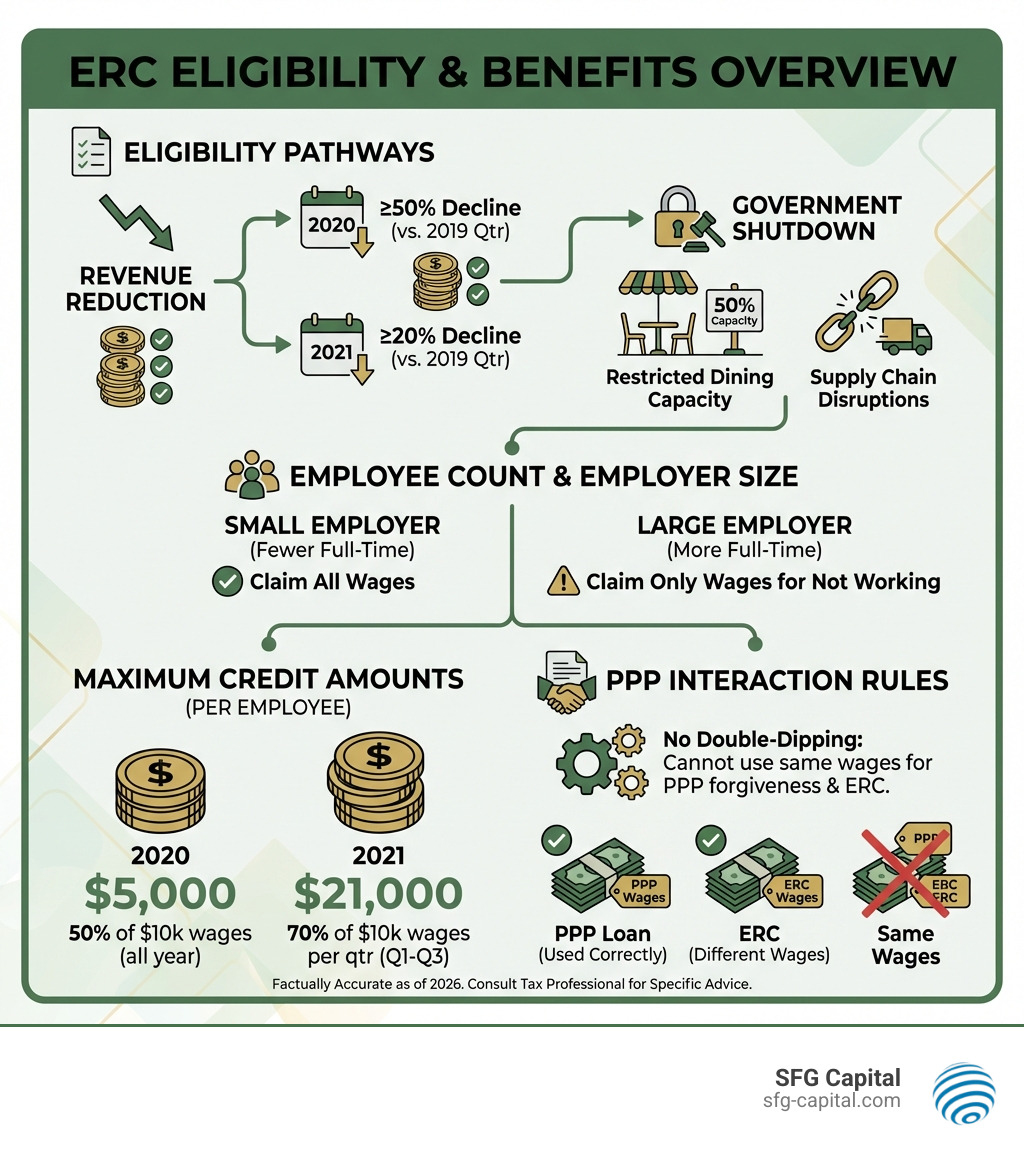
There were two main pathways for a business to qualify for the ERC, for both 2020 and 2021:
Significant Decline in Gross Receipts: This was the most straightforward qualification method.
- For 2020: Businesses qualified if their gross receipts for a calendar quarter were less than 50% of their gross receipts for the same calendar quarter in 2019. Eligibility continued until gross receipts for a quarter were more than 80% of the gross receipts for the same calendar quarter in 2019.
- For 2021: The rules were eased. Businesses qualified if their gross receipts for a calendar quarter were less than 80% of their gross receipts for the same calendar quarter in 2019. Alternatively, they could elect to use the immediately preceding calendar quarter to determine the reduction.
Full or Partial Suspension of Operations Due to Government Order: This pathway covered businesses whose operations were fully or partially suspended due to a government order limiting commerce, travel, or group meetings due to COVID-19. This is where things get a bit more nuanced and often required expert interpretation.
Examples of qualifying shutdowns include:
- A restaurant in Austin that had to close or limit on-site dining (e.g., closing every other table) due to COVID-19 restrictions.
- A business that typically met with clients in person but had to cancel meetings due to government restrictions.
- A local shop that had to reduce its operating hours or capacity because of COVID-19 restrictions and cleaning requirements.
- A manufacturer experiencing delayed production timelines caused by government-mandated supply chain disruptions.
- An event venue that had to cancel or significantly restrict attendance at a planned event due to COVID-19 orders.
Even if your revenue increased in 2020 or 2021, you could still qualify if you experienced a full or partial shutdown of your business due to a government order. This often surprises business owners, but it’s a critical detail where an ERC funding specialist excels.
For a detailed walkthrough of eligibility, check out our ERC Eligibility Checklist: Don’t Miss Out!. You can also learn more about the basics on our page: What is ERC?
How Much Funding a Business Could Receive
The potential funding from the ERC was substantial, making it one of the most lucrative pandemic relief programs.
- For 2020: Eligible businesses could receive a refundable tax credit of up to $5,000 per employee for the entire year. This was calculated as 50% of the first $10,000 in qualified wages and health plan expenses paid to employees after March 12, 2020, and before January 1, 2021.
- For 2021: The credit was significantly improved. Businesses could receive up to $7,000 per employee per quarter for the first three quarters (Q1, Q2, and Q3). This was calculated as 70% of the first $10,000 in qualified wages and health plan expenses paid per employee per quarter.
This means that a business could potentially receive a total refund of up to $26,000 per employee ($5,000 for 2020 + $7,000 for Q1 2021 + $7,000 for Q2 2021 + $7,000 for Q3 2021). For a business with, say, 10 employees, this could translate to a refund of $260,000 – a truly significant cash infusion.
Why You Need an ERC Funding Specialist
Navigating the ERC program isn’t a walk in the park. It’s more like a trek through a dense jungle with a 200-page tax code as your compass. The complexity of the regulations, the need for precise calculations, and the ever-present risk of an IRS audit make seeking specialized help not just a convenience, but a necessity for most businesses.

The Benefits of Using an ERC Funding Specialist
Best Expertise and Maximized Refunds: General CPAs are excellent at income tax, but the ERC is a payroll tax credit, and its rules are distinct and intricate. An ERC funding specialist lives and breathes ERC. Our proprietary software and professional team of CPAs have assisted thousands of businesses in retaining billions of dollars in stimulus funding. We average 10-20% more funding than a CPA not intimately familiar with the program, ensuring you get every dollar you deserve. This hyper-specialization means we understand the nuances of the 200-page tax code better than anyone. We can help identify obscure qualification pathways and ensure all eligible wages are included.
Accuracy and Compliance: Claiming the ERC incorrectly can lead to severe penalties or, worse, an audit. A specialist ensures your claim is carefully prepared and fully compliant with IRS guidelines. This includes properly documenting the impact of government orders or revenue declines, calculating qualified wages accurately, and avoiding common pitfalls like double-dipping with PPP loans.
Audit Protection: The IRS is increasing its scrutiny of ERC claims. Having an ERC funding specialist on your side means you have expert representation if your claim is audited. We can help you gather the necessary documentation and articulate your eligibility, giving you peace of mind.
Time Savings: Your time is valuable. The ERC application process is time-consuming, requiring extensive data collection and analysis. By outsourcing this to an ERC funding specialist, you can focus on running your business, knowing that experts are handling your claim efficiently.
Faster Access to Funds (Advance Funding): The IRS backlog for processing ERC claims can be lengthy, sometimes stretching 6-18 months or more. While waiting for a refund check can be frustrating, an ERC funding specialist like SFG Capital can offer advance funding or buyout options. This means you can receive a significant portion of your anticipated refund much faster, providing immediate cash flow for your business.
We understand the challenges, and we’re here to help. For more information, please visit our dedicated pages: ERC Specialists Who Can Help Your Business Claim Its Credit, Need ERC Help? Find Top Employee Retention Credit Advisors Here, and Employee Retention Credit Help.
How an ERC Funding Specialist Differs from a CPA
While your trusted CPA is indispensable for annual tax filings and general financial advice, the ERC is a beast of a different color. Here’s why an ERC funding specialist brings a unique and often more beneficial approach:
- Specialized Focus: Traditional CPAs handle a broad range of tax and accounting services, from income tax to bookkeeping. The ERC, however, is a payroll tax credit. Many CPAs aren’t equipped to handle these claims because it’s distinct from their typical business income tax returns. An ERC funding specialist has an exclusive focus on the ERC, meaning we’ve developed deep expertise and streamlined processes specifically for this program. This allows us to be the experts, resulting in more funding for your business.
- In-depth Program Knowledge: The ERC tax code is over 200 pages long, filled with intricate rules, interpretations, and amendments. Keeping up with these changes and understanding their implications requires constant dedication. Our team’s strict focus on ERC allows us to master these complexities, often identifying eligibility points and maximizing credits that a generalist might overlook. The research shows that companies like ours average 10-20% more funding than a CPA not familiar with the program.
- Proprietary Technology and Processes: We leverage specialized software and methodologies custom for ERC claim processing. This allows for more efficient data analysis, accurate calculations, and faster submission of amended payroll tax returns (Form 941-X). This streamlined process leads to faster results and quicker receipt of funds for your business.
- Proactive Audit Support: Because we deal exclusively with ERC, we’re well-versed in the documentation and substantiation required to withstand IRS scrutiny. Our services often include built-in audit support, which is a critical differentiator from many general accounting firms.
For a deeper understanding of this distinction, refer to our Employee Retention Credit Specialist Guide and From Compliance to Claims: Your Guide to Top ERC Tax Credit Services.
What to Look for in an ERC Funding Specialist
Choosing the right ERC funding specialist is a crucial decision that can significantly impact your refund amount and the overall experience. Here’s what businesses in Travis County and beyond should prioritize:
- Experience and Specialization: Look for a firm with a proven track record solely focused on ERC. Our team strictly focuses on ERC, allowing us to be the experts and resulting in more funding for your business. This specialization ensures deep regulatory knowledge and a higher chance of maximizing your claim.
- Transparent and Performance-Based Fees: A reputable ERC funding specialist will often operate on a performance-based fee structure, meaning they only get paid a percentage of the refund you receive. This aligns their success directly with yours. We pride ourselves on clear, upfront fee structures.
- Proprietary Technology and Efficient Processes: Efficient processing is key. Look for specialists who use advanced software and streamlined processes to handle claims quickly and accurately. Our proprietary software and professional team of CPAs have assisted thousands of businesses.
- Advance Funding Options: Given the IRS’s processing delays, immediate access to cash can be a game-changer. Inquire about advance funding, bridge loans, or buyout programs. SFG Capital, for instance, offers advance funding solutions to help you manage cash flow while awaiting your IRS refund. Explore our options: ERC Advance Funding and ERC Funding Solutions. If you need cash now, we can help: Need Cash Now? Top ERC Lenders to Finance Your Credit.
- Robust Customer Support and Communication: You should feel supported throughout the entire process. Look for a specialist that offers dedicated support and clear communication channels. We value customer service above all else and will always go out of our way to ensure that each client is satisfied with their experience working with us.
- Audit Support: A strong ERC funding specialist will stand by their work and offer audit support in case the IRS queries your claim. This is a critical safeguard.
- Local Expertise (for us, Travis County/Austin TX): While the ERC is a federal program, having a partner who understands the local business landscape can be an added advantage. As a firm deeply rooted in Travis County, we understand the specific challenges and opportunities for businesses in our community.
Navigating the Application and Funding Process
The journey to claiming your ERC funds involves several steps, from initial eligibility assessment to receiving your refund. While an ERC funding specialist simplifies this significantly, understanding the general process can help you prepare.
The Application Process for the ERC
Here’s a typical step-by-step process we follow with our clients:
- Initial Consultation & Eligibility Assessment: We start with a thorough review of your business operations during 2020 and 2021. This involves examining your gross receipts and assessing any government-mandated shutdowns or partial suspensions that affected your business in Austin or Travis County. This initial phase helps us determine if and how you qualify.
- Data Collection: Once eligibility is established, we’ll request necessary documentation, primarily payroll records (Form 941s), PPP loan details (if applicable), and any documentation related to government orders or revenue declines.
- Calculation and Claim Preparation: This is where our expertise truly shines. We carefully calculate the qualified wages and the maximum credit amount your business is entitled to, considering all applicable rules for 2020 and 2021. This includes navigating the complexities of PPP loan interaction to ensure no double-dipping.
- Submission of Amended Returns: We prepare and file amended payroll tax returns with the IRS on your behalf.
- IRS Processing and Refund: The IRS then processes your amended returns and issues the refund check. This is often the longest part of the process, which is why our advance funding options are so valuable.
For more details on the process, visit our ERC Funding Process page.
Understanding 2020 vs. 2021 Credit Calculations
The ERC program evolved between 2020 and 2021, with significant changes in qualification criteria and credit amounts. Here’s a quick comparison:
| Feature | 2020 ERC | 2021 ERC (Q1, Q2, Q3) |
|---|---|---|
| Maximum Credit | Up to $5,000 per employee for the entire year | Up to $7,000 per employee per quarter (total $21,000 for 2021) |
| Credit Rate | 50% of qualified wages | 70% of qualified wages |
| Qualified Wages Limit | First $10,000 in wages per employee for the year | First $10,000 in wages per employee per quarter |
| Eligibility (Gross Receipts) | < 50% of 2019 gross receipts for the same quarter | < 80% of 2019 gross receipts for the same quarter (or prior quarter) |
| Small Employer Definition | 100 or fewer full-time employees (FTEs) in 2019 | 500 or fewer FTEs in 2019 |
This table highlights why precise calculations are essential, especially when dealing with different rules across multiple quarters.
PPP Loan Interaction
A common misconception is that businesses that received a Paycheck Protection Program (PPP) loan cannot qualify for the ERC. This is incorrect! While you can’t use the same wages for both PPP loan forgiveness and ERC, it’s entirely possible to qualify for both. Our role as an ERC funding specialist is to carefully allocate wages to maximize both benefits without any overlap, ensuring compliance.
Timeline for Receiving ERC Funds
This is often the most pressing question for businesses. The IRS processes ERC claims by issuing refunds on amended payroll tax returns (Form 941-X). Due to the sheer volume of claims, the IRS has experienced significant backlogs. While timelines can vary, businesses often face waiting periods of 6 to 18 months, or even longer, for their refund checks.
This extended waiting period can create significant cash flow challenges. That’s where our ERC advance funding solutions come into play. We can provide you with immediate capital, essentially a bridge loan against your anticipated ERC refund, allowing you to access funds much faster. Learn more about how we can help with cash flow: ERC Bridge Loans.
Once you receive your ERC funds, you might wonder how to best use them. We’ve compiled some ideas here: What Can ERTC Funds Be Used For?.
Frequently Asked Questions about ERC Funding
We hear a lot of questions about the ERC, and for good reason! It’s a complex program. Here are some of the most common inquiries we address:
Can I qualify if I received a PPP loan?
Yes, absolutely! This is one of the most persistent myths surrounding the ERC. Many businesses mistakenly believe that receiving a PPP loan disqualifies them from the ERC, causing them to miss out on potentially hundreds of thousands of dollars in refunds.
The truth is, a company can have a PPP loan and still take advantage of the ERC. The key rule is that you cannot use the same dollar-for-dollar funds (i.e., the same wages) for both PPP loan forgiveness and the ERC. Our role as an ERC funding specialist is to strategically analyze your payroll data and PPP forgiveness application to ensure that wages are allocated correctly, maximizing both your PPP forgiveness and your ERC credit without any overlap. We carefully identify which wages were used for PPP and then calculate the ERC based on other eligible wages. This ensures full compliance while optimizing your total stimulus benefits.
Are ERC funds considered taxable income?
No, the ERC credit itself is not considered income for federal income tax purposes. This is great news, as it means the refund you receive is largely tax-free.
However, there’s a crucial accounting adjustment you need to be aware of: you must reduce any deductible wage expenses by the amount of the credit. This adjustment impacts your business’s taxable income, effectively increasing it by the amount of the credit. For example, if you claimed $100,000 in ERC, your deductible wage expenses for the relevant periods would be reduced by $100,000. This is a vital detail that an ERC funding specialist will ensure is correctly handled to maintain compliance with IRS regulations.
What is the deadline for filing an ERC claim?
The ERC program has specific deadlines for claiming the credit, which are tied to the statute of limitations for amending payroll tax returns (Form 941-X).
- For 2020 ERC claims: The general deadline to amend Form 941 for quarters in 2020 was typically three years from the date the original Form 941 was filed or two years from the date the tax was paid, whichever is later. This generally meant a deadline of April 15, 2024, for most 2020 claims.
- For 2021 ERC claims: The general deadline to amend Form 941 for quarters in 2021 is typically three years from the date the original Form 941 was filed or two years from the date the tax was paid, whichever is later. This generally means a deadline of April 15, 2025, for most 2021 claims.
These deadlines refer to the filing of the amended returns. The IRS has, at times, adjusted its processing procedures and has recently announced a moratorium on processing new ERC claims due to a surge in fraudulent submissions. This underscores the importance of having a legitimate, well-documented claim and working with a reputable ERC funding specialist who understands the current landscape and can ensure your claim is valid and defensible, should the IRS resume processing in the future. While the window for new claims may be paused or closing, specialists can still assist with existing claims, audits, and navigating the complex rules.
Conclusion
Navigating the intricacies of the Employee Retention Credit program can be daunting. From deciphering the 200-page tax code to ensuring compliance and maximizing your refund, it’s a journey best undertaken with an expert by your side. An ERC funding specialist brings unparalleled expertise, proprietary tools, and a dedicated focus that general accountants simply cannot match, often securing significantly more funding and providing crucial audit protection.
At SFG Capital, we pride ourselves on being that trusted partner for businesses in Travis County and beyond. We understand the local business environment and are committed to helping our community thrive. Our expertise goes beyond just filing claims; we offer a seamless process, from eligibility assessment to claim preparation, and most importantly, we provide advance buyout programs to circumvent lengthy IRS delays, ensuring you get the cash you need when you need it.
Don’t leave potential refunds on the table or risk costly errors. Partner with an ERC funding specialist who can open up the full potential of your ERC claim.
Ready to explore how we can help your business? Find our full range of services and see how SFG Capital can support your financial growth: Our Services.
You can also learn more about our commitment to businesses like yours on our About Us page. Let us help you secure the funding your business deserves.