
Don’t Leave Money on the Table with the ERC Refund
What Is an ERC Refund — and How Do You Get Yours?
If you’re trying to understand the ERC refund process, here’s the short version:
| Key Point | Details |
|---|---|
| What it is | A refundable payroll tax credit for businesses that retained employees during COVID-19 |
| Who qualifies | Businesses with a significant drop in gross receipts or a full/partial government-mandated suspension in 2020–2021 |
| Maximum credit | Up to $5,000 per employee for 2020; up to $7,000 per employee per quarter for 2021 |
| How to claim it | File Form 941-X (amended payroll tax return) with the IRS |
| 2020 deadline | April 15, 2024 (expired) |
| 2021 deadline | April 15, 2025 |
| Tax treatment | Reduces your wage deductions — but does not count as taxable income |
| Spending rules | No restrictions — unlike PPP loans, you can use the funds however you need |
The Employee Retention Credit was created under the CARES Act as a lifeline for businesses that kept workers on payroll during the pandemic. It was later expanded significantly for 2021. For many businesses, it represents tens of thousands — sometimes hundreds of thousands — of dollars in refunds they’re still waiting to receive.
But the path from eligible to paid has been anything but smooth. The IRS has faced enormous backlogs, issued a moratorium on new claims, and launched aggressive fraud reviews. As of April 2024, over 597,000 ERC claims remained unprocessed. Many businesses are still waiting — frustrated, underfunded, and unsure what to do next.
This guide walks you through everything: eligibility, deadlines, tax treatment, IRS delays, scams to avoid, and what to do if your claim is challenged.
I’m Santino Battaglieri, founder of SFG Capital, a financial services firm that has purchased and funded over $500 million in ERC refund claims. My team works directly with CPAs and tax professionals to help businesses navigate the full ERC process — from eligibility analysis to funding — with a compliance-first approach. Let’s break this down step by step.
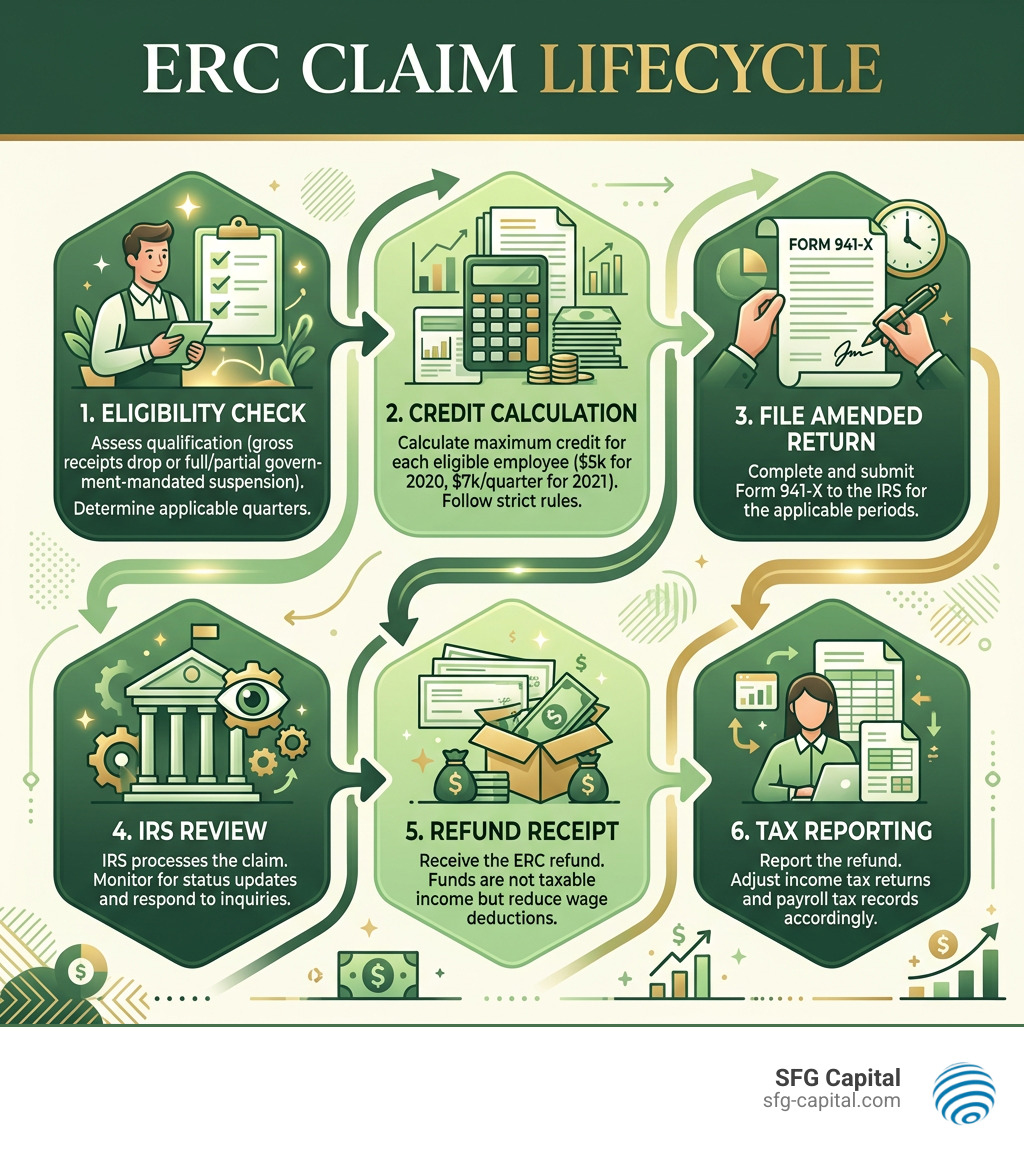
Understanding the ERC Refund: Eligibility and Deadlines
Navigating the erc refund landscape requires a clear understanding of the legislative shifts that occurred between 2020 and 2021. Originally, the CARES Act prohibited businesses that received Paycheck Protection Program (PPP) loans from claiming the ERC. However, the Consolidated Authorizations Act, 2021 retroactively changed this, allowing employers to benefit from both programs—provided the same wages aren’t used for both.
The America Rescue Plan of 2021 further extended the credit through the end of 2021, though the sunset date for most businesses was eventually moved up to September 30, 2021.

2020 vs. 2021 Eligibility Requirements
The rules for your erc refund changed significantly between the two years. If you are looking back at your payroll data, keep these distinctions in mind:
- 2020 Criteria: To qualify, your business must have experienced either a full or partial suspension of operations due to government orders or a 50% decline in gross receipts compared to the same quarter in 2019. The credit is 50% of up to $10,000 in qualified wages per employee for the year (a $5,000 max).
- 2021 Criteria: The barrier to entry was lowered. You only needed a 20% decline in gross receipts compared to 2019. The credit jumped to 70% of up to $10,000 in qualified wages per quarter. This means you could potentially claim $7,000 per employee for Q1, Q2, and Q3 of 2021.
- Recovery Startup Businesses: A special category exists for businesses that started after February 15, 2020, and have average annual gross receipts under $1 million. These businesses can claim the credit for Q3 and Q4 of 2021, capped at $50,000 per quarter.
Critical Filing Deadlines for Your ERC Refund
Time is of the essence, but it’s important to know which doors have already closed. The deadline for 2020 claims was April 15, 2024. If you missed that window, you can no longer file an initial claim for those periods.
However, the window for 2021 claims remains open until April 15, 2025. To claim the refund, you must file Form 941-X, which is an adjusted employer’s quarterly federal tax return. Because the IRS is under immense pressure to root out fraud, many businesses are finding that a ERC Refund Status Check – Don’t Be Left in the Dark is necessary to ensure their paperwork hasn’t fallen into a “black hole.”
How to Claim Your Refund and Navigate IRS Delays
If you’ve already filed, you know the “waiting game” is very real. Since mid-September 2023, the IRS has received roughly 3.6 million claims. This surge led to an immediate moratorium on processing new claims to protect against a wave of questionable submissions promoted by “ERC mills.”
Managing the IRS Backlog and Processing Times
As of April 2024, nearly 600,000 claims remained in the backlog. The IRS has shifted its processing timeline from a standard 90 days to 180 days or longer for many. If your claim is caught in this queue, you might find more information in our IRS ERC Backlog Update: Tracking Your Refund Status in 2025.
The IRS has also deployed hundreds of criminal investigators and referred thousands of claims for audit. If you are a business owner in Travis County or anywhere in the U.S. waiting on these funds, Decoding ERC Processing: Your Timeline for Employee Retention Credit Refunds can help you set realistic expectations. For those who can’t afford to wait, The Waiting Game: Understanding and Overcoming ERC Refund Delays explores why these bottlenecks exist and how to navigate them.
Spending Your ERC Refund Without Restrictions
One of the best features of the erc refund is its flexibility. Unlike PPP loans, which came with “forgiveness” strings attached and strict rules on payroll-to-utility ratios, the ERC is a refund of taxes you already paid.
| Feature | PPP Loan | ERC Refund |
|---|---|---|
| Category | Loan (Forgivable) | Tax Credit (Refundable) |
| Spending Limits | Strict (Payroll, Rent, Utilities) | No Restrictions |
| Audit Risk | High for large amounts | High due to recent fraud |
| Tax Impact | Not taxable; expenses deductible | Not taxable; reduces wage deduction |
Because there are no spending limitations, we often see our clients in Austin and across Travis County use these funds for:
- Reinvestment: Upgrading equipment or technology.
- Wage Increases: Boosting retention by rewarding the staff that stayed through the pandemic.
- Marketing: Aggressively pursuing new clients to make up for lost time.
- Expansion: Opening new locations or service lines.
Tax Treatment and Reporting Your ERC Refund
While the erc refund itself isn’t considered “gross income,” it has a significant impact on your tax returns. The most important rule to remember is that you cannot “double dip.” You must reduce your wage deduction on your income tax return by the amount of the credit you received.
Reporting Your ERC Refund as Income
IRS Notice 2021-20 and Notice 2021-49 clarify that the reduction in wage expenses must occur in the year the wages were paid, not the year the refund check arrives. This often requires amending 2020 or 2021 income tax returns.
However, recent Frequently asked questions about the Employee Retention Credit have provided some relief. If you received your refund after the statute of limitations for amending your original return has expired, the IRS has suggested you may be able to report the refund as income in the year received to avoid “whipsaw” tax scenarios. We always recommend consulting a trusted tax professional to determine the best path for your specific situation.
Handling Wage Expense Adjustments and Disallowances
What happens if you reduced your wage expenses in anticipation of a refund, but the IRS later disallows your claim? This is a common fear. Per Rev Rul 2020-27, the IRS initially took a hard line on deductions.
But there is good news: If your erc refund is ultimately disallowed in a later year (like 2024), you can generally increase your wage expense on your 2024 return. This allows you to recover the tax benefit without necessarily having to go back and re-amend your 2020 or 2021 returns.
Protecting Your Business: Scams, Withdrawals, and VDP
The “gold rush” of the ERC attracted some bad actors. “ERC Mills” began popping up, promising huge refunds to businesses that didn’t actually qualify, often charging massive contingency fees (sometimes 20-30%). The IRS has issued several news releases warning against these promoters.
The IRS ERC Withdrawal Program
If you realize your claim was filed incorrectly—perhaps because a promoter misled you about your eligibility—the IRS offers a way out. The Withdraw an Employee Retention Credit (ERC) claim program allows you to retract your claim as if it were never filed.
To qualify for the Withdrawal Program, you must meet these criteria:
- You filed an adjusted return (Form 941-X) only to claim the ERC.
- You want to withdraw the entire claim.
- The IRS has not yet paid the claim, or you have a check but haven’t cashed or deposited it.
If you have an uncashed check, you must void it and mail it back with your withdrawal request to the Cincinnati Refund Inquiry Unit. Approved withdrawals result in no interest or penalties.
The Voluntary Disclosure Program (VDP)
For those who already received and cashed an ineligible erc refund, the IRS launched the ERC Voluntary Disclosure Program. Under Announcement 2024-3, businesses could resolve erroneous claims by repaying only 80% of the credit received.
The 20% “discount” was designed to account for the fees businesses often paid to promoters, which are usually not recoverable. While the initial deadline for this program was March 22, 2024, the IRS continues to monitor these cases closely. Participating in such programs typically involves signing a closing agreement and provides protection against future audits on those specific periods.
Frequently Asked Questions about the ERC Refund
What should I do if my ERC claim is disallowed?
If your claim is disallowed, you have the right to appeal the decision within the IRS. You should work with a reputable tax professional to provide the necessary documentation, such as proof of government-ordered suspension or gross receipts records. If the disallowance is final and you had already reduced your wage deductions, you can typically adjust your wage expenses in the current tax year to compensate.
Are there any spending restrictions on the funds I receive?
No. Unlike the PPP, which was a loan that required specific usage for forgiveness, the erc refund is a return of overpaid taxes. Once the funds hit your bank account, they are yours to use for any business purpose—whether that’s paying down debt, hiring new staff, or marketing your services in Austin.
How does the ERC affect my prior-year tax returns?
The ERC is not taxable income, but it does reduce the amount of wages you can deduct. Generally, you must amend your 2020 or 2021 income tax returns to reflect lower wage expenses. This usually results in a higher income tax liability for those years, which is why set aside some of your refund to cover those adjustments.
Conclusion
The erc refund remains one of the most significant financial opportunities for businesses that survived the pandemic. However, with the IRS backlog still hovering around 597,000 claims and the 2021 filing deadline of April 15, 2025, approaching, you cannot afford to wait on the sidelines.
At SFG Capital, we understand the frustration of Travis County business owners who are tired of the “waiting game.” We specialize in helping businesses expedite their access to these funds. Whether you are looking for ERC refund advance services to bypass IRS delays or need a professional buyout of your claim, we offer performance-based solutions that put cash in your hands now.
Don’t let your hard-earned money sit in an IRS backlog for another year. If you’re ready to take control of your business’s financial future, get started with our services today. We are here to ensure you don’t leave a single dollar on the table.