
Why Businesses Are Seeking ERC Funding Solutions Now
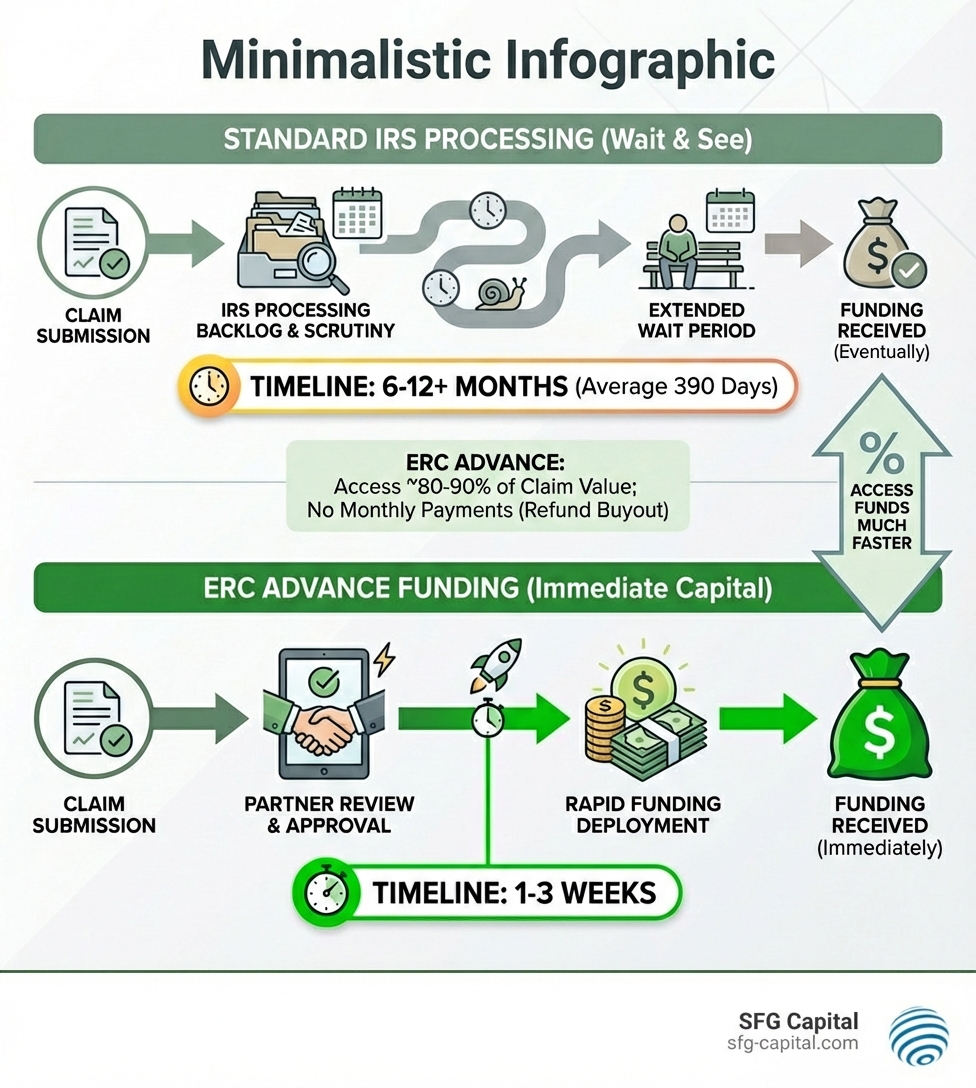
ERC loans (more accurately called ERC advances or refund buyouts) allow eligible businesses to access their Employee Retention Credit funds in 1-3 weeks instead of waiting 6-12+ months for the IRS. These aren’t traditional loans; they’re advance purchases of your future refund at a discounted rate, with no monthly payments.
Quick Answer: What Are Your ERC Funding Options?
- Wait for the IRS – Free, but takes 6-12+ months (or longer due to backlogs)
- ERC Advance Buyout – Get 80-90% of your refund in 1-3 weeks with no monthly payments
- Traditional Business Loan – Uses ERC claim as collateral, but creates debt obligation
- Claim Withdrawal – If you haven’t been paid yet and believe your claim is ineligible
The Reality of IRS Processing Today
The IRS is facing a massive backlog, with over 600,000 unprocessed claims as of late 2023. In response to a surge of questionable filings, the agency halted new claim processing on September 14, 2023. This has led to increased scrutiny and average wait times of 390 days in 2024.
For many businesses, this wait is simply too long. You need working capital now to cover payroll, rent, and growth opportunities—not a year from now.
That’s where ERC advance funding comes in. These services purchase your future IRS refund, giving you immediate capital without creating debt.
Is an ERC advance right for your business? It depends on your cash flow needs, the strength of your claim, and whether you can afford to wait for the IRS.
I’m Santino Battaglieri. I’ve led SFG Capital in funding over $500 million in ERC loans and advances while maintaining strict compliance. In this guide, I’ll explain your ERC funding options and how to choose the right solution for your business.
What is the Employee Retention Credit (ERC)? A Complete Breakdown
The Employee Retention Credit (ERC), or ERTC, is a refundable payroll tax credit—not a loan—designed to help businesses keep employees on payroll during the COVID-19 pandemic. If the credit exceeded your payroll tax liability, the IRS would send you the difference as a refund, providing a critical cash flow boost for businesses in Austin and across Travis County.

The Evolution of the ERC: From the CARES Act to Today
The ERC was not a static program. It began with the CARES Act in March 2020, offering a credit of 50% of qualified wages, up to $5,000 per employee for 2020. Initially, businesses with a Paycheck Protection Program (PPP) loan were excluded.
Subsequent legislation, like the Consolidated Appropriations Act (CAA) and the American Rescue Plan Act (ARPA), significantly expanded the program. These acts allowed PPP recipients to claim the ERC, extended the credit through Q3 2021, and increased the credit rate to 70% of qualified wages. This raised the potential maximum to $7,000 per employee per quarter in 2021. However, the Infrastructure Investment and Jobs Act (IIJA) later retroactively ended the program for most businesses for wages paid after September 30, 2021.
For a detailed look at how these legislative changes shaped the credit, you can review the IRS’s comparison chart: The ERC was created as part of the Coronavirus Aid, Relief, and Economic Security (CARES) Act of March 2020, and has since been updated and adjusted by subsequent legislation.
Are You Eligible? Key Requirements for Claiming the ERC
ERC eligibility primarily hinges on meeting one of two main tests during 2020 or the first three quarters of 2021:
- Full or Partial Suspension of Operations: Your business was fully or partially suspended due to a governmental order limiting commerce, travel, or group meetings. This includes capacity limits, restricted hours, or supply chain disruptions caused by such orders.
- Significant Decline in Gross Receipts: Your business experienced a sharp drop in gross receipts. For 2020, this meant a 50% drop compared to the same quarter in 2019. For 2021, the threshold was a 20% drop (i.e., gross receipts less than 80%) compared to the same 2019 quarter.
- Recovery Startup Business: A third category exists for businesses started after February 15, 2020, that met certain gross receipts thresholds, allowing them to qualify for Q3 and Q4 2021.
PPP Loan Recipients were eventually made eligible, but you cannot claim the ERC on the same wages used for PPP loan forgiveness. We help businesses in Travis County steer these complexities to ensure they meet all Employee Retention Credit Help requirements.
How to Calculate and Claim Your Credit
Calculating your potential ERC refund depends on the period:
- 2020 Credit Rules: The credit is 50% of up to $10,000 in qualified wages per employee for the entire year, for a maximum of $5,000 per employee.
- 2021 Credit Rules: The credit is 70% of up to $10,000 in qualified wages per employee, per quarter for the first three quarters, for a potential maximum of $21,000 per employee.
Qualified wages include salary and certain health plan costs but exclude wages used for PPP forgiveness or other federal credits. To claim the credit retroactively, you must file an amended payroll tax return, Form 941-X, for the relevant quarters. The deadline for amending 2020 returns is generally April 15, 2024, and for 2021 returns, it’s April 15, 2025. Claiming the ERC also reduces your deductible wage expenses, which may require amending your business’s income tax returns. For more on the claiming process, refer to this guide: How to Claim the Employee Retention Credit.
The Problem: Navigating IRS Delays and Claim Complexities
While the ERC offered a lifeline, receiving the funds has become a major challenge for businesses in Austin and Travis County. The process is now defined by long waiting times, increased IRS scrutiny, and the risk of audits for incorrect claims.

Why Is the IRS Taking So Long? The Processing Moratorium and Backlog
The IRS processing timeline for ERC claims has stretched to 6-12 months or even longer. This is due to a massive backlog (over 600,000 claims by late 2023) and a “surge of questionable claims.” In response, the IRS announced a moratorium on processing new claims on September 14, 2023, to combat scams and increase its review standards.
This action, while necessary to protect taxpayers, has created unprecedented delays for all businesses, including those with perfectly legitimate claims. For a full understanding of the IRS’s actions, you can read their official statement: IRS Announcement on ERC Processing.
This situation has created a critical cash flow problem for businesses that budgeted for these funds. We understand this “waiting game” and have developed solutions to help you steer it, as discussed in our guide: The Waiting Game: Understanding and Overcoming ERC Refund Delays.
The Dangers of Ineligible Claims and Improper Filing
The ERC’s complexity and value attracted aggressive promoters who often gave bad advice. The IRS has issued numerous warnings about these red flags:
- Unsolicited calls, texts, or emails promising ERC funds.
- Claims of eligibility within minutes, without a thorough review.
- Large upfront fees or contingency fees based on a percentage of the refund.
- Pressure to sign forms quickly or claims that “every business qualifies.”
Submitting an ineligible claim can lead to repayment of the credit plus substantial penalties and interest. The IRS is actively increasing audits and enforcement, making it crucial to work with a knowledgeable and ethical professional, as detailed in our Employee Retention Credit Specialist Guide.
What Happens if Your Claim is Ineligible or Disallowed?
If you submitted a claim you now believe is ineligible, the IRS has provided pathways to correct the issue:
- Claim Withdrawal Process: If you haven’t been paid or haven’t cashed the check, you may be able to withdraw the claim to avoid future penalties and interest.
- Voluntary Disclosure Program (VDP): For businesses that received an ineligible refund, the VDP allowed them to repay 80% of the credit to avoid further penalties. While the initial deadline has passed, the IRS may offer similar programs in the future.
- Amending Returns: You can always file an amended Form 941-X to correct a previous claim and repay any excess funds received.
- Repayment Obligations: If an audit finds your claim ineligible, you must repay the credit with penalties and interest. This is why proactive correction is highly recommended.
- Appeals Process: If your claim is disallowed, you have the right to an administrative appeal with the IRS.
Navigating these options is complex. We strongly recommend consulting with a reputable tax professional to determine the best course of action.
The Solution: How ERC Loans and Advances Provide Immediate Capital
For businesses in Austin and Travis County facing IRS delays and an immediate need for cash, ERC loans—or more accurately, ERC advances—offer a powerful solution. These funding options bridge the gap between filing your ERC claim and receiving the funds, providing the immediate liquidity you need.
What Exactly Are ERC Loans or Advance Buyouts?
An ERC advance buyout is different from a traditional loan. It is a financial transaction where a funding provider, like SFG Capital, purchases your future ERC refund at a discounted rate (typically advancing 80-90% of the expected refund).
- Not a Traditional Loan: There are no monthly payments and no debt is created on your balance sheet.
- We Wait for the IRS: You are selling an asset (your future refund) for immediate cash. We take on the risk and the long waiting period for the IRS to process the claim.
Our focus at SFG Capital is on the advance buyout model because it provides immediate, non-debt capital to businesses. It’s designed to bypass the long IRS wait times without adding to your financial liabilities. Think of it as ERC Bridge Loans that carry you over the IRS’s extended processing periods.
The Process: How to Get an ERC Loan or Refund Advance
Our process is streamlined to get you funded quickly:
- Submit Claim Documents: Provide your filed Form 941-X(s) and supporting documentation that substantiates your eligibility.
- Due Diligence: Our experts conduct a thorough compliance review to verify the strength and accuracy of your claim.
- Receive Term Sheet: Once verified, we present a clear term sheet outlining the advance amount and buyout rate with no hidden fees.
- Get Funded in Weeks: After you accept the terms, funds are deposited into your account, typically within 1 to 3 weeks.
- IRS Refund Remittance: When the IRS finally pays your refund, you simply remit the full amount to us to complete the transaction.
This is our ERC Funding Process, designed to be as simple and quick as possible for businesses in Travis County.
Benefits and Drawbacks of an ERC Advance
Deciding if an ERC advance is right for you involves weighing the pros and cons.
| Feature | Waiting for IRS Refund | ERC Advance Buyout |
|---|---|---|
| Access to Capital | 6-12+ months (or longer) | 1-3 weeks |
| Cost | Free (no discount) | Discount fee (typically 10-20% of refund) |
| Debt Obligation | None | None (it’s a buyout, not a loan) |
| Monthly Payments | None | None |
| IRS Risk/Wait | You bear the full risk & wait | We bear the risk & wait (after initial funding) |
| Cash Flow Impact | Delayed, unpredictable | Immediate, predictable |
| Flexibility of Funds | Eventually, but delayed | Immediate, for any business need |
Benefits (Pros):
- Fast Access to Capital: Get cash in weeks, not months. This is a game-changer for operations, expansion, or covering expenses.
- Certainty: An advance provides predictable capital, allowing for better financial planning. We assume the risk of unpredictable IRS processing times.
- No New Debt: It’s a sale of a future asset, not a loan. This keeps your balance sheet clean and avoids interest or monthly repayments.
- Bypassing IRS Delays: An advance allows you to sidestep the impractical wait caused by the IRS backlog and moratorium.
- Operational Flexibility: Use the immediate funds to invest in growth, pay down high-interest debt, or manage daily working capital. For ideas, see 5 Ways to Use ERC Funds to Strengthen Your Business.
Drawbacks (Cons):
- Discount Fee: The primary cost is the discount fee, which is the difference between your refund’s face value and the cash you receive upfront.
- Choosing a Reputable Funder: It’s vital to partner with a transparent funder with proven ERC expertise to ensure a secure and compliant transaction.
Frequently Asked Questions about ERC Funding
We often hear similar questions from businesses considering their ERC funding options. Let’s address some of the most common ones.
Is the Employee Retention Credit a loan?
No, absolutely not. The Employee Retention Credit (ERC) is a refundable tax credit, which functions like a grant from the U.S. government. It was designed to help businesses keep employees on their payroll.
Because it’s a credit, it does not need to be repaid to the IRS. As long as your claim is legitimate, the funds are yours. An ERC advance is simply a way to access those funds sooner by selling your future refund to a third party. The original credit itself remains a non-repayable grant, as the IRS states: The Employee Retention Credit isn’t a loan, so it doesn’t need to be repaid.
Can I still get an ERC advance if the IRS has paused processing?
Yes, you can. The IRS’s processing pause and delays are precisely why ERC advance funding has become such a vital solution.
Funding companies like SFG Capital operate independently of the IRS’s payout schedule, using our own private capital. Our decision to fund is based on the viability of your underlying ERC claim, not the IRS’s backlog. We take on the risk and the waiting period, allowing you to get cash now.
Even with the IRS moratorium, we can help eligible businesses in Travis County get the cash they need. This is a key way we help in Expediting Your ERC Refund: What You Need to Know.
How do I know if an ERC funding company is reputable?
Choosing the right partner is crucial. Here are key indicators of a reputable ERC funding provider:
- Transparency and Clear Fee Structure: They provide a detailed term sheet with all fees and terms upfront, with no hidden costs.
- No Upfront Fees: Be wary of companies demanding large fees before your advance is funded.
- Expertise in ERC: The company should demonstrate deep knowledge of ERC rules and IRS compliance to properly vet your claim.
- Performance-Based Fee Structure: Their incentives should align with yours. We only get paid when your claim is successfully processed and funded.
- Positive Reviews and Track Record: Look for a history of successful transactions and client testimonials. A company that has funded hundreds of millions in advances demonstrates reliability.
- Client-Centric Approach: A good partner takes the time to answer your questions and guide you through the process.
At SFG Capital, we adhere to these standards to provide honest and efficient service. Understanding these ERC Funding Requirements is your first step to a secure transaction.
Conclusion: Take Control of Your Business’s Finances Today
The Employee Retention Credit was a vital lifeline for countless businesses during the pandemic. However, the current reality of IRS processing—marked by significant backlogs, a moratorium on new claims, and heightened scrutiny—means that waiting for your refund can severely strain your business’s cash flow and hinder your ability to plan for the future.
For businesses in Austin, Travis County, and across the United States, the solution lies in taking proactive control. ERC loans, or more accurately, ERC advance buyouts, provide a powerful mechanism to open up your trapped capital immediately. By partnering with a reputable funding provider, you can convert your future ERC refund into present-day working capital, without incurring new debt or waiting indefinitely.
At SFG Capital, we specialize in expediting these refunds, offering a transparent and efficient process that gets you the funds you’ve earned in weeks, not months or years. Don’t let IRS delays dictate your business’s future. Empower your business with the capital it needs to grow, innovate, and thrive today.