
Don’t Wait for Uncle Sam and Use an ERC Buyout
Still Waiting on Your ERC Refund? Here’s What You Can Do Right Now
The erc buyout process is a straightforward way to sell your pending Employee Retention Credit (ERC) refund to a funding company in exchange for immediate cash — no waiting on the IRS, no loans, no monthly payments.
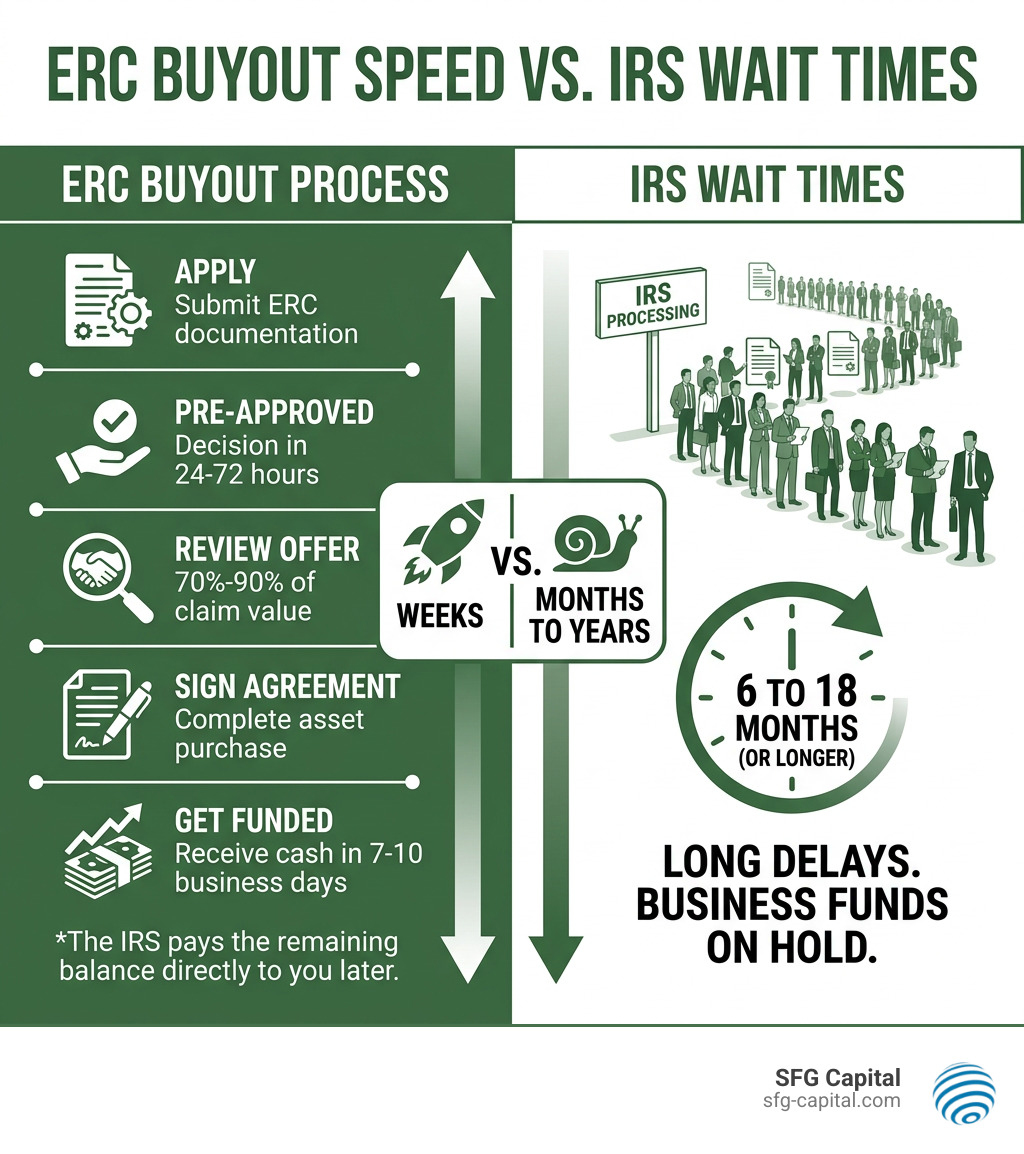
Here’s a quick overview of how it works:
- Apply – Submit your ERC documentation to a buyout provider
- Get pre-approved – Receive a pre-approval decision, often within 24-72 hours
- Review your offer – Typically 70%-90% of your total ERC claim value
- Sign the agreement – Complete the asset purchase paperwork
- Get funded – Receive your cash, usually within 7-10 business days
- Collect the holdback – The IRS pays the remaining balance directly to you later
If you’ve filed an ERC claim, you already know the frustration. The IRS is processing refunds on a timeline that can stretch 6 to 18 months — sometimes longer. For a business owner trying to make payroll, cover operating costs, or seize a growth opportunity, that wait isn’t just inconvenient. It can be damaging.
An ERC buyout cuts through that delay. Instead of waiting on Uncle Sam, you sell your pending refund as an asset and walk away with a large portion of its value — often up to 85% — within days.
This is not a loan. There’s no debt added to your books, no interest charges, and no monthly repayment schedule. The buyout company takes on the IRS wait in exchange for a portion of your refund. You get liquidity now, when your business actually needs it.
I’m Santino Battaglieri, founder of SFG Capital, and I’ve spent my career in structured financial services — having purchased and funded over $500 million in ERC claims with a compliance-first approach to the erc buyout process. In this guide, I’ll walk you through exactly how the process works, what it costs, what risks to watch for, and how to decide if it’s the right move for your business.
What is an ERC Buyout and How Does It Work?
At its core, an ERC buyout is an asset purchase. Think of it like selling a piece of equipment or real estate, except the “asset” you are selling is your right to receive a future tax refund from the IRS. Because it is a sale of an asset and not a loan, it is inherently debt-free. This is a critical distinction for many business owners in Travis County who don’t want to clutter their balance sheets with more liabilities.
When you participate in an ERC buyout, you are essentially trading a portion of your future refund for immediate liquidity. Understanding how the ERC refund works is the first step: the IRS owes you money for keeping employees on payroll during the pandemic. However, the IRS backlog is legendary. A buyout allows us to step into your shoes.
Unlike an ERC loan or a bridge loan, there are no monthly payments. You don’t have to worry about cash flow being strangled by interest checks every thirty days. Most buyouts are structured as non-recourse or limited-recourse transactions, meaning the funding company takes on the risk of the IRS delay.
By choosing to sell your ERC claim, you effectively move a “long-term receivable” (money the IRS might pay you in a year) into “cash on hand” (money you can use today). To dive deeper into the fundamentals, you can read our guide on what is ERC funding to see how these capital injections stabilize businesses during uncertain times.
Step-by-Step Breakdown of the ERC Buyout Process
The erc buyout process is designed to be significantly faster than the federal government’s pace. While the IRS might take a year to look at your Form 941-X, a private funding partner can analyze your file in a matter of days.
Here is the typical journey from application to cash:
- Initial Application: You provide basic information about your business and the size of your ERC claim.
- Due Diligence: This is where the heavy lifting happens. The funding team reviews your payroll records, original filings, and eligibility reports to ensure the claim is solid. This protects both you and the funder from future IRS audits.
- Offer Acceptance: Once the audit of your documents is complete, you’ll receive an offer. This typically ranges from 70% to 90% LTV (Loan-to-Value, though in a buyout, it’s more of a Purchase-to-Value).
- Closing & Funding: After signing the purchase agreement, the funds are usually disbursed via wire transfer.
For a more granular look at these stages, check out our detailed breakdown of the ERC funding process.
Documentation Needed for the ERC Buyout Process
To move through the erc buyout process quickly, you need to have your “financial house” in order. Funding companies aren’t just taking your word for it; they need to see the proof that was (or will be) sent to the IRS.
The following documents are almost always required:
- Form 941: Your original quarterly federal tax returns.
- Form 941-X: The amended returns that actually claim the credit.
- Detailed Payroll Records: Per-employee breakdowns for the quarters you are claiming.
- Bank Statements: Usually the last three months to verify active business operations.
- CPA Opinion or Eligibility Report: A professional explanation of why you qualify (e.g., government shutdown orders or a significant decline in gross receipts).
Having these ready is the best way to meet ERC funding requirements and avoid delays. If you are just starting your paperwork, our ERC funding application guide can help you gather everything correctly the first person.
Timeline and Funding in the ERC Buyout Process
How fast is “fast”? In ERC, speed is relative. Compared to the IRS’s 12-month average, the buyout timeline feels like a sprint.
- Pre-approval: Usually happens within 24 to 72 hours of submitting your initial docs.
- Full Underwriting: Can take 3 to 5 business days depending on the complexity of your claim (especially if you used a PEO).
- Funding: Once the agreement is signed, you can expect a wire transfer in about 7 to 10 business days.
This immediate liquidity is why so many Austin-based businesses are choosing buyouts. Instead of a “maybe” next year, it’s a “definitely” next week.
| Feature | IRS Refund | ERC Buyout |
|---|---|---|
| Wait Time | 6–18+ Months | 7–10 Business Days |
| Payment Type | Full Amount (Eventually) | Lump Sum (Upfront) |
| Monthly Payments | None | None |
| Debt on Balance Sheet | No | No |
| Risk of Delay | High | None (Transferred to Funder) |
Eligibility and Financial Impact of Selling Your Claim
Not every ERC claim is eligible for a buyout. Most programs have a minimum claim amount of $100,000, though some specialized providers may look at claims as low as $75,000. On the high end, buyouts can handle multi-million dollar claims for large enterprises.
One common question we hear in Travis County is: “Can I sell my claim if I used a PEO (Professional Employer Organization) like ADP or Paychex?” The answer is yes. While PEO-filed claims are more complex because the PEO files an aggregate return, they are still sellable. The credit belongs to your business, not the PEO.
From a financial health perspective, the impact is almost entirely positive. Because there is no liability created, your debt-to-equity ratio doesn’t budge. You are simply exchanging one asset for another. This is vital if you plan on applying for a traditional bank loan or mortgage in the near future; a buyout won’t negatively impact your credit capacity.
Furthermore, if you realize you made a mistake or want to withdraw an ERC claim before selling it, the IRS does provide a path for that. But once you’ve committed to the sale of your ERC claim, that cash becomes working capital you can use for anything from inventory to expansion.
Managing Risks: Audits, Clawbacks, and Holdbacks
No financial transaction is without risk, and the erc buyout process involves navigating the IRS’s scrutiny. The IRS has increased its focus on ERC fraud, which means your claim must be bulletproof.
To manage these risks, buyout companies use a holdback mechanism. Here is how it works:
- The Advance: You receive, for example, 80% of your claim value upfront.
- The Fee: The buyout company keeps a percentage (usually 13-20%) as their fee for taking the risk and waiting on the money.
- The Holdback: The remaining portion is held back. When the IRS finally sends the check, it often goes into a controlled account where the funder is paid back their advance, and the “holdback” (minus fees) is released to you.
This structure ensures that if the IRS reduces your claim during an audit, there is a buffer. It’s a key part of staying in compliance and ensuring you aren’t hit with an unexpected “clawback” (a demand to pay back the money).
We always recommend having a clear understanding of ERC funding and the audit landscape before signing. A reputable funder will do their own “mini-audit” of your files before giving you a dime—this is actually a good thing, as it gives you a professional second opinion on your claim’s validity.
Frequently Asked Questions about ERC Buyouts
What are the typical fees and LTV percentages for a buyout?
The cost of a buyout is essentially a “discount rate” for getting your money early. Typical fees range from 13% to 20% of the total claim value. In exchange, you receive an upfront payment (LTV) of 70% to 90%. The stronger your documentation and the larger your claim, the better the terms usually are.
Can I sell my claim if I filed through a PEO?
Yes, you can. Whether you used ADP, Paychex, or a smaller regional PEO, the credit is yours. However, the erc buyout process for PEO claims requires extra documentation, such as the PEO’s aggregate Form 941 and your specific allocation within that filing. It might take a few extra days for due diligence, but it is a very common scenario.
Does an ERC buyout add debt to my business balance sheet?
No. This is the primary advantage over an ERC loan. It is structured as an asset sale. There is no UCC-1 lien placed on your overall business assets (only on the specific tax credit being sold), and it does not affect your credit score or financial ratios like a loan would.
Conclusion
The IRS backlog is a reality, but it doesn’t have to be your reality. For businesses in Austin and throughout Travis County, the erc buyout process offers a bridge over the gap of federal delays. It provides the “breathing room” needed to keep growing without the burden of new debt.
At SFG Capital, we specialize in helping local businesses navigate these waters with expert assistance and a performance-based approach. We understand that every day you wait for your refund is a day you aren’t reinvesting in your team or your community.
Don’t let your hard-earned tax credits sit in an IRS processing center for another year. Take control of your cash flow today.