
Don’t Wait for Your ERC: Discover Funding Solutions Near Me
Why Local ERC Funding Solutions Matter for Your Business
ERC funding near me connects eligible businesses with local experts and funding solutions to access Employee Retention Credit refunds faster than waiting for IRS processing. If you’re searching for immediate support, here’s what you need to know:
Quick Answer: Finding ERC Funding Near You
- What it is: Services that help you claim or advance your ERC refund without waiting 12+ months for the IRS
- Who offers it: Local CPAs, tax specialists, and funding firms like SFG Capital in Travis County and nationwide
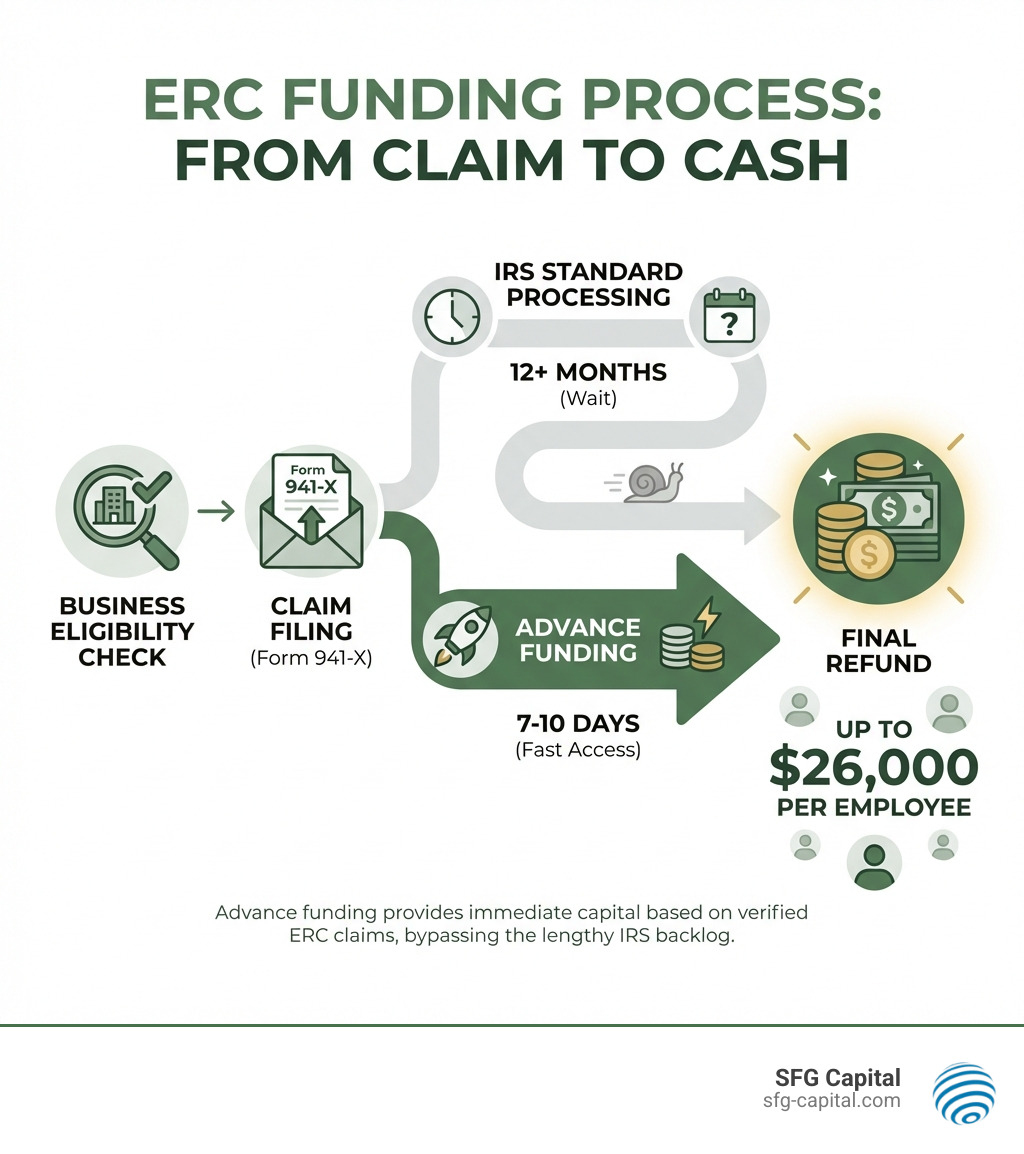
- Typical timeline: 7-10 days for advance funding vs. 12+ months through standard IRS processing
- Average refund: Up to $26,000 per W2 employee retained during 2020-2021
- Key requirement: Must have filed Form 941-X and maintained employees during the pandemic
The Employee Retention Credit was designed to help businesses keep workers on payroll during COVID-19, but the reality has been frustrating. As of October 2024, the IRS has approximately 1.2 million unprocessed ERC claims sitting in their backlog. Most business owners can’t afford to wait another year or more for money they’ve already earned.
This is where local ERC funding solutions come in. Rather than waiting for the U.S. Treasury to process your refund, specialized firms can evaluate your claim, verify your eligibility, and provide immediate capital—often within days instead of months. This isn’t a loan you need to repay; it’s an advance or purchase of your legitimate tax refund.
The challenge is finding reputable help. The IRS has issued multiple warnings about ERC scams, with aggressive promoters making false promises and charging excessive fees. Many business owners feel stuck between desperate cash flow needs and fear of audit penalties.
I’m Santino Battaglieri, and through SFG Capital, I’ve helped businesses access over $500 million in ERC funding using compliant, documentation-driven processes that protect against IRS scrutiny. My focus on erc funding near me searches comes from understanding that business owners need local expertise combined with fast, reliable capital access.
Understanding the Employee Retention Credit (ERC)
The Employee Retention Credit (ERC), sometimes called the Employee Retention Tax Credit or ERTC, is a refundable tax credit that was created under the CARES Act in response to the COVID-19 pandemic. Its primary purpose was to encourage businesses to retain their employees during the economic downturns of 2020 and 2021, even if their operations were suspended or their revenues declined. Unlike a loan or a grant, the ERC is a tax refund, meaning it directly reduces a business’s tax liability and, if the credit exceeds the taxes owed, the business receives the difference as a refund check from the U.S. Treasury.
We understand that navigating tax credits can be complex, but the core idea behind the ERC is simple: reward businesses for keeping their teams employed. You can learn more about the official guidance directly from the IRS. For a deeper dive into what ERC funding truly entails, explore our detailed guide: What is ERC Funding?.
Who is eligible for the ERC?
Eligibility for the ERC is multifaceted and depends on various factors, primarily related to your business’s operations during 2020 and 2021. Generally, eligible employers are those who operated a trade or business during these years and experienced either:
- A full or partial suspension of operations due to governmental orders limiting commerce, travel, or group meetings because of COVID-19. This could include mandatory shutdowns, capacity restrictions, or even supply chain disruptions that significantly impacted operations.
- A significant decline in gross receipts during a calendar quarter compared to the same quarter in 2019.
- For 2020: A decline of more than 50% in gross receipts for a calendar quarter compared to the same quarter in 2019.
- For 2021: A decline of more than 20% in gross receipts for a calendar quarter compared to the same quarter in 2019.
- Qualified as a “recovery startup business” for the third or fourth quarters of 2021. This applies to businesses that began operations after February 15, 2020, have average annual gross receipts not exceeding $1 million, and do not meet the gross receipts decline or government order suspension criteria.
The ERC is not available to individuals and is specifically for businesses with W2 employees.
How much funding can businesses receive through the ERC?
The potential funding through the ERC is substantial. Businesses can receive up to $26,000 per W2 employee retained during 2020 and 2021. This impressive figure breaks down as follows:
- For 2020: Up to $5,000 per employee (50% of the first $10,000 in qualified wages paid per employee for the entire year).
- For 2021: Up to $7,000 per employee per quarter for Q1, Q2, and Q3 (70% of the first $10,000 in qualified wages paid per employee per quarter). While the ERC was initially available for Q4 2021, a new law retroactively ended it for claims filed after January 31, 2024, for that quarter, unless the business qualified as a recovery startup business.
This means that for a business with, say, 10 eligible employees that met the criteria for all quarters in 2021, the potential refund could be as high as $210,000 (10 employees x $7,000/quarter x 3 quarters).

What are “Qualified Wages”?
“Qualified wages” refer to the wages and compensation paid to employees, including certain health plan expenses, that are eligible for the credit. However, there are important exclusions. For instance, qualified wages for ERC purposes generally do not include payroll costs associated with Paycheck Protection Program (PPP) loan forgiveness, shuttered venue operators grants, or restaurant revitalization grants. This prevents “double-dipping” benefits from multiple pandemic relief programs.
How to Secure ERC Funding Near Me Today
The ERC was a lifeline for many businesses in Travis County and across the nation, but the process of actually receiving the funds has been anything but fast. The IRS is currently struggling with a massive backlog of claims. As of October 26, 2024, there were approximately 1,200,000 unprocessed Forms 941-X, the form used to claim the ERC. This backlog has led to excruciatingly long wait times, often exceeding 12 months, for businesses eagerly awaiting their refunds. The National Taxpayer Advocate has even identified ERC processing delays as the number one most pressing problem for taxpayers, advocating for the IRS to complete processing of all outstanding ERC claims by the end of calendar year 2025. You can read the National Taxpayer Advocate’s report on ERC delays for more details.
For businesses in Travis County, waiting another year or more simply isn’t an option when cash flow is critical. This is precisely why we specialize in providing expedited ERC funding solutions. We understand that you need your money now, not someday. Our approach involves evaluating your claim, ensuring its accuracy, and then offering advance funding or a buyout of your legitimate ERC refund. This means we can often deliver funds within just 7-10 days, allowing you to bypass the IRS’s lengthy processing delays. We buy up to 70% of the total ERC amount, providing immediate capital when you need it most. To learn more about how we can help you accelerate your refund, visit our page on ERC Advance Funding.
How long does it typically take to receive ERC funds?
If you choose the traditional route of waiting for the IRS to process your Form 941-X, you could be in for a long haul. As mentioned, the IRS’s significant backlog means that receiving your ERC refund can take up to 12 months or even more. Many businesses have been waiting far longer than anticipated, creating financial strain and uncertainty.
However, with our expedited advance funding solutions, the timeline shrinks dramatically. We pride ourselves on delivering your funds within just 7-10 days. This rapid turnaround is a game-changer for businesses that need immediate access to capital. We essentially bridge the gap between your approved ERC claim and the IRS’s delayed payout, ensuring you don’t have to put your business plans on hold. Find the full details on how we can speed up your access to capital in our guide: The Fast Track to Your ERC Cash.
Where can businesses find reputable help for ERC applications?
Finding reputable help for ERC funding near me is crucial, especially given the complexities of the credit and the prevalence of scams. For businesses in Travis County, including Austin, we offer localized expertise combined with a national reach of resources. When seeking assistance, look for providers who:
- Specialize in ERC: Firms that strictly focus on ERC tend to have greater expertise and a deeper understanding of the nuances.
- Have CPA partners: Working with certified public accountants (CPAs) ensures that your claims are prepared accurately and compliantly.
- Offer transparent processes: You should clearly understand every step of the application and funding process, from eligibility assessment to fund disbursement.
- Provide dedicated support: A team that can answer all your ERC-related questions and guide you through the process is invaluable.
- Operate locally: For businesses in Travis County, finding a local partner means personalized service and a better understanding of your specific business context.
We are proud to serve the Travis County business community, providing dedicated support and expert assistance. Explore our specific services for local businesses: ERC Funding Travis County.
Eligibility and Documentation for Local ERC Funding
Understanding the specific eligibility requirements for the ERC is paramount to a successful claim. As we’ve touched upon, the criteria vary slightly between 2020 and 2021, and pinpoint which periods your business qualifies for.
Specific Eligibility Criteria for 2020 Versus 2021
To reiterate the key differences:
| Eligibility Criteria | 2020 | 2021 (Q1, Q2, Q3) |
|---|---|---|
| Government Order Suspension | Full or partial suspension of operations due to a government order limiting commerce, travel, or group meetings. | Same as 2020. |
| Significant Decline in Gross Receipts | Gross receipts for a quarter are less than 50% of gross receipts for the same quarter in 2019. | Gross receipts for a quarter are less than 80% of gross receipts for the same quarter in 2019 (or prior quarter in 2021 vs. 2019). |
| Recovery Startup Business | Not applicable. | Began operations after Feb 15, 2020, average annual gross receipts under $1M, and not otherwise eligible. Only for Q3 & Q4 2021. |
| Maximum Credit Per Employee | $5,000 (50% of first $10,000 in qualified wages for the year) | $7,000 per quarter (70% of first $10,000 in qualified wages per quarter) |
Our team can help you carefully review your financial records and operational impacts to determine your precise eligibility for each quarter. For a comprehensive overview of what’s needed, refer to our guide on ERC Funding Requirements.
What documentation is required to support an ERC claim?
A well-documented ERC claim is your best defense against potential IRS scrutiny and ensures a smoother processing experience. The IRS requires detailed records to substantiate your eligibility and the amount of credit claimed. Key documentation includes:
- Form 941-X: This is the Adjusted Employer’s Quarterly Federal Tax Return or Claim for Refund, which is used to retroactively claim the ERC. We handle the preparation and filing of this form on your behalf.
- Payroll Records: Detailed payroll reports showing qualified wages paid to employees during the eligible quarters. This includes information on employee names, Social Security numbers, wages paid, and any health plan expenses.
- Gross Receipts Data: Quarterly financial statements or other records demonstrating the decline in gross receipts (if you’re claiming eligibility based on revenue reduction). This will be compared to your 2019 gross receipts.
- Government Orders: Copies of any federal, state, or local government orders that led to a full or partial suspension of your business operations. This could include shutdown orders, capacity limits, or restrictions on specific business activities.
- Employee Headcounts: Documentation of your average number of full-time employees, particularly for determining whether you are a “small” or “large” employer for ERC purposes, as this impacts the definition of qualified wages.
- PPP Loan Documentation: If you received a PPP loan, documentation showing how those funds were used and which wages were allocated to PPP forgiveness to ensure no double-counting with ERC.
We assist businesses in Travis County with gathering, organizing, and verifying all necessary documentation, ensuring your claim is robust and audit-ready. This meticulous approach is part of our commitment to securing the maximum rightful credit for your business.
Avoiding Scams and Finding Reputable ERC Funding
The significant financial benefits of the ERC have, unfortunately, attracted unscrupulous promoters and scammers. The IRS has repeatedly voiced concerns about a large number of improper ERC claims and is closely reviewing tax returns that claim the credit. This means that while the credit is legitimate, how you claim it and who you work with are critically important.
What are the potential risks or scams associated with ERC claims?
The risks associated with illegitimate ERC claims are substantial and can include:
- IRS Audits: The IRS is actively auditing ERC claims, especially those that appear questionable. An audit can be time-consuming, stressful, and costly.
- Repayment of Credit: If your claim is deemed ineligible, you will be required to repay the entire credit amount received.
- Penalties and Interest: Beyond repayment, the IRS can impose significant penalties and interest on improperly claimed credits.
- Identity Theft: Providing sensitive business and personal information to fraudulent promoters can lead to identity theft and other financial crimes.
The IRS has issued strong warnings about ERC scams. They advise businesses to be wary of:
- Unsolicited advertisements or calls promoting ERC.
- Promoters claiming eligibility within minutes without a detailed review of your business’s specific situation.
- Large upfront fees or fees based on a percentage of the refund.
- Pressure tactics to sign documents quickly.
- Statements that “every business qualifies” without discussing your unique tax situation.
We stand firmly against such practices. Our priority is to ensure your claim is fully compliant and legally sound. For more information on navigating the ERC landscape safely, check out our ERC Credit: Complete Guide.
Where can businesses find reputable help for ERC applications?
To avoid these pitfalls, partner with a reputable and ethical firm for your ERC funding near me needs. When choosing a service provider, especially in Travis County, consider the following:
- Transparent Fee Structure: We operate on a performance-based fee, meaning we only get paid when you receive your funds. This aligns our success with yours and eliminates upfront risks.
- Expertise and Experience: Look for a team with extensive knowledge of tax law, payroll, and the specific nuances of the ERC program. Our team, including our CPA partners, brings years of experience to the table.
- Meticulous Documentation: A reputable firm will insist on thorough documentation and will help you gather and organize all necessary records to support your claim.
- Focus on Compliance: The best firms prioritize IRS compliance, ensuring that your claim is accurate and defensible if ever audited. They won’t make exaggerated promises or guarantee eligibility without a detailed review.
- Local Presence and Support: For businesses in Travis County, working with a local firm like ours ensures personalized attention and accessible support.
We pride ourselves on our ethical practices and our commitment to protecting our clients from potential IRS issues. We provide professional consultations, guiding you through every step of the process with integrity.
Frequently Asked Questions about ERC Funding
We often hear similar questions from business owners in Travis County and beyond regarding their ERC eligibility and the funding process. Here are some of the most common ones:
Can I get ERC if I received a PPP loan?
Yes, absolutely! Many businesses that received Paycheck Protection Program (PPP) loans are also eligible for the Employee Retention Credit. Initially, the rules prevented businesses from claiming both, but subsequent legislation (the Consolidated Appropriations Act of 2021) allowed businesses to qualify for both programs.
However, there’s a crucial caveat: you cannot use the same qualified wages to calculate both your PPP loan forgiveness and your ERC. This is often referred to as avoiding “double-dipping.” Our expert team carefully analyzes your payroll data to ensure that wages used for PPP forgiveness are not also claimed for ERC, maximizing your benefits from both programs while maintaining full compliance. To understand the intricate requirements and how PPP interacts with ERC, dig into our guide: Unlock Your ERC Requirements: Advances and What You Need to Know.
What are the deadlines for ERC applications?
The deadlines for ERC applications have been a moving target, causing confusion for many businesses. While the ERC program itself covered wages paid in 2020 and 2021, the ability to claim these credits retroactively has specific deadlines:
- For 2020 claims: The deadline to amend tax returns (Form 941-X) to claim the ERC for wages paid in 2020 was generally April 15, 2024.
- For 2021 claims: The deadline to amend tax returns (Form 941-X) to claim the ERC for wages paid in 2021 is generally April 15, 2025.
It’s important to note a significant change: a new law retroactively ended the ERC program for claims related to Q3 and Q4 2021 if those claims were filed after January 31, 2024. This means that if you hadn’t filed for Q3 or Q4 2021 by that date, you might no longer be eligible for those specific quarters unless you qualify as a recovery startup business. Claims for prior quarters (all of 2020, Q1, Q2 2021) filed before their respective deadlines are unaffected.
The complexity of these deadlines and legislative changes underscores the importance of working with knowledgeable professionals. The ongoing backlog at the IRS has also prompted advocacy from various groups, including a letter from NY Congressional members to the IRS Commissioner, highlighting the impact of delays on businesses. You can read the Full content of the letter can be read here.
What are the consequences of submitting an ineligible ERC claim?
Submitting an ineligible ERC claim can have serious repercussions for your business. The IRS is taking a firm stance against erroneous claims, and the consequences can be significant:
- Repayment of the Credit: If the IRS determines your claim was ineligible, you will be required to repay the entire amount of the credit you received.
- Penalties: The IRS can impose substantial penalties for inaccurate or fraudulent claims. These can include accuracy-related penalties (20% of the underpayment) and even civil fraud penalties (75% of the underpayment) in severe cases.
- Interest: In addition to penalties, you will typically owe interest on the underpayment from the original due date of the tax return.
- Audits: An ineligible claim significantly increases your risk of an IRS audit, which can be a lengthy and burdensome process, potentially extending to other areas of your tax returns.
The IRS has provided a pathway for businesses that submitted ineligible claims to avoid these issues. If you submitted an ineligible claim and it hasn’t been paid yet, or if you received a check but haven’t cashed or deposited it, you might be able to withdraw the claim. This can help you avoid future audits, repayment demands, penalties, and interest.
This is why our meticulous approach to eligibility assessment and documentation is so vital. We ensure that every claim we help prepare is accurate, compliant, and defensible, protecting your business from future complications. For a step-by-step guide on the application process and what to avoid, consult our ERC Funding Application: A Step-by-Step Guide to Claiming Your Credit.
Conclusion
The Employee Retention Credit represents a significant opportunity for businesses in Travis County and across the U.S. to recoup funds for retaining employees during the unprecedented challenges of the pandemic. However, the path to accessing these funds is fraught with complexities, from understanding intricate eligibility rules to navigating massive IRS backlogs and avoiding predatory scams.
At SFG Capital, we are dedicated to simplifying this process for you. As specialists in ERC funding near me solutions, we combine deep expertise with a commitment to speed and compliance. We understand that time is money, especially for growing businesses. That’s why we offer expedited advance funding, allowing you to access up to 70% of your rightful ERC refund in as little as 7-10 days, rather than waiting 12 months or more for the IRS.
Our performance-based fee structure means our success is directly tied to yours – we only get paid when you receive your funds. We partner with experienced CPAs and tax professionals to ensure your claim is carefully prepared, fully documented, and audit-ready, safeguarding your business from future IRS scrutiny.
Don’t let the IRS backlog or the fear of scams deter you from claiming the credit your business deserves. If you’re a business owner in Travis County looking for reliable, fast, and compliant erc funding near me, we are here to help.
Ready to open up your ERC funds without the wait? Explore our comprehensive ERC Funding Solutions and take the first step toward securing the capital your business needs today.