
Do You Qualify for ERC? Navigating the Employee Retention Credit Requirements
Understanding Employee Retention Credit Qualifications: A Critical Overview for Business Owners
ERC qualifications determine whether your business can claim a valuable COVID-19 relief tax credit worth up to $26,000 per employee. To qualify, your business must meet one of two primary tests:
Primary ERC Qualification Criteria:
- Government Suspension Test – Your business operations were fully or partially suspended by a government order related to COVID-19
- Gross Receipts Decline Test – Your gross receipts declined by 50% (2020) or 20% (2021) compared to the same quarter in 2019
Quick Eligibility Summary:
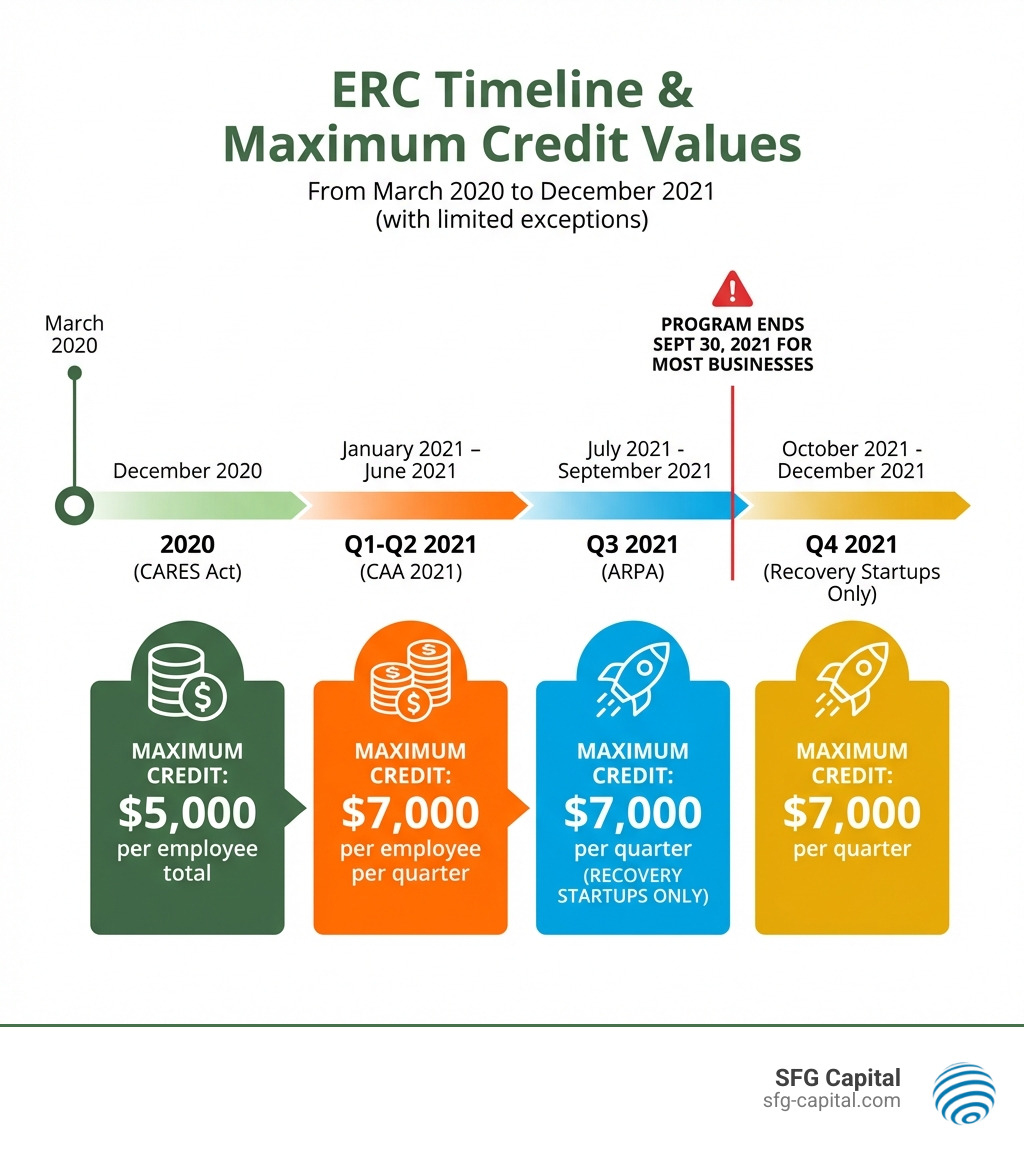
- Credit Value: Up to $5,000 per employee (2020) or $7,000 per employee per quarter (2021)
- Program Period: March 12, 2020 through September 30, 2021 (December 31, 2021 for Recovery Startups)
- Business Size: Most employers with W-2 employees qualify, including tax-exempt organizations
- Current Status: Program ended September 30, 2021, but eligible businesses can still file amended returns
The Employee Retention Credit (ERC) was one of the most valuable pandemic relief programs created under the CARES Act in March 2020. It was designed as a refundable payroll tax credit to encourage businesses to keep employees on their payroll during the COVID-19 pandemic, even when operations were disrupted or revenue declined significantly.
The program went through several legislative changes—expanded by the Consolidated Appropriations Act of 2021 and the American Rescue Plan Act—before being retroactively ended by the Infrastructure Investment and Jobs Act on September 30, 2021 (with limited exceptions for Recovery Startup Businesses through December 31, 2021).
Why understanding ERC qualifications matters now:
Many eligible businesses never claimed the credit during the pandemic. Others filed claims but are now facing IRS scrutiny as the agency works through a massive backlog while simultaneously investigating fraudulent claims. The stakes are high—the credit can be worth tens or even hundreds of thousands of dollars for qualifying businesses, but improper claims can result in penalties, interest, and repayment demands.
The challenge? ERC qualification rules are complex, changed multiple times during the program, and are frequently misunderstood. The IRS has paused processing new claims filed after January 31, 2024, citing widespread abuse by promoters making false eligibility promises. This creates a difficult environment for legitimate businesses trying to claim what they’re rightfully owed.
I’m Santino Battaglieri, and through SFG Capital, I’ve helped businesses steer erc qualifications by purchasing and funding over $500 million in ERC claims, working closely with tax professionals to ensure compliance with IRS guidance. In this guide, we’ll break down exactly how ERC qualifications work, what’s changed, and how to determine if your business is eligible.
Simple guide to erc qualifications terms:
The Two Primary Paths to ERC Qualifications
To determine your business’s erc qualifications, you generally need to meet one of two primary tests for the relevant calendar quarter: the Government Suspension Test or the Gross Receipts Decline Test. These tests evaluate how your business was impacted by the COVID-19 pandemic.
We’ll also discuss “qualified wages,” which are the wages (including certain health plan expenses) paid to employees that can be used to calculate the credit amount. For most employers, these are wages subject to social security taxes. Only wages paid after March 12, 2020, and before October 1, 2021 (or December 31, 2021, for recovery startup businesses) count towards the credit.
For official guidance, you can always refer to the Employee Retention Credit | Internal Revenue Service.
Understanding the Government Suspension Test
The first path to erc qualifications is demonstrating that your business operations were fully or partially suspended due to a government order related to COVID-19. This isn’t just about whether your doors were closed; it’s about whether the government mandate had a “more than nominal” impact on your business.
A “more than nominal” impact generally means that the portion of your business operations affected by the government order accounted for at least 10% of your gross receipts or total employee hours in 2019.
Examples of qualifying government orders include:
- Local, State, and Federal Mandates: Orders from state or local governments in Travis County, or federal agencies, requiring businesses to close, limit capacity, or restrict specific activities.
- Commerce Limitations: Orders restricting travel, limiting hours of operation, or mandating closures of non-essential businesses.
- Group Meeting Limitations: Restrictions on gatherings that impacted event venues, gyms, or restaurants with dine-in services.
Consider a restaurant in Austin, TX, that was forced to close its indoor dining but could still offer takeout. While not fully shut down, the inability to serve customers indoors could constitute a partial suspension if it had a significant impact on revenue or employee hours.

Even if your business wasn’t directly ordered to close, you might qualify if your operations were impacted by a government order that affected your suppliers. For example, if a key supplier was forced to shut down due to a government order, causing your business to suspend critical operations because you couldn’t get necessary materials, this could potentially count as a qualified suspension.
Meeting the Gross Receipts Decline Test
The second primary path to erc qualifications involves demonstrating a significant decline in gross receipts. This test measures the economic impact of the pandemic on your business’s revenue.
Here’s how it generally works for businesses in Travis County:
- Calculating Gross Receipts: Gross receipts include all income from your business operations, including sales, services, and investments, but generally exclude returns and allowances.
- Comparing Quarters (2019 Baseline):
- For 2020: Your gross receipts for a calendar quarter in 2020 must be less than 50% of your gross receipts for the same calendar quarter in 2019. Once you meet this 50% decline, you remain eligible for the ERC until your gross receipts for a subsequent quarter exceed 80% of your gross receipts for the same calendar quarter in 2019.
- For 2021: Your gross receipts for a calendar quarter in 2021 must be less than 80% of your gross receipts for the same calendar quarter in 2019. If you didn’t meet the 20% decline in the current quarter, you could also look at the immediately preceding calendar quarter. For example, to qualify for Q2 2021, you could compare Q2 2021 to Q2 2019, or Q1 2021 to Q1 2019 if the Q1 comparison allowed you to qualify for Q1 2021.
- Aggregation Rules for Related Businesses: If you operate multiple businesses or are part of a controlled group (e.g., related entities under common ownership), you must aggregate the gross receipts and employee counts of all related entities to determine eligibility. This prevents businesses from artificially separating to meet eligibility thresholds.
This test provides a clear, quantitative measure of financial hardship, allowing many businesses to qualify even if they weren’t directly shut down by a government order.
ERC Eligibility: 2020 vs. 2021 Key Differences
The erc qualifications evolved significantly between 2020 and 2021, thanks to subsequent legislation like the Consolidated Appropriations Act of 2021 and the American Rescue Plan Act (ARPA). These changes generally expanded eligibility and increased the potential credit amount, reflecting the prolonged economic impact of the pandemic.
Here’s a side-by-side comparison of the key differences:
| Feature | 2020 ERC Rules | 2021 ERC Rules (Q1, Q2, Q3) |
|---|---|---|
| Credit Rate | 50% of qualified wages | 70% of qualified wages |
| Max Credit Per Employee | $5,000 per employee (for the entire year) | $7,000 per employee per quarter (up to $21,000 for Q1-Q3) |
| Qualified Wages Per Employee | Up to $10,000 in total wages per employee for the year | Up to $10,000 in wages per employee per quarter |
| Employee Threshold for “Large Employer” | More than 100 full-time employees (based on 2019 average) | More than 500 full-time employees (based on 2019 average) |
| Gross Receipts Decline Percentage | Gross receipts less than 50% of the same quarter in 2019 | Gross receipts less than 80% of the same quarter in 2019 (or prior quarter’s comparison) |
| Interaction with PPP | Initially, couldn’t claim both. Later allowed, but not on same wages. | Allowed, but not on same wages. |
| Program End Date | December 31, 2020 | September 30, 2021 (for most businesses); December 31, 2021 (for Recovery Startup Businesses) |
Specific ERC Qualifications for 2020
For wages paid between March 13, 2020, and December 31, 2020, the erc qualifications were:
- Credit Rate: A tax credit of 50% of qualified wages.
- Wage Limit: Wages were capped at $10,000 per employee for the entire year. This means the maximum credit per employee for 2020 was $5,000.
- Gross Receipts Test: A business had to experience a decline in gross receipts of 50% or more when compared to the same calendar quarter in 2019.
- Employee Threshold: Only businesses with 100 or fewer full-time employees (based on 2019 averages) could claim the credit for all employees, regardless of whether they were working or not. Larger employers could only claim the credit for employees who were not providing services.
Expanded ERC Qualifications for 2021
The rules for 2021, covering wages paid from January 1, 2021, to September 30, 2021 (and through December 31, 2021, for recovery startup businesses), were significantly more generous:
- Credit Rate: The credit increased to 70% of qualified wages.
- Wage Limit: The per-employee wage limit also increased to $10,000 per quarter. This meant a potential maximum credit of $7,000 per employee per quarter, or up to $21,000 for the first three quarters of 2021.
- Gross Receipts Test: The eligibility threshold for gross receipts decline was lowered to 20% compared to the same calendar quarter in 2019. This made it much easier for businesses to qualify. Additionally, you could elect to use the immediately preceding quarter to determine eligibility. For example, if you didn’t qualify for Q1 2021 based on Q1 2019 receipts, you could look at Q4 2020 versus Q4 2019.
- Employee Threshold: The definition of a “large employer” increased to more than 500 full-time employees (based on 2019 averages). This meant many more businesses could claim the credit for all employees, regardless of whether they were working or not.
These expansions made the ERC a much more accessible and valuable credit for businesses continuing to face pandemic-related challenges in 2021.
Special Cases and Exclusions for ERC Eligibility
Beyond the core government suspension and gross receipts tests, certain special circumstances and exclusions influenced erc qualifications. These include how the ERC interacted with other COVID-19 relief programs and specific rules for different types of entities.
Many businesses initially believed they couldn’t claim the ERC if they received a Paycheck Protection Program (PPP) loan. However, subsequent legislation clarified that businesses could claim both, as long as the same wages were not used for both PPP loan forgiveness and the ERC. This “no double-dipping” rule was critical. Similarly, wages used for Shutter Venue Operator Grants or the Restaurant Revitalization Fund could not also be used for ERC calculations.

Are Tax-Exempt Organizations Eligible?
Yes, tax-exempt organizations in Travis County could absolutely be eligible for the ERC, provided they met the same government suspension or gross receipts decline tests as for-profit businesses.
This includes a wide range of organizations:
- 501(c) Organizations: Many types of non-profits, such as charitable organizations, labor unions, and social welfare organizations, could qualify.
- Churches: Religious organizations that met the eligibility criteria could claim the credit.
- Private Schools: Educational institutions, including private K-12 schools, colleges, and universities, were eligible if they experienced the required impact.
- Museums: Museums, which often operate as non-profits with an educational purpose, could also qualify.
- Hospitals: Many hospitals, particularly those that are tax-exempt, were eligible.
For tax-exempt organizations, the ERC provided crucial support to maintain their vital services and workforce during the pandemic. We at SFG Capital understand the unique needs of these organizations and work to ensure they access the funds they deserve. Learn more about Our Process.
What is a Recovery Startup Business?
This is a key exception to the ERC’s retroactive end date. The Infrastructure Investment and Jobs Act retroactively ended the ERC for most businesses as of September 30, 2021. However, a special category called “recovery startup businesses” could claim the credit for wages paid through December 31, 2021.
To qualify as a startup recovery businesses, a business must meet three criteria:
- It began carrying on a trade or business after February 15, 2020.
- Its average annual gross receipts for the three taxable years preceding the quarter for which the credit is claimed (or for its existence if shorter) did not exceed $1 million.
- It did not meet the government suspension or gross receipts decline tests for the third or fourth quarters of 2021.
For these businesses, the maximum credit was capped at $50,000 per quarter for the third and fourth quarters of 2021, providing significant relief to new ventures launched during the pandemic.
The Current Status: IRS Moratorium, Scams, and Claim Management
The landscape for ERC claims has become increasingly complex. While the credit was a lifeline for many businesses, the IRS has faced a surge in questionable claims, leading to a significant backlog and concerns about fraud.
In response, the IRS announced a moratorium on processing new ERC claims filed after January 31, 2024. This paused ERC processing was a direct result of widespread scams and a high volume of improper claims, which the IRS estimates could be in the tens of billions of dollars. The agency is now focusing on processing existing claims and developing a new withdrawal program for businesses that submitted ineligible claims.
The consequences of submitting an ineligible ERC claim can be severe, including repayment of the credit, along with potential penalties and interest. This makes it more important than ever for businesses in Travis County to ensure their erc qualifications are solid.
How to Spot and Avoid ERC Scams
With the IRS processing moratorium and increased scrutiny, it’s crucial for businesses to be vigilant against ERC scams. We’ve seen a rise in unscrupulous promoters making false promises and pressuring businesses into ineligible claims. Here are key warning signs to look out for:
- Unsolicited Calls or Ads: Be wary of unexpected calls, emails, or social media ads promoting “guaranteed” ERC refunds.
- Promises of Guaranteed Eligibility: No legitimate tax professional can guarantee eligibility without a thorough review of your specific financial situation and operations. Statements like “every business qualifies” are a major red flag.
- Large Upfront Fees: Legitimate tax professionals typically charge reasonable fees for their services, not exorbitant upfront costs.
- Contingency Fees Based on Refund Amount: Promoters who base their fees solely on a percentage of the refund amount may have an incentive to inflate the credit, potentially leading to an ineligible claim.
- Pressure to Sign: Any pressure to sign documents quickly or without full understanding should raise suspicion.
- Lack of Due Diligence: If a promoter doesn’t ask detailed questions about your business’s specific government orders, gross receipts, and employee wages, they are likely not performing proper due diligence.
Protecting your business means working with reputable professionals who prioritize compliance over quick profits. For more insights on navigating these challenges, check out our Blog.
Managing Your Claim: Amending, Withdrawing, or Appealing
What if you’ve already submitted an ERC claim and now have concerns about its eligibility, or your claim has been disallowed? The IRS has provided pathways to address these situations.
- Filing Form 941-X: If you realize you made an error on an original Form 941 (Employer’s Quarterly Federal Tax Return) or a previously filed Form 941-X (Adjusted Employer’s Quarterly Federal Tax Return or Claim for Refund) related to ERC, you can use Form 941-X to correct it. This form allows you to adjust both underpayments and overpayments, ensuring your claim accurately reflects your erc qualifications.
- Process for Withdrawing an Unpaid Claim: The IRS offers a withdrawal program for businesses that submitted an ineligible ERC claim but haven’t yet received the refund, or received a check but haven’t cashed it. Withdrawing an ineligible claim can help you avoid future audits, repayment demands, penalties, and interest. This is a critical step if you’ve identified errors or believe your claim was based on faulty advice.
- Appealing a Disallowed Claim (Letter 105-C): If your ERC claim is disallowed, the IRS will typically send you a Letter 105-C or a similar notice. You have the right to appeal this decision. The appeals process allows you to present your case to an independent IRS office. It’s crucial to respond promptly and provide all necessary documentation to support your erc qualifications.
- Special Rules for Wage Expense Deductions: If your ERC claim is ultimately disallowed, and you had previously reduced your wage expense deduction on your income tax return for the year the ERC was claimed, there’s a special statutory rule to help. You don’t necessarily need to amend that prior income tax return. Instead, in the year the ERC disallowance becomes final, you can increase your wage expense deduction on your income tax return by the amount that was previously reduced. This prevents the need to file amended returns for years that might be closed under the statute of limitations.
Frequently Asked Questions about ERC Qualifications
Navigating the complexities of the Employee Retention Credit can raise many questions. Here, we address some of the most common inquiries regarding erc qualifications and the current status of the program.
Can I still claim the ERC?
Yes, for periods covered by the program, you can still claim the ERC if you haven’t already. While the program officially ended for most businesses on September 30, 2021, and for recovery startup businesses on December 31, 2021, the statute of limitations for filing amended payroll tax returns (Form 941-X) is generally three years from the date the original Form 941 was filed or two years from the date the tax was paid, whichever is later.
This means:
- For 2020 claims (quarters Q2, Q3, Q4), the deadline is typically April 15, 2024.
- For 2021 claims (quarters Q1, Q2, Q3), the deadline is typically April 15, 2025.
However, be aware of the IRS moratorium on processing new ERC claims filed after January 31, 2024. While you can still file, the processing of these claims is currently paused as the IRS addresses widespread fraud concerns. If you are filing a new claim, ensure you meet all erc qualifications and have robust documentation.
What happens if my ERC claim is disallowed?
If your ERC claim is disallowed, you’ll receive an official notice from the IRS, such as a Letter 105-C. This notice will explain the reason for the disallowance. You have several options:
- Review the Disallowance: Carefully examine the IRS’s reasoning. Did they miss information? Misinterpret your eligibility?
- Appeal the Decision: If you disagree with the disallowance and believe your business met the erc qualifications, you can typically appeal the decision to the IRS Office of Appeals. This involves providing additional documentation and arguing your case.
- Special Statutory Rule for Wage Expense: As discussed earlier, if you had reduced your wage expense deduction on your income tax return in anticipation of receiving the ERC, and your claim is now disallowed, you may be able to increase your wage expense deduction in the year the disallowance becomes final. This avoids the need to amend prior income tax returns, which could be past the statute of limitations.
It’s vital to consult with a qualified tax professional if your ERC claim is disallowed to understand your options and ensure proper compliance.
What is the difference between the US Employee Retention Credit and the European Research Council (ERC)?
This is a common point of confusion due to the shared acronym! However, they are entirely separate entities with vastly different purposes:
US Employee Retention Credit (ERC): This is a refundable payroll tax credit for US businesses, including those in Travis County, that retained employees during the COVID-19 pandemic. Its purpose was economic relief and employee retention, based on criteria like government orders or declines in gross receipts. We’ve been discussing this program throughout this guide.
European Research Council (ERC): This is a funding organization for frontier research, established by the European Union. Its mission is to stimulate scientific excellence in Europe by funding top researchers of any nationality and age who propose innovative ideas. It offers grants for various career stages (Starting, Consolidator, Advanced Grants) to support investigator-driven research conducted in EU Member States or associated countries. It has no connection to US tax credits or COVID-19 relief for businesses. For example, For Non-European Researchers can apply, but the research must take place in an EU member state or associated country.
So, while both use the acronym “ERC,” they operate in completely different spheres—one is a US tax incentive, the other a European research grant program.
Conclusion: Secure Your Funds and Steer ERC Complexity
Understanding erc qualifications is not a simple task. The program’s legislative journey, the varying rules for 2020 and 2021, and the current IRS scrutiny underscore the complexity. However, for many businesses in Travis County, the Employee Retention Credit represents a significant opportunity to recover funds that can fuel future growth and stability.
The potential for up to $26,000 per employee is a substantial benefit, but it hinges on carefully documenting your eligibility through either the government suspension or gross receipts decline tests. We’ve seen how critical proper documentation and adherence to IRS guidelines are, especially with the agency’s current moratorium on processing new claims and heightened awareness of scams.
At SFG Capital, we understand the challenges businesses face in navigating these intricate regulations and the frustration of waiting for refunds. That’s why we specialize in helping businesses in Travis County expedite their Employee Retention Credit refunds. We offer advances and buyouts, allowing you to bypass IRS delays and access your funds quickly. Our performance-based fee structure ensures that our success is tied to yours, providing expert claim assistance without upfront financial burdens.
Don’t let the complexity deter you from claiming what your business is rightfully owed. If you believe your business meets the erc qualifications, we encourage you to seek professional guidance to ensure your claim is accurate and compliant.
To explore how we can help your business secure and expedite your ERC funds, please don’t hesitate to Contact Us. Let us help power your business forward: https://sfg-capital.com/uncategorized/funding-growth-how-erc-can-power-your-business-forward/.