
ERC Solutions: Finding the Right Partner for Your Employee Retention Credit
Why ERC Refund Companies Matter for Your Business
ERC refund companies help businesses steer the complex Employee Retention Credit claim process and secure their rightful refunds faster. The ERC is a refundable tax credit worth up to $26,000 per employee for businesses that retained workers during COVID-19, but claiming it correctly requires specialized expertise and careful documentation.
Key things to know about ERC refund companies:
- They specialize in ERC claims – Unlike general tax preparers, these firms focus exclusively on maximizing Employee Retention Credit refunds
- Typical fees range from 15-25% of your refund amount, charged only if you receive money
- They handle the entire process – From eligibility analysis to filing Form 941-X to IRS audit support
- Processing times vary – Companies can file your claim in as little as 7 days, but IRS refunds currently take 8+ months due to processing backlogs
- Some offer advance funding – Bridge loans or refund advances let you access capital immediately instead of waiting for the IRS
The ERC program was created by the CARES Act in 2020 to help businesses keep employees on payroll during the pandemic. While it ended for most businesses in 2021, eligible companies can still claim credits for wages paid through December 31, 2021 until the April 15, 2025 deadline.
But there’s a catch: The IRS has placed a processing moratorium on ERC claims due to widespread fraud concerns, causing delays of over 8 months for legitimate refunds. The agency has also issued warnings about aggressive marketing scams and placed the ERC on its annual “Dirty Dozen” list of tax scams.
Getting it wrong can be costly. Businesses that incorrectly claim the ERC may face repayment demands, interest charges, and civil penalties. The IRS’s ERC Voluntary Disclosure Program (which had a March 22, 2024 deadline) allowed businesses to repay 80% of incorrect claims, but that window has closed.
This is why choosing the right ERC refund partner matters so much. You need a company with deep expertise in payroll tax law, a proven track record, and the resources to support you through potential audits.
I’m Santino Battaglieri, and through SFG Capital, I’ve personally overseen the funding of over $500 million in ERC claims, working directly with CPAs and tax professionals to ensure every claim meets IRS compliance standards. My experience in the ERC refund companies space has shown me that the difference between a smooth process and a compliance nightmare often comes down to choosing a partner who prioritizes documentation integrity over aggressive filing strategies.
Understanding the ERC Program and Current IRS Delays
Navigating the intricacies of the Employee Retention Credit (ERC) can feel like deciphering a complex puzzle, but understanding its core principles is the first step toward open uping significant financial relief for your business. The ERC, established under the CARES Act, isn’t a loan you have to repay; it’s a refundable tax credit designed to reward businesses that kept employees on their payrolls during the economic disruptions caused by COVID-19.
What is the ERC and Who is Eligible?
At its heart, the ERC is a refundable tax credit against certain employment taxes. This means that if the credit exceeds your tax liability, the IRS sends you the difference as a refund – a direct cash injection for your business. Unlike the Paycheck Protection Program (PPP), which was a loan, the ERC funds do not need to be paid back, making it an incredibly valuable resource.
So, who qualifies for this generous credit? Generally, eligible employers experienced one of two scenarios during 2020 and 2021:
- Significant Decline in Gross Receipts: Your business saw a substantial drop in revenue compared to a prior quarter (e.g., a 50% decline in Q2 2020 compared to Q2 2019, or a 20% decline in 2021 quarters compared to 2019).
- Full or Partial Suspension of Operations Due to Government Order: This is a broad category that covers businesses whose operations were fully or partially limited by a governmental authority due to COVID-19. This could include reduced hours, capacity restrictions, or even supply chain disruptions.
The ERC is not just for businesses that were completely shut down. Many businesses that experienced operational changes, such as shifting hours for sanitation, reducing goods or services, or facing supply chain interruptions, may also qualify. Our team at SFG Capital understands these nuances deeply, ensuring we explore every avenue for your eligibility. For more in-depth information, you can consult our detailed guide on Employee Retention Credit Help.
How the ERC Program Has Evolved
The ERC program wasn’t static; it evolved significantly between 2020 and 2021.
- 2020: The credit was worth up to $5,000 per employee for the entire year, applicable to wages paid between March 13 and December 31, 2020. Eligibility was based on a 50% decline in gross receipts or a full/partial suspension.
- 2021: The credit became even more generous, offering up to $7,000 per employee per quarter for the first three quarters (Q1, Q2, Q3). This meant a potential maximum of $21,000 per employee for 2021, bringing the total potential credit to $26,000 per employee across both years. The gross receipts decline threshold was lowered to 20% for 2021 quarters.
A common question we receive is about the interaction between ERC and PPP loans. Initially, businesses couldn’t claim both, but subsequent legislation allowed businesses that received PPP loans to also claim the ERC, provided the same wages weren’t used for both programs. This opened the door for many more businesses to qualify.
Current Deadlines and IRS Processing Delays
While the ERC program ended for most businesses on September 30, 2021 (with some exceptions for recovery startup businesses through December 31, 2021), the window to claim the credits is still open for many.
- For qualified wages paid in 2020: The deadline to apply was April 15, 2024. This means claims for 2020 are now closed.
- For qualified wages paid in 2021: Businesses can still claim these credits until April 15, 2025.
However, there’s a significant elephant in the room: IRS processing times. The IRS has candidly stated that it has placed a processing moratorium on ERC claims due to a surge in questionable claims and outright fraud. This means that while some ERC refund companies can file your claim with the IRS in as little as seven days, the actual refund check could take over 8 months to arrive. This delay can be frustrating, to say the least. We’ve explored this challenge in depth in our article, The Great ERC Wait: Understanding Your Delayed Employee Retention Credit.

This lengthy waiting period is a critical factor for businesses needing immediate cash flow. It’s why our approach at SFG Capital focuses not just on accurate claims, but also on providing solutions to bridge this financial gap.
The High Stakes of ERC: Risks, Penalties, and Corrections
The ERC presents a fantastic opportunity for businesses, but it’s not without its pitfalls. The IRS has made it abundantly clear that they are cracking down on improper claims, and the consequences of getting it wrong can be severe. This is where the expertise of reputable ERC refund companies becomes invaluable.
Risks and Consequences of Incorrectly Claiming the ERC
The IRS has been vocal about the widespread issues surrounding the ERC, even placing it on its annual “Dirty Dozen” list of tax scams. What happens if your claim is deemed incorrect?
- Repayment: You’ll be required to repay the entire credit amount you received.
- Interest: Interest will be charged on the repaid amount, often retroactively to the date the credit was initially received.
- Civil Penalties: These can include penalties for failure-to-pay, failure-to-file, accuracy-related penalties (20%), and even civil fraud penalties (75%).
- Criminal Investigation: In cases of egregious fraud, the IRS may pursue criminal investigations, which could lead to significant fines and imprisonment.
The IRS warns against aggressive marketing tactics from some ERC refund companies that promise large refunds without proper due diligence. These “ERC promoters” often charge exorbitant fees, make unrealistic promises, and may encourage ineligible businesses to claim the credit. Our focus at SFG Capital is always on compliance first, ensuring your claim is defensible.
Implications on Your Business’s Income Tax Return
Claiming the ERC has a direct impact on your business’s income tax return, specifically regarding wage expense deductions. When you claim the ERC, you must reduce your deductible wage expenses by the amount of the credit for the same tax period. This is because the ERC is essentially a reimbursement for wages paid.
For example, if you claimed a $50,000 ERC for wages paid in Q3 2021, you would need to reduce your 2021 wage expense deduction on your income tax return by $50,000. For more details on how the ERC affects your income tax, the IRS provides guidance on Claiming the ERC.
What happens if your ERC claim is later disallowed, but you’ve already reduced your wage expense on a past income tax return? The IRS offers some flexibility. You can generally increase your wage expense on a later income tax return (e.g., your 2024 return) for the year the disallowance becomes final, rather than having to amend the original income tax return for the year the ERC was claimed. This provides a practical solution, especially when the statute of limitations for amending older returns might be closing.
Options for Businesses That Incorrectly Claimed the ERC
If you suspect or find that your business incorrectly claimed the ERC, the IRS has provided pathways for correction, though some deadlines have passed:
- Claim Withdrawal Program: If you filed an ERC claim but have not yet received the refund (or received a check but haven’t cashed it), and you now realize you don’t qualify, you may be able to withdraw your claim. This treats the entire adjusted employment tax return (e.g., Form 941-X) as if it were never filed, and the IRS will not impose penalties or interest. This is a crucial tool for businesses that acted in good faith but later identified errors. You can find detailed instructions on how to withdraw your claim at the IRS’s page: Withdraw an Employee Retention Credit (ERC) claim.
- Voluntary Disclosure Program (VDP): For businesses that received an ERC refund but were not entitled to it, the IRS launched the ERC Voluntary Disclosure Program. This program allowed participants to repay 80% of the ERC received, avoiding interest and penalties. However, the deadline to apply for the initial ERC-VDP was March 22, 2024. This window has now closed. If you missed this deadline and believe you have an ineligible claim, it’s imperative to consult with a qualified tax professional to discuss your options.

Understanding these risks and correction mechanisms highlights why partnering with knowledgeable ERC refund companies is not just about maximizing your refund, but also about safeguarding your business from future IRS scrutiny.
How to Evaluate and Select the Right ERC Refund Partner
Choosing the right ERC refund company is arguably as important as understanding the credit itself. With so many providers in the market, distinguishing between legitimate experts and less scrupulous operators can be challenging. Our experience has taught us that a thorough evaluation process is key to protecting your business.
Key Criteria for Vetting ERC Refund Partners
When considering ERC refund companies, we recommend focusing on several critical areas:
- Team Credentials: Look for firms that employ credentialed professionals such as CPAs (Certified Public Accountants), tax attorneys, and payroll specialists. These individuals possess the deep understanding of tax law and payroll nuances required to accurately assess eligibility and calculate credits. A dedicated team of tax professionals, like ours at SFG Capital, ensures that your claim is not only maximized but also fully compliant with IRS regulations. Our Employee Retention Credit Specialist Guide offers further insights into what makes a specialist truly effective.
- Dedicated ERC Focus: While a general CPA might handle some ERC claims, companies that specialize solely in ERC are often better equipped. Their exclusive focus allows them to stay abreast of the latest IRS guidance, program changes, and audit triggers. This specialization can lead to greater accuracy and potentially higher refunds. For example, some specialists claim to recover 10% to 20% more than less familiar providers due to their focused expertise.
- Audit Support and Representation: The IRS is actively auditing ERC claims. A reputable partner should offer robust audit support, including assistance with responding to IRS inquiries (like Letter 6612), providing documentation, and potentially representing your business before the IRS. Ensure their service explicitly covers this crucial aspect. Tax attorneys and Enrolled Agents (EAs) are particularly skilled in IRS representation.
- Client Testimonials and Track Record: While specific company names are outside our scope here, look for evidence of successful claims and satisfied clients. Companies that have recovered substantial amounts for their clients demonstrate a proven ability.
- Data Security: You’ll be sharing sensitive payroll and financial data. Ensure your chosen partner has stringent data security protocols in place to protect your confidential information.
Understanding the Pricing Models of ERC Services
The way ERC refund companies charge for their services is a significant consideration. The most common model is a contingency fee:
- Contingency Fees: This is typically a percentage of the refund you receive. Rates generally range from 15% to 25% of your approved ERC refund. This model aligns the company’s success with yours – they only get paid if you get paid. For example, some companies charge 15%, while others might charge 25%.
- Performance-Based Fees: Similar to contingency fees, this implies that the fee is tied to the successful outcome of your claim. This is our preferred model at SFG Capital, as we believe in a partnership approach where our compensation is directly linked to the value we deliver to your business. If no refund is secured, no fee is charged.
- Upfront Fees: Be wary of ERC refund companies that demand substantial upfront fees before any work is done or before your eligibility is even confirmed. While some legitimate firms might charge a small engagement fee, a large non-refundable upfront payment without a clear path to a refund can be a red flag.
Red Flags to Watch Out For When Choosing an ERC Service Provider
The IRS has issued numerous warnings about aggressive and fraudulent ERC promoters. Here’s a list of red flags to help you identify questionable providers:
- Aggressive Marketing: Unsolicited calls, emails, or social media messages promising guaranteed, large refunds without understanding your specific business details.
- Upfront Fees: As mentioned, avoid companies demanding large upfront payments.
- Guarantees of Eligibility: No legitimate ERC refund company can guarantee your eligibility without a thorough review of your financial records and operations.
- Lack of Detailed Documentation Requests: A reputable provider will ask for extensive documentation, including payroll records, PPP loan details, and detailed explanations of how government orders impacted your business. If they don’t, that’s a major red flag.
- No Involvement of Tax Professionals: Be cautious if the company doesn’t involve CPAs or tax attorneys in the claim preparation or review process. The ERC is a complex tax credit, not just a simple form.
- Overly Simplistic Eligibility Criteria: Claiming “everyone qualifies” or using a quick, generic quiz that doesn’t dig into the specifics of government orders or gross receipts. While some companies offer quick qualification processes (e.g., a 45-second quiz), this should only be a preliminary step, followed by rigorous due diligence.
- Lack of Audit Support: If they disappear after filing your claim or offer no assistance in case of an IRS audit, they are not a true partner.
- Pushing for Claims Despite Clear Ineligibility: A trustworthy provider will tell you if you don’t qualify, even if it means no business for them.
By keeping these criteria and red flags in mind, you can confidently select an ERC refund company that will genuinely assist your business in Travis County and beyond.
The Process: From Claim to Cash with an ERC Partner
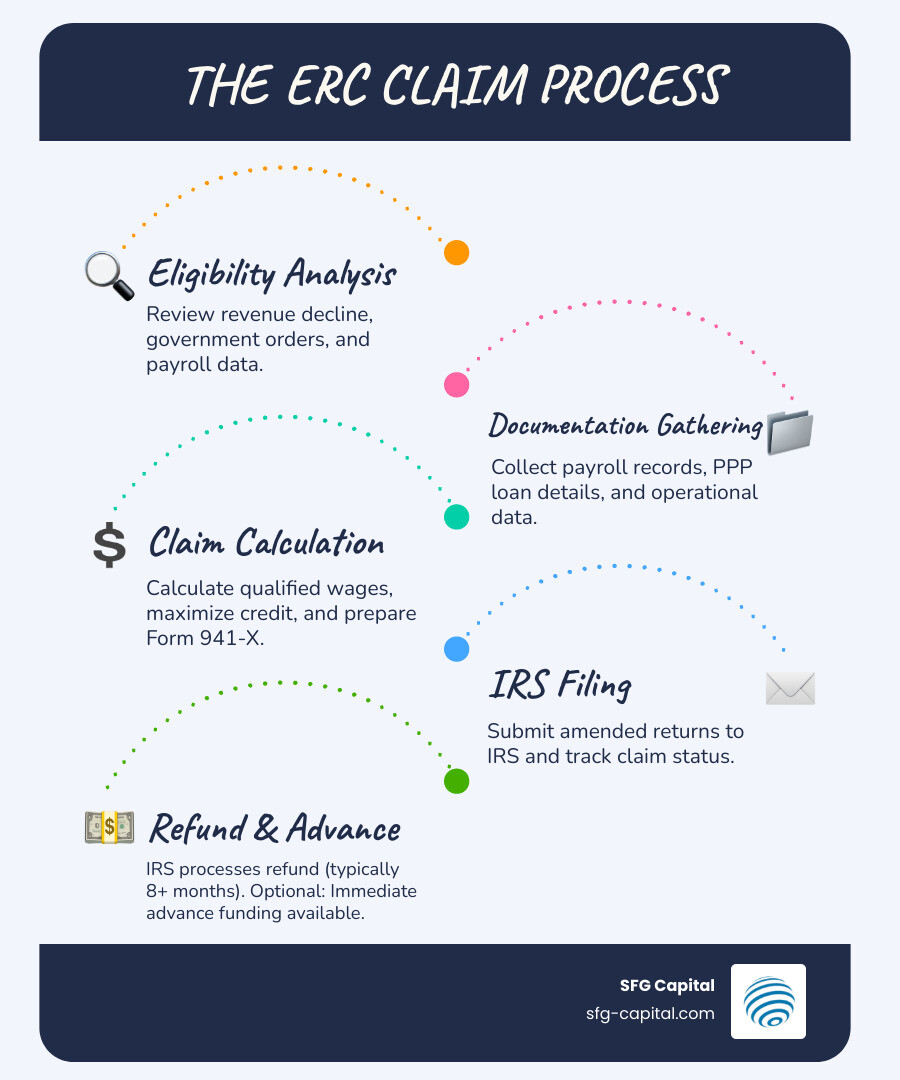
Once you’ve chosen a trusted ERC refund company, what does the journey from initial inquiry to receiving your refund look like? While the specific steps may vary slightly between providers, the core process remains consistent, focusing on meticulous data collection, accurate calculation, and diligent filing.
The Typical Processing Steps
- Initial Qualification: This often begins with a quick, preliminary assessment. Many ERC refund companies offer online forms or short quizzes to gauge your potential eligibility. Some, for instance, boast a qualification process that takes approximately 45 seconds. This initial step helps determine if a deeper dive is warranted.
- Document Submission: This is where the real work begins. You’ll need to provide comprehensive documentation, including:
- Detailed payroll records (e.g., Form 941s, payroll reports) for 2019, 2020, and 2021.
- Gross receipts data for relevant quarters to prove revenue decline.
- Information related to government orders that impacted your business operations, including specific dates and limitations.
- PPP loan documentation, if applicable, to ensure no wage overlap.
- Financial statements and other relevant business records.
- Claim Calculation and Filing: Your ERC partner will analyze all submitted data to determine your precise eligibility and calculate the maximum allowable credit. This involves:
- Identifying qualified wages for each eligible quarter.
- Applying the correct credit percentages (e.g., 50% for 2020, 70% for 2021).
- Preparing and filing amended quarterly employment tax returns (Form 941-X) with the IRS. Our dedicated team ensures that this process is handled with the utmost accuracy to maximize your credit while remaining compliant. For a detailed look at how this all comes together, refer to our ERC Funding Process.
Processing Time: Filing vs. Refund
It’s crucial to distinguish between the time it takes an ERC refund company to file your claim and the time it takes the IRS to process and send your refund.
- Company Filing Time: Some efficient ERC refund companies can get your claim filed with the IRS in as little as seven days, provided you supply all necessary documentation promptly.
- IRS Processing Time: This is the bottleneck. As we’ve discussed, the IRS has placed a processing moratorium on ERC claims. This means that after your claim is filed, you could be waiting over 8 months to receive your refund. This delay, while frustrating, is unfortunately beyond the control of any ERC provider.
The Role of ERC Advance Funding and Bridge Loans
The significant IRS processing delays have created a demand for solutions that provide businesses with quicker access to their funds. This is where ERC advance funding and bridge loans come into play.
- What is an ERC Advance? An ERC advance, or bridge loan, is a short-term financing option that provides your business with immediate capital, using your pending ERC refund as collateral. It essentially allows you to access a portion of your anticipated refund now, rather than waiting many months for the IRS. You can learn more about this option in our guide, ERC Refund Advance.
- Benefits: The primary benefit is immediate working capital. This can be critical for businesses needing to cover operational expenses, invest in growth, or simply maintain cash flow while they await the IRS refund. It effectively bypasses the lengthy IRS wait times.
- Drawbacks: These services come with fees, which are essentially the cost of accessing your money sooner. The specific fees and qualification requirements will vary depending on the provider. It’s important to understand the terms and ensure the cost is justified by your immediate capital needs.
At SFG Capital, we understand the urgency many Travis County businesses face. We offer advance funding and buyouts to help you steer these IRS delays, providing quick access to your deserved funds with a performance-based fee structure.
How ERC Refund Partners Handle IRS Audits
The possibility of an IRS audit is a significant concern for any business claiming the ERC. A top-tier ERC refund company doesn’t just file your claim; it prepares you for and supports you through potential audits.
- Proactive Documentation: A key strategy is to build an “audit-proof” file from the outset. This means meticulous documentation of eligibility, qualified wages, government orders, and calculations. Our process emphasizes this proactive approach, ensuring every claim we handle is thoroughly substantiated.
- Responding to IRS Inquiries: The IRS may send various notices, such as Letter 6612, which indicates an audit of your ERC claim. Your ERC partner should be equipped to help you respond effectively and provide any requested information.
- Representation: In the event of a full audit, having professional representation is paramount. This is where the involvement of tax attorneys and Enrolled Agents (EAs) within an ERC refund company or through their network becomes critical. These professionals can communicate directly with the IRS on your behalf, negotiate, and defend your claim. Our team includes such experts, ensuring you have robust support. For a broader understanding of how we can assist with ERC challenges, please see ERC Help: Everything You Need to Know About the Employee Retention Credit.
Conclusion: Secure Your ERC Refund with Confidence
The Employee Retention Credit remains a powerful financial tool for businesses that steerd the challenging waters of the pandemic. However, as we’ve explored, the path to claiming these funds is fraught with complexity, evolving IRS guidance, significant processing delays, and the very real risk of audits and penalties for incorrect claims.
This landscape underscores a crucial truth: attempting to steer the ERC process alone, or with an inexperienced provider, can turn a potential windfall into a costly headache. The right ERC refund company acts as your expert guide, ensuring compliance, maximizing your eligible credit, and providing peace of mind.
When making your choice, remember to prioritize:
- Specialized Expertise: Look for firms with deep, dedicated knowledge of ERC tax law, backed by credentialed professionals like CPAs and tax attorneys.
- Transparent and Performance-Based Fees: Opt for providers who charge a percentage of your actual refund, with no hidden upfront costs, aligning their success with yours.
- Robust Audit Support: Ensure your partner will stand by your claim, offering assistance and representation if the IRS comes calling.
- Solutions for Delays: If immediate capital is a concern, consider providers who offer ERC advance funding to bridge the gap during long IRS processing times.
At SFG Capital, we pride ourselves on being that trusted partner for businesses in Travis County. Our team is committed to expediting your ERC refund, offering performance-based fees, and providing advance funding options to get you the capital you need, when you need it. We work diligently to ensure your claim is not only accurate and maximized but also fully defensible against any IRS inquiry.
Don’t leave your valuable ERC refund to chance. Partner with experts who understand the nuances of the program and are dedicated to your financial success.