
How to Turn Your Austin ERC Refund into Cash Today
Still Waiting on Your ERC Refund? Here’s How to Get Cash Now
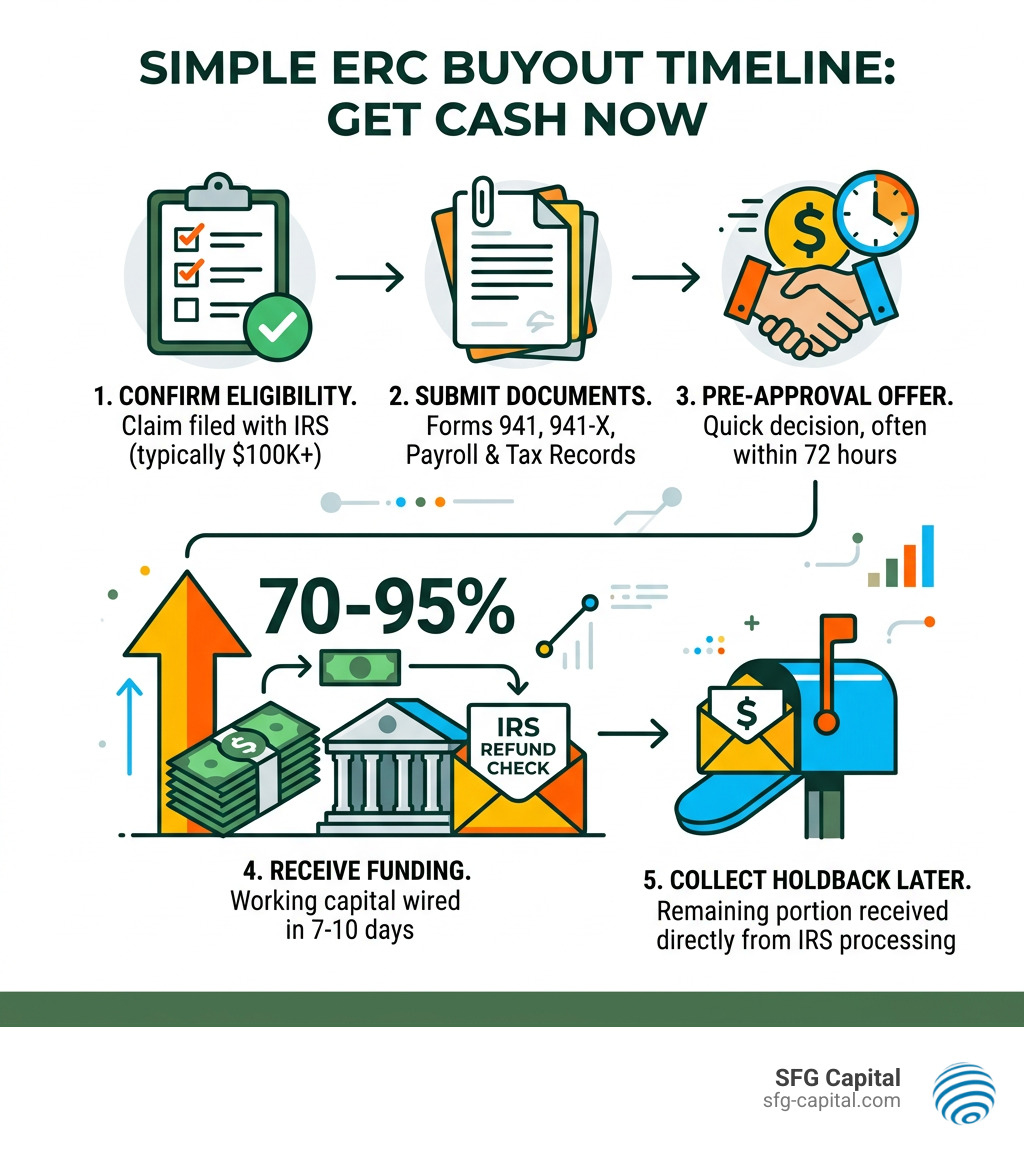
If you want to buyout ERC refund now, here is the short answer:
- Confirm eligibility – Your ERC claim must typically be at least $100,000 and already filed with the IRS.
- Submit documents – Provide Form 941, Form 941-X, payroll records, tax returns, and bank statements.
- Get a pre-approval offer – Most providers issue decisions within 72 hours.
- Receive funding – Get 70-95% of your ERC claim value wired to you in as little as 7-10 business days.
- Collect the holdback later – The remaining portion comes directly from the IRS once they process your refund.
The IRS is sitting on a massive backlog of ERC claims. Businesses across Travis County and the rest of the country are waiting 12 to 18 months — sometimes longer — for refunds they’ve already earned.
That wait has a real cost. Payroll still comes due. Rent doesn’t pause. Growth opportunities don’t wait for the IRS.
The CARES Act made $370 billion available to small businesses to help them survive COVID-related disruptions. Millions of eligible employers filed ERC claims. But “eligible” doesn’t pay the bills — cash in your account does.
An ERC buyout lets Austin business owners convert that pending refund into working capital today, without taking on debt or waiting another year to see a dime.
I’m Santino Battaglieri, founder of SFG Capital, and I’ve spent years helping businesses navigate the ERC landscape — including structuring compliant buyout ERC refund now transactions that have totaled over $500 million in purchased claims. In this guide, I’ll walk you through exactly how the process works, what it costs, and whether it’s the right move for your business.
What is an ERC Buyout and How Does it Work?
At its core, an ERC buyout is a financial transaction known as an asset purchase. It is not a loan, and it is not a line of credit. Instead of borrowing money and paying it back with interest, you are selling the rights to a future asset—your pending Employee Retention Tax Credit—to a third-party funding provider.
When you decide to buyout ERC refund now, you are essentially trading a portion of your future check for immediate liquidity. Because the IRS is currently wading through a backlog of millions of amended returns, the wait time for these funds has stretched from a few months to over a year.
In a buyout, the funding company performs deep due diligence on your claim to ensure it was filed correctly. Once approved, they pay you a significant portion of the claim upfront. To secure the transaction, a UCC-3 lien is typically placed on the specific tax credit asset. This isn’t a lien on your entire business or your building; it’s a legal marker that says, “When this specific check arrives, it belongs to the funder.”
One of the most important mechanics to understand is the holdback. Most buyouts fund between 70% and 90% of the total claim value. The remaining percentage (the holdback) is often paid directly to you by the IRS once they finally process the refund. This structure keeps the transaction off your balance sheet as debt, which is a major relief for businesses looking to maintain a clean financial profile. For more on the frustrations of the current timeline, see our guide on ERC Refund Delays: Should You Sue or Just Keep Waiting?
Why You Should Consider a Buyout ERC Refund Now
The primary reason to buyout ERC refund now is simple: cash flow. In the business world, a dollar today is almost always worth more than a dollar eighteen months from now—especially when that “dollar” is stuck in an IRS processing center in Ogden, Utah.
Many Austin businesses are facing what we call “opportunity cost.” Perhaps you have the chance to buy out a competitor, invest in new equipment for your Travis County facility, or lock in inventory at a massive discount. If your capital is tied up in a pending tax credit, you’re essentially paralyzed.
Waiting 12–18 months for the IRS is a gamble. We’ve seen businesses struggle with survival while waiting for “their” money. By choosing to sell your ERC claim, you regain control of your timeline. You stop being a spectator to the IRS’s internal delays and start being an active manager of your company’s growth.
Key Benefits of a Buyout ERC Refund Now
Why choose a buyout over other forms of financing? Here are the heavy hitters:
- No Debt on the Balance Sheet: Since it’s an asset sale, it doesn’t show up as a liability. This is crucial if you plan on applying for a traditional bank loan or mortgage in the near future.
- No Credit Impact: Most buyout providers focus on the strength of the ERC claim itself rather than your personal or business credit score.
- Non-Recourse Options: Many buyouts are structured so that if the IRS takes forever to pay, you aren’t on the hook for monthly interest payments.
- High Advance Rates: You can typically access 70% to 95% LTV (Loan-to-Value, though in this case, it’s “Purchase-to-Value”).
- Speed: You can go from a pile of paperwork to a wire transfer in about 10 business days.
For a deeper dive into the mechanics, check out our ERC Advance Funding Complete Guide.
Comparing Your Options: Buyout vs. Advance vs. Loan
Not all ERC funding is created equal. It’s a bit like choosing between a truck, a sedan, and a motorcycle—they all get you down I-35, but the experience is very different.
| Feature | ERC Buyout | ERC Advance | ERC Bridge Loan |
|---|---|---|---|
| Structure | Asset Purchase | Purchase/Loan Hybrid | Traditional Loan |
| Balance Sheet | No Debt | Usually No Debt | Debt Liability |
| Monthly Payments | None | None | Interest-Only or Principal |
| Cost | 13% – 20% flat fee | Discounted Rate | 4-5% fee + monthly interest |
| Speed | 7-10 Days | 7-14 Days | 5-7 Days |
| Risk | Funder assumes most risk | Shared Risk | Business assumes all risk |

An ERC Buyout is the “cleanest” option for most. You sell the asset, get your cash, and move on. An ERC Advance is similar but sometimes includes provisions where you might have to pay it back if the IRS hasn’t paid within a certain timeframe (usually 18 months). An ERC Bridge Loan is a standard debt instrument; it’s fast, but it adds a liability to your books and requires monthly payments.
If you are looking to bridge the gap, understanding these nuances is the difference between a smooth financial move and a surprise headache.
The Step-by-Step Process to Buyout ERC Refund Now
If you’re ready to move forward, the process is surprisingly streamlined. We know you’ve already done enough waiting, so we aim for speed.
- Application (4 Minutes): Most providers have a short digital form to get the basics.
- Pre-Approval (72 Hours): Once you submit your initial numbers, you’ll get a “soft” offer. This tells you the LTV and the fee.
- Due Diligence: This is the deep dive. The funding team will review your eligibility reports to make sure your claim is “clean.” They want to see that you actually qualified under the Gross Receipts test or the Government Orders test.
- Closing and Funding (7-10 Days): After the contracts are signed and the UCC-3 is filed, the funds are wired directly to your business account.
Most buyout programs require a minimum claim of $100,000, though some specialized funds for larger enterprises can handle claims up to $10,000,000. If you’re tired of the “pending” status on the IRS portal, don’t wait—learn how to get an ERC loan or advance today.
Required Documentation for Fast Funding
To get funded in 7 to 10 days, you need to have your “financial house” in order. The more complete your file, the faster the wire hits your account. You will typically need:
- Form 941: Your original quarterly tax returns for 2020 and 2021.
- Form 941-X: The amended returns that show your ERC claim.
- Payroll Summaries: Detailed reports showing wages paid per employee per quarter.
- Eligibility Report: A detailed breakdown explaining why you qualify (e.g., a list of specific government shutdown orders that affected your Austin business).
- Financial Statements: P&L and Balance Sheets from 2019 through the present.
- Bank Statements: Usually the last 3 months to verify active operations.
- Tax Returns: Your federal business tax returns for 2019–2022.
Risks, Costs, and Tax Implications to Consider
We believe in total transparency. Choosing to buyout ERC refund now isn’t free. The typical cost ranges from 13% to 20% of the total ERC amount. While that might seem steep, you have to weigh it against the 18-month wait and the 8-10% inflation or interest you might be paying on other debts in the meantime.
IRS Clawbacks and Audits
What happens if the IRS audits you later and says, “Actually, you weren’t eligible for that $200,000”? This is called a clawback. Reputable buyout providers often require or provide “Audit Protection” or “Tax Insurance.” In many non-recourse buyouts, the funder takes on the risk of the IRS taking a long time to pay, but you usually remain responsible if the claim was fraudulent or based on incorrect data.
Tax Implications
The ERC is not “tax-free money” in the traditional sense. You are required to reduce your deductible wage expenses by the amount of the credit, which may increase your taxable income for the year the wages were paid. Selling your claim doesn’t change this requirement. We always recommend a quick chat with your CPA before finalizing a refund advance.
Frequently Asked Questions about ERC Buyouts
What happens if the IRS denies my claim after the buyout?
This depends on whether your contract is recourse or non-recourse. In a non-recourse buyout, the funder assumes the risk of the IRS’s ability to pay. However, if the denial is due to errors in your filing or misrepresented data, the funder may have the right to seek repayment. This is why the due diligence phase is so rigorous—funders only buy claims they are confident will be paid.
Will selling my ERC affect my business credit score?
No. Because an ERC buyout is structured as an asset sale (selling a receivable), it is not reported as debt to credit bureaus. It’s actually a great way to improve your financial position by replacing a “stuck” asset with liquid cash, which you can use to pay down existing high-interest debt. For more on using ERC to manage debt, see our section on ERC bridge loans.
Can I sell an ERC claim filed through a PEO like ADP?
Yes! Many Austin businesses use Professional Employer Organizations (PEOs) like ADP, Paychex, or Insperity. Even though the PEO filed the claim under their own EIN, the credit belongs to your business. These claims are absolutely sellable, though the documentation process involves a few extra steps to ensure the PEO remits the funds correctly once received. We have extensive experience with ERC funding solutions for PEO-filed claims.
Conclusion
The IRS backlog isn’t going away anytime soon. For businesses in Travis County, waiting for a check that might not arrive until next year is a strategy that carries significant risk. Whether you need to cover payroll, expand your operations, or simply want the peace of mind that comes with a healthy bank balance, a buyout is a powerful tool.
At SFG Capital, we specialize in helping Austin business owners navigate these complex waters. We offer expert assistance to ensure your claim is solid and provide the fastest path to liquidity through our performance-based fee structure. We don’t get paid unless you get funded.
Don’t let your hard-earned tax credits sit in a government backlog. Take control of your cash flow today. For more information on how we can help your Travis County business, explore more info about our ERC funding services.