
Is the IRS ERC Program Still Accepting Claims?
Understanding the IRS ERC Program: Origins and Intent
#
The IRS ERC program is a refundable tax credit created to help businesses keep employees on payroll during the COVID-19 pandemic — and yes, some claims are still being processed, but the landscape has changed dramatically.
Here’s what you need to know right now:
| Question | Quick Answer |
|---|---|
| Is the ERC still accepting new claims? | No. The filing deadline was April 15, 2025 |
| Are existing claims still being processed? | Yes — roughly 597,000 claims remain in the IRS backlog as of April 2025 |
| How long is processing taking? | Up to 546 days in 2025, due to enhanced IRS scrutiny |
| Was there a Voluntary Disclosure Program? | Yes — both programs are now closed (last deadline: Nov. 22, 2024) |
| What if I claimed ERC incorrectly? | You may still be able to withdraw or amend your claim |
| Should I work with a tax professional? | Yes — the IRS strongly recommends it |
The ERC started as a lifeline for struggling businesses. But it grew into one of the most complex — and misused — relief programs in U.S. history. The Joint Committee on Taxation originally projected the program would cost $78 billion. Final estimates now put the cumulative cost at $302 billion, nearly four times that initial figure.
If you filed a claim and are still waiting, or if you’re unsure whether your claim was legitimate, this guide walks you through exactly where things stand today.
I’m Santino Battaglieri, founder of SFG Capital, a firm that has purchased and funded over $500 million in IRS ERC program claims with a strict focus on compliance and documentation integrity. My team works alongside experienced CPAs and tax counsel every day to help business owners navigate ERC eligibility, processing delays, and funding options safely.
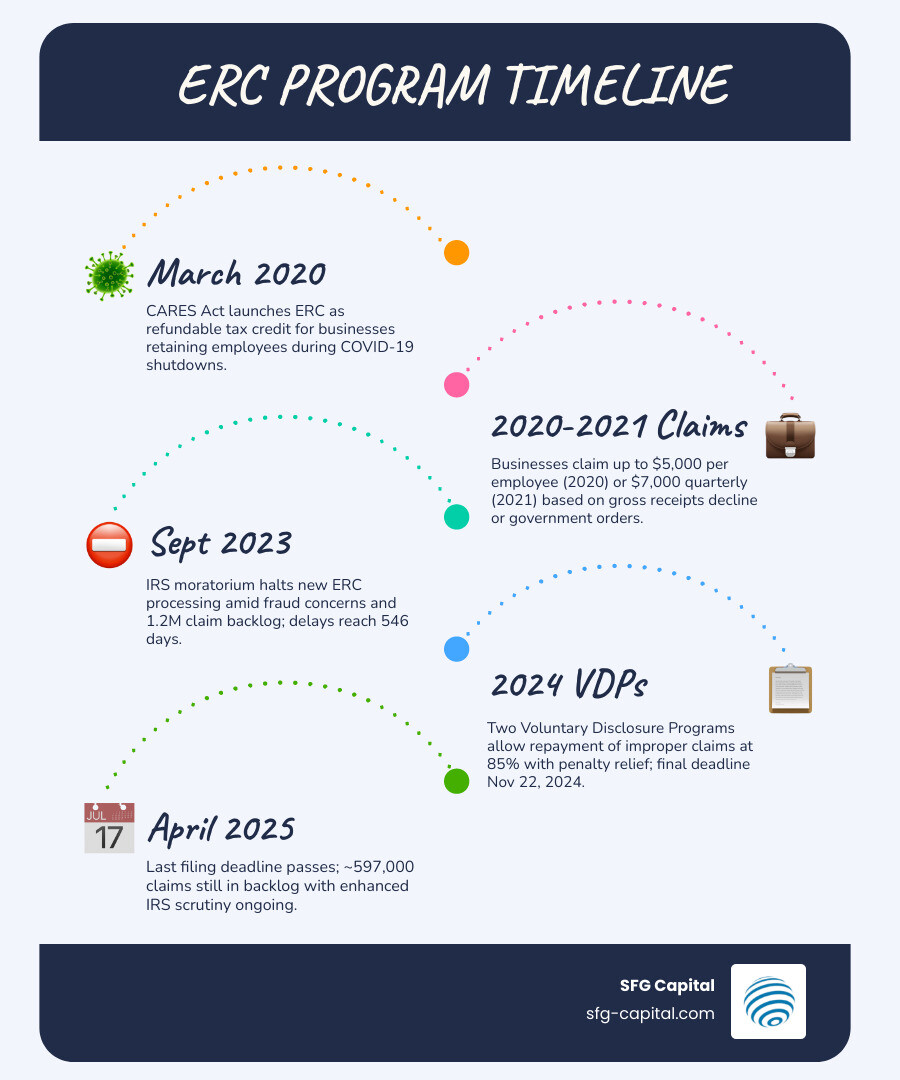
When the pandemic hit in early 2020, the federal government scrambled to prevent mass unemployment. The result was the CARES Act, which introduced the Employee Retention Credit (ERC). This wasn’t a loan like the Paycheck Protection Program (PPP); it was a refundable tax credit designed to reward employers for keeping their staff on the payroll despite forced closures or massive revenue drops.
Initially, the IRS ERC program was quite modest. For 2020, it provided a credit equal to 50% of qualified wages, capped at $5,000 per employee for the entire year. However, as the pandemic lingered, lawmakers realized businesses needed more help. Subsequent legislation, including the American Rescue Plan Act, expanded the credit significantly for 2021, raising the stakes for both taxpayers and the IRS.
To get a deeper dive into the technicalities, you can read our guide on What is ERC? and explore The ERC Explained to see how it specifically impacts employment tax obligations for both for-profit and tax-exempt organizations.
Eligibility Criteria for the IRS ERC Program
Determining if you qualify for the IRS ERC program is often where things get “mathy” and a bit complicated. Generally, there are two main “tests” for eligibility. You only need to pass one of them for a given quarter to qualify.
- The Government Mandated Suspension Test: Your operations were fully or partially suspended due to orders from an appropriate governmental authority limiting commerce, travel, or group meetings due to COVID-19.
- The Gross Receipts Test: You experienced a “significant decline” in gross receipts compared to the same quarter in 2019.
| Feature | 2020 Eligibility | 2021 Eligibility |
|---|---|---|
| Credit Rate | 50% of qualified wages | 70% of qualified wages |
| Max Credit | $5,000 per employee (Annual) | $7,000 per employee (Quarterly) |
| Gross Receipts Decline | > 50% vs 2019 | > 20% vs 2019 |
| Employee Limit | 100 (for full credit) | 500 (for full credit) |
It is important to note the “nominal impact” rule. If a government order affected more than 10% of your business operations (measured by gross receipts or total service hours), the IRS generally considers that a partial suspension. For a step-by-step walkthrough, check out The ERC Eligibility Checklist and our article Are You Eligible?.
Aggregation Rules and Recovery Startup Businesses
The IRS doesn’t let you “cheat” the system by splitting one large company into five small ones. Under the IRS ERC program, aggregation rules apply. If multiple entities are under “common control” (think parent-subsidiary or brother-sister groups), they are treated as a single employer for the purpose of counting employees and measuring gross receipts.
However, there was a special “bonus” round for new businesses. Recovery Startup Businesses (RSBs) are entities that started after February 15, 2020, and have average annual gross receipts of $1 million or less. These businesses could claim the ERC for the third and fourth quarters of 2021, even if they didn’t meet the suspension or gross receipts tests, with a cap of $50,000 per quarter. You can learn more about these specific requirements in our guide, Unlock Your ERC.
The Processing Moratorium and Fraud Concerns
By 2023, the IRS ERC program had become a victim of its own success—and of aggressive marketing. “ERC Mills” began popping up everywhere, promising business owners huge checks with little to no documentation. This led to a surge of questionable claims that threatened to drain the federal treasury.
In September 2023, the IRS took the unprecedented step of issuing a moratorium on processing new claims. At that time, the backlog had reached 600,000 unprocessed claims, with 50,000 new ones arriving every single week.
The impact of this pause was massive:
- Backlog Growth: The backlog eventually peaked at 1.2 million claims in October 2024.
- Processing Delays: Wait times exploded. In 2022, a refund might take 100 days. By 2025, that average stretched to 546 days.
- Cost Control: Without the moratorium, experts at the Penn Wharton Budget Model (PWBM) estimated the program could have cost $567 billion. The IRS’s aggressive stance helped bring that projected final cost down to $302 billion.
For those stuck in this “limbo,” we provide detailed ERC Help to understand what’s happening behind the scenes at the IRS.
Navigating the IRS ERC Program Processing Moratorium
During the moratorium, the IRS wasn’t just sitting on its hands; it was building better “fraud filters.” They released a press release on aggressive marketing to warn taxpayers that just because a promoter said you qualify, doesn’t mean the IRS agrees.
A 2023 paper on preparer influence by researcher Lucas Goodman found that using an “aggressive” preparer increased a firm’s likelihood of filing for the ERC from 27% to a staggering 95%. This data confirmed the IRS’s fear: many businesses were being led into improper claims by third parties. If you’re wondering how to handle your pending claim during this period, see Navigating the ERC Program.
Warning Signs of ERC Scams and “Mills”
How do you spot an “ERC Mill”? We’ve seen them all, and they usually follow a specific script. The IRS has spent years warning on false claims, and you should look out for these red flags:
- Percentage-Based Fees: They only get paid if you get a refund (often 15% to 30% of the total).
- Unsolicited Ads: Aggressive radio, TV, or social media ads.
- Immediate Eligibility: Telling you that you qualify before they even look at your books.
- Upfront Payments: Asking for a “consulting fee” before any work is done.
- Vague Explanations: Relying on “supply chain” issues without showing a specific government order that caused the disruption.
Resolving Improper Claims: The Voluntary Disclosure Program (VDP)
Knowing that many businesses were misled, the IRS offered an “olive branch” in the form of the Voluntary Disclosure Program (VDP). This was essentially a way for businesses to say, “Oops, I shouldn’t have claimed this,” and pay it back with significantly reduced penalties.
The second VDP, which closed on November 22, 2024, was particularly generous. It allowed participants to:
- Repay only 85%: You got to keep 15% of the credit you received.
- Avoid Interest: The IRS waived interest on the amount you were repaying.
- Avoid Penalties: No civil penalties were assessed.
- No Audit: Participation generally protected that tax period from a future employment tax audit.
If you are looking for how these applications were structured, our guide on the ERC Funding Application provides context on the documentation required for IRS interactions.
Eligibility for the Second VDP
The second VDP wasn’t open to everyone. To qualify, a business had to meet several strict criteria:
- The claim must have been for a 2021 tax period.
- The refund must have already been processed and paid (cashed or deposited).
- The taxpayer must now believe they were entitled to $0 of the credit.
- The business could not be under a criminal investigation or an ongoing employment tax audit.
The IRS provided extensive IRS VDP FAQs to help businesses determine if this was their best path to compliance.
Application Requirements and Form 15434
Applying for the VDP required more than just a phone call. Taxpayers had to use the IRS Document Upload Tool to submit Form 15434 (Application for Employee Retention Credit Voluntary Disclosure Program).
Along with this form, applicants had to:
- Submit Form SS-10 to extend the statute of limitations for the IRS to assess the tax.
- Make the 85% payment via EFTPS (Electronic Federal Tax Payment System).
- Sign a final closing agreement with the IRS.
- If they couldn’t pay the full 85% immediately, they had to include Form 433-B to request an installment agreement.
Details of these requirements were outlined in IRS Announcement 2024-30.
Options After the VDP Closure: Withdrawal and Corrections
If you missed the November 2024 VDP deadline, don’t panic—but do move quickly. You still have options to fix an improper claim before the IRS finds you.
The most effective tool remaining is the claim withdrawal program. This is for businesses that filed a claim but haven’t received the money yet, or received a check but haven’t cashed it. By withdrawing, you treat the claim as if it never happened, which can protect you from penalties and interest.
If you have already cashed the check, your remaining option is to file Form 941-X to amend your return and pay back the credit. While you won’t get the 15% discount offered by the VDP, doing this voluntarily is much better than waiting for an audit. The ERC Claim Deadline and check The ERC Explained for amendment procedures.
Frequently Asked Questions about the IRS ERC Program
How do wage calculations and health insurance interact with the ERC?
Qualified wages aren’t just the numbers on a W-2. They also include the employer’s share of health plan expenses. According to Notice 2021-20, you can include “pre-tax” employee contributions and employer-paid premiums. However, you cannot count wages paid to “large” employers (over 100 or 500 employees depending on the year) unless the employee was being paid not to work.
Can I claim the ERC if I received PPP or Provider Relief Funds?
Yes, but you can’t “double-dip.” You cannot use the same dollar of wages to justify both PPP loan forgiveness and an ERC claim. This “coordination” is one of the most common errors in the IRS ERC program. Additionally, while Provider Relief Funds (PRF) are included in your gross receipts calculation, they do not automatically disqualify you from claiming the ERC on those wages, provided you follow the rules in Notice 2021-49.
What should I do if I received a refund but believe I am ineligible?
If the money is in your bank account but your gut (or a reputable CPA) tells you the claim was wrong, the best move is to file an amended return immediately. This stops the clock on interest accrual and demonstrates “good faith” to the IRS. Use the IRS Eligibility Checklist to double-check your status before taking action.
Conclusion
Navigating the IRS ERC program in 2025 feels a bit like walking through a minefield. Between the 546-day processing delays and the intense scrutiny of the IRS backlog, business owners in Travis County and across the U.S. are understandably frustrated.
At SFG Capital, we specialize in helping Austin-based businesses bypass these IRS delays. We understand that “waiting two years” isn’t a viable financial strategy for most employers. That’s why we offer refund advances and buyout options for existing ERC claims. We take on the wait time so you can get back to growing your business.
Our fees are performance-based, meaning we only succeed when you do. If you have an outstanding claim and need liquidity now, or if you just need expert guidance on where your claim stands, we are here to help. Reach out to us today for Employee Retention Credit Help and let’s get your funds moving.