
Is Your ERC Contingency Fee a Fair Deal? Unpacking the Details
Understanding What You’re Paying For: The ERC Contingency Fee Explained
ERC contingency fee arrangements have become one of the most controversial topics in the Employee Retention Credit landscape. Here’s what you need to know:
Quick Answer: What is an ERC Contingency Fee?
- A fee structure where ERC service providers charge a percentage of your total refund (often 15-30%)
- You pay nothing upfront—fees come out of your credit when received
- The IRS has issued strong warnings against these arrangements
- Professional standards (AICPA, Circular 230) prohibit CPAs and enrolled agents from charging contingency fees for amended tax returns
- These fees create potential conflicts of interest that may lead to inflated or improper claims
If you used a third-party ERC provider under a contingency fee agreement, you’re not alone. Thousands of businesses turned to outside help to claim the Employee Retention Credit during 2021-2022, often attracted by promises of “no upfront cost” and taking a percentage only if you got a refund. But as the IRS has slowed claim processing, denied many applications, and ramped up audits, business owners are now asking: Was this fee structure actually a good deal?
The reality is more complex than most providers admit. While contingency fees sound appealing—especially when cash is tight—they raise serious red flags for the IRS and professional tax organizations. The fee structure itself can incentivize providers to maximize refund amounts rather than ensure accuracy and compliance, potentially putting your business at risk for penalties, interest, and clawbacks.
I’m Santino Battaglieri, and through SFG Capital, I’ve worked with businesses navigating over $500 million in ERC claims, including reviewing problematic ERC contingency fee agreements and helping clients understand their options. Many businesses find too late that their original agreement doesn’t protect them when IRS issues arise.
What is an ERC Contingency Fee and Why is it Controversial?
The Employee Retention Credit (ERC) was a refundable tax credit introduced under the CARES Act to help businesses keep employees on their payroll during the COVID-19 pandemic. It was designed for businesses that experienced a full or partial suspension of operations due to government orders, or a significant decline in gross receipts. Eligible employers could claim the ERC on original or amended employment tax returns, typically Form 941-X. This credit was a lifeline for many, offering substantial relief when businesses needed it most.
However, the complexity of the ERC program led many business owners to seek assistance from third-party providers. This is where the ERC contingency fee entered the scene. A contingency fee agreement means the provider charges a percentage of the total ERC refund amount your business receives. This percentage can range, but we’ve seen it anywhere from 10% to 30%. The appeal is obvious: no upfront payment, and the provider only gets paid if you get a refund. It sounds like a win-win, right?
Not so fast. The IRS has expressed significant concerns about these arrangements, even issuing stern warnings to employers. As we’ve seen, the IRS has been actively cautioning employers about aggressive marketing tactics and the potential for fraud associated with these fee structures. The core controversy stems from the idea that a fee tied directly to the refund amount can incentivize providers to inflate claims or push eligibility boundaries, leading to inaccurate or even fraudulent applications.
The Official IRS Stance
The IRS has been unequivocally clear about its disapproval of ERC contingency fee arrangements for tax preparation. They’ve stated that contingency or percentage-based fees are prohibited when preparing either an original or amended tax return, which is how the ERC is claimed via Form 941-X. This stance is rooted in established professional standards, particularly Treasury Department Circular 230, which governs the practice of tax professionals before the IRS.
These warnings are not just polite suggestions; they highlight a serious issue of compliance and ethics. The IRS has identified that many “ERC mills” or unscrupulous third parties are using aggressive marketing—including unsolicited calls and emails—to entice taxpayers into making claims they may not be entitled to. They often promise inflated ERC amounts or guarantee audit protection, which are major red flags. The focus should always be on compliance and accuracy when claiming the ERC tax credit.
How These Fees Can Inflate Claims
The inherent conflict of interest in a ERC contingency fee model is a major concern. When a provider’s payment is directly proportional to the size of the ERC refund, there’s a strong incentive to maximize that refund, even if it means pushing the limits of eligibility or taking aggressive positions that aren’t fully supported by IRS guidance.
This can lead to providers:
- Pushing eligibility boundaries: Advising businesses that don’t truly qualify to claim the credit.
- Maximizing fees: Encouraging employers to include wages that aren’t eligible or to calculate the credit based on inflated numbers.
- Overlooking important interactions: Failing to inform taxpayers that they cannot claim the ERC on wages already used for Paycheck Protection Program (PPP) loan forgiveness or other tax credits. They might also neglect to mention the requirement to reduce wage deductions on income taxes by the amount of the ERC received.
All of these actions increase the risk of inaccuracy and can have severe consequences for your business. The IRS has warned that making false or improper claims for the employee retention credit can result in repayment of the credit with interest and penalties, and even audits or criminal investigations. This is why we, at SFG Capital, emphasize accuracy and compliance above all else.
The Great Debate: Arguments For and Against Contingency Fees
The discussion around ERC contingency fee structures isn’t entirely one-sided. While the IRS and professional bodies raise valid concerns, there are also arguments for why these fees became so prevalent. It’s a delicate balance between accessibility and risk.

The Case for Contingency Fees
For many small businesses, the primary appeal of a ERC contingency fee is the lack of upfront cost. During the pandemic, when cash flow was tight, many businesses simply couldn’t afford to pay large hourly or fixed fees for complex tax advice. Contingency fees offered a way to access expert help without immediate financial strain.
Proponents of contingency fees often argue that this model places “skin in the game” for the preparer. If the business doesn’t receive a refund, the provider doesn’t get paid, theoretically aligning their interests with the client’s success. This shared risk can be attractive, especially for businesses unsure of their eligibility or the potential refund amount. Payment from the refund itself also means the business doesn’t have to dip into its operating capital.
The Case Against the ERC Contingency Fee
Despite the perceived benefits, the arguments against the ERC contingency fee are substantial and primarily center on ethical considerations and the potential for abuse.
- Professional Standards: As highlighted by the AICPA and IRS Circular 230, tax professionals like CPAs and enrolled agents are generally prohibited from charging contingent fees for preparing original or amended tax returns. This prohibition exists to prevent conflicts of interest and ensure that tax advice is objective and accurate, not driven by a desire to maximize a fee.
- Unconscionable Fees: Circular 230, Section 10.27, also speaks to “unconscionable fees,” which can be a subjective but important consideration. When a provider charges a large percentage of a potentially massive refund, it can quickly amount to a fee that seems disproportionate to the actual work performed, especially if the claim is straightforward or, worse, inaccurate.
- Incentivizing Fraud and Lack of Due Diligence: The biggest concern is that contingency fees can incentivize providers to be less diligent in verifying eligibility or even to encourage businesses to take aggressive, unsupported positions. The focus shifts from “is this claim legitimate?” to “how can we get the biggest refund?” This can lead to businesses filing claims they are not entitled to, increasing their risk significantly.
We believe that professional advice should always prioritize the client’s best interest and compliance, not just the largest possible refund.
The IRS Crackdown: Regulations, Risks, and Recourse
The IRS’s concerns about ERC claims, particularly those involving ERC contingency fee arrangements, have escalated into a full-blown crackdown. This has manifested in several ways, from processing delays to new enforcement actions. The IRS announced an immediate moratorium on processing new ERC claims starting September 14, 2023, due to a surge of questionable claims. This pause allows them to intensify audit work and investigations on promoters and businesses filing dubious claims, leading to significant delays for all businesses, even legitimate ones.

Understanding the Rules: Circular 230 and Court Rulings
IRS Circular No. 230 is the bedrock of tax preparer regulation, outlining the duties and restrictions for those who practice before the IRS. It specifically prohibits contingency fees for preparing original or amended tax returns. However, the application of this rule has been complicated by court rulings like Loving v. IRS and Ridgely v. Lew. These decisions have restricted the IRS’s ability to regulate unenrolled tax return preparers, creating a regulatory gray area.
While CPAs and enrolled agents are still bound by Circular 230 and their professional ethical standards (like those from the AICPA), many of the “ERC mills” operating today are not licensed CPAs or attorneys. This means they might not be directly subject to Circular 230’s prohibitions, or they operate in a manner that skirts these regulations. This distinction is crucial, as it means the average business owner might not be able to differentiate between a regulated professional and an unregulated promoter.
Potential Risks for Your Business
The risks for businesses that have used ERC contingency fee providers for claims that turn out to be inaccurate or fraudulent are substantial:
- Repayment of Credit: If the IRS determines your claim was erroneous, you will have to repay the entire credit amount.
- Substantial Penalties: This can include accuracy-related penalties (e.g., 20% of the underpayment) or even fraud penalties (75%).
- Interest Charges: Interest can accrue on the underpaid tax from the original due date, significantly increasing the total amount owed.
- IRS Audit: An improper ERC claim can trigger a comprehensive audit of your business’s tax returns, potentially uncovering other issues.
- Amending Income Tax Returns: Businesses that improperly claimed the ERC often also need to amend their income tax returns to reduce previously taken wage deductions, which further complicates their tax situation.
- Potential Criminal Investigation: In severe cases of intentional fraud, businesses and their principals could face criminal charges.
We’ve seen these consequences firsthand, and they can be devastating for a business. The IRS has clearly stated that making false or improper claims for the employee retention credit will have serious repercussions.
What to Do if You Have an Improper ERC Contingency Fee or Claim
If you’re concerned about your ERC claim or the fees charged by your provider, don’t panic, but do act swiftly. Here are the steps we recommend:
- Review Your Agreement: Get a copy of your ERC contingency fee agreement and review it carefully. Understand what services were covered, what guarantees (if any) were made, and what recourse you have.
- Consult a Trusted Tax Professional: Seek a second opinion from an independent, reputable tax professional (like a CPA or tax attorney) who is not operating on a contingency fee basis for ERC. They can help assess the validity of your original claim and the terms of your fee agreement.
- Consider the IRS Voluntary Disclosure Program (VDP): The IRS has announced a Voluntary Disclosure Program for employers to resolve erroneous ERC claims. This program allows businesses that received an erroneous ERC to come forward, pay back 80% of the credit, and avoid penalties and interest, provided they meet specific eligibility criteria. It’s a way to get right with the IRS with potentially less severe consequences.
- Explore the Claim Withdrawal Process: For businesses that have filed an ERC claim but have not yet received the refund, the IRS offers a claim withdrawal process. This can help you avoid potential penalties if you realize your claim was incorrect before it’s processed.
- Report Fraud: If you believe your ERC provider engaged in fraudulent activity or aggressive marketing tactics, you can report them to the IRS. You can also report instances of fraud and IRS-related phishing attempts to the IRS at phishing@irs.gov and to the Treasury Inspector General for Tax Administration at 800-366-4484.
Navigating these complexities can be daunting, but you don’t have to do it alone. If you’re in Travis County or anywhere in the United States and have questions about your ERC claim or provider, please don’t hesitate to Contact Us. We’re here to help.
Beyond the Standard Fee: Exploring Your Options
Given the serious risks associated with ERC contingency fee arrangements, many businesses are wisely seeking alternative fee structures. We believe in transparent, ethical, and client-aligned approaches that prioritize your business’s long-term financial health.
SFG Capital’s Fee Structures
At SFG Capital, we offer fee structures that align our interests with yours, focusing on compliance and value, not just maximizing a refund. Our approach includes:
- Performance-Based Fees: Instead of a simple percentage of the refund, our fees are structured to reflect the complexity of your claim and the value we provide, while upholding ethical standards. This means we’re still motivated to get you the best possible outcome, but always within the bounds of IRS guidelines.
- Transparent Pricing: We believe you should know exactly what you’re paying for. Our pricing models are clear, predictable, and discussed upfront, eliminating surprises.
- Flexible Fee Models: We understand that every business is unique. We work with you to find a fee arrangement that fits your specific situation and needs, ensuring cost predictability without compromising on expert guidance.
Our commitment is to guide you through the intricate ERC process with integrity and expertise. You can learn more about how we work and our client-focused approach by visiting Our Process.
Funding Solutions from SFG Capital
A challenge businesses face with ERC claims is the long wait for refunds, especially with the current IRS processing moratorium. While the IRS works through its backlog, your business in Travis County might need that capital now. That’s where our funding solutions come in.
We provide ERC advances (also known as ERC buyouts) that allow you to access your anticipated refund funds quickly, bypassing the lengthy IRS delays. This means:
- Immediate Access to Capital: Get the cash you need to reinvest in your business, manage cash flow, or pay off debt, without waiting months or even years.
- Mitigating Risk: By receiving your funds upfront, you reduce your exposure to potential future IRS changes or further processing delays.
- Financial Certainty: Our solutions provide predictable access to your funds, allowing for better financial planning and peace of mind.
We’re dedicated to helping businesses like yours secure their ERC funds efficiently and reliably. To explore our comprehensive ERC funding solutions, including advances and expert claim assistance, visit Our Services.
Frequently Asked Questions about ERC Fees
Can a CPA legally charge a contingency fee for an ERC claim?
Generally, no. Professional standards from the AICPA and rules in IRS Circular 230 prohibit CPAs from charging contingent fees for services involving the preparation of an amended tax return, which is how the ERC is claimed. While some might try to argue exceptions, the prevailing professional guidance is clear: CPAs should bill for ERC assistance using traditional arrangements like hourly or fixed fees.
What is a typical ERC contingency fee percentage?
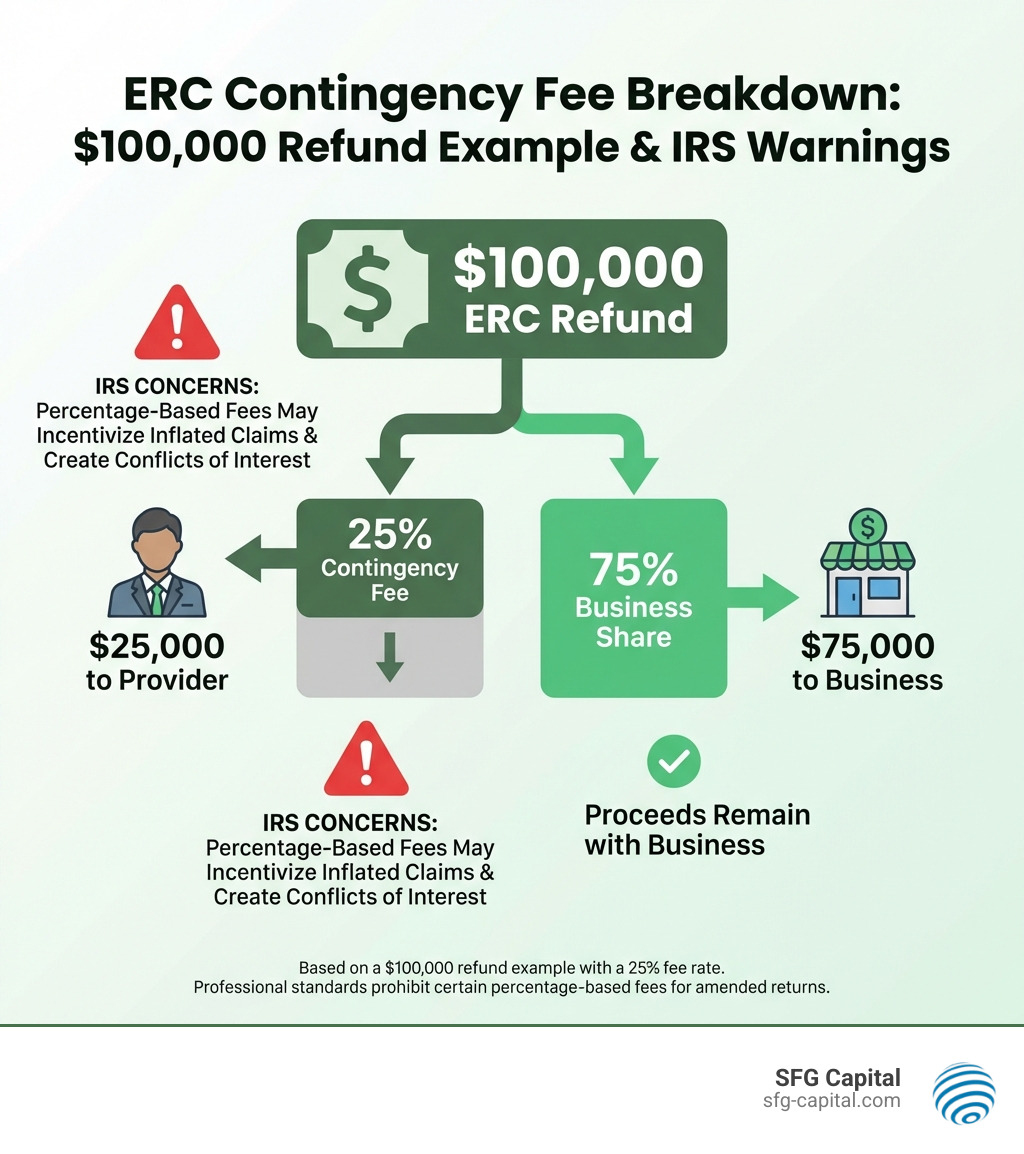
Fees vary widely but aggressive marketers often charge between 15% and 30% of the total credit amount. We’ve even seen some as high as 30%. The IRS views high percentage-based fees as a major red flag for fraudulent claims, as they incentivize preparers to maximize the refund rather than ensure accuracy. For example, a 25% contingency fee on a $100,000 ERC refund means $25,000 goes to the provider, leaving you with $75,000.
What should I do if I think my ERC provider filed an incorrect claim?
Immediately seek a second opinion from a reputable, independent tax professional who is not compensated on a contingency basis. This expert can review your original claim for accuracy and eligibility. Depending on your situation, you can explore options like the IRS’s claim withdrawal process (if the refund hasn’t been received) or the Voluntary Disclosure Program (if you’ve already received the refund) to correct the error and limit potential penalties and interest.
Conclusion
Navigating ERC claims and their associated fees can feel like walking through a minefield. While the allure of a ERC contingency fee—no upfront cost, payment only if you win—is understandable, the risks it poses to your business are significant and often outweigh the initial appeal. The IRS’s intensified scrutiny, coupled with professional ethical standards, paints a clear picture: these fee structures can lead to conflicts of interest, inflated claims, and severe consequences for your business down the line.
For businesses in Travis County and beyond, the key is to prioritize transparency, compliance, and accurate advice. Reviewing fee agreements, understanding the inherent risks, and seeking assistance from trusted professionals who operate with ethical fee structures are paramount. Exploring alternative solutions like performance-based fees and refund advances can provide financial certainty and speed up access to funds, allowing you to focus on what you do best—running your business. SFG Capital specializes in providing these expert-guided funding solutions, helping you open up your ERC funds responsibly and efficiently.