
Why Understanding Your ERC Claim Status Matters
Your ERC claim status determines when you will receive your refund from the IRS. With processing delays often stretching for many months or even over a year, knowing where your claim stands is critical for cash flow planning and day-to-day decision-making.
To check your ERC claim status, you can:
- Call the IRS Business & Specialty Tax Line at 800-829-4933.
- Contact the Taxpayer Advocate Service for hardship cases.
- Work with a professional tax service that has dedicated IRS access.
You will need your EIN, tax period information, and filing dates ready before you reach out.
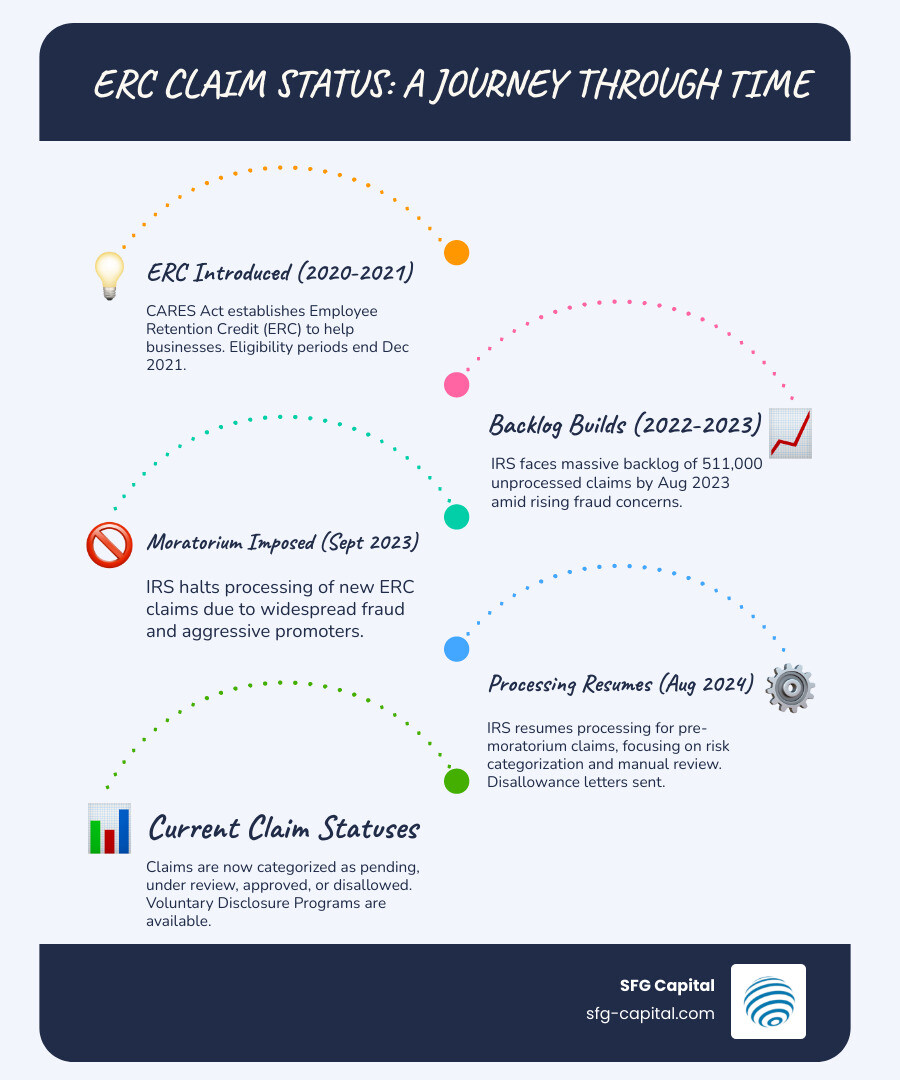
The Employee Retention Credit (ERC), created under the CARES Act, allowed eligible employers to claim a refundable tax credit using Form 941-X. However, the program has been plagued by problems. As of August 2023, the IRS had a backlog of over 500,000 unprocessed claims. A moratorium on new claims was imposed in September 2023 due to fraud concerns, and in August 2024, thousands of disallowance letters were sent.
This means your claim could be waiting in the backlog, flagged for review, categorized as high-risk, or even disallowed. The stakes are high, as improper claims face full repayment with penalties and interest. Many businesses were pushed by aggressive promoters to file, leaving them exposed to IRS audits.
I am Santino Battaglieri of SFG Capital. Our team has helped businesses steer over $500 million in ERC claims with a focus on strict compliance and active monitoring of claim status. Our goal is to ensure businesses understand their position and access their refunds through legitimate channels.
The Current State of IRS ERC Processing
The journey of an ERC claim is complex. What began as a lifeline for businesses has become a landscape of backlogs and intense scrutiny. The sheer volume of applications, coupled with fraud concerns, has led to significant processing delays.
As of August 2, 2023, the IRS reported an inventory of approximately 511,000 unprocessed Forms 941-X. This massive backlog is a primary reason for the extended wait times. You can check the IRS’s general operations status for updates, but specific ERC information remains hard to get. Our team at SFG Capital works to keep our clients informed every step of the way.
In September 2023, the IRS announced a moratorium on processing new claims filed after September 14, 2023, to combat widespread fraud. In August 2024, the agency resumed processing for some of these claims, but with a major caveat: a vast majority showed a risk of being improper. This means most claims now face a manual review and are categorized by risk, slowing the process for everyone.
Why Are ERC Claims So Delayed?
Business owners often ask, “Why is my ERC refund taking so long?” Several factors contribute to what we call “The Great ERC Wait.”
- Unprecedented Claim Volume: The ERC’s popularity overwhelmed the IRS. The backlog of over half a million amended returns (Form 941-X) far outstripped the agency’s processing capacity.
- Fraud Prevention Measures: The IRS has intensified its review process to combat fraudulent claims. This cautious approach means even legitimate claims take longer to verify.
- Staffing Shortages: Like many organizations, the IRS has faced staffing challenges, creating a bottleneck for managing a massive influx of complex tax forms.
- Manual Paper Processing: Form 941-X cannot be e-filed. Every claim must be processed manually, which is inherently slow and labor-intensive.
These factors mean that initial wait time estimates are obsolete. Many businesses now wait many months, or even longer, for their refunds.
The IRS Moratorium and What It Means for You
The IRS’s September 2023 moratorium was a direct response to the flood of improper claims. Initially, claims submitted after September 14, 2023, were paused. In August 2024, the IRS began processing claims filed through January 31, 2024, in a phased, risk-based approach.
This means:
- High-risk claims: Face comprehensive audits, significantly extending processing time.
- Low-risk claims: Move more quickly but still face increased scrutiny.
- Unacceptable risk claims: Are likely to be disallowed.
This phased resumption means continued uncertainty and longer waits for many. It underscores the importance of having a legitimate claim, as we’ve discussed in our article, The Great ERC Wait: Understanding Your Delayed Employee Retention Credit.
How to Check Your ERC Claim Status
Waiting for a substantial refund is nerve-wracking, and not knowing your ERC claim status adds to the anxiety. While patience is required when dealing with the IRS, there are ways to check on your claim.
Methods for Checking Your ERC Claim Status
- Calling the IRS Directly: The primary contact is the IRS Business & Specialty Tax Line at 1-800-829-4933. Be prepared for long wait times. Have your Federal Employer Identification Number (EIN) and the relevant tax periods ready to help the representative locate your claim.
- Contacting the Taxpayer Advocate Service (TAS): If the delay is causing your business significant financial hardship, the TAS may be able to help. This independent organization within the IRS helps taxpayers resolve issues they can’t solve through normal channels.
- Checking Mail for IRS Notices: The IRS communicates primarily through mail. Watch for any notices or requests for information, as they are crucial for understanding your claim’s status.
- Online Tools (Limited for ERC): Unlike individual refunds, there is no “Where’s My ERC Refund?” online portal for Form 941-X because these amended returns are processed manually. Phone calls and professional assistance are the most reliable methods.
The Benefits of Using a Professional Service
Navigating the IRS bureaucracy can be overwhelming. Professional services like SFG Capital offer significant advantages.
- Dedicated IRS Practitioner Lines: Reputable tax professionals have access to dedicated IRS lines with shorter wait times and more experienced representatives. This can speed up the process of getting an update.
- Expert Navigation: We are well-versed in IRS procedures and ERC regulations. We know what to ask and how to interpret IRS responses, preventing miscommunication.
- Time Savings: Instead of spending hours on hold, you can focus on your business while we handle IRS communications.
- Proactive Issue Detection: Our experience helps us spot potential issues with a claim early, allowing us to address red flags before they cause further delays.
- Comprehensive Support: Beyond checking your ERC claim status, we offer holistic support, from preparing documentation to advising on next steps, such as exploring ERC Funding Solutions to bridge the wait. Learn more on our Employee Retention Credit Help page.
Common Reasons for Delays and IRS Reviews
Beyond the general backlog, specific issues with your claim can trigger a closer look from the IRS, leading to significant delays in your ERC claim status.
Red Flags That Can Trigger an IRS Review
The IRS is concerned about improper ERC claims, many driven by aggressive third-party promoters. In a press release on October 19, 2022, the agency warned employers to beware of third parties promoting improper Employee Retention Credit claims.
Common red flags that can get your claim flagged for review include:
- Aggressive ERC Promoters: If your claim was prepared by a firm known for aggressive marketing or making unrealistic promises, the IRS will likely scrutinize it more closely. The agency is actively investigating and auditing such firms.
- Ineligible Claims: The biggest red flag is claiming the ERC without meeting the strict eligibility criteria, such as failing to show a significant decline in gross receipts or incorrectly claiming a suspension of operations due to a government order.
- Supply Chain Disruption Claims: While valid in some cases, claims based on general supply chain issues without a direct, documented government order causing the suspension are viewed with skepticism.
- Overly Broad Interpretations: Promoters often encouraged businesses to apply based on loose interpretations of the rules, like “inability to find new employees,” which are not valid qualifying events.
- Promoter Warning Signs: The IRS has listed warning signs, including unsolicited calls, promises of guaranteed qualification, large upfront or contingency fees, and statements that “every business qualifies.”
Why Your ERC Claim Status Might Be ‘Under Review’
Even if your claim is legitimate, it can still be placed under review for several reasons:
- Filing Errors: Simple mistakes on Form 941-X, like incorrect calculations or missing information, can trigger a manual review.
- Inconsistent Calculations: Discrepancies between your ERC claim and other tax filings can raise red flags.
- High-Dollar Claims: Larger ERC claims naturally receive greater scrutiny.
- Association with Known “ERC Mills”: If your claim was prepared by a firm the IRS has identified as problematic, it may be automatically flagged.
Understanding these triggers highlights the importance of working with ethical, knowledgeable professionals who prioritize compliance and ensure your ERC Funding Requirements are met correctly.
What to Do If Your Claim is Ineligible or Incorrect
Finding your ERC claim might be ineligible is stressful, but the IRS has provided pathways to correct these errors and avoid severe consequences. Acting quickly is key to managing your ERC claim status effectively.
The ERC Claim Withdrawal Program
If you believe your claim was ineligible and you haven’t received or cashed the refund check, the ERC Claim Withdrawal Program is your best option. This allows you to proactively remove the claim from the IRS processing queue.
- Who is eligible? You can withdraw a claim if it has not yet been paid, or if you received a check but have not cashed or deposited it.
- How to withdraw: The process depends on your situation. The IRS provides specific instructions on how to prepare and submit your withdrawal request.
- Benefits: A successful withdrawal means the IRS treats the claim as if it was never filed, helping you avoid penalties and interest. Withdrawing a fraudulent claim, however, does not grant immunity from potential criminal investigation.
For detailed instructions, refer to the official IRS Withdrawal Program guidance. This process is not for those who simply need to reduce their claim amount; that requires filing an amended return. Our team can help you steer the ERC Funding Process and determine the correct path.
Voluntary Disclosure Programs (VDP)
What if you already received and used an ERC refund but now realize the claim was ineligible? The IRS’s Voluntary Disclosure Programs (VDP) offer a lifeline.
- Purpose: VDPs are for taxpayers who received an ERC they weren’t entitled to. Coming forward voluntarily can resolve tax obligations at a reduced cost and help avoid audits.
- Key Terms: Under the VDP, participants typically repay 80% of the ERC they received. The IRS waives penalties and interest if the repayment is made by the deadline.
- Deadlines are Crucial: The IRS has offered multiple VDPs with strict deadlines. For example, a second VDP was opened in August 2024 with a deadline of November 22, 2024, for certain 2021 claims. It is vital to be aware of the specific criteria for any active VDP.
You can find more information on the details of the second ERC VDP. Participating in a VDP is a serious decision that should be made with guidance from a qualified tax professional.
Consequences of a Disallowed or Fraudulent Claim
Receiving an IRS disallowance letter for your ERC claim is a serious matter. It means the agency has determined your business was not eligible, and the consequences can be substantial.
When an ERC claim is disallowed, the primary consequence is the repayment of the credit plus accrued interest and penalties. IRS penalties can be severe:
- Accuracy-related penalties: Typically 20% of the underpayment.
- Civil fraud penalties: Can be as high as 75% of the underpayment in cases of intentional fraud.
- Failure-to-pay penalties: These can add up quickly if corrected returns are not handled promptly.
Beyond financial penalties, the IRS is pursuing criminal investigations for fraudulent claims, which could lead to significant fines and even prison time. The disallowance letters sent to 28,000 businesses in August 2024 underscore the agency’s seriousness. If you were misled by a promoter and now face a disallowed claim, it’s crucial to understand your options. Our team can discuss solutions, including an ERC Refund Advance, to help manage the financial impact.
Impact on Your Income Tax Return
An often-overlooked consequence of a disallowed ERC claim is its effect on your income tax return. When you claim the ERC, you must reduce your wage expense deduction on your income tax return by the credit amount. You cannot get a tax deduction for wages that were subsidized by the credit.
So, what happens if your ERC claim is later disallowed?
- The Good News: You don’t necessarily have to amend your original income tax return. IRS guidance allows you to increase your wage expense on your income tax return for the year the disallowance becomes final.
- Example: If your 2021 ERC claim was disallowed in 2024, you can increase your wage expense on your 2024 income tax return by the amount of the disallowed credit.
- Why This Helps: This practical solution avoids the complexity of amending older tax returns, which may be outside the statute of limitations. It ensures your business can still claim the proper wage deduction.
For more details, you can refer to IRS guidance on wage expense adjustments. Understanding this interplay is vital. Our team helps businesses ensure all tax implications are correctly handled, regardless of their ERC claim status.
Frequently Asked Questions about ERC Claim Status
We understand that the ERC process can be confusing, with many questions arising about your ERC claim status and what comes next. Here, we address some of the most common inquiries we receive.
What is the typical processing time for an ERC claim?
There is no longer a “typical” processing time.
- Pre-moratorium claims: Before the September 2023 pause, wait times were already 6 to 12 months or longer. The initial 6-8 week estimate is long gone.
- Moratorium-era claims: Claims filed between September 14, 2023, and January 31, 2024, are just beginning to be processed as of August 2024. They will likely take longer as they are being reviewed based on risk.
- Influencing factors: Processing time depends on claim complexity, accuracy, amount, and the overall IRS backlog. High-risk claims will face extensive audits, delaying processing indefinitely.
What are the penalties for fraudulent ERC claims?
The IRS is taking fraudulent ERC claims very seriously, and the penalties can be severe. If a claim is found to be fraudulent, the consequences include:
- Full repayment of the credit plus interest.
- Accuracy-related penalties of 20% of the underpayment.
- Civil fraud penalties as high as 75% of the underpayment.
- Potential criminal prosecution, which can result in large fines and prison time.
These penalties highlight the importance of ensuring your claim is legitimate. If you have concerns, consider the Withdrawal Program or VDP.
Where can I find official IRS guidance on the ERC?
For the most accurate and up-to-date information regarding the ERC, the IRS website is your definitive source. We always direct our clients to these official resources.
Key pages to consult include:
- The main Employee Retention Credit page: This page provides a comprehensive overview of the ERC.
- The ERC frequently asked questions: This extensive FAQ section addresses a wide range of common questions.
- IRS Newsroom: The IRS regularly issues news releases and alerts regarding ERC updates. Staying informed through the IRS Newsroom is crucial.
While we provide expert guidance, always cross-reference with the official IRS publications for the most authoritative information.
Conclusion: Take Control of Your ERC Refund
The ERC refund process has become far more complex than anticipated. Massive IRS backlogs, the processing moratorium, and intense fraud scrutiny mean that understanding your ERC claim status requires diligence and patience.
Delays are the new normal, and the consequences of an ineligible claim—from full repayment with penalties to criminal charges—are severe. It is imperative for businesses in Travis County and beyond to ensure their claims are legitimate and fully compliant with IRS rules. For those who filed an incorrect claim, the IRS has provided pathways like the Withdrawal and Voluntary Disclosure Programs to mitigate penalties.
At SFG Capital, we understand the frustration of waiting for funds that are rightfully yours. For businesses in Travis County tired of waiting, we offer a way to bridge the gap. We specialize in providing ERC Funding Solutions that allow you to access your funds now, bypassing IRS delays. Our performance-based fee structure aligns our interests with yours, providing expert claim assistance while getting you the capital you need to thrive. Don’t let IRS delays hold your business back; take control of your ERC refund today.