
Patience, Grasshopper: What to Expect from Your ERC Refund Timeline
Understanding the ERC Refund Wait Time: What Business Owners Need to Know Right Now
The ERC refund wait time has become one of the most pressing concerns for business owners who filed for the Employee Retention Credit. If you’re wondering when your refund will arrive, here’s what you need to know:
Current ERC Refund Wait Times (2025):
- Standard processing: 10-12 months or longer
- Total unprocessed claims: Over 1.4 million as of December 2024
- Processing goal: Extended from 90 days to 180+ days
- Claims filed after September 2023: Subject to moratorium, timeline uncertain
- Claims filed before September 2023: Expected summer 2024 (now delayed into 2025)
The reality is stark. What was supposed to be a lifeline for businesses keeping employees on payroll during COVID-19 has turned into an agonizing waiting game. The IRS backlog is massive, fraud concerns have led to processing moratoriums, and legitimate claims are caught in the crossfire.
Why the delays? The IRS is manually processing hundreds of thousands of Form 941-X returns, reviewing 10-20% of claims for potential fraud, and still receiving approximately 17,000 new claims every week. With stricter compliance reviews now in place, even straightforward claims face extended scrutiny.
For business owners who were counting on that refund for working capital, expansion, or simply staying afloat, these delays create real financial hardship. Some businesses have been waiting over a year with no clear end in sight.
I’m Santino Battaglieri, and through SFG Capital, I’ve worked with businesses navigating the ERC refund wait time challenge, having purchased and funded over $500 million in ERC claims. I understand how these delays impact real businesses and their ability to operate. This guide will walk you through what’s actually happening with ERC refunds, why the wait is so long, and what options you have while you’re stuck in limbo.
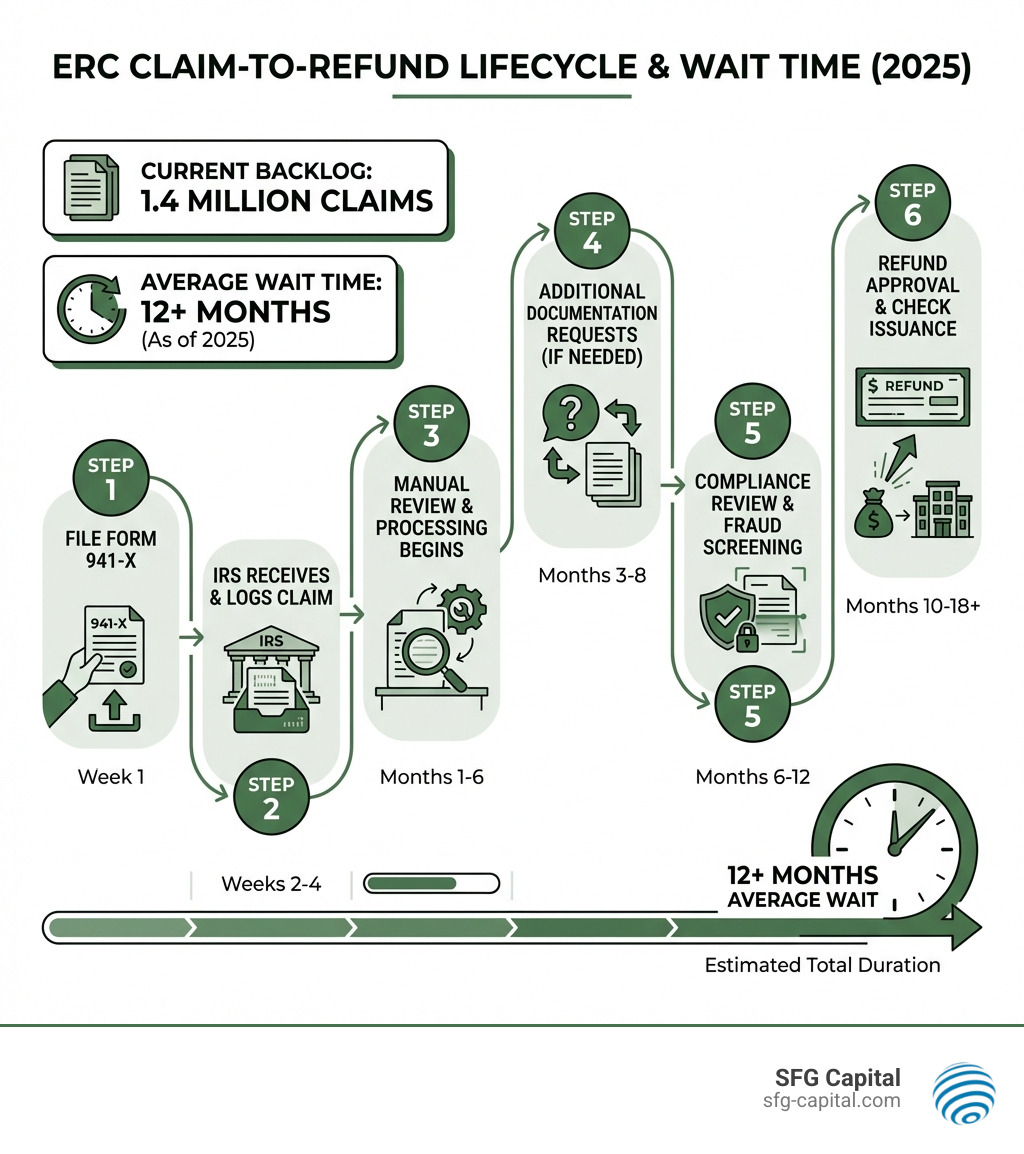
Current Reality: What is the ERC Refund Wait Time in 2025?
If you’re a business owner in Austin, TX, or anywhere in Travis County, you’re likely feeling the strain of the prolonged ERC refund wait time. The short answer to “How long does it take to receive my ERC refund?” is: probably longer than you’d like. While early estimates suggested a few weeks to a few months, the current reality paints a much grimmer picture. Taxpayers have reported waiting anywhere from 10-12 months, and in some cases, even longer than a year, for their ERC refunds.
As of December 2024, the IRS reported a staggering backlog of over one million ERC claims. This means that many businesses have been waiting for more than a year to receive funds that were intended to provide crucial relief during the COVID-19 pandemic. The average time to get an ERC refund has increased significantly, and there’s a substantial backlog of unprocessed payroll tax returns (Form 941-X).
The IRS had initially set a standard processing goal of 90 days for ERC claims. However, with stricter compliance reviews now in place, this goal has been extended to 180 days—and much longer if a claim faces further review or audit. This means that even if your claim is perfectly filed, you could be looking at a minimum of six months, and realistically, much more.
A particularly frustrating aspect for many is the moratorium. The IRS placed a processing moratorium on new ERC claims in September 2023, which has caused significant delays. While eligible ERC claimants who filed before this moratorium were initially told to expect payments in the summer of 2024, this timeline has now been pushed back, with many still waiting well into 2025. This situation is far from ideal, and we understand the frustration it causes.
For more detailed updates on the IRS’s operations and how they impact the ERC, you can always check the IRS COVID-19 operations page. We also regularly update our resources, such as How Long Until Your ERC Refund Arrives? A 2026 Update, to keep our clients informed of the latest developments.

Factors Influencing Your ERC Refund Wait Time
So, why are these ERC refunds taking so long to process? Several critical factors contribute to the extended ERC refund wait time:
- Manual Processing of Form 941-X: Unlike many other tax forms, the amended payroll tax return (Form 941-X), which is used to claim the ERC, cannot be e-filed. This means hundreds of thousands of these forms are paper returns that must be hand-processed by specially trained IRS staff. This manual review is inherently slower and more prone to delays than automated electronic processing. As of February 2023, the IRS reported an inventory of approximately 557,000 unprocessed Forms 941-X.
- Overwhelming Volume of Claims: The sheer number of ERC claims filed has swamped the IRS. While the program was intended to help businesses, its popularity and the retroactive nature of some claims led to an unprecedented volume of submissions. Despite the September 2023 moratorium on processing new claims, the IRS still estimates it receives around 17,000 new ERC claims every week. This continuous influx adds to the already colossal backlog.
- Increased Scrutiny and Fraud Concerns: The ERC program, unfortunately, attracted aggressive marketing from “ERC mills” that often pushed ineligible businesses to file claims or inflated eligible claims. This led to a significant number of improper claims. The IRS estimates that 10-20% of ERC claims show a high risk of errors or fraud. To combat this, the IRS has ramped up its compliance reviews, slowing down processing for all claims, including legitimate ones. Large ERC claims, in particular, are often reviewed at least twice, adding to the delay.
- Complexity of Claims and Additional Documentation: The ERC’s eligibility criteria and calculation methods can be complex. Claims that are intricate, have errors, or are missing documentation require more time for IRS staff to review, clarify, or request additional information. This back-and-forth can significantly prolong the processing time.
- Staffing Shortages: Despite recent efforts to hire more staff, the IRS has faced challenges in having enough qualified personnel to handle the immense workload, especially for specialized tasks like ERC claim processing.
These factors combined create a perfect storm, resulting in the prolonged ERC refund wait time that businesses are currently experiencing. We dig deeper into these issues in The Great ERC Wait: Understanding Your Delayed Employee Retention Credit.
How to Check Your ERC Refund Wait Time Status
Checking the status of your ERC refund can feel like trying to find a needle in a haystack, mainly because the IRS’s existing online tools aren’t built for it. The standard “Where’s My Refund?” tool is designed for individual tax refunds (Form 1040), and while some taxpayers with pass-through entities have reported finding their ERC refund status there, it’s not reliable for all. Similarly, the “Where’s My Amended Return?” tool tracks Form 1040X for amended individual returns, not the Form 941-X used for ERC.
So, how can you check your ERC refund wait time status?
- Call the IRS Business Helpline: The most direct, albeit often frustrating, method is to call the IRS business helpline at 1-800-829-4933. Be prepared for potentially long wait times. When you call, ensure you have the following information ready:
- Your Employer Identification Number (EIN)
- The specific quarters for which you filed the ERC claim
- The estimated mailing date of your Form 941-X
- The expected refund amount
- All relevant tax return information
- Note: While you can get information, speaking with an IRS agent won’t necessarily accelerate the refund process.
- Contact the Taxpayer Advocate Service (TAS): If the delay in receiving your ERC refund is causing significant financial hardship for your business, you might be able to seek assistance from the Taxpayer Advocate Service. The TAS helps taxpayers whose problems with the IRS are causing economic harm or who are facing other specific issues. This isn’t a general expediting service but rather a resource for extreme cases.
- Monitor Your Mail: The IRS communicates primarily via mail. Keep an eye out for any correspondence, such as requests for additional information (like Letter 6612, which indicates an audit) or notices regarding your claim.
Duplicate ERC refund claims will likely result in even longer delays due to investigation. The IRS specifically advises against filing second returns claiming the same refund. For more insights on tracking your refund, refer to Don’t Be Left Waiting: How to Track Your Employee Retention Credit Refund.
Why the IRS Backlog is Causing Massive Delays
The current state of the ERC refund wait time is largely a symptom of the massive backlog at the IRS, exacerbated by deliberate policy decisions aimed at curbing fraud. Let’s break down the reasons behind this bottleneck.
First and foremost, the IRS is struggling with an unprecedented volume of claims. As of December 2024, over 1.4 million ERC claims remained unprocessed. This is a colossal undertaking for an agency that relies heavily on manual processing for amended payroll tax returns (Form 941-X).
A significant factor contributing to the delays is the September 2023 moratorium. The IRS announced an immediate stop to processing new ERC claims, effective September 14, 2023. This decision was a direct response to a surge of questionable claims and aggressive marketing tactics by “ERC mills” that misled many businesses into filing ineligible claims. The IRS noted that 10-20% of ERC claims show a high risk of errors or fraud, and they’ve initiated 450 criminal cases over $7 billion in ERC fraud.
This moratorium was implemented to allow the IRS to implement new safeguards and improve compliance reviews. While the intention is to protect taxpayers from scams and ensure the integrity of the program, it means that even legitimate claims filed after September 2023 are simply not being processed. For those filed before the moratorium, processing continues, but at a significantly slower pace. The processing goal for existing claims went from 90 days to 180 days, and potentially much longer if the claim is flagged for further review or audit.
Adding to the challenge, despite the moratorium, the IRS still receives an estimated 17,000 new ERC claims every week. These claims are not being processed and are simply accumulating, creating an even larger pile for when the moratorium is eventually lifted. The agency has stated that the moratorium would last until at least December 31, 2023, but it has clearly extended beyond that, with no definitive end date announced.
The complexity of the ERC rules themselves also plays a role. The initial rollout was rapid, and the rules evolved, leading to confusion and errors. This complexity, combined with the aggressive promotion of the credit, created an environment ripe for mistakes and fraudulent claims. The IRS is now sifting through this intricate landscape, which inevitably slows down processing for everyone.
The IRS’s efforts to address the backlog include increased funding and hiring, but these measures take time to yield significant results. The “One Big Beautiful Bill Act of 2025” (a proposed piece of legislation mentioned in some sources) could further complicate matters by potentially extending the audit window for certain ERC claims to six years, increasing the IRS’s scrutiny and potentially prolonging the ERC refund wait time.
Understanding this internal landscape of the IRS is crucial for any business waiting on its refund. We explore the journey of your claim through the IRS in more detail in The Waiting Game: Understanding Your ERC Claims Journey Through the IRS. The IRS has also provided information on their efforts to combat fraud and offer withdrawal processes for improper claims, which you can find on their IRS announces withdrawal process page.
Navigating Incorrect Claims and IRS Audits
One of the less humorous aspects of the ERC refund wait time is the potential for an incorrect claim to land you in hot water with the IRS. Given the aggressive marketing from some “ERC mills,” many businesses, perhaps unknowingly, filed claims they weren’t fully eligible for. This section addresses the risks and what to do if you suspect an issue.
Risks of Incorrectly Claiming the ERC
The risks of incorrectly claiming the ERC are significant and extend beyond just delays. If the IRS determines your claim was improper, you could face:
- Repayment: You’ll have to pay back the refund received.
- Penalties and Interest: The IRS can impose substantial penalties and interest on the incorrect amount.
- Criminal Prosecution: In cases of willful fraud, individuals could face criminal investigation and prosecution.
The IRS is actively pursuing cases of fraud, initiating hundreds of criminal cases. This is why it’s crucial to ensure your eligibility was, and remains, solid.
What to Do if You Suspect an Incorrect Claim
If you suspect your ERC claim was incorrect or you no longer believe you qualify, the IRS has provided pathways for resolution:
ERC Withdrawal Program:
- Who can use it? You can use this if you filed an amended employment tax return (like Form 941-X) only to claim the ERC (no other adjustments), want to withdraw the entire amount, and the IRS has either not paid your claim yet, or you’ve received a refund check but haven’t cashed or deposited it.
- How to request withdrawal: The process depends on your situation. If you haven’t received a refund and aren’t under audit, you can fax a signed copy of your amended return with “Withdrawn” written on it to 855-738-7609. If you received a check but haven’t cashed it, you’ll void the check and mail it with your withdrawal request. If you’re under audit, you’ll send the request to your assigned examiner.
- What happens next? If accepted, your ERC claim is treated as if it was never filed, and the IRS generally won’t impose penalties or interest. However, withdrawing a fraudulent claim doesn’t exempt you from potential criminal investigation. You may also need to amend your income tax return if you previously reduced wage expenses based on the ERC.
- You can find detailed instructions on the Withdrawal Program page on IRS.gov.
ERC Voluntary Disclosure Program (ERC-VDP): This program was for businesses that already received an improper ERC payment. It allowed them to repay 80% of the received amount without interest or penalties. However, this program had a deadline of March 22, 2024, and is now closed.
Navigating IRS Audits and Notices
The IRS is actively auditing ERC claims. If your claim is selected for review, you might receive one of these notices:
- Letter 6612: This notice from the IRS indicates that your organization’s tax return claiming the ERC refund is under audit. Any refund will be held until the audit is concluded. This means your ERC refund wait time will extend significantly, possibly for many more months or even years, depending on the complexity of the audit.
- Letter 105-C: This is a more serious notice, indicating that your ERC claim has been formally disallowed or denied. It will provide the reason for the decision, the affected tax year, and crucial information about your appeal rights and legal action timeframes. If you receive Letter 105-C, you typically have a two-year window from the date of the letter to file an appeal.
If you receive any of these notices, it’s critical to respond promptly and accurately. We highly recommend consulting with a trusted tax professional or ERC specialist. For a comprehensive overview of the ERC, including eligibility and compliance, check out ERC Help: Everything You Need to Know About the Employee Retention Credit.
Strategies to Bypass the Wait: Advances and Funding
The ERC refund wait time is more than just an inconvenience; it can be a significant cash flow problem for businesses, especially those in Austin, TX, and Travis County, who were counting on these funds for operations, expansion, or recovery. While we’ve discussed the limited options for expediting the IRS’s processing, some businesses simply can’t afford to wait 10-18 months, or even longer.
This is where alternative funding solutions come into play. At SFG Capital, we understand that waiting for the IRS to catch up isn’t a viable business strategy for many. We specialize in helping businesses in Travis County, and across the US, access their ERC funds sooner through ERC advances and buyouts.
How ERC Advances and Buyouts Work:
Instead of waiting for the IRS check, you can receive a significant portion of your anticipated ERC refund upfront. This isn’t a loan in the traditional sense; it’s an advance or buyout based on the value of your legitimate ERC claim.
- Immediate Liquidity: This provides immediate access to capital, allowing you to bridge the gap caused by the IRS delays. You can use these funds for payroll, inventory, equipment, expansion, or simply to improve your cash flow.
- Performance-Based Fees: Our services are typically structured with performance-based fees, meaning we only get paid when you do, or when the advance is provided. This aligns our success with yours.
- Expert Claim Assistance: We work with you to verify your claim’s accuracy and legitimacy, ensuring it stands up to IRS scrutiny. Our expertise can help mitigate future issues and give you peace of mind.
For businesses facing a critical need for capital, an ERC advance or buyout can be a lifeline. It allows you to bypass the agonizing ERC refund wait time and put your funds to work for your business now. We’ve helped numerous businesses steer this complex landscape, and we’re committed to providing transparent and efficient solutions.
If you’re in Travis County and the IRS delays are impacting your business, don’t just wait. Explore your options for immediate funding. Learn more about how we can help you with ERC Funding Advance Complete Guide.
Frequently Asked Questions about ERC Timelines
We know the ERC refund wait time raises many questions. Here are answers to some of the most common ones we hear from business owners.
What are the deadlines for claiming the ERC for 2020 and 2021?
The deadlines for claiming the Employee Retention Credit are crucial, and they depend on the year for which you are claiming qualified wages:
- For qualified wages paid in 2020: The deadline to claim the ERC for 2020 wages passed on April 15, 2024. If you haven’t filed for 2020 wages by this date, you are unfortunately no longer able to do so.
- For qualified wages paid in 2021: Businesses still have time to claim the ERC for 2021 wages. The deadline for these claims is April 15, 2025.
These deadlines are statutory and relate to the statute of limitations for amending quarterly payroll tax returns. Missing these dates means you forfeit your right to claim the credit. If you haven’t yet explored your eligibility for 2021, now is the time to act. Don’t miss out on this valuable credit; check out The ERC Eligibility Checklist: Don’t Miss Out for guidance.
Can businesses expedite their ERC refund process through the IRS?
Directly expediting your ERC refund process through the IRS is challenging, as the agency primarily processes claims in the order they are received, subject to the current backlog and moratorium. However, there are limited scenarios where some form of “expediting” might be considered:
- Taxpayer Advocate Service (TAS): As mentioned earlier, if the delay in your ERC refund is causing significant economic harm to your business, you can contact the Taxpayer Advocate Service. They may be able to intervene if your case meets their criteria for hardship, but this is not a guaranteed fast-track for all claims.
- Refund Lawsuits: In extreme cases of prolonged and unreasonable delays, some businesses might consider filing a refund lawsuit in federal court. This is a legal process, typically a last resort, and should only be pursued with experienced legal counsel, as it can be costly and time-consuming.
For the vast majority of businesses, the most effective “expediting” strategies involve ensuring your claim is perfectly accurate and complete from the outset to avoid further delays due to IRS inquiries, and exploring alternative funding solutions if immediate liquidity is needed. Learn more about these options in Expediting Your ERC Refund: What You Need to Know.
How does the ERC impact a business’s income tax return?
The Employee Retention Credit impacts a business’s income tax return because the amount of qualified wages used to calculate the ERC must be reduced by the amount of the credit. This is a crucial detail that many businesses, especially those who used less reputable “ERC mills,” sometimes overlook.
Here’s how it works:
- When you claim the ERC, you must reduce your deductible wage expense on your income tax return for the year the wages were paid by the amount of the credit. For example, if you claimed an ERC for 2021 wages, you would need to reduce your 2021 income tax deduction for wages.
- What if your ERC claim is later disallowed? This is where it gets tricky. If the IRS ultimately disallows your ERC claim, you can no longer reduce your wage expense by that amount. The good news is that you don’t necessarily have to amend your original income tax return. The IRS provides guidance that if your ERC claim is disallowed, you may, in the year the disallowance becomes final, increase your wage expense deduction on your income tax return by the amount it was previously reduced. For example, if a 2021 ERC claim was disallowed in 2024, you could increase your wage expense on your 2024 income tax return. This provides flexibility and helps businesses avoid amending old returns, especially if the statute of limitations for those years is closing.
It’s essential to account for this interaction correctly to avoid future tax issues. For more information, the IRS offers guidance on Claiming the ERC.
Conclusion
The ERC refund wait time has undoubtedly become a test of patience for businesses across the country, including those here in Travis County. The journey from filing an ERC claim to receiving your refund is currently fraught with significant delays due to massive IRS backlogs, manual processing, and heightened scrutiny against fraud. While the credit was designed as a swift relief measure, the reality is a prolonged waiting game that extends well into 2025 for many.
Understanding the reasons behind these delays—from the sheer volume of paper claims and staffing challenges to the September 2023 moratorium and the ongoing fight against improper claims—is the first step. Knowing how to check your claim status, even with the limited tools available, and what to do if you suspect an error or receive an IRS notice, empowers you to steer this complex landscape.
For businesses that simply cannot afford to wait for the IRS to catch up, alternative funding solutions offer a critical lifeline. Programs like ERC advances and buyouts provide immediate access to the capital you’re owed, allowing you to bypass the lengthy IRS processing times and keep your business moving forward.
We encourage you to stay informed, proactively monitor your claim, and consult with trusted professionals, especially if you’re facing financial hardship due to delays or have concerns about your claim’s accuracy. Don’t let the ERC refund wait time stifle your business’s potential. Open up your ERC requirements and explore how you can access your funds sooner.
Unlock Your ERC Requirements: Advances and What You Need to Know