
Why Businesses Are Turning to ERC Claim Buyouts
An ERC claim buyout allows businesses to sell their pending Employee Retention Credit refund for immediate cash—typically 70-90% of the total claim value. Here’s what you need to know:
Key Facts About ERC Claim Buyouts:
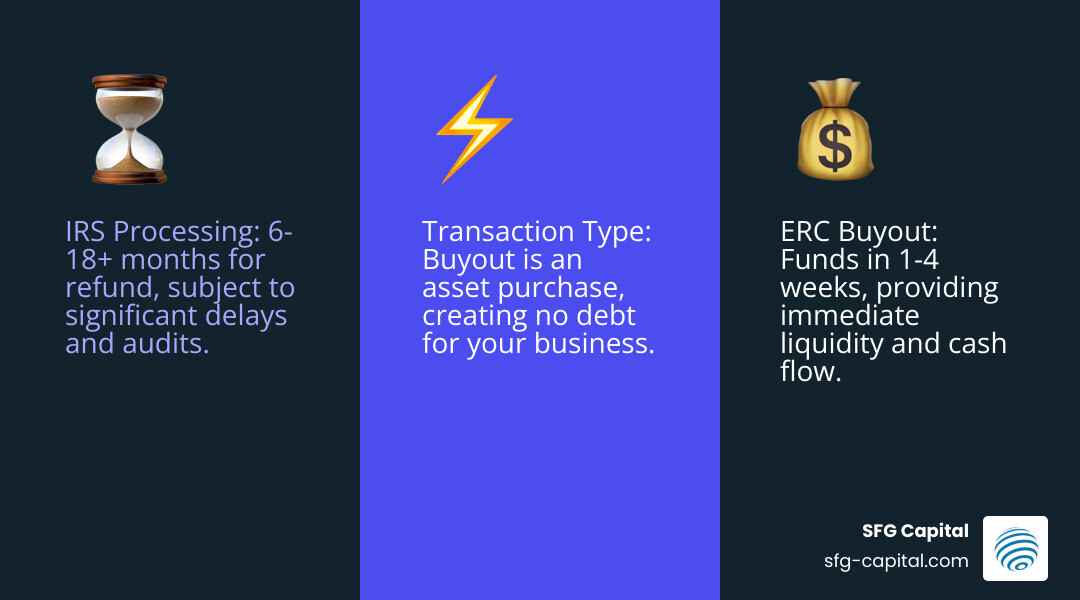
- Funding Speed: Receive funds in 1-4 weeks vs. 6-18+ months waiting for the IRS.
- Upfront Cash: Get 70-90% of your claim value immediately.
- No Debt Created: It’s an asset purchase, not a loan, so no monthly payments are required.
- Minimum Claim: Most programs require at least $100,000 in total ERC claims.
- Structure: You sell your future refund; the buyer collects from the IRS when processed.
The Employee Retention Credit has been a lifeline for businesses impacted by the COVID-19 pandemic. However, with IRS processing delays stretching 12-18 months or longer, many owners are approved for refunds but can’t access the money. Bills pile up, and growth opportunities pass by.
This is where ERC claim buyouts come in. Instead of waiting, you can sell your pending claim to a funding company and receive the majority of your money in weeks. It’s not a loan; it’s an outright purchase of your future refund. A third-party buyer purchases your claim at a discount, paying you 70-90% of the value upfront. They then collect the full refund from the IRS. You get immediate working capital without adding debt, and the buyer profits from the difference.
For many, this trade-off—accepting slightly less for immediate liquidity—makes perfect financial sense. Whether you need to make payroll, invest in growth, or pay down high-interest debt, an ERC buyout provides the breathing room your business needs.
I’m Santino Battaglieri of SFG Capital. I’ve helped facilitate over $500 million in ERC claim buyouts, and my experience shows that when structured properly, an ERC claim buyout is a powerful financial tool for eligible businesses.
Understanding Your Options: ERC Buyout vs. Advance
When seeking faster access to your Employee Retention Credit funds, you’ll encounter three main options: ERC buyout, ERC advance, and ERC loan. Their structures and risks differ, so understanding them is key to choosing the right path for your business.
Let’s break them down:
-
ERC Buyout (or ERC Claim Buyout): This is the cleanest option. An ERC claim buyout is an asset purchase, not a loan. We buy your future ERC refund, taking on the risk of IRS processing. You get a lump sum upfront (typically 80-90% of the claim) and have no further obligations. There are no monthly payments, no interest, and no debt added to your balance sheet.
-
ERC Advance: An advance also provides a lump sum upfront. However, it’s often structured more like a loan collateralized by your ERC. If the IRS denies, reduces, or significantly delays the claim, you might have to repay the advance. This is known as “recourse,” meaning your business still carries some risk.
-
ERC Loan (or ERC Bridge Loan): This is a traditional short-term loan using your pending ERC refund as collateral. It comes with interest payments and a repayment schedule, adding debt to your balance sheet. Your business is responsible for repayment regardless of when the IRS sends the refund.
Recourse vs. Non-Recourse: This is a vital distinction.
- Non-Recourse: In a non-recourse ERC claim buyout, the buyer assumes the risk. If the IRS denies or reduces a validly prepared claim, you are generally not responsible for repaying the funds. This is the model we use at SFG Capital to de-risk the process for our clients.
- Recourse: A recourse advance or loan means you may have to repay the funds if the IRS claim fails or is delayed. The ultimate financial risk remains with you.
At SFG Capital, we focus on non-recourse ERC claim buyout solutions to ensure that once you receive your funds, your worries about the ERC are over. For a deeper dive, explore our guide on What is ERC Funding?.
| Feature | ERC Buyout | ERC Advance (Recourse) | ERC Loan (Bridge Loan) |
|---|---|---|---|
| Structure | Asset Purchase | Collateralized Loan / Advance against future refund | Traditional Loan |
| Risk Transfer | Yes, to the buyer (non-recourse) | Limited, risk often remains with the business | Risk remains with the business |
| Repayment | None (buyer collects from IRS) | Potentially required if IRS claim is delayed/denied | Required with interest, regardless of IRS payout |
| Speed | Fast (1-4 weeks) | Fast (1-4 weeks) | Fast (days to weeks) |
| Debt on B/S | No | Potentially, depending on structure | Yes |
| Interest | No (discounted purchase price) | Potentially, if repayment is triggered | Yes, standard loan interest |
| Ideal For | Businesses seeking finality and risk transfer | Businesses needing quick cash, comfortable with some risk | Businesses needing short-term capital, comfortable with debt |
The Complete Guide to the ERC Claim Buyout Process
We’ve streamlined the ERC claim buyout process to be as efficient and transparent as possible, getting you funds in 1 to 3 weeks—a vast improvement over the 6-12+ months the IRS takes. Pre-approval decisions can come in as little as 24-72 hours.
Our typical process for an ERC claim buyout looks like this:
- Initial Inquiry & Application: Start with a free consultation where we discuss your situation and basic business information to see if a buyout is a good fit.
- Documentation Submission: Once eligibility is confirmed, we’ll request specific documents to evaluate your claim.
- Claim Evaluation & Custom Offer: Our experts review your documents to verify eligibility and calculate your claim’s value. We then present a custom, no-obligation offer, typically for 80-85% of your total ERC amount.
- Due Diligence & Agreement: Upon offer acceptance, we conduct a brief due diligence phase to verify information. You’ll then sign an agreement to formalize the ERC claim buyout.
- Funding Disbursement: After the agreement is signed, we disburse funds directly to your business, often within 10 business days. The process is fast, with no loans or interest.
You don’t have to sell your entire ERC refund; selling a portion is an option. This gives you immediate cash while you wait for the rest of your refund from the IRS. For more details, see our guide on Expediting Your ERC Refund: What You Need to Know.
What Documentation Will You Need?
Having your documents ready is key to a rapid process. The more complete your submission, the faster we can get you funded. We typically require:
- Forms 941 and 941-X: Your original and amended quarterly tax returns, with proof of filing the 941-X.
- Payroll Data: Detailed payroll summaries for the claimed periods.
- Profit & Loss (P&L) Statements: Your P&L statements for 2019-2022.
- Business Tax Returns: Federal business tax returns for 2019-2022.
- ERC Eligibility Calculations & Summary: The detailed calculations supporting your claim.
- Bank Statements: The last 3 months of business bank statements.
- Signed Application & Program Agreement: Our application and the final agreement.
- Debt Schedule (if applicable): A schedule of existing business debts.
What to Expect from an ERC Claim Buyout Offer
Our offer will clearly state the upfront percentage of your claim we are purchasing, typically 80% to 85%. For a $100,000 claim, an 80% offer means you receive $80,000 immediately.
The remaining portion (the “holdback”) is not lost. The IRS will send this balance directly to you once they process your refund. We collect the portion we purchased, and you receive the rest. There are no hidden fees or monthly interest with an SFG Capital buyout. The “cost” is the difference between the full ERC amount and the cash you receive upfront.
We typically work with businesses that have a minimum total ERC claim of $100,000.
Weighing the Pros and Cons of an ERC Buyout
Deciding if an ERC claim buyout is right for your business means weighing its advantages against its drawbacks. It’s about finding the balance that suits your immediate and long-term needs.
The Primary Benefits of an ERC Claim Buyout
For many business owners in Travis County and Austin, the benefits are compelling, especially given the current IRS landscape.
- Fast Funding: The biggest advantage is speed. Instead of waiting 6-18+ months for the IRS, a buyout gets funds into your account in as little as 7-10 business days from offer acceptance, with pre-approvals in as little as 24 hours.
- No Debt Liability: A buyout is an asset purchase, not a loan. It doesn’t add debt to your balance sheet or require monthly payments, freeing up cash flow and preserving your debt-to-equity ratio for future financing.
- Improved Cash Flow & Working Capital: Immediate access to your ERC funds dramatically improves liquidity. This cash can cover payroll, inventory, or other vital expenses. Businesses use these funds to make strategic investments or pay off high-interest debt, as detailed in 5 Ways to Use ERC Funds to Strengthen Your Business.
- Simplified Process & Reduced Stress: We handle the wait with the IRS. Once the buyout is complete, you can refocus on growing your business instead of tracking IRS processing times.
- Risk Transfer (Non-Recourse): Our non-recourse buyouts mean we assume the processing risk. If the IRS denies or reduces a correctly filed claim, you generally don’t have to repay the funds.
- Reinvestment Opportunities: Accessing funds sooner lets you seize opportunities faster, like upgrading equipment or launching marketing campaigns. Learn more in Funding Growth: How ERC Can Power Your Business Forward.
Potential Downsides of an ERC Claim Buyout
While beneficial, it’s important to understand the potential drawbacks:
- Discounted Payout: You will receive less than 100% of your total ERC claim value upfront. This discount reflects the value of immediate capital and the risk we assume. If you don’t have an urgent need for cash, waiting for the full amount might be preferable.
- Vetting Providers: The ERC market has many providers, not all reputable. It’s crucial to work with a trusted partner like SFG Capital with a proven track record and transparent processes.
- Understanding the Agreement: We ensure you fully understand the terms of the ERC claim buyout, including its non-recourse nature and how the remaining balance is handled.
- Tax Implications: The original ERC refund has tax implications (it reduces deductible wage expenses). Discuss how an early payout interacts with this with your CPA.
Impact on Your Balance Sheet or Credit:
An ERC claim buyout is an asset purchase, so it does not add debt to your balance sheet and does not directly impact your business’s credit score. We are purchasing an asset (your future refund), not extending credit.
Navigating IRS Compliance and Choosing a Reputable Provider
The Employee Retention Credit has been a lifeline for businesses but has also attracted aggressive marketing and scams. The IRS is cracking down on improper claims, making it crucial to steer this landscape carefully and partner with a reputable provider.

The Current IRS Stance on ERC Claims
The IRS is vocal about its concerns over fraudulent ERC claims, implementing a moratorium on processing new claims to combat abuse. This increased scrutiny means any claim, whether sold in a buyout or not, must be fully compliant.
Here’s what to know about the IRS’s stance:
- Processing Delays & Scrutiny: The IRS faces significant delays (well over a year), during which they actively audit claims. A filed claim isn’t guaranteed until it’s officially processed and paid.
- Withdrawal Program: If you filed a claim but now believe you’re ineligible (and haven’t been paid), the IRS offers a Withdraw an Employee Retention Credit (ERC) claim program. This lets you retract the claim to avoid potential penalties.
- Voluntary Disclosure Program (VDP): For businesses that received a refund they weren’t entitled to, the IRS created the ERC Voluntary Disclosure Program. This program allowed businesses to repay a discounted amount to get back into compliance. If you have concerns, review the IRS guidance on Resolving an Improper ERC Claim.
- Amending Returns: To reduce (but not fully withdraw) an ERC claim, you must amend your employment tax return instead of using the withdrawal program.
Given this environment, choosing a reputable provider for your ERC claim buyout is paramount. Look for:
- Transparency: A trustworthy provider is upfront about fees, the buyout percentage, and the process.
- Expert Support: The team should have deep expertise in ERC eligibility and tax law. Our Employee Retention Credit Specialist Guide offers more insights.
- Clear Agreements: The buyout agreement should be easy to understand and detail the non-recourse nature.
- Reputation and Track Record: Seek providers with positive reviews and a solid history of successful transactions.
At SFG Capital, we prioritize compliance. We conduct thorough due diligence on every claim, protecting your business and ours. We help businesses in Travis County and Austin, TX, steer these complexities with peace of mind.
Frequently Asked Questions about ERC Claim Buyouts
An ERC claim buyout is a significant financial decision. Here are answers to common questions we receive:
Who is the ideal candidate for an ERC buyout program?
A buyout is an excellent solution for:
- Businesses Needing Immediate Cash Flow: If you have urgent operational expenses or want to seize growth opportunities, a buyout provides funds much faster than the IRS.
- Companies with Pending Claims Over $100,000: Buyouts are most beneficial for claims of $100,000 or more, ensuring an efficient process for both parties.
- Owners Wanting to De-Risk the ERC Process: A non-recourse buyout transfers the risk and administrative burden of waiting for the IRS to the buyer.
- Businesses Looking to Invest or Pay Down Debt: Quick capital allows for strategic moves like expansion, technology upgrades, or eliminating high-interest debt.
Will selling my ERC claim affect my business’s credit score?
No, an ERC claim buyout typically does not directly affect your business’s credit score.
- It’s Not a Loan: A buyout is an asset purchase, not a loan. We are buying a future receivable, so it does not appear as debt on your credit report or balance sheet.
- No New Debt: Since no debt is created, there are no monthly payments that could be missed.
The capital from a buyout can even help improve your financial standing by allowing you to pay other obligations on time.
Can I sell an ERC claim that was filed through a Professional Employer Organization (PEO)?
Yes. Claims filed through a PEO (like ADP or Paychex) are generally eligible for an ERC claim buyout.
The credit belongs to your business, even if the PEO handled the filing. We frequently work with these claims and can guide you through the process, which may involve coordinating with your PEO to obtain the necessary documentation.
Conclusion: Open up Your ERC Funds and Move Your Business Forward
The Employee Retention Credit was designed as a lifeline, but prolonged IRS delays have turned it into a waiting game. An ERC claim buyout is a powerful solution to bypass these delays, converting your pending refund into immediate, actionable capital.
Opting for a buyout is a strategic financial move. You gain improved cash flow, reinvestment opportunities, and the peace of mind that comes from transferring IRS processing uncertainty to a trusted partner. It’s a debt-free way to fortify your financial position and plan for the future with confidence.
For businesses in Travis County and Austin, TX, SFG Capital is here to help. We provide transparent, efficient, and non-recourse ERC claim buyout solutions to empower you to take control of your cash flow without the burden of IRS waiting periods.
Don’t let your ERC refund remain trapped in backlogs. Take the next step to open up your funds and propel your business forward.
Explore Your ERC Funding Solutions today and let us help you turn your pending ERC into immediate capital.