
Why Advance Tax Credits Matter for Your Business Cash Flow
Advance tax credits allow eligible businesses and individuals to receive tax benefits before filing annual returns, converting future refunds into immediate working capital. Instead of waiting months for the IRS or CRA to process claims, you can access these funds now through government payments or third-party financing using future credits as collateral.
Quick Overview: Understanding Advance Tax Credits
- What they are: Tax credits paid before you file your tax return.
- Who qualifies: Businesses in R&D or film; individuals buying Marketplace health insurance; families with childcare costs.
- How much: Business credits range from 16% to 37.5% of eligible costs; personal credits vary by income.
- Key benefit: Immediate liquidity instead of waiting 6-18+ months.
- Main risk: Repayment may be required if circumstances change or estimates are incorrect.
This mechanism exists in two forms. For personal tax credits like the Premium Tax Credit (PTC) in the US, governments estimate eligibility and send monthly payments to insurers. For business tax credits—particularly R&D and film production—companies can receive government advances or work with specialized lenders providing funding secured by future refundable credits worth up to 37.5% federally in Canada.
The cash flow advantage is substantial. Corporations needing liquidity cannot always wait until the end of the fiscal year. For example, a production company with $1 million in eligible expenditures could secure up to $360,000 in credits to keep projects moving and payroll met without traditional debt.
However, advance credits require reconciliation. If your income increases or project criteria aren’t met, you may owe money back. While the 2020 repayment requirement for the PTC was suspended, that was a rare exception. Business credits involve further complexity, often requiring specialized legal counsel to manage assignments to lenders and ministerial discretion.
Who Should Consider Advance Tax Credits?
This strategy is ideal if you:
- Need working capital immediately and cannot wait for standard processing.
- Have predictable, recurring eligible expenditures (R&D, film, childcare).
- Thoroughly understand eligibility and can document compliance.
- Can manage the reconciliation process and potential repayment.
I’m Santino Battaglieri, and through SFG Capital, I’ve helped businesses steer over $500 million in tax credit transactions, including structured advance funding. Understanding compliance and reconciliation is essential to making these programs work without creating unexpected liabilities.
The Strategic Value of Advance Tax Credits for Businesses
For businesses, advance tax credits are a strategic financial tool that addresses the lag between incurring expenses and receiving tax refunds. Instead of waiting years for the IRS, businesses in Austin and Travis County can tap into these funds sooner to manage growth or liquidity challenges.
Understanding the distinction between refundable and non-refundable credits is vital. Non-refundable credits only reduce tax liability to zero. Refundable credits, however, result in direct payments even if no tax is owed, making them the backbone of advance tax credit financing. Lenders in this space manage risks related to government discretion through specialized legal counsel and security documents.
A prominent example is the Employee Retention Credit (ERC). While not a direct IRS advance, businesses can secure financing against pending ERC refunds to overcome processing delays. For a comprehensive look, explore our ERC Advance Funding Complete Guide.
Accelerating Cash Flow with Advance Tax Credits
The primary benefit is converting future benefits into immediate working capital. These programs allow companies to:
- Fund operations: Cover payroll and rent without taking on traditional debt.
- Invest in growth: Allocate capital to new projects or equipment.
- Improve liquidity: Maintain a healthier balance sheet and reduce reliance on emergency loans.
- Manage debt: Use funds to pay down high-interest obligations.
This is vital for Travis County businesses where cash flow is king. Our ERC Funding Solutions provide immediate access to these entitled funds.
Eligibility for Advance Tax Credits in Specialized Industries
While direct US government advance programs for business credits are limited, other jurisdictions like Canada offer robust models. These illustrate the types of industries governments target for incentives.

- Scientific Research and Development (SR&D): Encourages innovation with federal credits up to 35% for eligible expenditures like wages.
- Film & Video Production: Supports the creative economy. The federal PSTC provides 16% of labor costs, while Quebec’s QPSTC offers up to 36% for specific activities.
| Credit Type (Example) | Jurisdiction | Base Rate | Additional Rate | Total Potential |
|---|---|---|---|---|
| SR&D (Wages) | Federal (CA) | Up to 35% | N/A | Up to 35% |
| SR&D (Wages) | Quebec | Up to 30% | N/A | Up to 30% |
| Film PSTC | Federal (CA) | 16% | N/A | 16% |
| Film QPSTC | Quebec | 20% | +16% (Special Effects) | Up to 36% |
These examples show the financial incentives available, making them excellent candidates for advance financing through third-party lenders.
Navigating Personal and Regional Advance Tax Credits
Advance tax credits also benefit individuals. In the US, the Premium Tax Credit (PTC) for health insurance is the most common example. Other regions, like Canada, use similar models for various personal benefits.
Navigating Personal Advance Tax Credits
The PTC helps low-to-moderate income families afford health insurance via the Marketplace. Learn more at Topic no. 612, The Premium Tax Credit.
- Eligibility: Generally requires enrollment in a Marketplace plan and household income between 100% and 400% of the federal poverty line (FPL). See Publication 5187 for details.
- Advance Payments: Eligible users can have the Marketplace send payments (APTC) directly to insurers, lowering monthly premiums.
- Reconciliation: At year-end, you must reconcile APTC with your actual allowed credit using Form 8962.
The American Rescue Plan Act (ARPA) expanded eligibility for 2021 and 2022 by removing the 400% FPL cap, allowing more Americans to receive assistance.
Regional Variations: Quebec and Federal Rules
Other governments implement structured programs that serve as useful comparisons for how advance payments can be managed.
Canadian Federal Benefits:
The CRA administers the Canada Child Benefit (CCB) and GST/HST credit as tax-free monthly or quarterly payments. These are estimated based on prior income and reconciled annually.
Quebec-Specific Rules:
Quebec offers several advance tax credits managed by Revenu Québec:
- Childcare Expenses: Applications must be filed by December 1st for 12 equal monthly payments.
- RL-19 Slip: Reports advance payments; these amounts are considered income for Quebec tax purposes and must be reported.
- Administration: SODEC certifies film eligibility, while Investissement Québec guarantees loans for advances on refundable credits.
- Direct Deposit: Mandatory for receiving most Quebec advance payments.
These examples show that while the concept is universal, administrative processes and reporting requirements vary by jurisdiction.
The Mechanics of Reconciliation and Repayment
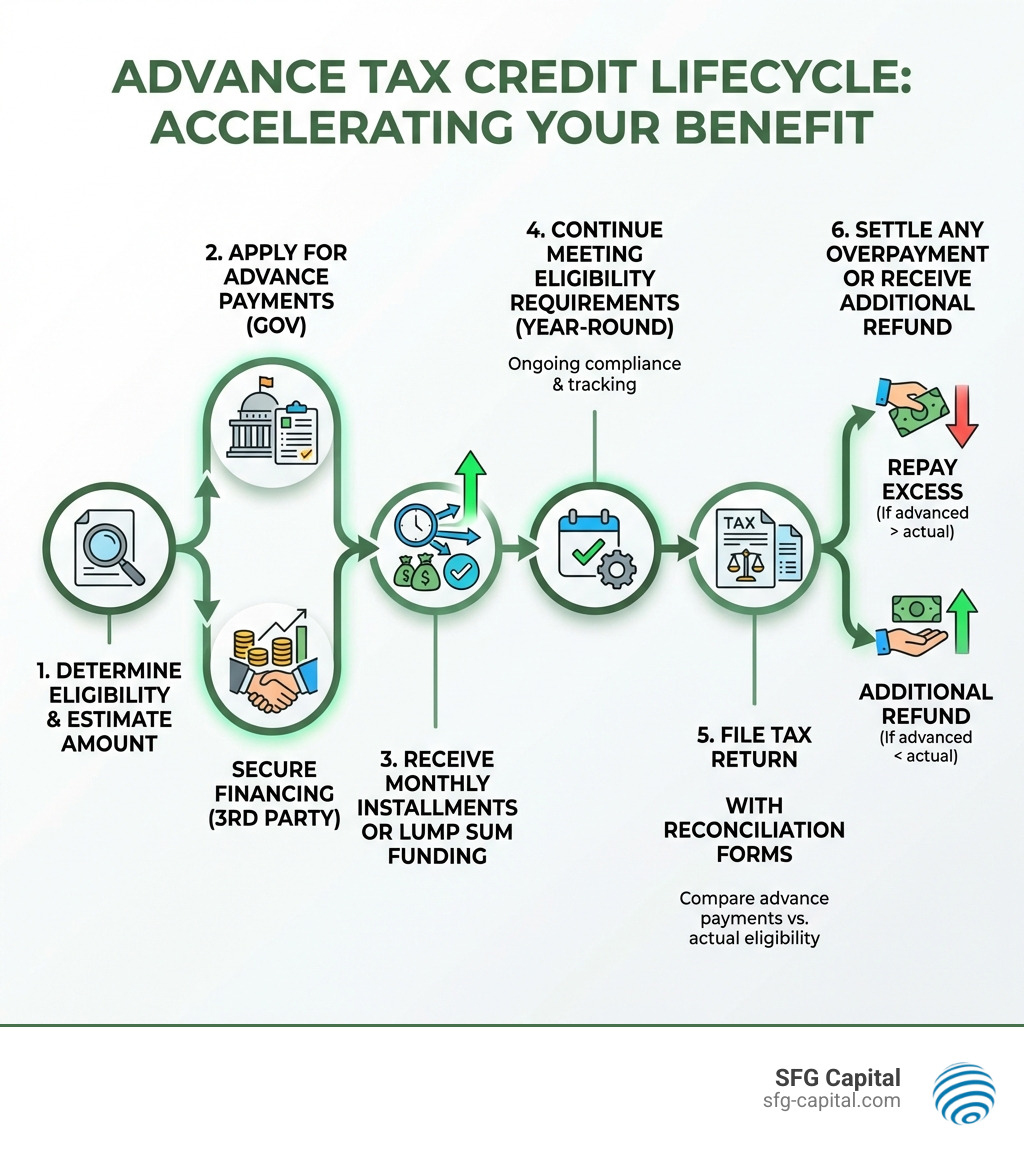
Advance tax credits are based on estimates. Your actual eligibility is determined when you file your annual return. Reconciliation is the process of comparing what you received against what you were actually entitled to.
For the US Premium Tax Credit (PTC), use IRS Form 8962. You will compare the APTC paid to your insurer against the actual PTC allowed based on final income. Form 1095-A from the Marketplace provides the data needed. The Instructions for Form 8962 offer detailed guidance.
For businesses leveraging the ERC, reconciliation occurs when the IRS processes amended payroll tax returns (Form 941-X). SFG Capital helps secure funds quickly through an ERC Refund Advance.
Reporting Changes in Circumstances
If you receive the PTC, you must report life changes to the Marketplace immediately to avoid repayment issues. Key changes include:
- Income Fluctuations: Increases may lower your credit; decreases may raise it.
- Family Size: Marriage, divorce, or new dependents.
- Address Changes: Location affects available plans and credit amounts.
- Other Coverage: Becoming eligible for employer plans or Medicaid.
Reporting these allows for mid-year adjustments, preventing large tax-time debts or ensuring you don’t miss out on additional help. Certain events also trigger a Special Enrollment Period.
Handling Overpayments and Underpayments
For US Premium Tax Credit (PTC):
- Underpayment: If your allowed PTC is higher than the APTC paid, your refund increases or tax owed decreases.
- Overpayment: If APTC was too high, you must repay the excess. Repayment is capped based on income relative to the FPL, unless your income exceeds 400% FPL, requiring full repayment.
- 2020 Exception: Repayment was suspended for the 2020 tax year under ARPA.
- Unemployment (2021): Special rules for 2021 capped household income at 133% FPL for those receiving unemployment benefits, potentially increasing the credit.
Failing to file a return when receiving APTC can lead to losing future eligibility, requiring you to pay full health insurance premiums. In Quebec, failing to report RL-19 amounts can result in withholdings from future refunds. Accurate estimation and diligent filing are essential.
Frequently Asked Questions about Advance Tax Credits
What happens if my estimated advance tax credit is too high?
If your estimate is too high, you received more than you were entitled to. When filing your return, you typically repay the excess. For the US PTC, this reduces your refund or increases tax owed, with repayment caps for those under 400% FPL. In Quebec, you must repay the difference to Revenu Québec.
Are advance tax credit payments considered taxable income?
It depends on the credit. The US PTC is a prepayment of a credit, not taxable income. Canadian federal benefits like the CCB are also tax-free. However, Quebec advance payments reported on an RL-19 slip are considered income for provincial tax purposes. Always check the specific rules for your jurisdiction.
Can I use future tax credits as collateral for a business loan?
Yes. This is the basis of advance tax credit financing. While government debts aren’t always assignable, many jurisdictions allow corporations to pledge refundable credits (like R&D or ERC) as collateral for immediate financing. Because these assignments aren’t always binding on the government, lenders use specialized legal counsel to manage the risk. SFG Capital specializes in these solutions for Travis County businesses, helping you bypass IRS delays.
Conclusion
Advance tax credits offer a powerful solution for businesses and individuals seeking to transform future tax benefits into immediate financial relief. Whether it’s a business leveraging an anticipated ERC refund for working capital or an individual using the Premium Tax Credit to lower monthly health insurance premiums, the core advantage is accelerated cash flow.
However, this financial agility comes with the responsibility of understanding the mechanics of reconciliation, the implications of changing circumstances, and the potential for repayment. While the specific rules vary by jurisdiction and credit type—from the IRS’s Form 8962 for US Premium Tax Credits to Quebec’s RL-19 slips for provincial advance payments—the principle remains: these are estimates that require year-end adjustment.
For businesses in Travis County, utilizing advance tax credits can be a game-changer for liquidity and financial planning. We specialize in helping companies like yours steer the complexities of these programs, particularly for significant claims like the Employee Retention Credit. Our expertise ensures you can mitigate risks and access your entitled funds without unnecessary delays.
Don’t let valuable tax credits sit idle. Understand how to proactively leverage them to support your business’s growth and stability. For a deeper dive into how we can assist you, explore our ERC Funding Process and find More info about ERC funding solutions.