
The ERC Refund Journey: From Claim to Cash, Eventually
Why the ERC Refund Timeline Has Become a Major Concern for Business Owners
The ERC refund timeline has become one of the most frustrating challenges for businesses trying to access COVID-19 relief funds. If you’re waiting for your Employee Retention Credit refund, here’s what you need to know:
- Current wait times: 10-12 months or longer for most claims
- Processing status: Generally untraceable through IRS systems
- Key bottleneck: Manual processing of paper-filed Form 941-X returns
- Major issue: IRS processing moratorium since September 2023 due to fraud concerns
- What to avoid: Filing duplicate claims, which triggers investigations and further delays
The Employee Retention Credit was created as part of the CARES Act to help businesses keep employees on payroll during the COVID-19 pandemic. It’s a refundable payroll tax credit that can be worth thousands of dollars per employee. But getting that money has proven far more difficult than Congress intended.
The problem is simple: The IRS is drowning in ERC claims while simultaneously trying to combat widespread fraud. Taxpayers have reported waiting anywhere from 10-12 months, and in some cases longer, for their refunds. The agency placed a processing moratorium on new claims in September 2023, and approximately 400,000 claims worth about $10 billion remain in limbo.
Making matters worse, the IRS systems don’t currently track the status of ERC refund claims on amended payroll tax returns. This means most businesses are left in the dark about where their claim stands or when they might actually receive their money.
Most recently, the program has been the subject of frequent questions about the slow turnaround time for ERC refunds. If you filed an ERC refund claim and are wondering when you’ll receive your refund, the short answer is that it’ll likely take an unusually long time for that money to reach your mailbox.
I’m Santino Battaglieri, and through SFG Capital, I’ve helped businesses steer the ERC refund timeline by purchasing and funding over $500 million in ERC claims, giving companies access to their capital without waiting for IRS processing. In this guide, I’ll walk you through what’s really happening with ERC refunds and what you can do about it.
Understanding the Current ERC Refund Timeline and Delays
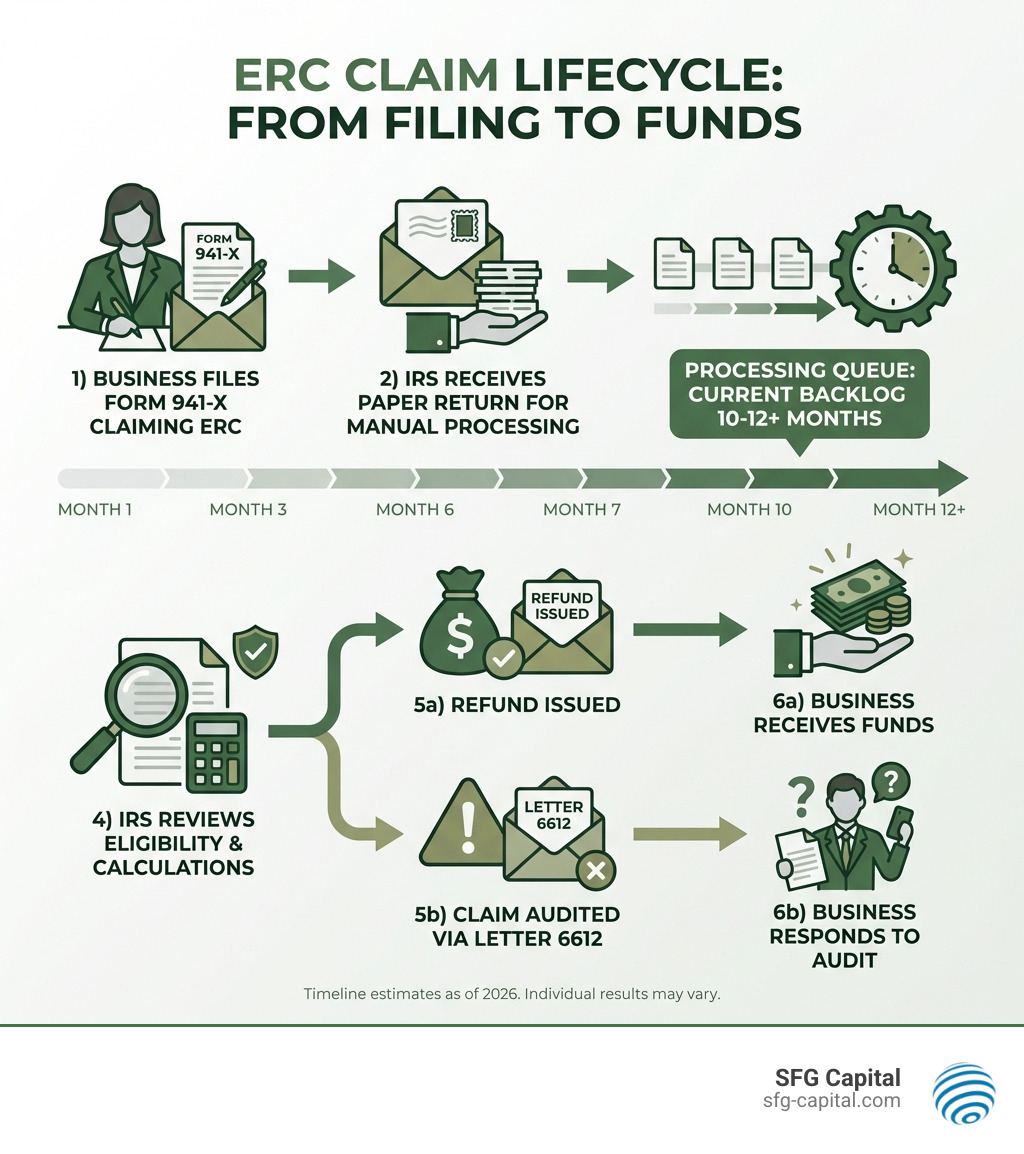
The journey from filing an ERC claim to receiving your refund has become a test of patience for many businesses. We understand the frustration, especially when these funds are crucial for your operations. The ERC refund timeline has stretched significantly, now often exceeding 8 months, and in many cases, taxpayers in Travis County and across the U.S. are reporting waits of 10 to 12 months, or even longer. This isn’t just an inconvenience; it’s a major cash flow challenge for businesses that were counting on these credits.

So, why the extensive delays? The primary culprit is the sheer volume of claims combined with the IRS’s manual processing system for these specific types of claims. Unlike many other tax filings that can be processed digitally, ERC refund claims are typically submitted on amended payroll tax returns, primarily Form 941-X. These paper returns require manual review and processing by specially trained IRS staff. This labor-intensive process was already slow, but the explosion in ERC claims has created an unprecedented backlog. Our research into IRS COVID-19 operations has shown that even with efforts to streamline, the manual nature of these claims is a significant bottleneck. The IRS itself has acknowledged the challenges, citing a combination of staffing shortages and the complexity of verifying each claim.
How to Track Your ERC Refund Timeline Status
One of the most disheartening aspects of the current situation is the inability to track the status of your ERC refund claim. If you’ve filed a Form 941-X to claim the ERC, you’ve likely finded that the IRS’s online tools, which are useful for tracking individual income tax refunds, simply don’t provide information for these amended payroll tax returns. This leaves businesses in the dark, unable to determine where their claim is in the processing queue or when they might expect their funds.
The IRS systems are not designed to give real-time updates for these types of claims, meaning the status of your ERC refund timeline is largely untraceable. While we wish we could offer a magic button for tracking, the reality is that direct inquiries to the IRS often lead to long hold times and representatives who are unable to provide specific processing details. This lack of transparency only adds to the anxiety for business owners eagerly awaiting their refunds. For more insights into this challenge, you can learn more info about ERC refund status check services.
Typical Waiting Periods for 2024 and Beyond
As we’ve mentioned, the typical waiting period for an ERC refund has unfortunately extended well beyond initial expectations. In 2024, and likely moving into 2025, businesses should brace for waiting periods that can easily stretch to 10-12 months or even longer. This prolonged ERC refund timeline is a direct consequence of the massive processing backlog and the moratorium the IRS implemented.
The moratorium, which began in September 2023, was a necessary step for the IRS to address a surge in questionable claims and to protect taxpayers from aggressive marketing and scams. While critical for the integrity of the program, it has undoubtedly exacerbated delays for legitimate claims. The IRS continues to process claims received before the moratorium, but at a slower pace as they increase scrutiny. This means that even claims filed well before September 2023 are still caught in the backlog. For a deeper dive into these delays, check out more info about the great ERC wait.
Navigating the IRS Backlog and Processing Moratorium
The IRS’s decision to implement a processing moratorium on new ERC claims in September 2023 sent ripples through the business community. This was a significant move, driven by mounting concerns over fraud and aggressive marketing tactics that led many ineligible businesses to file claims. The IRS stated it had entered a “new phase of increasing scrutiny on dubious submissions” for the ERC.
At the time of the moratorium, the IRS had a significant inventory of claims, approximately 400,000, representing about $10 billion, that were awaiting processing. This backlog, combined with the new policy of increased review, has drastically slowed the ERC refund timeline. The moratorium aims to protect taxpayers from scams and allow the IRS to develop new procedures to deal with the growing fraud risk. You can read more about this in the scientific research on the IRS processing moratorium.
Despite the current challenges, it’s important to remember why the ERC was created. It was a lifeline for businesses during an unprecedented crisis. Eligibility requirements were specific, focusing on businesses that experienced a significant decline in gross receipts or were subject to full or partial suspension of operations due to government orders.
| ERC Eligibility Comparison | 2020 (Q2, Q3, Q4) | 2021 (Q1, Q2, Q3) |
|---|---|---|
| Max Credit Per Employee | $5,000 | $7,000 per quarter |
| Gross Receipts Decline | >50% vs. 2019 | >20% vs. 2019 (or prior quarter) |
| Government Order | Full or partial suspension | Full or partial suspension |
| Recovery Startup Business | Not applicable | Yes (Q3 only for credit) |
| Max Wages per Employee | $10,000 annually | $10,000 per quarter |
Why Duplicate Claims Cause Further Delays
In the face of lengthy delays, it’s natural to feel impatient. However, we strongly advise against filing a second ERC claim for the same period if you haven’t received your refund yet. The IRS explicitly states that filing duplicate claims will only lead to further complications and significantly prolong your ERC refund timeline.
When a duplicate claim is identified, it triggers an investigation by the IRS. This isn’t a quick process; it involves manual review to determine if the claims are indeed identical and why a second one was filed. This extra layer of scrutiny diverts resources and attention away from processing other legitimate claims, including your original one. Instead of expediting your refund, a duplicate claim can flag your account for additional review, potentially leading to an audit and pushing your refund even further into the future. It’s truly a waiting game, and understanding how to steer it without causing more delays is key. Learn more info about the waiting game and overcoming delays.
The Role of the Taxpayer Advocate Service
When facing significant delays and an untraceable ERC refund timeline, some businesses might consider reaching out to the Taxpayer Advocate Service (TAS). TAS is an independent organization within the IRS that helps taxpayers resolve problems with the IRS that they haven’t been able to solve through normal channels. They can be particularly helpful in cases of financial hardship or if IRS actions are causing significant difficulties.
While TAS can’t magically speed up every claim, they can intervene in certain situations, especially if a delay is causing a significant hardship for your business or if you’ve been unable to get answers through regular IRS channels. Additionally, for extreme cases, some taxpayers have resorted to filing refund lawsuits to compel the IRS to process their claims. However, this is a complex legal route that should be pursued only after careful consideration and consultation with legal counsel. For strategies on speeding up your refund, explore more info about expediting your ERC refund.
Correcting or Withdrawing an Improper ERC Claim
The IRS has been very clear: if you believe you incorrectly claimed the ERC, it’s crucial to take action. This is particularly important given the IRS’s increased scrutiny and commitment to rooting out improper claims. We’ve seen many businesses in Travis County realize, often after the fact, that they didn’t fully meet the eligibility criteria or that their claim was overstated.
Fortunately, the IRS has provided pathways for businesses to correct these situations without facing harsher penalties. They introduced an ERC withdrawal program and, more recently, voluntary disclosure programs. The withdrawal program is for those who filed an adjusted employment tax return solely for the ERC, made no other adjustments, want to withdraw the entire claim, and either haven’t received the refund or received a check but haven’t cashed it. If your withdrawal is accepted, the adjusted return is treated as if it was never filed, meaning no penalties or interest will be imposed. This can be a huge relief. For detailed instructions on this process, refer to the scientific research on withdrawing an ERC claim.
Warning Signs of ERC Scams to Look Out For:
- Unsolicited calls or advertisements pushing ERC claims.
- Promoters claiming everyone qualifies without a thorough eligibility review.
- Fees based on a percentage of the refund amount (contingency fees).
- Pressure to sign documents quickly or without understanding them.
- Claims that promise “guaranteed” refunds or bypass IRS eligibility rules.
What Letter 6612 Signifies for Your Claim
Receiving a Letter 6612 from the IRS can certainly be unsettling. This letter is a notice from the IRS indicating that your ERC claim is under audit. It means your claim has been selected for a more in-depth review, and the IRS will be scrutinizing your eligibility and the calculations behind your credit.
When you receive Letter 6612, your ERC refund will be put on hold until the audit concludes. This further extends your ERC refund timeline, potentially for many more months. The IRS will request documentation to verify your eligibility, such as evidence of a significant decline in gross receipts or government-mandated shutdowns, and supporting payroll records. It’s crucial to respond promptly and thoroughly to all IRS requests. If you believe your claim is legitimate, gather all necessary documentation and consider working with a tax professional experienced in ERC audits. For more information on navigating these situations, see more info about resolving improper ERC claims.
Participating in the Voluntary Disclosure Program
For businesses that received an ERC but later realized they were not entitled to it, the IRS offered the Employee Retention Credit Voluntary Disclosure Program (ERC-VDP). This program provided a valuable opportunity to resolve the issue proactively and avoid potentially harsher consequences like audits, significant penalties, and interest.
The ERC-VDP, which initially had a deadline of March 22, 2024, and a subsequent program that closed on November 22, 2024, allowed eligible employers to repay only 80% of the credit received. The benefits were substantial:
- Repay only 80% of the ERC received.
- No repayment of interest received on the refund.
- No need to amend income tax returns to reduce wage expense (the 20% reduction wasn’t taxable income).
- Waiver of penalties and interest on the claimed ERC amount if paid in full.
This program was a lifeline for many who, perhaps due to aggressive promoters or misunderstanding complex rules, ended up with an ineligible claim. While the deadlines for these specific programs have passed, they underscore the IRS’s commitment to addressing improper claims. If you’re concerned about an ineligible claim and didn’t participate, consult with a tax professional to understand your current options. You can find detailed information about the program in the scientific research on the ERC Voluntary Disclosure Program.
Legislative Changes and the OBBBA Impact
The ERC program, initially launched under the CARES Act, underwent several legislative changes over its lifespan. These changes expanded eligibility and the amount of the credit, but also added layers of complexity. One significant piece of legislation impacting the ERC refund timeline and claims landscape was the “One Big Beautiful Bill Act” (OBBBA).
While the full details of the OBBBA are extensive, one key provision directly affected ERC claims: it disallowed pending ERC claims submitted after January 31, 2024, specifically for the third and fourth quarters of 2021. This meant that if your business had filed a claim for those specific quarters after that date, those claims would be rejected. However, claims for Q3 and Q4 2021 filed before January 31, 2024, remained unaffected. This legislative tweak highlighted the dynamic nature of the ERC rules and the need for businesses to stay informed. Many of the initial legislative changes that shaped the ERC program are detailed in documents like the scientific research on the Consolidated Authorizations Act.
Strategies to Manage a Delayed ERC Refund Timeline
Given the current extended ERC refund timeline, many businesses in Travis County and beyond simply cannot afford to wait 10-12 months or longer for their much-needed capital. This is where alternative strategies come into play. We understand that immediate access to funds can make all the difference, especially for small to medium-sized businesses navigating ongoing economic challenges.
One of the most effective strategies to bypass these IRS delays is through ERC advance funding or bridge loans. These financial solutions allow you to receive a significant portion of your anticipated ERC refund upfront, providing you with immediate working capital. At SFG Capital, we specialize in providing these types of solutions. We offer advances and buyouts on your ERC claims, allowing you to access your funds without the agonizing wait. Our performance-based fee structure ensures that our interests are aligned with yours – we only succeed when you do. This means you can get the cash you need now, allowing you to invest in growth, manage payroll, or simply maintain stability while the IRS continues its lengthy processing. To explore how this can benefit your business, learn more info about ERC advance funding.
The Extended Statute of Limitations and Penalties
Another crucial aspect introduced by recent legislative changes, including the OBBBA, is the extended statute of limitations for IRS audits related to ERC claims. Previously, the standard audit period was three years. However, the OBBBA extended this to six years. This means the IRS now has a longer window to audit an ERC claim, increasing the importance of having accurate records and ensuring your initial claim was legitimate. This extension applies to both the employment tax returns where the ERC was claimed and the corresponding income tax returns.
Furthermore, the OBBBA introduced new penalties to address improper ERC claims. A 20% penalty can now be applied for erroneous refund or credit claims. This penalty, which was previously only applicable to income tax, significantly raises the stakes for businesses that filed ineligible claims. There are also new due diligence requirements for ERC promoters, with a $1,000 penalty for non-compliance, aiming to curb the aggressive and often misleading marketing tactics that contributed to the surge in improper claims. The original framework and subsequent expansions of the ERC, including those influencing these changes, can be found in documents like the scientific research on the American Rescue Plan of 2021.
Frequently Asked Questions about ERC Refunds
We encounter many questions from business owners navigating the complexities of the ERC. Here are some of the most common ones we hear, along with our insights.
What are the deadlines for claiming ERC for 2020 and 2021?
It’s important to be aware of the deadlines for claiming the ERC, as some have already passed.
- For qualified wages paid during 2020: The deadline to claim the ERC was April 15, 2024. If you missed this deadline, unfortunately, you can no longer file an original or amended return to claim the credit for 2020.
- For qualified wages paid during 2021: The deadline to claim the ERC is April 15, 2025. This means you still have time to assess your eligibility and file an amended payroll tax return (Form 941-X) if your business qualifies.
These deadlines are critical, and missing them means forfeiting a potentially significant credit. We encourage businesses in Travis County to act swiftly if they believe they are eligible for the 2021 credit. For a comprehensive guide on the application process, refer to more info about the ERC credit application path.
How does the ERC interact with PPP loans?
Initially, businesses that received a Paycheck Protection Program (PPP) loan were not eligible to claim the ERC. This created a difficult choice for many employers during the early days of the pandemic. However, legislative changes retroactively altered this rule, offering much-needed flexibility.
The Consolidated Appropriations Act, 2021 (CAA21), enacted on December 27, 2020, retroactively allowed employers that received PPP loans to also claim the ERC. This was a game-changer, but with a crucial caveat: the same wages cannot be used for both PPP loan forgiveness and the ERC. You must ensure there’s no “double-dipping” – meaning you can’t claim the ERC for wages that were already used to justify PPP loan forgiveness. This requires careful allocation and documentation. Understanding this interaction is key to maximizing both benefits without running afoul of IRS rules. For detailed information on how PPP forgiveness impacts your ERC, explore more info about how PPP forgiveness impacts ERC.
What are the tax implications of receiving an ERC refund?
Receiving an ERC refund has specific income tax implications that employers need to understand. The ERC itself is not included in your business’s gross income. However, the wages used to calculate the ERC must be reduced by the amount of the credit. This means that your wage expense deduction on your income tax return for the year the wages were paid needs to be adjusted.
For example, if you claimed the ERC for wages paid in 2020, you would need to reduce your 2020 wage expense deduction by the amount of the ERC. If you had already filed your 2020 income tax return before claiming the ERC, you would typically need to file an amended income tax return (e.g., Form 1120-X or 1040-X) to reflect this reduction.
The IRS has issued guidance on this, including Notice 2021-20, which clarified that an employer does not include the ERC in income but reduces the allowed deduction for wages. Interestingly, the IRS has also offered some revised guidance for employers who received their ERC refunds after the statute of limitations for amending their original income tax returns had expired. In such cases, the IRS has suggested that employers can include the ERC in income for the year of receipt, rather than being required to amend prior-year returns. This nuance highlights the complexity and the need for careful tax planning, especially given the extended ERC refund timeline. For further details on wage expense adjustments, refer to the scientific research on wage expense adjustments.
Conclusion
Navigating the ERC refund timeline has proven to be a significant hurdle for many businesses, changing a much-needed relief program into a test of endurance. From the IRS’s manual processing backlog and the moratorium on new claims to the complexities of legislative changes and the threat of audits, the journey from claim to cash is anything but straightforward.
For businesses in Austin, Travis County, and across the United States, understanding these challenges and knowing your options is paramount. While the IRS works through its backlog and aims to combat fraud, eligible employers should still pursue their claims, but with eyes wide open to the potential delays and pitfalls.
At SFG Capital, we believe that businesses shouldn’t have to wait indefinitely for funds they are rightfully owed. Our mission is to bridge this gap. We help businesses in Travis County expedite their Employee Retention Credit refunds by offering advance funding and buyouts. With our performance-based fee structure, we ensure you get quick access to your capital, allowing you to focus on what matters most: growing your business. We handle the complexities, providing expert assistance so you can bypass the IRS delays and put your ERC funds to work today.
If your business has a pending ERC claim and you’re tired of waiting, don’t hesitate to reach out. We’re here to help you turn your claim into cash, eventually, but much sooner than the IRS might. Learn more info about our services and how we can assist you.