
The Ultimate Guide to Getting Your ERC Claim Funded Early
What You Need to Know About ERC Advance Funding Requirements
ERC advance funding requirements are a core concern for any established researcher looking to secure early access to grant capital before standard refund or disbursement timelines catch up.
Here is a quick summary of the key requirements:
| Requirement | Details |
|---|---|
| Applicant type | Active Principal Investigator (PI) with significant research achievements |
| Track record | Demonstrated achievements within the last 10 years |
| Time commitment | Minimum 30% of working time on the ERC project |
| Residency | At least 50% of working time in an EU Member State or Associated Country |
| Host Institution | Must be a legal entity in an EU Member State or Associated Country |
| Max funding | Up to €2.5 million for 5 years, plus up to €1 million additional |
| Funding model | Single lump sum (80% upfront, 20% on completion) |
| Success rate | Approximately 11% |
Whether you are an established research leader or a mid-career scientist, understanding these requirements early gives you a clear edge in a highly competitive process.
I’m Santino Battaglieri, and through my work at SFG Capital — where we have purchased and funded over $500 million in ERC claims — I have developed deep expertise in ERC advance funding requirements and the structured funding solutions that help eligible claimants access capital faster. In the sections below, I’ll walk you through everything you need to know to navigate this process with confidence.
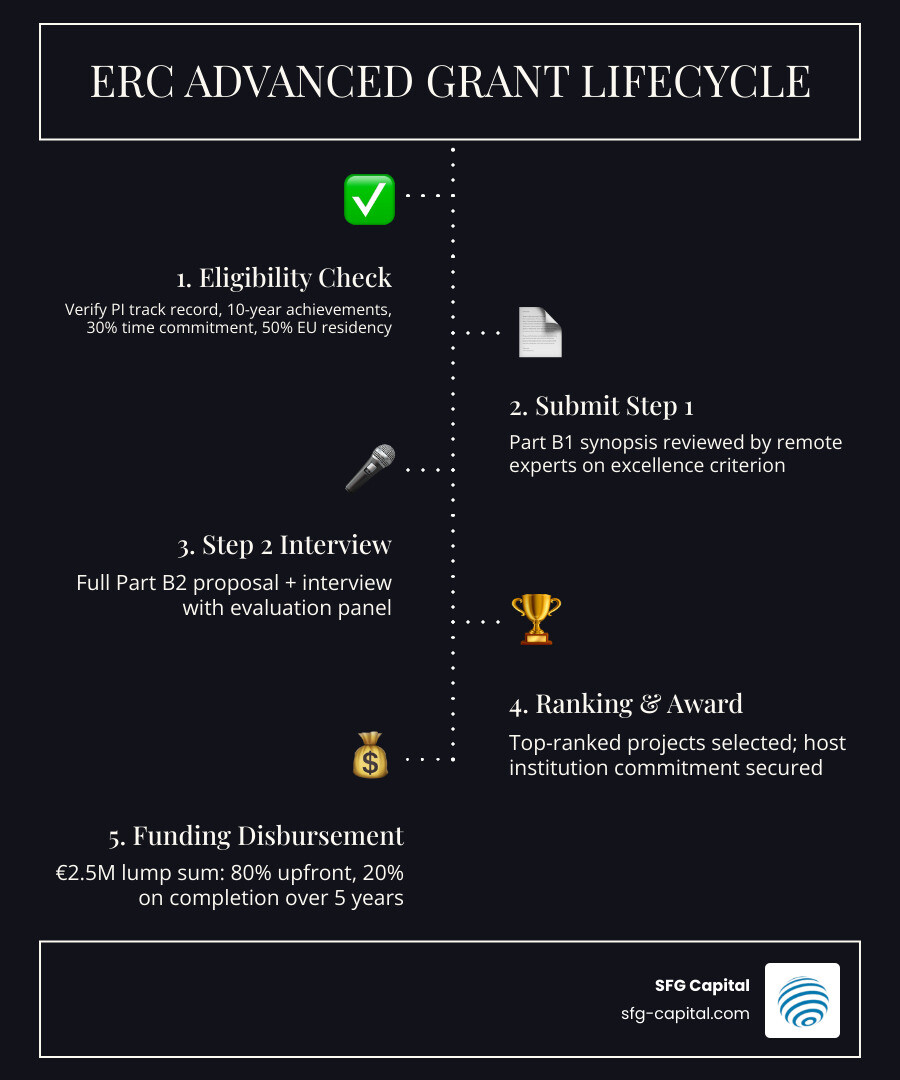
Who is Eligible for ERC Advanced Grant Funding?
When we talk about the European Research Council (ERC) Advanced Grant, we are looking at the heavy hitters of the scientific world. This isn’t just about having a good idea; it’s about having the pedigree to back it up. The primary applicant is known as the Principal Investigator (PI). Unlike other grants that might target “young” researchers, the Advanced Grant is specifically for established research leaders.
To meet the ERC Funding Requirements, a PI must demonstrate a track record of significant achievements over the last 10 years. This isn’t a vague suggestion; the ERC looks for specific benchmarks. We’re talking about leading at least 10 publications as the main author in major international peer-reviewed journals, or perhaps having three major research monographs under your belt. Other markers of excellence include holding five or more patents, delivering 10 invited presentations at major conferences, or having led three significant research expeditions.
Research Independence and Leadership
The ERC wants to see that you are an independent force in your field. This means showing that you’ve produced important work without the “supervision” of your former PhD advisors. You need to be an exceptional leader in terms of both the originality and the significance of your research contributions.
The Host Institution and Geography
Your research cannot happen in a vacuum—it needs a home. You must Visit official ERC Advanced Grant webpage to confirm that your chosen Host Institution (HI) is a legal entity located in an EU Member State or one of the associated countries. This includes countries like Norway, Turkey, and, thanks to recent political agreements, the United Kingdom.
The “Mid-Career” Surprise
Here is a fun fact that often surprises people: you don’t have to be at the very end of your career to win. In the 2023 round, 18% of successful winners were actually mid-career researchers (those 12–17 years post-PhD). If you have the track record, the ERC doesn’t care about your age.
Time and Residency Commitments
Securing this funding comes with a “physical presence” catch. You must commit at least 30% of your total working time to the ERC project itself. Furthermore, you must spend at least 50% of your total working time residing or working within an EU Member State or Associated Country. The ERC is investing in European excellence, and they want that excellence to stay (at least half the time) in Europe!
Key ERC Advance Funding Requirements and Budget Structures

Understanding the money is where things get interesting. The ERC Advanced Grant is generous, but it is highly structured. The standard maximum grant is €2.5 million for a period of 5 years. If your project is shorter, the amount is reduced pro rata.
The Lump Sum Model: A Game Changer
One of the most significant shifts in erc advance funding requirements recently is the move to the “lump sum” model. In the past, researchers had to file endless cost claims for every test tube and plane ticket. Now, the grant is awarded as a single lump sum based on your estimated budget.
How does the payout work? Usually, you receive an 80% upfront payment (pre-financing) at the start of the project. The remaining 20% is paid out upon successful completion and approval of the final report. This “advance” nature of the funding is designed to give you the liquidity needed to get a massive project off the ground without waiting for reimbursements.
Additional Funding: The €1 Million “Bonus”
Sometimes, €2.5 million isn’t enough for truly ground-breaking work. You can request up to an additional €1 million (bringing the total to €3.5 million) for specific “extraordinary” costs. According to the current Work Programme, this extra funding is reserved for:
- Start-up costs for PIs moving to the EU/Associated Country from elsewhere.
- Major equipment purchases.
- Access to large-scale facilities.
- Major experimental or field work costs (excluding personnel).
In 2022, about 14% of awarded projects successfully secured this extra million. If you are relocating from a non-associated third country (like the US) to the EU, that additional amount can even go up to €2 million in some cases!
Indirect Costs and Financial Reporting
The grant covers 100% of your eligible direct costs. On top of that, the ERC provides a flat-rate contribution of 25% for “indirect costs” (overhead like rent, electricity, and admin). While the lump sum model simplifies things, you still need to provide a detailed budget justification in your proposal to show that your estimates are realistic and based on your institution’s usual accounting practices.
Navigating the Two-Step Evaluation and Submission Process
Getting ERC Advance Funding is a marathon, not a sprint. The evaluation process is famous for its rigor, focusing on one single criterion: Excellence. This applies to both the ground-breaking nature of the project and the brilliance of the PI.
Step 1: The Remote Review
Once you submit your application via the Funding & Tenders Portal, it goes to one of 28 evaluation panels. These panels are divided into three main domains:
- PE: Physical Sciences and Engineering
- LS: Life Sciences
- SH: Social Sciences and Humanities
In Step 1, the panel members and remote experts look primarily at Part B1—your extended synopsis, CV, and track record. They are looking for the “Big Picture.” If they aren’t convinced by the five-page synopsis, they won’t even look at the technical details in Part B2. Only about 44 proposals per panel are typically retained for Step 2.
Step 2: The Deep Dive and Interview
If you pass Step 1 with an “A” ranking, the reviewers finally open Part B2, which is your full 14-page scientific proposal. This is where you prove the feasibility of your high-risk ideas.
The climax of Step 2 is the interview. You will be invited to present your project to the panel (usually in Brussels or via video link). This is your chance to defend your “high-risk, high-gain” approach. You need to Unlock Your ERC Requirements, Advances, and What You Need to Know regarding how to handle tough questions about your methodology and risk mitigation plans.
Selecting the Right Panel
Choosing the right panel is a strategic decision. You should look at the panel keywords and past funded projects to see where your research fits best. If your work is interdisciplinary, you can pick a primary and a secondary panel, but remember: one panel will always take the lead.
Maximizing Success: Tips and Resources for Applicants
With a success rate of roughly 11%, you need more than just a good CV; you need a strategy. Here are some “insider” tips we’ve gathered from successful applicants and consultants:
- Balance Risk and Feasibility: The ERC loves “high-risk” projects, but they hate “impossible” ones. You must show that while the idea is bold, you have the preliminary data and a solid mitigation plan if things go sideways.
- Don’t Just Summarize B2 in B1: Part B1 (the synopsis) should be written for a generalist in your field, focusing on the “Why” and the “So What?” Part B2 is for the specialists who want to see the “How.”
- Use the ERC Dashboard: The ERC dashboard is a goldmine. Use it to see what kind of projects have been funded in your panel recently. It helps you “calibrate” your ambition.
- Engage Your National Contact Point (NCP): Every country has a National Contact Point. These folks provide free advice, review drafts, and sometimes even run mock interviews. Use them!
- Ethics and Open Science: Don’t treat the ethics self-assessment as an afterthought. Serious ethical issues (like human embryonic stem cell research) require a deep dive. Similarly, the ERC is a fierce proponent of Open Science. You must plan for immediate open access to publications and follow FAIR (Findable, Accessible, Interoperable, Reusable) data principles.
Frequently Asked Questions about ERC Advance Funding Requirements
What are the specific erc advance funding requirements for mid-career researchers?
While the Advanced Grant is for “established” leaders, there is no strict “years since PhD” limit. If you are a mid-career researcher (12–17 years post-PhD) and can show you’ve led major projects, secured significant funding, and influenced your field, you are eligible. In fact, 18% of 2023 winners fell into this category. The key is providing evidence of leadership that matches the “Advanced” profile. For more details, check out our ERC Advance Funding Complete Guide.
How do resubmission limits affect erc advance funding requirements?
The ERC doesn’t want to review the same “not-quite-ready” proposal every year. If your proposal receives a Category B score at Step 1, you are typically barred from applying the following year. If you get a Category C, you might have to wait two years. These restrictions are designed to force applicants to significantly improve their work before trying again. It’s always better to wait until your proposal is perfect than to rush a submission and get “locked out” of the next cycle. You can read more about navigating these hurdles in our Employee Retention Credit Advance Guide.
What documents are required for a complete application?
A complete application is quite a stack! You’ll need:
- Administrative Forms (Part A): General info about the PI and the Host Institution.
- Part B1: The 5-page Extended Synopsis plus your CV and Track Record (4 pages).
- Part B2: The 14-page full Scientific Proposal.
- Host Institution Binding Statement of Support: An official letter from your HI promising to host you and let you work independently. You can find the template in the Host Institution Binding Statement of Support documentation.
- Ethics Self-Assessment: Identifying any potential ethical issues.
- Budget Justification: A clear breakdown of how you’ll spend the lump sum.
Conclusion
Navigating erc advance funding requirements is a complex but rewarding journey. Whether you are aiming for the €2.5 million standard grant or the additional €1 million for major equipment, the key is to demonstrate unparalleled scientific excellence and a rock-solid track record.
At SFG Capital, we understand that waiting for large capital disbursements—whether they are research grants or tax refunds—can be a major bottleneck for growth and innovation. While the ERC provides its own “advance” through the 80% pre-financing model, many businesses in Travis County and across the United States face similar waiting games with the IRS regarding the Employee Retention Credit (ERC).
If you are a business owner in Austin, TX, or the surrounding areas dealing with IRS delays, we are here to help. We offer specialized advance funding and buyout options for your ERC claims. We bypass the federal backlog by providing you with capital today, backed by our expert claim assistance and a performance-based fee structure. You don’t have to wait months or years for the government to move; we can help you unlock that liquidity now.
Ready to bridge the gap and get your funding on track? More info about our services is just a click away. Let’s get your project—and your business—moving forward.