
Waiting for Your Tax Refund is the Hardest Part
How Long Does the IRS Take to Process a Tax Return?
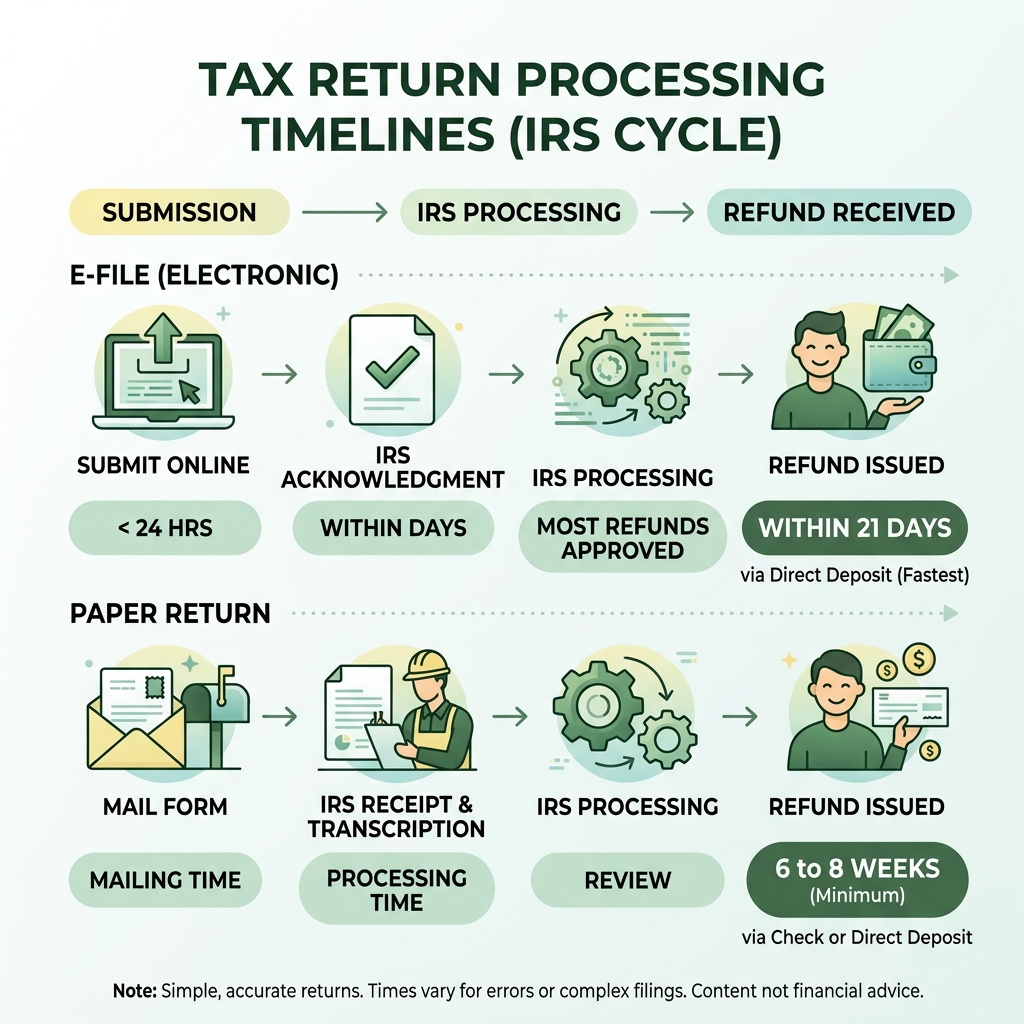
The irs time to process tax return varies depending on how you file — here’s a quick breakdown:
| Filing Method | Typical Processing Time | Refund via Direct Deposit |
|---|---|---|
| E-file (electronic) | Within 21 days | Fastest option |
| Paper return | 6 to 8 weeks | Slower than e-file |
| Amended return (Form 1040-X) | Up to 16 weeks | Same as filing method |
| Business returns (e-file) | Within 21 days | Varies by form |
| Paper Form 941 (payroll) | Several months | Depends on backlog |
Bottom line: E-file with direct deposit and you’ll likely see your refund in 21 days or less. Paper file and you’re looking at 6 to 8 weeks minimum.
More than 9 out of 10 refunds are issued within 21 days for taxpayers who e-file. But that’s only true if your return is clean — no errors, no special credits, no missing information.
If you’re a business owner waiting on an Employee Retention Credit (ERC) refund, the timeline is a different story entirely. ERC claims filed on Form 941-X have faced multi-year backlogs, leaving businesses starved of working capital they urgently need.
I’m Santino Battaglieri, founder of SFG Capital, and our firm has purchased and funded over $500 million in ERC claims — giving us a front-row seat to exactly how unpredictable the irs time to process tax return can be for businesses. Let’s walk through everything you need to know so you can plan accordingly.
Important irs time to process tax return terms:
Understanding the IRS Time to Process Tax Return
When we talk about the irs time to process tax return, we are really looking at two very different worlds: the digital fast lane and the paper-clogged slow lane. The IRS is a massive agency, and while they have modernized significantly, they still handle millions of physical documents every year.
For the vast majority of Americans, the 21-day window is the gold standard. If you file your Form 1040 electronically and choose direct deposit, the IRS typically accepts that return within 24 to 48 hours. From that moment of “acceptance,” the clock starts ticking. In fact, most taxpayers who follow this path see their money hit their bank accounts in fewer than three weeks.
However, if you decide to go old-school and mail in a paper return, you should settle in for a long wait. The IRS notes that paper-filed returns generally take 6 to 8 weeks (42 to 56 days) to process. This is because a human being or a high-speed scanner has to manually input your data into the system before the actual verification begins. If you are looking for ways to Speed Up Your Tax Refund: Strategies to Expedite IRS Processing, the single best piece of advice we can give you is to stop using stamps and start using software.
According to official IRS processes refunds documentation, choosing direct deposit is not just about speed; it’s about security. Paper checks can be lost, stolen, or misdirected. By linking an FDIC-insured bank account or using the National Credit Union Locator tool to find a local institution, you ensure that once the IRS hits “send,” the money goes exactly where it belongs.
Factors Affecting the IRS Time to Process Tax Return for Individuals
Even if you e-file, your return might get pulled over for a “random inspection” or, more likely, because something didn’t add up. There are several Common Reasons for Slow Tax Refunds that can turn a 21-day wait into a 180-day ordeal.
- Math Errors: This is the most common culprit. If your numbers don’t balance, the IRS system flags the return for manual review.
- Missing Signatures: If you’re filing a joint return and your spouse forgets to sign, the IRS can’t process it.
- Incomplete Information: Forgetting a W-2 or a 1099 form means the IRS has to reach out to you via mail to ask for the missing pieces.
- Identity Theft Concerns: To protect your money, the IRS uses sophisticated programming to detect potential fraud. If they suspect someone else is trying to file in your name, they will hold the refund until you verify your identity.
The IRS explicitly states Why it may take longer than 21 days for some filers. If your return requires a correction to the Child Tax Credit or the Recovery Rebate Credit, expect a delay. In these cases, the IRS review process can take anywhere from 45 to 180 days, depending on the complexity of the issue.
Impact of Tax Credits on Processing Speed
If you are a low-to-moderate-income filer, you might be eligible for the Earned Income Tax Credit (EITC) or the Additional Child Tax Credit (ACTC). These credits are fantastic for your bottom line, but they come with a built-in delay thanks to a law called the PATH Act.
By law, the IRS cannot issue refunds for returns claiming these specific credits before mid-February. This gives the agency extra time to verify that the claims are legitimate and prevent identity thieves from making off with large fraudulent refunds. Even if you file on the very first day of tax season in January, your refund will be held.
If you claimed the Additional Child Tax Credit (ACTC) and EITC and chose direct deposit, you should generally expect your refund by the first week of March, provided there are no other errors on your return.
Tracking Your Status: How to Use IRS Tools Effectively
We know the feeling of checking your bank balance every morning, hoping to see those four digits appear. Instead of stressing, we recommend using the official tools provided by the government.
The most popular tool is the Where’s My Refund? tool. This system provides real-time updates and is updated once every 24 hours, usually overnight. You can start checking the status of your refund:
- 24 hours after e-filing a current year return.
- 3 or 4 days after e-filing a prior-year return.
- 4 weeks after mailing a paper return.
To use the tool, you’ll need three specific pieces of information:
- Your Social Security Number (SSN) or Individual Taxpayer Identification Number (ITIN).
- Your filing status (Single, Married Filing Jointly, etc.).
- The exact whole dollar amount of your expected refund.
If you prefer using your phone, the IRS2Go app offers the same functionality on the go. For those who need a more detailed breakdown of their filing history, we suggest reading our Guide to Getting a Tax Refund Expedited.
Using Your Online Account for Transcripts
Sometimes, “Where’s My Refund” doesn’t give you enough detail, especially if your return is under review. In this case, your best bet is to access your online account.
To sign in, you will need to verify your identity using ID.me. Once inside, you can view your tax transcripts. These transcripts show “codes” that indicate when a return was received, when a refund was approved, or if a hold has been placed on the account. If you’re confused about how the login process works, the IRS provides an Online Account Frequently Asked Questions page to help you navigate the security requirements.

Processing Timelines for Business Returns and Amended Forms
For business owners, the irs time to process tax return can be even more complicated. While a standard Form 1120 (Corporate Income Tax Return) filed electronically typically follows the 21-day rule, paper filings and amended returns are a different story.
Amended returns (Form 1040-X for individuals or 1120-X for corporations) are notorious for long wait times. Currently, the IRS suggests that amended returns can take up to 16 weeks to process, but during peak seasons or periods of high backlog, this can stretch even longer.
The IRS maintains a Processing status for tax forms page that they update regularly. As of the most recent updates:
- Form 1040 (Paper): The IRS is currently processing original paper returns received in early 2026.
- Form 1120 (Paper): Original corporate returns received in March 2026 are currently being processed.
- Form 941 (Paper): Original payroll tax returns received in March 2026 are current.
If you are looking for a Guide to 2026 ERC and 941-X Processing Times, you’ll find that amended payroll returns (Form 941-X) are handled separately from standard income tax amendments.
Business-Specific IRS Time to Process Tax Return and ERC Claims
This is where we at SFG Capital spend most of our time. The Employee Retention Credit (ERC) has been a lifeline for many businesses in Travis County, but the IRS processing of Form 941-X has been historically slow.
The IRS has dealt with a massive backlog of ERC claims, leading to a moratorium on new claims at various points to allow them to catch up. For businesses waiting on these funds, the “standard” timelines don’t apply. It is not uncommon for an ERC refund to take 6 to 12 months—or even longer—to arrive.
We help businesses Estimate Your ERC IRS Processing Time by looking at when the claim was submitted and the current status of the IRS backlog. If you can’t afford to wait a year for the government to move, there are options. We specialize in providing ERC Refund Advances, allowing you to get your cash now while we take on the wait.
Common Roadblocks to a Speedy Refund
Even if you do everything right, external factors can slow down the irs time to process tax return.
One major roadblock is the Treasury Offset Program (TOP). If you owe back taxes, delinquent child support, or certain federal or state debts, the Bureau of the Fiscal Service can “offset” your refund. This means they take some or all of your refund to pay off those debts. If this happens, you will receive a notice in the mail explaining the reduction.
Another scary roadblock is identity theft. If the IRS suspects your return is fraudulent, they will send you Letter 5071C. You will have to go through a verification process before they release your money. This can add months to your timeline.
If the “Where’s My Refund” tool says your check was mailed but you haven’t seen it, you may need to ask the IRS to do a refund trace. This is common if you moved and didn’t update your address, or if a paper check was stolen from your mailbox.
Finally, the Average Time for IRS to Approve Refund is just an average. During the height of tax season (late March through April), processing times naturally creep up as the volume of returns hits its peak.
Frequently Asked Questions about IRS Processing
When can I start checking the status of my tax refund?
You don’t have to wait weeks to start looking. If you filed electronically, you can check the Where’s My Refund? tool just 24 hours after the IRS accepts your return. If you mailed a paper return, you’ll need to be much more patient—wait at least 4 weeks before the system will have any record of your filing.
What should I do if my refund is delayed beyond 21 days?
First, don’t panic. Check “Where’s My Refund” to see if there is a specific message or “Take Action” indicator. If it’s been more than 21 days since you e-filed and the tool tells you to contact the IRS, you can call the IRS hotline at 800-829-1954. Be prepared for long wait times! For a visual guide on why your money might be stuck, you can watch this video on held or stopped refunds.
Are there differences in processing times for state tax refunds?
Yes, absolutely. The IRS only handles your federal taxes. Your state refund is managed by your state’s Department of Revenue (or the Comptroller in some states). Each state has its own processing system and timeline. Some states are incredibly fast (within a week), while others can take longer than the IRS. Since we are based in Austin, we know that Texas does not have a state income tax—which is one less thing for Travis County residents to worry about!
Conclusion
Waiting for the IRS is never fun, but understanding the irs time to process tax return can help you manage your expectations and your cash flow. For individuals, the formula is simple: e-file + direct deposit = 21 days. For businesses, especially those dealing with amended returns or specialized credits like the ERC, the timeline is much more complex.
At SFG Capital, we understand that for a business in Travis County, “time is money” isn’t just a cliché—it’s a reality. If you’re tired of the IRS waiting game and need to expedite your ERC funding, we are here to help. We offer performance-based fees and expert claim assistance to ensure you get the funds you’ve earned without the multi-month headache.
Whether you’re waiting on a personal refund to fund a vacation or a business credit to hire new staff, stay proactive, use the digital tools available, and don’t hesitate to seek professional help if the wait becomes too much to handle.