
Why ERC Processing Time Matters for Your Business
ERC processing time has become one of the most pressing concerns for businesses that filed for the Employee Retention Credit. What was once a two-month wait has stretched into a frustratingly long delay, often exceeding eight months or more.
The Employee Retention Credit was created through the CARES Act as a lifeline for businesses that kept employees on payroll during the COVID-19 pandemic. It offered substantial refunds, up to $26,000 per employee, to help companies survive unprecedented economic disruption.
But what should have been relief has turned into frustration. The IRS placed a moratorium on new ERC claims in September 2023, and a massive backlog means many legitimate businesses are still waiting for funds they filed for years ago. The reality is stark: businesses that counted on ERC funds are stuck in limbo, watching their financial plans crumble while the IRS works through its backlog.
This guide will walk you through everything you need to know about ERC processing time. You will learn why delays happen, how to check your claim status, what to do with IRS notices, and which options are available if you cannot afford to wait.
I’m Santino Battaglieri, and through SFG Capital, I’ve helped businesses steer the complexities of ERC processing time by purchasing and funding over $500 million in claims, providing immediate capital while clients wait for IRS refunds. My experience with thousands of ERC transactions has given me insight into what businesses face during this frustrating waiting period and how to manage it effectively.
The Employee Retention Credit (ERC): A Primer for Businesses
To truly understand the current state of ERC processing time, it helps to know a bit about the credit itself. The Employee Retention Credit (ERC) was a federal tax credit designed to encourage businesses to keep employees on their payrolls during the economic disruptions caused by the COVID-19 pandemic.
History and Purpose of the ERC
The ERC was initially established by the Coronavirus Aid, Relief, and Economic Security (CARES) Act in March 2020. Its core purpose was simple: provide financial incentives to employers to retain their workforce, even when their operations were fully or partially suspended or they experienced significant declines in gross receipts.
Initially, businesses that received a Paycheck Protection Program (PPP) loan could not also claim the ERC. However, Congress later recognized the need for broader support. The Consolidated Authorizations Act, 2021 (CAA21), enacted in December 2020, retroactively changed this, allowing employers who received PPP loans to also claim the ERC. This significantly expanded the pool of eligible businesses. The credit was further extended and improved by the American Rescue Plan of 2021, covering wages paid through the third quarter of 2021.
The IRS provides a comprehensive IRS ERC Overview for those looking for more background on the program.
Key Eligibility Criteria for the ERC
Eligibility for the ERC primarily hinged on two main criteria during the qualifying periods:
- Significant Decline in Gross Receipts: This meant a business experienced a certain percentage reduction in its gross receipts compared to a corresponding quarter in 2019. The specific percentage varied by year (for example, 50% for 2020, 20% for 2021).
- Full or Partial Suspension of Operations: This applied if a business’s operations were fully or partially suspended due to government orders limiting commerce, travel, or group meetings because of COVID-19.
These criteria were specific and detailed. Determining eligibility often required careful analysis of a business’s financials and operational changes during the pandemic. The IRS shared an IRS Eligibility Checklist and FAQs to help businesses and their advisors steer this complexity.
Qualified wages depended on employer size and included certain health plan expenses. The rules differed for large and small employers, which made precise calculations important for both eligibility and claim amount.
ERC, PPP, and Tax Implications
The interaction between the ERC and other pandemic relief programs, particularly PPP loans, was a common area of confusion. As mentioned, the CAA21 retroactively allowed businesses to claim both, provided the same wages were not used for both programs. This meant careful planning was essential to maximize benefits without double-dipping.
A significant tax implication of receiving an ERC refund relates to wage deductions. While the ERC itself is not taxable income, the amount of the credit reduces the deductible wage expenses on a business’s income tax return. This is outlined in IRS Notice 2021-20. If a business claimed the ERC after filing its original income tax return, it generally needed to file an amended income tax return to reflect this reduction in wage deductions.
This interplay with tax returns has become particularly complex due to the lengthy ERC processing time. Many businesses received their ERC refunds long after the statute of limitations for amending their original income tax returns for 2020 or 2021 had passed. The IRS acknowledged this issue, providing guidance that if an ERC claim is disallowed and final, businesses can adjust wage expenses on a later tax return instead of amending the original year. This aims to prevent further complications for taxpayers already facing delays.
The Current State of ERC Processing Time and Delays

If you are among the many businesses still waiting for your ERC refund, you are not alone. The journey from filing an ERC claim to receiving a refund has evolved into a protracted waiting game, largely due to unprecedented backlogs and changes in IRS policy.
What is the Typical Wait Time for an ERC Refund?
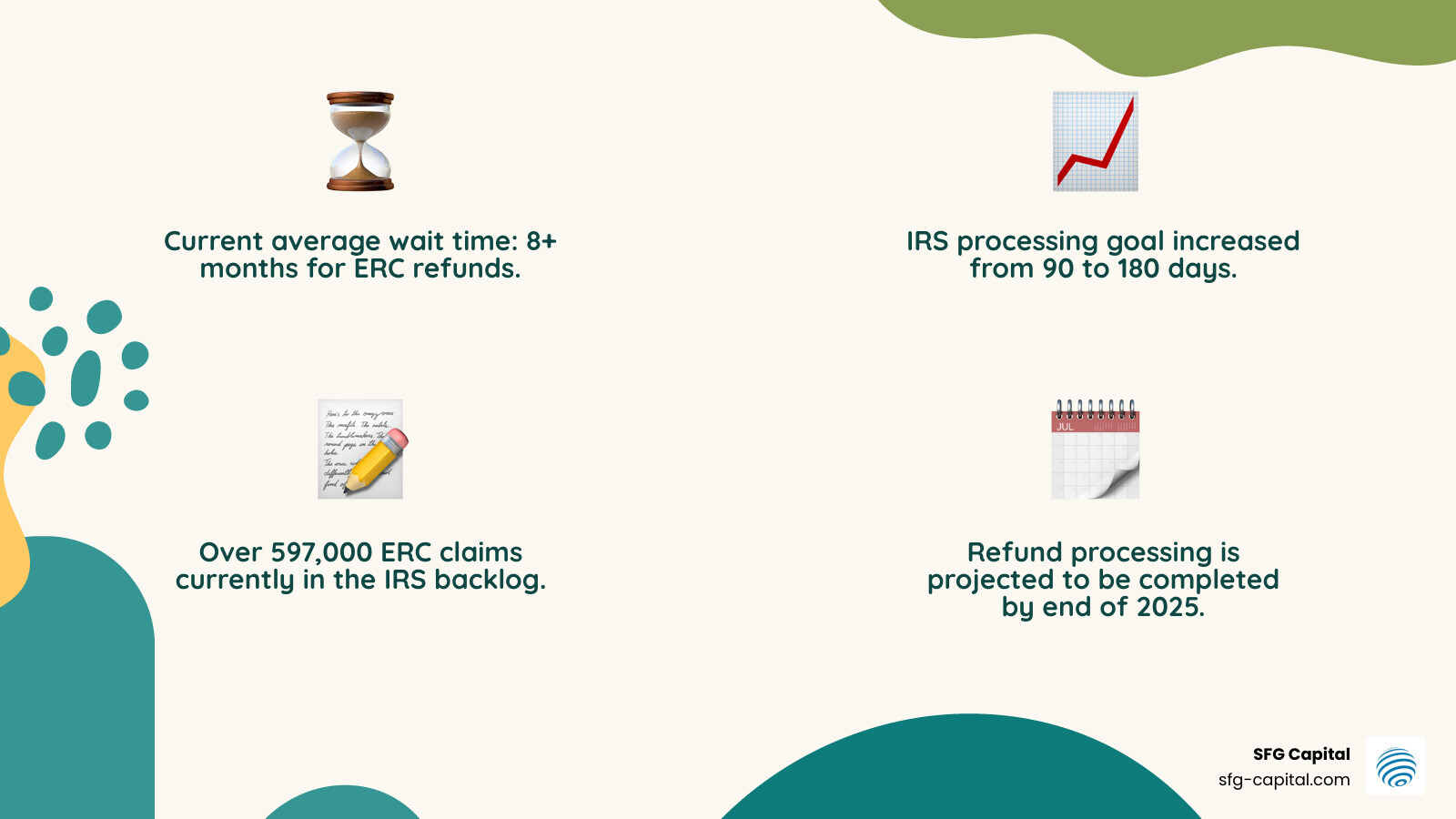
In the early days of the program, businesses could expect refunds in about two months. Today, that timeline is a distant memory. Here is a snapshot of the recent reality:
- Initial estimates: around 2 months or less in the early program days
- Current experience for many filers: 8 or more months, sometimes longer
- IRS goal during the moratorium period: 180 days for claims filed before the moratorium, increased from 90 days
- Reported backlog at one point: over 597,000 unprocessed claims as of early 2024
The IRS has acknowledged the massive backlog, and the journey from filing to refund has become a waiting game for many businesses that counted on these funds. You can find more details on this situation via IRS Updates on ERC Processing.
Factors Contributing to the Long ERC Processing Time
Several overlapping issues have contributed to the extended ERC processing time:
- High claim volume: Millions of companies across the United States filed for the ERC for 2020 and 2021 due to pandemic-related shutdowns and operating restrictions.
- Manual processing of Form 941-X: ERC claims are typically made on amended payroll tax returns (Form 941-X), which often require manual processing by trained IRS staff.
- IRS staffing issues: The IRS has faced staffing shortages in recent years, which has compounded delays when combined with high claim volume.
- Increased fraud scrutiny: Concerns about fraudulent and questionable ERC claims led the IRS to implement stricter review processes, naturally slowing down the entire processing pipeline. The IRS signaled this new phase of increasing scrutiny in a news release.
The IRS has described how operational constraints and manual processing have affected timing in its broader IRS Backlog Information.
How the IRS Moratorium Impacts the ERC Processing Time
A major development affecting ERC processing time was the IRS announcement of an immediate moratorium on processing new ERC claims in September 2023. This September 2023 moratorium announcement was a direct response to the surge of questionable claims and aggressive marketing by promoters.
The moratorium meant that the IRS stopped processing any new claims filed after the announcement date. For claims already in the pipeline, the IRS increased its processing goal from 90 to 180 days, indicating a more thorough review process. This has meant that even legitimate claims filed before the moratorium have been subject to longer wait times and increased scrutiny. The IRS continues to move forward with ERC claims, but with a slower, more deliberate pace.
How to Steer Your Claim: From Status Checks to IRS Notices
Navigating the ERC landscape can feel like sailing through a fog, especially with the extended ERC processing time. Knowing how to check your claim status and understand IRS communications can help you stay informed, even if it does not always speed things up.
How Can I Check the Status of My ERC Refund?
The IRS “Where’s My Refund?” tool is primarily for individual income tax refunds (Form 1040). For businesses, checking the status of an ERC refund (filed on Form 941-X) typically requires a more direct approach:
- Call the IRS Business and Specialty Tax Line: Have your Employer Identification Number (EIN), the tax period or periods for which you claimed the ERC, and any relevant tax return information ready. Hold times can be long.
- Check your IRS account transcript: You can request an IRS account transcript for the relevant tax periods. This document can sometimes show if a refund has been processed or if there are holds on your account.
- Consult your tax professional: If you worked with a tax professional to file your claim, they might have access to information or practitioner hotlines that can help track the status.
As HopkinsCPA notes, How to Check ERC Refund Status confirms that direct communication with the IRS is key. Due to the current ERC processing time, no news does not necessarily mean bad news; it often just means they are still working through the queue.
Dealing with Incorrect Claims and Potential Fraud
The IRS’s increased scrutiny means that if you incorrectly claimed the ERC, there could be serious consequences. Reviewing your eligibility is essential, especially if you used a third-party promoter whose claims now seem questionable.
- If you received payment but were ineligible: You may have to repay the refund, potentially with interest and penalties. The IRS has established a settlement program for businesses that received ERC payments but were later found to be ineligible.
- If your claim is unprocessed and you believe it is incorrect: The IRS has created an IRS ERC Withdrawal Guidance process. This allows businesses to withdraw their unpaid ERC claims if they now believe they do not qualify.
- Voluntary Disclosure Program: For businesses that intentionally claimed the ERC improperly, the IRS launched a Voluntary Disclosure Program (Announcement 2024-3). This program offers a pathway to come forward, repay the credit, and avoid criminal prosecution.
The key takeaway is to be proactive. If you have any doubts about your eligibility, consult a trusted tax professional immediately.
Understanding IRS Letters About Your ERC Claim

During the extended ERC processing time, you might receive various letters from the IRS concerning your claim. It is vital to understand what each means:
- Letter 6612: This letter indicates that your pending ERC claim is being audited. If you receive this, your refund will be held until the audit concludes.
- Letter 105-C: This is a notice of disallowance, meaning the IRS has denied your ERC claim, either partially or fully. It should provide a reason for the disallowance. If you receive a Letter 105-C, you have options, including appealing the decision.
- Letter 106-C: This letter relates to the Employee Retention Credit and addresses situations where the IRS has made an adjustment to your account regarding the ERC. Understanding your Letter 106-C, Employee Retention Credit is crucial for knowing how to respond.
Receiving any of these letters can be daunting, but they are part of the IRS process. Do not ignore them. Instead, gather all relevant documentation and, if you have not already, engage a tax professional to help you understand and respond appropriately.
Your Options for Managing Delays and Denials
The extended ERC processing time and the possibility of denial can be incredibly frustrating for businesses relying on these funds. While direct expedition is challenging, you do have options to manage the situation.
Are There Ways to Expedite My ERC Refund?
There are very limited direct ways to speed up the IRS ERC processing time once your claim is submitted. The IRS generally processes claims in the order they are received, and the backlog has meant significant delays for many filers.
Some very specific and extreme circumstances might allow for intervention, such as:
- Financial hardship: In rare cases of severe financial hardship, the Taxpayer Advocate Service (TAS) might be able to assist. However, their resources are also stretched, and criteria are strict.
- Refund lawsuit: In some instances, businesses have filed refund lawsuits against the IRS to compel action. This is a complex, costly, and time-consuming legal process, typically reserved for very large claims or when all other avenues have failed.
For most businesses, the reality is that waiting is part of the process. The best “expediting” strategy is to ensure your initial claim was carefully prepared, accurate, and fully compliant to avoid any further delays due to IRS inquiries or audits. You can explore these limited options in more detail in this guide on Expediting Your ERC Refund: What You Need to Know.
How to Appeal a Disallowed ERC Refund Claim
If you receive a Letter 105-C disallowing your ERC claim, you have the right to appeal the decision. Timing is essential.
- Thirty-day window: You typically have 30 days from the date on the disallowance notice to file an appeal.
- Prepare your case: Your appeal should clearly state why you believe the IRS decision is incorrect. This involves referencing your original claim, providing supporting documentation, and citing relevant tax law or IRS guidance.
- Seek professional guidance: Appealing an IRS decision is complex. Working with a qualified tax attorney or CPA experienced in ERC appeals can help you prepare a robust argument, represent you during the appeals process, and steer the nuances of the tax code.
The Benefits of Professional Help and Alternative Funding
Given the complexities and extended ERC processing time, seeking professional help can be invaluable.
There are two main benefits:
- Avoiding errors and ensuring compliance: Expert tax professionals can help ensure your initial ERC claim is accurate and fully compliant with IRS guidelines, minimizing the risk of audit or disallowance. They can also assist in responding to IRS inquiries or appealing unfavorable decisions.
- Managing cash flow during delays: Even with a well prepared claim, the IRS ERC processing time can create significant cash flow challenges. This is where alternative funding solutions can be important.
At SFG Capital, we understand that waiting months or even years for a refund can be detrimental to your business. That is why we offer ERC Funding Solutions designed for eligible businesses. We provide advances or buyouts on verified ERC refunds, giving you access to a substantial portion of your funds more quickly. This can help you:
- Maintain operations and meet payroll
- Invest in growth opportunities
- Avoid debt or other high-interest financing
- Reduce uncertainty created by IRS delays
Our process is streamlined, and our fees are performance-based, meaning we only get paid when you do. We work with you to understand your claim, verify its validity, and provide the capital you need, often on a much shorter timeline than waiting for the IRS alone. Learn more about how we help with ERC Advance Funding Complete Guide.
Frequently Asked Questions about ERC Processing
Below are answers to some common questions businesses have about ERC processing time.
How has the IRS moratorium affected ERC processing times?
The September 2023 moratorium halted the processing of new claims. For claims already submitted, it increased scrutiny and extended the stated processing goal from 90 to 180 days. This added to the existing backlog and created longer, more uncertain wait times.
What happens if I incorrectly claimed the ERC?
If you have already been paid, you may need to repay the funds with interest and penalties. The IRS offers a settlement program to help certain taxpayers resolve these liabilities. If your claim is still unprocessed, you can use the IRS withdrawal process to cancel it and potentially avoid future penalties. Reviewing your eligibility with a qualified tax professional is strongly recommended if you have any doubts.
What are my options if I cannot wait months or years for the IRS?
Direct ways to accelerate IRS processing are limited. However, some businesses work with specialized funding companies that offer ERC advance funding. For example, SFG Capital provides ERC funding options that allow eligible businesses to access a portion of their expected refund more quickly, helping bridge cash flow gaps while the IRS continues its review.
Conclusion: Taking Control of Your ERC Refund Timeline
The journey to receiving your Employee Retention Credit refund has become a test of patience, marked by unforeseen delays, IRS backlogs, and increased scrutiny. The extended ERC processing time has left many legitimate businesses in a difficult position, struggling to access the funds they rightfully earned.
As we’ve covered, your best strategy is to be proactive. This means:
- Verifying your eligibility to ensure your claim is solid.
- Monitoring your claim status by contacting the IRS directly.
- Understanding any IRS notices you receive and responding promptly.
- Appealing a denial if you have a legitimate case.
While we can’t control the IRS’s pace, we can control how we respond. For businesses in Travis County that simply cannot afford to wait months or even years for their ERC refund, SFG Capital offers a clear path forward. We specialize in providing advance funding solutions, allowing you to bypass the IRS delays and access your capital when you need it most. Don’t let the IRS’s backlog hold your business back. Take control of your financial future today.