
Don’t Let the ERC Clock Run Out on Your Refund
The ERC Program Ending: Key Deadlines and What Happens to Your Refund
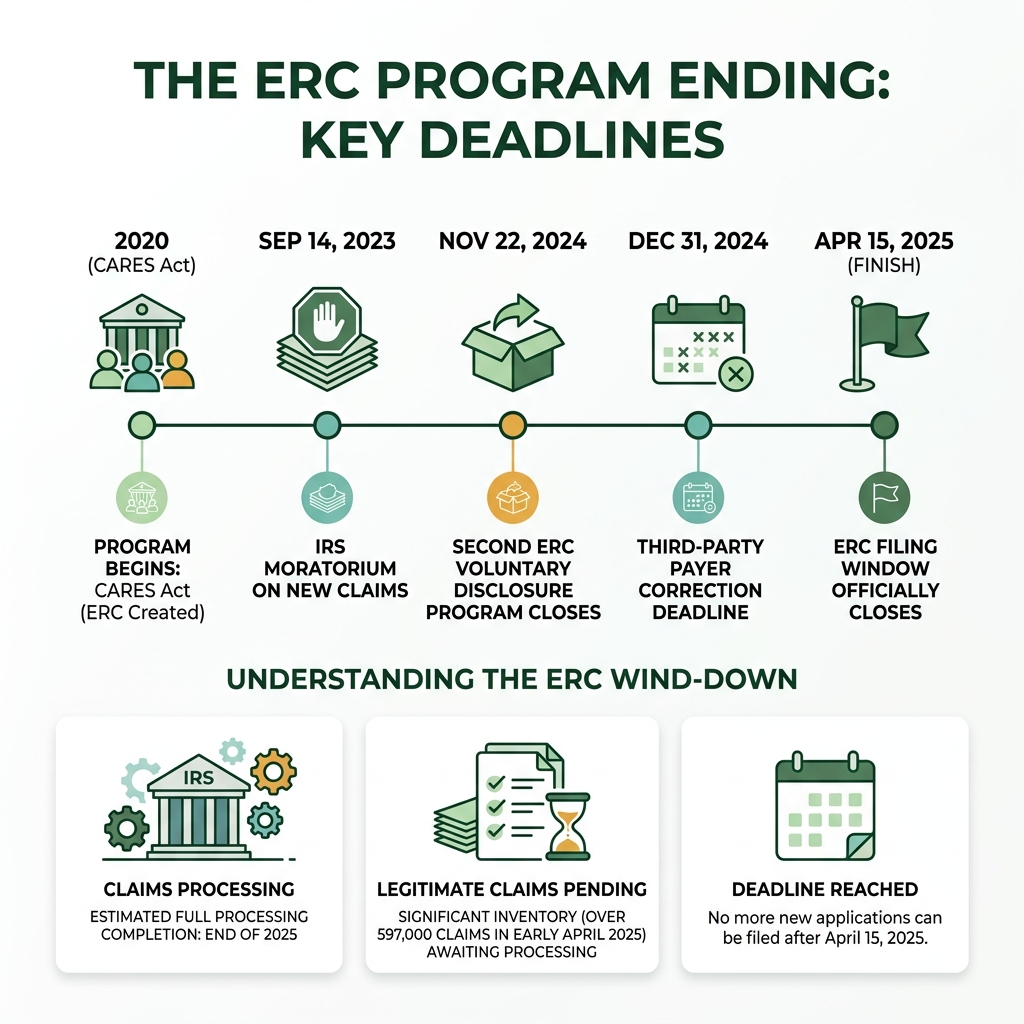
The erc program ending is now official — the window to file new Employee Retention Credit claims closed on April 15, 2025. Here’s a fast summary of what that means for your business:
| Key Event | Date |
|---|---|
| ERC filing window closes | April 15, 2025 |
| Second ERC Voluntary Disclosure Program closes | November 22, 2024 |
| Third-party payer correction deadline | December 31, 2024 |
| IRS moratorium on new claims began | September 14, 2023 |
| Estimated full processing completion | End of 2025 |
The ERC was created under the CARES Act to help businesses keep employees on payroll during the COVID-19 pandemic. For eligible businesses, it offered a powerful refundable tax credit — sometimes worth hundreds of thousands of dollars.
But the road to actually getting that money has been anything but smooth.
Aggressive marketing by third-party promoters led to a flood of questionable claims. The IRS responded with a processing moratorium, voluntary disclosure programs, and disallowance notices. Meanwhile, over 597,000 legitimate claims are still sitting in the IRS’s inventory as of early April 2025 — with some businesses waiting years for a refund they’re rightfully owed.
If you filed a claim and haven’t been paid yet, the clock is still ticking — and knowing your options matters more than ever.
I’m Santino Battaglieri, founder of SFG Capital, a firm that has purchased and funded over $500 million in ERC claims and helped businesses navigate the full arc of the erc program ending — from eligibility analysis to structured funding solutions. In the sections below, I’ll walk you through every critical deadline, resolution option, and IRS process you need to understand right now.
Basic erc program ending glossary:
Understanding the ERC Program Ending and Final Deadlines

For many business owners in Travis County, the Employee Retention Credit felt like a lifeline that suddenly turned into a maze. The erc program ending isn’t just a single date on a calendar; it’s a series of shutters closing on different parts of the program.
The most significant milestone was April 15, 2025. This was the final deadline for businesses to file amended employment tax returns (Form 941-X) to claim the credit for 2021 tax periods. While the window for 2020 claims closed a year earlier, this final date effectively ended the era of “new” ERC applications.
The IRS has been very clear: IRS moves forward with Employee Retention Credit claims but with extreme caution. This caution was sparked by a “perfect storm” of aggressive marketing by “ERC mills” and a massive influx of ineligible claims that forced the agency to implement a moratorium on processing new claims starting September 14, 2023.
If you are still waiting on a check, you aren’t alone. You can find more details on how to manage these timelines in our guide on 2025 ERC Deadlines and How to Beat the IRS Clock.
Why the erc program ending matters for 2021 claims
The transition into the erc program ending phase is critical because of the statute of limitations. Once the deadline passes, you generally cannot go back and ask for more money, even if you realize later that you were eligible for a higher amount.
For 2021 claims, the stakes were higher because the credit amounts were more generous—up to $7,000 per employee per quarter for the first three quarters of the year. Businesses that missed the April 2025 cutoff have effectively lost the right to claim those funds. If you’ve already filed, your focus shifts from “applying” to “surviving the wait.” For a deeper dive into the mechanics of these final dates, check out The 2025 ERC Application Deadlines Survival Guide.
Legislative shifts and the Tax Relief for American Families and Workers Act
It’s important to note that the erc program ending almost happened much sooner than April 2025. In early 2024, Congress considered the Tax Relief for American Families and Workers Act of 2024. This proposal sought to move the filing deadline up to January 31, 2024, retroactively.
The logic was simple: lawmakers wanted to use the “savings” from ending the ERC early to fund other tax priorities, like expanding the Child Tax Credit and reviving R&D tax breaks. While the retroactive January deadline didn’t ultimately become law in that specific form, the sentiment was clear—lawmakers may look to prematurely end ERC shortly after the enactment of the legislation to curb fraud. This legislative pressure is a big reason why the IRS has become so much more aggressive with audits and disallowances.
Resolving Improper Claims: VDP and Withdrawal Options
As the erc program ending approached, the IRS realized that many well-meaning business owners had been talked into filing improper claims by shady consultants. To help these businesses “come clean” without facing the full wrath of an audit, the IRS introduced the Voluntary Disclosure Program (VDP).
The VDP was a rare “get out of jail relatively cheap” card. It allowed businesses that received an ERC refund in error to pay back a portion of the money in exchange for a release from future audits on those specific tax periods. For many in Travis County who realized their “consultant” might have stretched the truth about their eligibility, this was the best way to sleep at night.
You can learn more about the urgency of these programs in our article ERC Claim Deadline: What You Need to Know Now.
Benefits of the now-closed second ERC-VDP
The second ERC-VDP, which closed on November 22, 2024, offered a 15% discount on repayment. This meant businesses only had to repay 85% of the credit they received. Why the discount? The IRS acknowledged that many businesses paid high fees to promoters, so they let the business keep 15% to help cover those lost costs.
The benefits were massive:
- No Interest or Penalties: The IRS waived the usual interest and penalties that come with underpaying taxes.
- Audit Protection: Settling through the VDP meant the IRS would not audit the ERC claim for those periods.
- No Amended Returns: Participants didn’t have to go through the headache of amending their income tax returns to adjust for the wage expenses they had previously deducted.
If you missed this window, the IRS still provides an ERC-VDP information page, but the terms for resolving errors now are likely to be much more stringent. You should still use the determining eligibility on the IRS website to see if your past claim stands up to scrutiny.
How to withdraw a claim after the erc program ending
If you filed a claim but haven’t received the money yet—and you’ve started to have second thoughts about your eligibility—you don’t necessarily need a disclosure program. You can use the IRS withdrawal process.
Withdrawal is the best option for businesses that:
- Filed a claim but haven’t received a refund.
- Received a check but haven’t cashed or deposited it.
- Realize they were ineligible (perhaps they didn’t actually have a “nominal effect” from a government order).
By withdrawing, you treat the claim as if it never happened, which protects you from penalties and interest. If you’re wondering if the IRS is even still looking at these, the answer is a resounding yes. See our analysis on Is the IRS ERC Program Still Accepting Claims? for more on the current state of the queue.
Navigating the IRS Backlog and Disallowance Notices
The current state of the erc program ending is defined by one word: backlog. As of early April 2025, over 597,000 ERC claims remained in the IRS inventory. Even though the filing window is closed, the processing window is wide open and moving at a snail’s pace.
Earlier in the process, the numbers were even more staggering. At one point, the IRS still had 1,057,000 unprocessed Forms 941-X to review and analyze. To deal with this, the IRS has been converting paper returns into digital formats to use AI and automated filters to catch “red flag” claims.
Realistically, it could take until the end of 2025 for the IRS to finish this work. For a detailed breakdown of what this means for your wait time, see A Comprehensive Guide to 2026 ERC and 941-X Processing Times.
Understanding Letter 105-C and Letter 106-C
If the IRS decides your claim doesn’t pass muster, you won’t get a phone call—you’ll get a letter. These are the two most common “rejection” notices.
| Notice Type | What it Means | Your Next Step |
|---|---|---|
| Letter 105-C | Full Disallowance: The IRS has rejected your entire ERC claim. | You have 30 days to protest the decision or file an appeal. |
| Letter 106-C | Partial Disallowance: The IRS has approved part of your claim but rejected another part. | You can accept the partial amount or protest the disallowed portion. |
Receiving a Letter 105-C can be heart-stopping, but it isn’t always the final word. Many of these letters are issued because of simple documentation gaps. If you get one, you need to act fast. You can find more details on Understanding your Letter 106-C, Employee Retention Credit to see how to respond.
Protecting taxpayer rights during the erc program ending
The National Taxpayer Advocate has expressed concern that the IRS’s aggressive stance on the erc program ending might be trampling on taxpayer rights. Specifically, the IRS has been criticized for issuing “template” disallowance notices that don’t explain why a claim was rejected, making it impossible for a business to defend itself.
To protect yourself, you should be aware of:
- Fast Track Appeals: A process designed to resolve disputes quickly without a full-blown court case.
- Form 907: This form is used to extend the statute of limitations. If your protest is stuck in the system for more than two years, the IRS is legally barred from issuing a refund unless you have an extension like Form 907 in place.
- Taxpayer Advocate Service (TAS): If you are facing extreme financial hardship because of the delay, the TAS may be able to help expedite your case.
Frequently Asked Questions about the ERC Program Ending
Can I still file a new ERC claim today?
Technically, no. The filing window for 2020 claims closed on April 15, 2024, and the window for 2021 claims closed on April 15, 2025. If you haven’t filed by now, the erc program ending has officially moved past the application phase. The only exception would be for very specific “protective claims” filed earlier to toll the statute of limitations.
What should I do if I receive an ERC disallowance notice?
Don’t panic, but do act. You typically have 30 days to file a formal protest. Gather all your evidence—government orders that affected your business, gross receipts records showing a decline, and payroll data. If the IRS notice is vague, you have the right to ask for a more detailed explanation of the disallowance.
How long will it take the IRS to process the remaining backlog?
The IRS Commissioner has indicated that processing the nearly 600,000 remaining claims will likely continue through the end of 2025. They are prioritizing the oldest claims and those that involve financial hardship, but the “complex” nature of these audits means the wait remains long.
Conclusion
The erc program ending represents the closing of a major chapter in pandemic relief. While the deadlines to apply have passed, the struggle to actually receive those funds—or to defend the claims you’ve already made—is still very much alive for businesses across Travis County.
At SFG Capital, we understand that waiting until the end of 2025 for a refund isn’t an option for every business. We help Austin-based companies navigate this final phase by offering ERC refund advances and claim buyouts. If you have a legitimate claim stuck in the IRS backlog, we can provide immediate liquidity so you don’t have to wait on the government’s timeline.
We operate on a performance-based fee structure, meaning we only succeed when you do. Whether you need an advance to fuel your growth or expert assistance in reviewing your claim’s eligibility before an audit hits, we are here to help.