
Why Your ERC Refund is Critical for Business Cash Flow Right Now
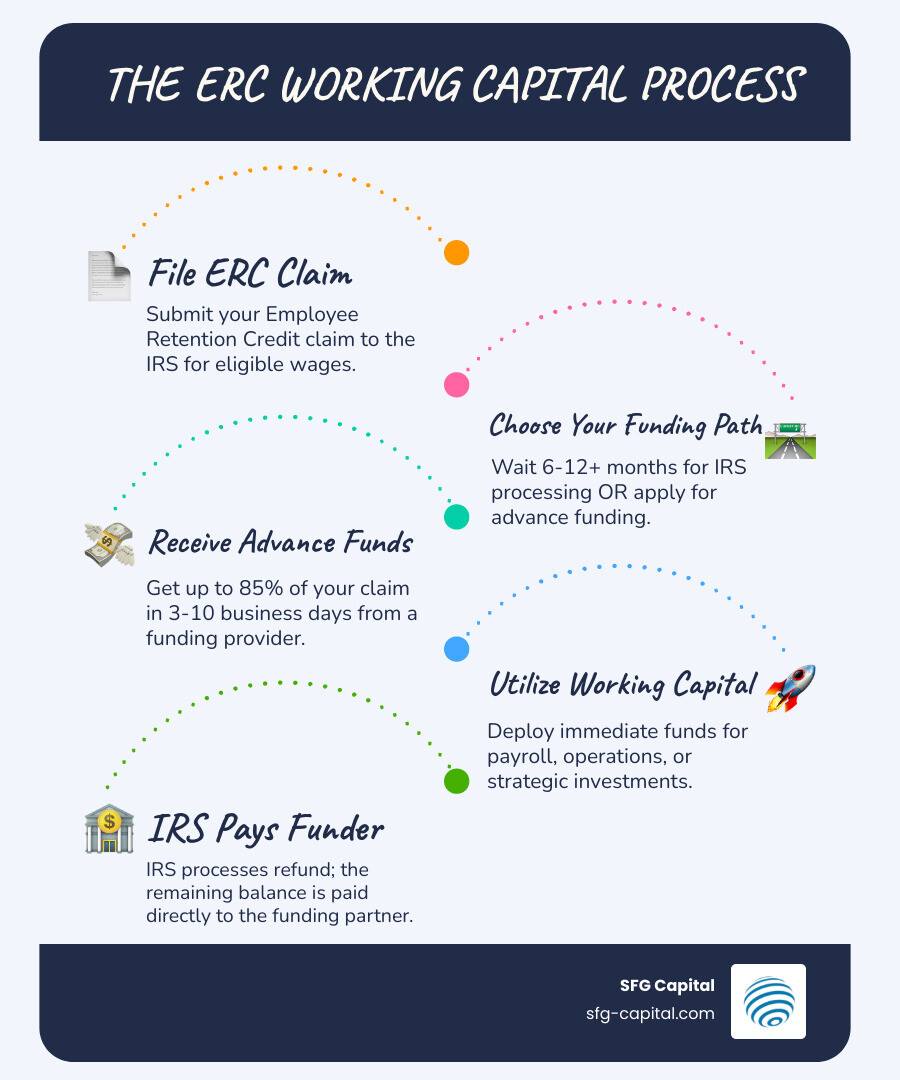
ERC working capital is the immediate, usable cash flow a business can access by converting its pending Employee Retention Credit refund into funds today, rather than waiting months or years for the IRS to process the claim. Here’s what you need to know:
Quick Answer: Accessing ERC Working Capital
- What it is: Converting your future ERC refund into immediate cash (typically up to 85% of claim value)
- Why it matters: IRS processing delays now average 6-12+ months, creating severe cash flow gaps
- How to access it: Through ERC advance funding programs that purchase your tax credit claim
- Timeline: Receive funds in 3-10 business days vs. waiting months for the IRS
- Key requirement: Most programs require a minimum ERC claim of $100,000
The Employee Retention Credit was designed to reward businesses that kept employees on payroll during COVID-19. It’s a refundable payroll tax credit worth up to $26,000 per employee for qualifying wages paid between March 2020 and December 2021.
But here’s the problem: the IRS is severely backlogged. Many businesses that filed ERC claims in 2022 are still waiting for their refunds in 2024. Some have waited over a year with no resolution in sight.
This creates a painful cash flow gap. You did everything right—retained employees and filed the paperwork—but you can’t access the money you’re owed to pay vendors, cover payroll, or invest in growth.
That’s where ERC working capital solutions come in. Instead of waiting indefinitely for the IRS, businesses can work with specialized funding providers to convert their pending ERC refund into immediate cash. This isn’t a loan—it’s the sale of a future asset, your tax credit receivable, in exchange for working capital today.
I’m Santino Battaglieri, and through SFG Capital, I’ve helped businesses access over $500 million in ERC working capital. My approach helps eligible businesses convert their ERC claims into usable funds quickly, without adding debt to their balance sheet.
What is the ERC and How Does It Impact Your Working Capital?
The Employee Retention Credit (ERC), part of the CARES Act, is a refundable payroll tax credit. It was designed to incentivize employers in places like Austin and Travis County to keep their teams employed when operations were disrupted by the COVID-19 pandemic.

In simple terms, if your business experienced a significant decline in gross receipts or faced a full or partial suspension of operations due to government orders, you likely qualify for this credit. It’s a credit against certain employment taxes, and crucially, it’s refundable, meaning any excess credit beyond your tax liability is paid back to you as a refund. The maximum credit per employee can be up to $26,000, broken down as $5,000 for 2020 and $21,000 for 2021. For a more comprehensive understanding, our ERC Credit Complete Guide offers detailed insights.
The Waiting Game: Why Your ERC Refund is Tied Up
While the ERC was a guide of hope for many, the reality of receiving those funds has been a frustrating waiting game. The IRS, overwhelmed by the sheer volume of submissions—including some potentially fraudulent ones—implemented a moratorium on processing new claims and an “improved compliance review” procedure. This has led to massive backlogs, with many businesses waiting 6-12 months, or even longer, for their refunds. We’ve seen submissions from as far back as 2022 still awaiting IRS processing in 2024.
Imagine planning your business’s future around a significant refund, only to have it tied up indefinitely. This delay creates a substantial cash flow gap, impacting everything from daily operations to investment opportunities. For businesses in Austin and Travis County striving to recover and grow, this situation can be incredibly stressful. We understand this struggle, which is why we’ve put together insights on Understanding and Overcoming ERC Refund Delays.
How ERC Relates to Your Business’s Working Capital
Working capital is the lifeblood of any business. It’s the difference between your current assets (cash, accounts receivable, inventory) and your current liabilities (accounts payable, short-term debts). A healthy working capital position means you have enough liquidity to cover day-to-day operational costs, manage unexpected expenses, and seize growth opportunities.
Your pending ERC refund, while delayed, is a significant asset on your balance sheet—it’s a receivable. However, if you can’t access it, its value as immediate ERC working capital is diminished. This is where the ERC program, despite its delays, can still be a powerful tool. By converting this future receivable into immediate cash, you can bridge those critical cash flow shortages, fund payroll, pay vendors, and keep your business running smoothly. It transforms a theoretical asset into tangible, usable funds, directly impacting your business’s ability to operate and thrive. For more insights on how to manage this, check out our guide to working capital solutions.
How to Access Your ERC Working Capital in Days, Not Months
Waiting for the IRS to process your ERC refund, which can take 6-12 months or longer, is not feasible for many businesses in Austin and Travis County that need funds now.

This is precisely why specialized ERC advance funding solutions have emerged. These programs allow businesses to access their ERC working capital much faster, often open uping up to 85% of their anticipated ERC claim upfront. Instead of waiting indefinitely, you can receive funds in days, not months. This expedited access is crucial for businesses looking to maintain stability and pursue growth without being held hostage by government backlogs. We specialize in Expediting Your ERC Refund to help you steer these challenges.
Understanding Your Funding Options: Advance Funding
When it comes to accessing your ERC funds faster, you’ll primarily encounter two main types of solutions: ERC advances (also known as buyouts) and ERC bridge loans. While they both aim to provide quick access to cash, their fundamental structures are quite different, and understanding these differences is key for your business.
ERC Advance (or Buyout): An Asset Purchase, Not a Loan
An ERC advance is structured as an outright purchase of your anticipated ERC refund. We, as the funding provider, essentially buy your ERC receivable from you for a discounted price. This is a crucial distinction: it’s not a loan. This means:
- No Debt Liability: Since it’s an asset purchase, it doesn’t add debt to your balance sheet. This can be a huge advantage for businesses that want to avoid increasing their liabilities or impacting their credit scores.
- No Repayment: Once we purchase the credit, you don’t have to worry about making monthly payments. We assume the risk and the wait for the IRS refund.
- Performance-Based Fees: Our fees are typically structured as a percentage of the advanced amount, and they are usually netted off within the transaction, meaning no out-of-pocket costs for you.
- Speed: Pre-approval decisions can be made in as little as 72 hours, with funds disbursed typically within 7-10 business days from an accepted offer. In a perfect scenario, some businesses can receive funding in as little as 3 days.
ERC Bridge Loan: A Debt-Based Solution
An ERC bridge loan, as the name suggests, is a traditional loan. It uses your anticipated ERC refund as collateral.
- Debt Creation: This adds debt to your balance sheet, and you will have an obligation to repay the loan with interest.
- Repayment: You typically make monthly interest-only remittances until the IRS refund is received, at which point the loan is repaid in full.
- Interest Rates: While some bridge loans might offer competitive rates (as low as 2% in some cases), they still carry an interest burden.
- Speed: Similar to advances, bridge loans can also offer quick approval and funding times, often within 1-2 weeks.
For businesses in Austin and Travis County, the choice between an advance and a loan often comes down to their comfort with debt and their desire for a cleaner balance sheet. Many prefer the ERC advance because it provides the immediate ERC working capital without the burden of a new loan. Our ERC Advance Funding focuses on this asset-purchase model.
Here’s a quick comparison:
| Feature | ERC Advance (Buyout) | ERC Bridge Loan |
|---|---|---|
| Debt Creation | No (asset purchase) | Yes (debt liability) |
| Repayment | No repayment obligation | Yes, with interest |
| Speed | Typically 3-10 business days to fund | Typically 1-2 weeks to fund |
| Cost Structure | Discount fee (percentage of advanced amount) | Interest rates + potential fees |
| Balance Sheet | Cleaner, no new liabilities | Adds debt, impacts debt-to-equity ratio |
The Step-by-Step Process to Get an ERC Advance
Getting your hands on that much-needed ERC working capital doesn’t have to be complicated. We’ve streamlined our process to be as efficient and transparent as possible for businesses in Austin and Travis County:
- Initial Contact & Application: It all starts with a simple conversation. You reach out to us, and we guide you through a quick application process. This helps us understand your business and your ERC claim.
- Documentation Submission: We’ll request key documents to verify your ERC claim and perform our due diligence. This typically includes IRS Forms 941 and 941-X, business tax returns, profit & loss statements, and bank statements (more on this below).
- Underwriting & Verification: Our team of experts reviews your submitted documents to validate the accuracy and eligibility of your ERC claim. This thorough underwriting process is crucial to minimize the risk of future disallowance by the IRS and ensures we only transact high-quality, well-supported submissions. This is where our expertise in tax credits truly shines.
- Receiving an Offer: Once our review is complete, we’ll provide you with a clear, non-binding offer for an ERC advance, outlining the percentage of your claim we can fund and the associated fee. You’ll know exactly what to expect.
- Funding & Disbursement: Upon your acceptance of the offer, we finalize the agreement. The funding timeline for an ERC advance can be remarkably fast – often as little as 3-5 business days from initial contact to funds disbursed in a perfect scenario, or typically 7-10 business days from accepted offer to funds disbursed. We can even fund one quarter of an ERC claim today and another quarter in a month’s time, offering flexibility.
Our goal is to get you the cash you deserve quickly, allowing you to focus on running and growing your business. You can learn more about our process on our ERC Advance Funding page.
Qualifying for an ERC Advance
While the ERC program was broadly available, ERC advance programs, like ours, have specific criteria to ensure we’re funding legitimate and verifiable claims. For businesses in Austin and Travis County, understanding these requirements upfront can save you time and streamline the process.
Eligibility Criteria for ERC Funding Programs
Generally, to qualify for an ERC advance or buyout program with a reputable provider, your business will need to meet several key criteria:
- Minimum ERC Claim Amount: Most providers, including us, typically require a minimum ERC claim of $100,000. This threshold ensures the advance is substantial enough to make a meaningful impact on your working capital.
- Filed ERC Claim: You must have already filed your Employee Retention Credit claim with the IRS, specifically using IRS Form 941-X. Proof of filing and tracking numbers are often required.
- Operational and Solvent Business: Your business must be financially solvent and actively operational. We’re looking to support thriving businesses, not those on the brink of closure.
- No Bankruptcies or Felony Convictions: Business owners should be free of active bankruptcies or felony convictions. This is a standard requirement for most financial services.
- No Tax Liens or Judgments: While some flexibility might exist, generally, a clean record regarding tax liens or judgments is preferred.
These criteria help us ensure the validity of your claim and our ability to successfully retrieve the refund from the IRS. For more details on overall ERC eligibility, you can refer to What is ERC Funding?.
Documentation Needed to Secure Your ERC Working Capital
To expedite your ERC advance, having your documentation ready is paramount. The more organized you are, the faster we can process your application and get you your funds. Here’s a list of documents typically required:
- IRS Form 941s and 941-Xs: For each quarter claimed, with proof of filing and tracking numbers. These are critical as they are your official claim documents.
- Profit & Loss (P&L) Statements: For 2019-2021, and sometimes for the current year. These help us understand your business’s financial performance during the eligibility periods.
- Balance Sheets: Providing a snapshot of your assets, liabilities, and equity.
- Business Tax Returns: Copies of your business tax returns from 2019-2022.
- Previous Three Months’ Bank Statements: To assess cash flow and operational activity.
- Identification: For all 20% or greater shareholders (e.g., Driver’s License or Passport).
- IRS Form W-9: For the authorized signer.
- Copies of Articles of Incorporation and Bylaws, or Operating Agreement: To verify business legal structure.
- Voided Check: For direct deposit of funds.
- IRS Form 8821 and 7216 Consent Forms: These allow us to communicate with the IRS on your behalf regarding your claim.
Gathering these documents proactively will significantly speed up the process of converting your pending ERC refund into usable ERC working capital.
Navigating Risks and Choosing a Reputable Provider
The beneficial Employee Retention Credit program has unfortunately attracted opportunistic “ERC mills” and fraudulent actors. The IRS has warned about promoters who oversimplify eligibility, leading to incorrect claims and potential audits. For businesses in Austin and Travis County, it’s crucial to approach ERC advances with caution and due diligence. Our commitment is to ensure you receive expert Employee Retention Credit Help that is compliant and secure.
The Risks and Benefits of Accessing ERC Working Capital
Like any financial decision, accessing your ERC working capital through an advance comes with both risks and benefits:
Benefits:
- Immediate Cash Injection: The most obvious benefit is getting immediate access to capital that would otherwise be tied up for months or years. This can be a game-changer for managing cash flow.
- No Debt Added: As an asset purchase, an ERC advance doesn’t add debt to your balance sheet, preserving your borrowing capacity for other needs.
- Risk Mitigation: By selling your receivable, you transfer the risk of IRS delays and the administrative burden of waiting to the funding provider.
- Business Stability: Immediate funds can help you pay employees, manage operations, invest in growth, or address cash shortages without stress.
Risks:
- Cost of the Advance: The fee for an ERC advance reduces the total amount you ultimately receive from your ERC claim. You’re paying for the speed and convenience.
- Potential for Claim Reduction or Denial: While reputable providers conduct thorough underwriting, there’s always a slight risk that the IRS might later reduce or deny a claim. If a claim is completely disallowed, the transaction may need to be unwound, though we work to dispute such denials. This is why choosing a provider who underwrites properly and stands by you is critical.
- Selling the Entire Claim: Some providers may require you to sell all of your ERC credits because the IRS does not allow different quarters to be sent to different addresses. This means you commit the entire claim to one provider.
Understanding these factors allows you to make an informed decision that aligns with your business’s financial strategy.
How to Ensure You’re Working with a Trusted ERC Partner
In a landscape filled with both legitimate and questionable ERC providers, choosing a trusted partner is paramount. Here’s what businesses in Austin and Travis County should look for:
- Transparency in Fees and Process: A reputable provider will clearly outline their fees, the percentage of your claim they can advance, and the entire process from application to funding. There should be no hidden costs or vague terms.
- Expertise in Tax Credits: Look for partners with deep knowledge of tax regulations and a proven track record in ERC. They should be able to explain the nuances of your claim and conduct thorough due diligence. Our Employee Retention Credit Specialist Guide provides an overview of what true expertise looks like.
- Avoid High-Pressure Sales Tactics: Be wary of providers who promise unrealistic timelines or guarantee funding without proper vetting. A legitimate process involves careful review and verification.
- Clear Underwriting Process: A good partner will perform rigorous underwriting to ensure the validity of your ERC claim. This protects both you and the funding provider from potential IRS scrutiny down the line. They should be able to explain their due diligence process.
- Focus on Compliance: The IRS is scrutinizing claims. A trusted partner will prioritize compliance and help you ensure your original ERC claim was correctly filed and supported by documentation. We understand the IRS’s posture and ensure our process aligns with the highest standards.
We pride ourselves on being a transparent, expert-driven partner for businesses seeking to open up their ERC working capital.
Strategically Using ERC Funds to Strengthen Your Business
Once you’ve successfully accessed your ERC working capital, the possibilities for strengthening your business are vast. These funds aren’t restricted like some loans; they’re yours to deploy strategically where they’ll have the greatest impact on your operations and growth.
How to leverage your ERC working capital for growth
For businesses in Austin and Travis County, this influx of cash can be a catalyst for significant advancement:
- Managing Payroll and Operations: The most immediate use is often to cover ongoing payroll, rent, utilities, and other operational expenses, especially when facing cash shortages due to slow customer payments or seasonal dips. This ensures business continuity and keeps your team intact.
- Paying Vendors and Suppliers: Prompt payment to vendors can strengthen relationships, potentially leading to better terms, discounts, and a more reliable supply chain.
- Investing in Marketing and Sales: A robust marketing campaign can drive new customer acquisition and revenue growth. Your ERC funds can fuel these initiatives.
- Purchasing Equipment and Technology: Upgrading outdated equipment or investing in new technology can boost efficiency, productivity, and competitiveness.
- Expanding Operations: Whether it’s opening a new location, increasing production capacity, or expanding service offerings, ERC working capital can provide the necessary capital for expansion.
- Paying Down High-Interest Debt: Reducing existing high-interest debt can significantly improve your business’s financial health, freeing up cash flow in the long run.
- Hiring Key Talent: Bringing in new employees with specialized skills can be crucial for innovation and scaling your business.
- Seizing Market Opportunities: Sometimes, a unique opportunity arises—a chance to acquire a competitor, secure a large contract, or invest in a new product line. Having readily available working capital allows you to act quickly.
We’ve seen our clients use their funds for all these purposes, changing a pending credit into tangible business growth. Our insights on Funding Growth: How ERC Can Power Your Business Forward dig deeper into these strategies.
Long-term financial implications of using ERC working capital
The strategic use of ERC working capital can have profound long-term financial implications for your business:
- Improved Liquidity: Consistently having enough cash on hand means your business is more resilient to economic fluctuations and unexpected challenges.
- Strengthened Balance Sheet: By avoiding new debt and potentially reducing existing liabilities, your balance sheet becomes stronger, making your business more attractive to future investors or lenders.
- Avoiding High-Interest Debt: Accessing ERC funds today can prevent the need to take on expensive, short-term loans or merchant cash advances, saving you significant interest costs over time.
- Fueling Sustainable Growth: By investing in areas like technology, talent, and expansion, you’re building a foundation for sustainable, long-term growth rather than just surviving.
- Improved Financial Stability: Knowing you have a reliable source of funds to manage operations and seize opportunities provides peace of mind and allows for better long-term planning.
Accessing your ERC funds efficiently helps convert a past benefit into future prosperity for your business.
Frequently Asked Questions about ERC Working Capital
We often hear similar questions from business owners in Austin and Travis County exploring their options for ERC working capital. Here are some of the most common ones:
How is an ERC advance different from an ERC loan?
This is a critical distinction. An ERC advance is the sale of your future tax credit. It’s an asset sale, not a loan, so it does not add debt to your balance sheet, and you have no repayment obligation. We assume the wait for the IRS.
An ERC loan, on the other hand, is a traditional form of debt. While it uses your anticipated refund as collateral, you are borrowing money and must repay it with interest. This adds a liability to your balance sheet. Our approach favors the advance model to help you maintain a healthier financial position.
How long does it typically take to receive funds through an ERC advance?
Timelines vary, but funds can be disbursed remarkably quickly. While a perfect scenario is 3-5 business days from initial contact, it typically takes 7-10 business days from an accepted offer to funds disbursed. This is a stark contrast to waiting months or even years for the IRS to process your refund.
What are the risks of accessing my ERC credits for immediate cash?
The primary risk associated with an ERC advance is that the fee paid for the speed and convenience reduces the total amount of the credit you ultimately receive. You’re effectively paying a discount for immediate liquidity.
There’s also a potential, though rare with proper vetting, risk if your original ERC claim is later reduced or denied by the IRS. This is precisely why working with a reputable funder who performs thorough underwriting and due diligence on your claim is absolutely crucial. Our rigorous process aims to minimize this risk by only funding well-supported claims and assisting clients if any disputes arise with the IRS.
Conclusion
The Employee Retention Credit was a vital lifeline for businesses, but prolonged IRS processing delays have created new challenges, turning a promised benefit into a frustrating wait.
This is where ERC working capital solutions become indispensable. By converting your future ERC refund into present-day cash through an advance or buyout, you transform a pending asset into immediate, usable funds. This strategic move allows businesses in Austin and Travis County to bypass IRS delays, maintain robust cash flow, and proactively invest in their future. It’s about taking control of your financial destiny, rather than passively waiting.
At SFG Capital, we’re dedicated to helping eligible businesses like yours open up this crucial capital quickly and efficiently. Our structured, compliance-focused funding solutions are designed to provide you with the ERC working capital you need, without adding debt to your balance sheet. Don’t let IRS backlogs hold your business back.