
Understanding the Employee Retention Credit: Your Gateway to COVID-19 Relief Funds
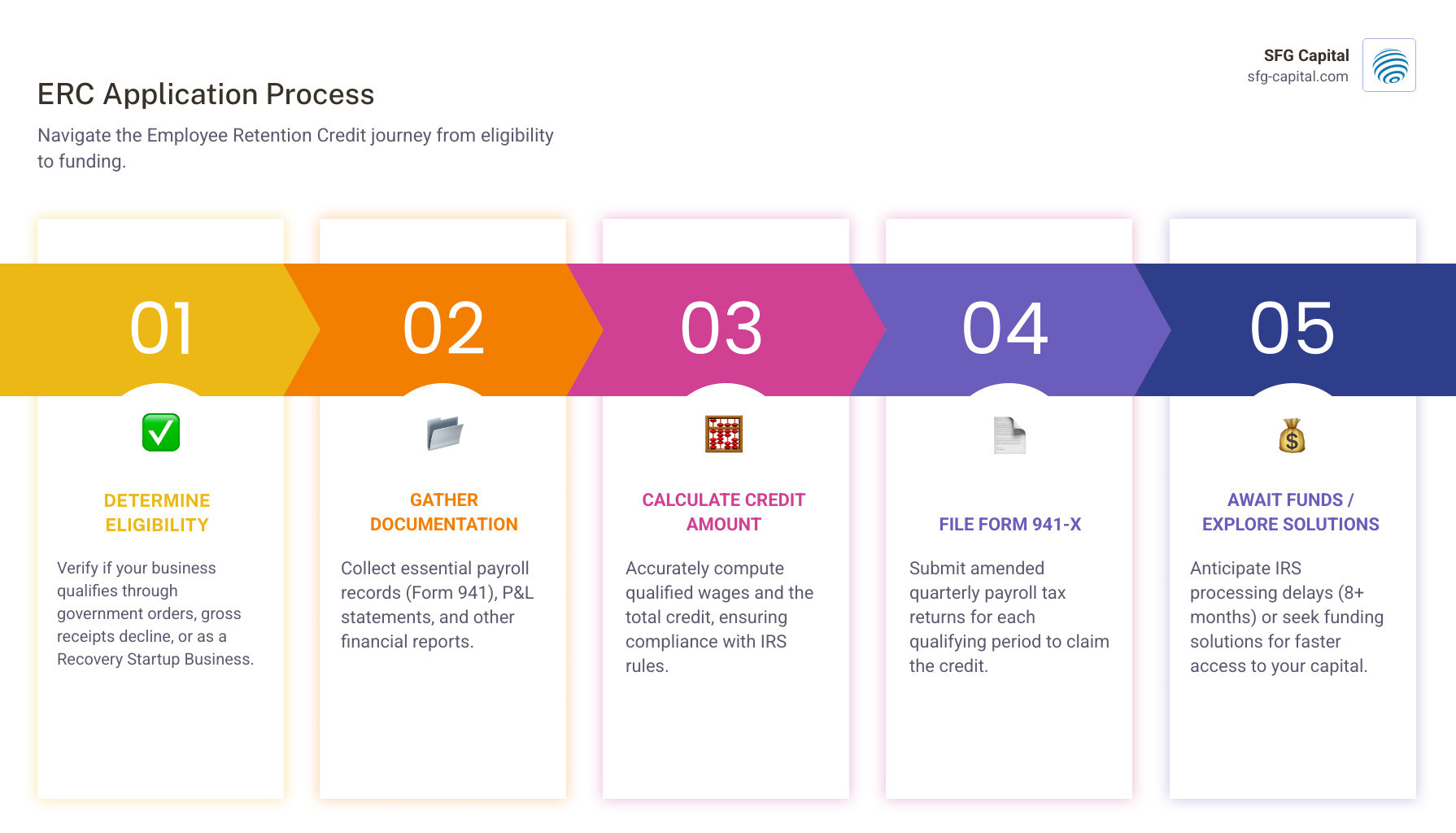
Apply ERC credit by following these essential steps:
- Determine eligibility – Check if your business meets government shutdown, gross receipts decline, or Recovery Startup Business criteria
- Gather documentation – Collect Form 941 payroll tax forms, profit/loss statements, and payroll reports
- Calculate qualified wages – Determine eligible wages (excluding PPP-covered wages and owner compensation)
- File Form 941-X – Submit amended quarterly tax returns for each qualifying period
- Mail to IRS – Send completed forms to the appropriate IRS processing center (Ogden, Utah or Cincinnati, Ohio)
The Employee Retention Credit (ERC) is a refundable tax credit established under the CARES Act to help businesses that retained employees during the COVID-19 pandemic. Available for qualified wages paid between March 13, 2020, and December 31, 2021, this credit can be worth thousands or even millions of dollars for eligible businesses.
However, the path to claiming your ERC isn’t straightforward. The IRS suspended acceptance of new ERC claims until at least December 31, 2023, due to concerns about program integrity. Currently, the IRS is processing approximately 400,000 claims valued at about $10 billion, with refund wait times extending beyond eight months.
The stakes are high. Incorrectly claiming the ERC can result in repayment with interest and penalties, while underclaiming means leaving money on the table that your business has already earned. The IRS has also issued warnings about ERC scams and unscrupulous promoters taking advantage of confused business owners.
Despite these challenges, legitimate businesses that qualify for the ERC deserve to receive these funds. Whether your operations were suspended by government orders, you experienced a significant decline in gross receipts, or you qualify as a Recovery Startup Business, understanding the application process is crucial.
I’m Santino Battaglieri, and through SFG Capital, I’ve helped businesses steer over $500 million in ERC claims with a compliance-driven approach that prioritizes accurate eligibility analysis and proper documentation when businesses apply ERC credit. This guide will walk you through the complete process, from determining eligibility to filing your claim and understanding your options for accessing funds faster than standard IRS timelines.
Decoding Your ERC Eligibility: Are You Qualified?

Before you can even think about how to apply ERC credit, the very first step is to definitively determine if your business qualifies. This isn’t a one-size-fits-all scenario; eligibility is based on specific criteria tied to the economic impacts of the COVID-19 pandemic. There are three primary paths to ERC eligibility:
- Government Order Suspension: Your business operations were fully or partially suspended due to a government order limiting commerce, travel, or group meetings due to COVID-19. This means a government authority (federal, state, or local) imposed restrictions that impacted your ability to operate as usual.
- Significant Decline in Gross Receipts: Your business experienced a significant decline in gross receipts during specific quarters in 2020 or 2021 compared to the same quarter in 2019. We’ll dive into the specifics of this decline shortly, as the percentages vary between years.
- Recovery Startup Business (RSB): For the third and fourth quarters of 2021, if your business started after February 15, 2020, and meets certain gross receipts thresholds, you might qualify as an RSB, even if you didn’t experience a suspension or gross receipts decline. RSBs are limited to a maximum of $50,000 in ERC per quarter.
It’s crucial to approach eligibility with caution. The IRS has been very clear about concerns regarding improper claims, and we strongly advise reviewing the official IRS Eligibility Checklist to guide your initial assessment. For instance, a common misconception is that supply chain disruptions alone qualify a business. The IRS clarifies that a supply chain disruption by itself doesn’t qualify you; you must carefully review if a government order impacting your suppliers meets the criteria.
Key Differences: 2020 vs. 2021 Rules
The ERC program evolved, meaning the rules for 2020 and 2021 have distinct differences that impact eligibility and the credit amount. It’s like comparing apples and oranges, but both are fruit!
| Feature | 2020 Rules (Qualified Wages: March 13 – Dec 31, 2020) | 2021 Rules (Qualified Wages: Jan 1 – Dec 31, 2021) |
|---|---|---|
| Eligibility | 50% decline in gross receipts vs. same 2019 quarter | 20% decline in gross receipts vs. same 2019 quarter (or previous quarter for Q1) |
| Employee Limit | 100 full-time employees in 2019 | 500 full-time employees in 2019 |
| Wage Cap | $10,000 annual qualified wages per employee | $10,000 quarterly qualified wages per employee |
| Credit Rate | 50% of qualified wages | 70% of qualified wages |
| Maximum Credit | $5,000 per employee per year | $7,000 per employee per quarter ($21,000 for Q1-Q3 2021) |
| RSB Eligibility | Not applicable | Eligible for Q3 and Q4 2021 only, max $50,000 per quarter |
For 2020, your business is generally eligible if it experienced a 50% gross receipts decline in a calendar quarter compared to the same quarter in 2019, or if operations were fully or partially suspended by a government order. For 2021, the gross receipts decline threshold drops to 20%. This means more businesses could qualify in 2021.
Determining Your Eligibility Status
Let’s break down how to specifically nail down your eligibility. This requires a diligent review of your business’s financial and operational history during the pandemic period.
- Gross Receipts Test: To qualify based on a decline in gross receipts, you need to compare your quarterly gross receipts for 2020 and 2021 to the corresponding quarters in 2019. For 2020, a 50% drop in a quarter compared to 2019’s comparable quarter makes you eligible. For 2021, it’s a 20% drop. You can also use the immediately preceding quarter to qualify for 2021 (e.g., Q1 2021 eligibility can be based on Q4 2020 vs. Q4 2019 gross receipts).
- Government Shutdown Test: Did a government order mandate a full or partial suspension of your business operations? This could include capacity restrictions, closures of certain business activities (like dining in), or curfews. Documentation of these orders and how they impacted your operations is key. A partial suspension means that a government order limited your ability to conduct business, even if you weren’t fully shut down.
- Recovery Startup Business (RSB) Criteria: If your business began operations after February 15, 2020, and its average annual gross receipts for the three preceding tax years (or the period it was in existence) do not exceed $1 million, you might be an RSB. This path is specifically for the third and fourth quarters of 2021.
The rules are intricate, and applying them correctly to your unique business situation is paramount. For a more comprehensive dive into the nuances of eligibility, we encourage you to explore our detailed guide: More on ERC eligibility.
How to Apply for the ERC Credit: A Step-by-Step Guide

Now that you’ve determined your eligibility, it’s time to apply ERC credit. This process can be complex, often feeling like navigating a labyrinth, which is why many businesses in Travis County and beyond choose to work with specialists. While we’ll outline the steps for self-filing, be warned: the IRS regulations are complicated, and miscalculations can lead to penalties or missed funds. As your trusted partner, we’re here to help simplify this journey. Explore Our Process to see how we can assist you.
Step 1: Gather Required Documentation
Accurate and thorough documentation is the bedrock of a successful ERC claim. Think of it as building a case for your credit – you need all the evidence!
Here’s a list of the essential documents you’ll need:
- 941 payroll tax forms for each quarter of 2020 and 2021. These forms report your quarterly payroll taxes and are the basis for your amendment.
- Profit and Loss statements for each quarter of 2019, 2020, and 2021. These are vital for proving gross receipts decline.
- Payroll summary reports for 2020 and 2021, detailing wages paid to employees.
- Monthly healthcare statements, if applicable. Employer-paid healthcare costs can be considered qualified wages under certain conditions.
- If your business received a Paycheck Protection Program (PPP) loan, gather all PPP loan documents, including forgiveness applications. This is critical to avoid “double-dipping” on wages.
- Documentation of any government orders that fully or partially suspended your business operations. This could include executive orders, local mandates, or health department directives.
Step 2: Calculate Your ERC Claim Amount
This is where the rubber meets the road, and accuracy is paramount. The calculation involves identifying qualified wages, applying the correct credit rates, and accounting for various exclusions.
- Qualified Wages Definition: Qualified wages generally include cash wages, tips, and certain employer-provided health plan expenses. For 2020, the maximum qualified wages per employee was $10,000 annually. For 2021, it was $10,000 per employee per quarter.
- Interaction with PPP Loans: A critical point: you cannot claim ERC on wages that were reported as payroll costs for PPP loan forgiveness. This is known as the “no double-dipping” rule. You’ll need to carefully allocate wages to ensure they are not used for both programs.
- Owner and Family Member Wage Exclusion: Wages paid to majority business owners and certain family members typically do not qualify for the ERC. This is a common area of error for self-filers.
- Healthcare Costs Inclusion: Employer-paid healthcare costs can be added to an employee’s qualified wages, especially if the total wages for that employee in a given quarter were less than the $10,000 cap.
- Credit Calculation:
- For 2020, the credit is 50% of qualified wages, up to $5,000 per employee annually.
- For 2021, the credit is 70% of qualified wages, up to $7,000 per employee per quarter.
Miscalculating these amounts is a significant risk of self-filing. Overclaiming can lead to severe penalties, while underclaiming means leaving money on the table.
How to Apply for ERC Credit by Amending Tax Returns
The actual process to apply ERC credit involves amending your previously filed quarterly payroll tax returns. You’ll use IRS Form 941-X, Adjusted Employer’s Quarterly Federal Tax Return or Claim for Refund. You must file a separate Form 941-X for each qualifying quarter.
Here’s a general guide to filling out Form 941-X:
- Business Information: Fill out your unique business information at the top of the form, clearly indicating the quarter and year you are amending.
- Part 1 (Reason for Correction): Check box 2, “Claim a refund or abatement.”
- Part 2 (Certification): Certify that you have filed all necessary supplementary payroll tax forms and check all applicable boxes for your business status.
- Part 3 (Adjustments): This is the heart of the form. You’ll enter your original wage amounts in Column 2 and the corrected, qualified ERC wages in Column 1. The difference, and the resulting credit, will flow through to Column 4. This section requires careful attention to detail.
- Part 4 (Explanation): Provide a detailed explanation of how your corrections were determined. This is where you explain your eligibility (e.g., government order, gross receipts decline) and how you calculated your qualified wages.
- Sign and Date: Don’t forget to sign and date the form!
It’s highly recommended to follow the official IRS 941-X instructions carefully. Once completed, you’ll need to mail your Form 941-X to the appropriate IRS Submission Processing Center. For businesses in Travis County, you’ll typically send it to either Ogden, Utah, or Cincinnati, Ohio, depending on your state and whether you are including a payment. You can find the specific mailing instructions for Form 941-X on the IRS website.
Important Tax Implications
Claiming the ERC has a ripple effect on other areas of your taxes. Specifically, you must reduce your income tax deduction for wages by the amount of the ERC claimed. This typically means you’ll need to amend your income tax returns for the years you claimed the credit.
For example, if you claimed ERC for 2021 wages, you’ll need to go back and reduce your wage expense deduction on your 2021 income tax return by that amount. If your ERC claim is later disallowed, the IRS has provided guidance that you may increase your wage expense on your income tax return for the year the disallowance is final, rather than having to amend prior returns, offering some flexibility.
Navigating the Post-Application Landscape
Once you’ve diligently prepared and submitted your ERC claim, a new phase begins: waiting. And currently, that wait can be quite significant.
Current IRS Processing Times and Moratorium
In a move to address widespread concerns about fraudulent claims, the IRS suspended the acceptance of new ERC claims as of October 23, 2023, until at least December 31, 2023. While this suspension was temporary for new applications, it highlighted the IRS’s integrity concerns and has significantly impacted processing times for existing claims.
The IRS is currently processing approximately 400,000 ERC claims, valued at about $10 billion. Unfortunately, due to this backlog and increased scrutiny, it may take over 8 months to receive an ERC refund. Some businesses have reported waiting even longer, sometimes up to a year. This moratorium and extended processing time can be a major challenge for businesses in Austin, TX, and across Travis County that are relying on these funds for cash flow. You can always check for the latest IRS updates on the Employee Retention Credit.
ERC Filing Deadlines You Can’t Miss
While the IRS has suspended new claims, there are still crucial deadlines to be aware of for amending past returns:
- 2020 Claims: The deadline to apply ERC credit for qualified wages paid in 2020 was April 15, 2024. This deadline has now passed.
- 2021 Claims: Businesses still have time to apply ERC credit for qualified wages paid in 2021, with a deadline of April 15, 2025. Don’t miss this window if you believe you’re eligible for 2021.
Tired of Waiting? How to Get Your Funds Faster
The prolonged IRS processing times can create significant cash flow challenges for businesses that have legitimately claimed the ERC. Waiting 8+ months, or even longer, isn’t always feasible when you have operational costs, payroll, or growth opportunities staring you down.
This is where SFG Capital steps in. For businesses in Travis County and beyond, we understand that waiting for the IRS to process your refund can feel like an eternity. We offer ERC Funding Solutions designed to provide immediate access to your anticipated ERC refund. Our solutions, such as ERC Refund Advances and ERC Bridge Loans, help you bypass the IRS delays, putting the capital you’ve earned back into your business when you need it most. We believe you shouldn’t have to wait for funds you’ve already earned.
Risks, Scams, and Compliance: Protecting Your Business
The popularity and complexity of the ERC have unfortunately attracted unscrupulous actors. The IRS has issued numerous warnings about scams and aggressive promoters, often referred to as “ERC mills.” Protecting your business from these pitfalls is just as important as correctly claiming the credit.
Warning Signs of ERC Scams and Promoters
Be extremely wary of any individual or firm exhibiting these characteristics:
- Unsolicited Advertisements: Cold calls, emails, or social media messages pushing ERC claims.
- Large Upfront Fees: Charging substantial fees before any work is done or without a clear understanding of your eligibility.
- Percentage-Based Fees: Firms that charge a fee based on a percentage of your refund, rather than a flat fee for their services. This can incentivize them to inflate your claim.
- “Everyone Qualifies” Claims: Promoters who assert that “every business qualifies” for the ERC without reviewing your specific financial situation or eligibility criteria.
- Quick Eligibility Determinations: Claims that they can determine your eligibility in minutes without asking for detailed documentation.
- Pressure Tactics: Any attempt to pressure you into signing contracts quickly or making hasty decisions.
The IRS has explicitly warned taxpayers to be on the lookout for these signs. You can find comprehensive IRS warnings on scams on their official website. Always seek advice from a reputable tax professional, such as a CPA or tax attorney, who understands your business and the intricate tax laws.
Consequences of an Incorrect ERC Claim
The IRS is actively scrutinizing ERC claims. If your business incorrectly claimed the ERC, the consequences can be severe:
- Repayment with Interest: You will likely be required to repay the incorrectly claimed credit, along with significant interest accrued from the date the refund was issued.
- Penalties: The IRS can assess various penalties, including accuracy-related penalties (20%), civil fraud penalties (75%), and failure-to-pay or failure-to-file penalties. These can add substantially to the repayment amount.
- IRS Audits (Letter 6612): If the IRS suspects an incorrect claim, they may initiate an audit. Receiving a Letter 6612 indicates that the IRS is auditing your tax return claiming the ERC refund, and any refund will be held until the audit is concluded.
- Criminal Investigation: In severe cases of intentional fraud, there’s a risk of criminal investigation and prosecution, which can lead to hefty fines and even prison time.
Made a Mistake? How to Fix an Incorrect Claim
If you realize your business may have incorrectly claimed the ERC, don’t panic, but act quickly. The IRS has provided pathways to correct errors and potentially mitigate penalties.
- Claim Withdrawal Process: If you submitted an ERC claim that you now believe was incorrect, and you have not yet received the credit or have received but not cashed/deposited the check, you might be able to use the ERC claim withdrawal process. This can help you avoid future issues like audits, repayment, and penalties.
- ERC Voluntary Disclosure Program (ERC-VDP): The IRS previously offered an ERC-VDP, which allowed eligible taxpayers to repay ERCs at a discounted rate (80% of the amount received) and avoid interest and penalties if certain conditions were met. The deadline for this specific program was March 22, 2024. While this deadline has passed, the IRS may offer similar programs in the future, so it’s always wise to check the FAQs on the VDP for any updates.
- Amending Returns to Correct Errors: If the withdrawal process or a VDP is not applicable, you can file another adjusted employment tax return (Form 941-X) to reduce the amount of your ERC claim or make other necessary corrections. This demonstrates proactive compliance to the IRS.
Frequently Asked Questions about How to Apply for ERC Credit
Here are some common questions we hear from businesses in Travis County when they want to apply ERC credit:
Can I still apply for the ERC if I received a PPP loan?
Yes, absolutely! Many businesses that received PPP loans are also eligible for the ERC. However, there’s a crucial caveat: you cannot use the same wages to claim both benefits. This is often referred to as “no double-dipping.” Wages that were reported as payroll costs for PPP loan forgiveness cannot also be used to calculate your ERC. Careful allocation of wages is necessary to ensure compliance.
How long does it take to receive an ERC refund?
Unfortunately, due to the IRS processing moratorium and significant backlog, receiving an ERC refund can take a considerable amount of time. Currently, it may take over 8 months, and sometimes even longer, for the IRS to process and issue a refund. This extended wait can severely impact a business’s cash flow. For businesses in Austin, TX, that can’t afford to wait, our ERC Funding Solutions are specifically designed to help bridge this gap, providing you with the funds you need without the lengthy IRS delay.
What happens if my ERC claim is denied?
If your ERC claim is denied, the IRS will typically send you a “notice of disallowance” (like Letter 105-C). You generally have 30 days from the date on this notice to appeal the decision. It’s important to review the reasons for the disallowance and, if you believe it’s incorrect, formally appeal within the given timeframe.
Additionally, if you reduced your wage expense deduction on your income tax return because you claimed the ERC, and that ERC claim is later disallowed, you have options. You may increase your wage expense on your income tax return for the year the disallowance is final, or you may file an amended return or a protective claim for refund to deduct your wage expense for the year the ERC was claimed. This provides a mechanism to recoup the deduction if the credit doesn’t materialize.
Conclusion: Secure Your ERC Funds with Confidence
Navigating the complexities of the Employee Retention Credit can feel like a full-time job, but for eligible businesses, the financial benefits are substantial. We’ve walked through the critical steps to apply ERC credit: understanding eligibility, carefully gathering documentation, accurately calculating your claim, and correctly filing amended tax returns. We’ve also highlighted the current challenges of IRS processing delays and the ever-present risks of scams and incorrect claims.
The ERC was a vital lifeline for many businesses during unprecedented times, and those who legitimately qualify deserve to receive these funds. While the IRS’s heightened scrutiny and processing backlog mean patience is key, proactive and compliant action is even more so.
For businesses in Travis County and beyond who have correctly claimed their ERC but can’t afford to wait months for their refund, SFG Capital offers robust ERC Funding Solutions. We provide a pathway to immediate access to your funds, allowing you to focus on your business’s growth and stability without being constrained by IRS timelines. Don’t let delays impact your future; secure your ERC funds with confidence, knowing you have a trusted partner by your side.