
ERC Refund Delays: Should You Sue or Just Keep Waiting?
ERC Payment Delays Are Still Stranding Thousands of Businesses in 2026
ERC payment delays continue to affect hundreds of thousands of businesses that filed legitimate claims years ago — and many are still waiting with no clear end in sight.
Here’s a quick summary of why refunds are delayed and what the current situation looks like:
| Key Factor | Current Status |
|---|---|
| Claims still pending | ~41,000 in examination or appeals as of Dec. 31, 2025 |
| Peak backlog | 1.2 million claims as of Oct. 2024 |
| Average wait time | 12–24+ months for many businesses |
| Main causes | IRS moratorium, fraud screening, ERC mills, paper-filing backlogs |
| IRS risk categories | 10–20% high-risk (denied), 60–70% flagged for review, 10–20% low-risk |
| Estimated unpaid refunds | Over $86 billion as of 2025 |
The Employee Retention Credit (ERC) was created under the CARES Act to help businesses keep workers on payroll during the COVID-19 pandemic. Eligible businesses could claim up to $5,000 per employee in 2020 and up to $7,000 per employee per quarter in 2021. It was meant to be fast relief. Instead, for many business owners, it turned into a years-long waiting game.
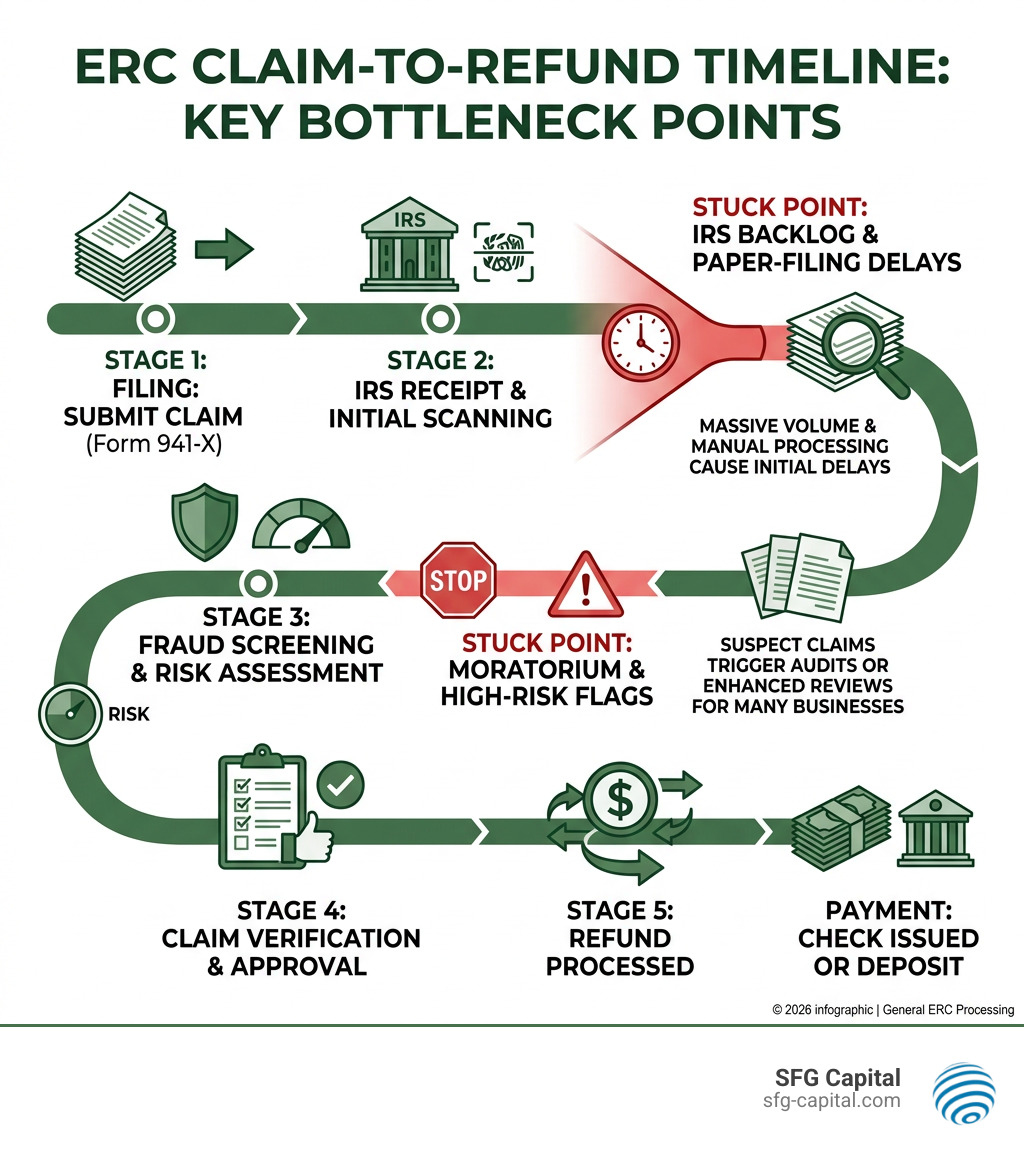
The IRS was flooded with nearly 5 million claims — many filed by aggressive third-party promoters known as “ERC mills” who pushed businesses to claim the credit regardless of eligibility. That wave of potentially fraudulent filings triggered a full processing moratorium in September 2023, slowing everything down — including legitimate claims.
The result? Businesses that played by the rules are now stuck waiting alongside bad actors, watching cash flow dry up while the IRS sorts through the mess.
I’m Santino Battaglieri, founder of SFG Capital, and I’ve worked directly on over $500 million in ERC claims — giving me a front-row seat to the full spectrum of erc payment delays, from straightforward backlogs to complex audit disputes. In the sections below, I’ll break down exactly why these delays are happening, what your options are, and how to decide whether to wait it out or take action.
Understanding the Root Causes of ERC Payment Delays in 2026
If you feel like your refund is stuck in a black hole, you aren’t imagining it. The primary catalyst for the massive erc payment delays we see today was the moratorium enacted by the IRS on September 14, 2023. This was a “stop-work” order on new claims designed to protect the Treasury from a surge of questionable filings.
But why was the surge so bad? Enter the “ERC mills”—aggressive promoters who charged high contingency fees and promised every business owner they were eligible, regardless of the actual rules laid out in Notice 2021-20. These promoters often ignored the interaction between ERC and PPP loans, which was later clarified in the Consolidated Authorizations Act, 2021.
Beyond fraud prevention, the IRS faced significant digitization hurdles. Most ERC claims were filed on paper Form 941-X. In an age of instant digital transfers, the IRS was literally manual-typing data from millions of pieces of paper into their systems. This labor-intensive process, combined with the need to verify complex eligibility rules under the America Rescue Plan of 2021 and Notice 2021-49, created a perfect storm for backlogs.
Furthermore, resource reallocation has played a role. The IRS shifted many agents away from standard processing to staff the Criminal Investigation division and the identity theft victim assistance units. In fact, by FY 2024, the average time to resolve identity theft cases related to tax issues ballooned to nearly two years.
The IRS Backlog: Current Status and Risk Categorization
As we navigate through 2026, the mountain of paperwork is finally shrinking, but it remains formidable. At its peak in late 2024, the IRS faced a staggering backlog of 1.2 million claims. According to the 2024 Annual Report to Congress by the National Taxpayer Advocate, many of these businesses had already been waiting for more than a year.
The IRS has adopted a “risk-based” approach to clearing the remaining pile. This means every claim is fed through an algorithm to determine its likelihood of being improper.
- Low-Risk Claims: These are the “clean” claims that meet all obvious criteria. The IRS announced plans to process roughly 400,000 of these in late 2024 and 2025.
- High-Risk Claims: These are claims flagged for potentially being “ERC mill” products or having mathematical errors.
- Examination and Appeals: As of the February report to Congress, the IRS claimed to have “closed” almost all non-examined claims by the end of 2025. However, “closed” is a technical term; it often means the claim was moved into the examination phase or sent to Appeals, where approximately 41,000 claims remained stuck as of December 31, 2025.
Why ERC Payment Delays Persist for High-Risk Claims
If your claim falls into the “unacceptable risk” category, which the IRS estimates accounts for 60-70% of the backlog, you are likely in for a long manual review. Per IR-2024-169, these claims are not automatically denied, but they require a human agent to verify documentation.
Common triggers for these erc payment delays include:
- Claiming the credit for all four quarters of 2021 (when the credit was generally only available for the first three quarters for most).
- Overlapping wages with PPP loan forgiveness.
- Lack of proof regarding a “nominal impact” from a government order.
We always recommend businesses use the ERC eligibility checklist to ensure their documentation is airtight before the IRS even asks for it.
Navigating ERC Payment Delays with the Taxpayer Advocate Service
For businesses in Travis County facing a genuine “economic burden”—meaning the delay is causing you to miss payroll or risk closure—the Taxpayer Advocate Service (TAS) may be able to help. TAS is an independent organization within the IRS that acts as your “voice” at the agency.
The National Taxpayer Advocate’s 2025 Purple Book has even recommended that Congress require the IRS to act on refund claims within one year. While they can’t magically print you a check today, they can often cut through the red tape if you can prove significant financial hardship. You can learn more about their processes on the TASNTA on YouTube channel.
Legal and Administrative Remedies: To Sue or to Wait?
When the waiting becomes unbearable, or if you receive a Letter 105-C (the formal notice of claim disallowance), you have to make a choice.
- The Administrative Appeal: If you receive a Letter 105-C, you generally have 30 days to protest the decision to the IRS Independent Office of Appeals. This is often a “ping-pong” match where Appeals sends the case back to Examination for more data, adding months to the erc payment delays.
- The “Two-Year Trap”: Under IRC Section 6532(a)(1), you have two years from the date of the disallowance letter to file a lawsuit in federal court. Crucially, filing an appeal with the IRS does not pause this clock. If your appeal is still pending after 18 months, you may need to file a protective lawsuit or ask the IRS to sign Form 907 to extend the time to sue.
- The Withdrawal Program: If you realize your claim was filed incorrectly by an aggressive promoter, the IRS created an Announcement 2024-3 withdrawal program. This allows you to rescind the claim as if it were never filed, avoiding penalties and interest.
- Voluntary Disclosure: For those who already received the money but now realize they weren’t eligible, the Voluntary Disclosure Program (VDP) often allows you to pay back a portion (historically 85%) of the credit to settle the matter without further audit.
It’s worth noting that the Rev Rul 2020-27 guidance reminds us that while the credit isn’t taxable income, it does reduce your wage deductions. This means if you finally get your refund in 2026 for a 2020 claim, you may have complex tax amendments to file, though some recent guidance suggests you might be able to include the adjustment in the year of receipt if the statute of limitations has expired on the original return.
Financial Impacts and Strategic Alternatives for Businesses
The real-world impact of these delays on the Finance of a business can be devastating. We have seen thousands of companies forced to take on high-interest debt or scale back operations while waiting for their own money.
At SFG Capital, we understand that “waiting for the IRS” isn’t a viable business strategy for a company in Travis County trying to meet a Friday payroll. This is why Our Process focuses on providing immediate liquidity.
- Cash Flow Crisis: Many businesses have missed opportunities to invest in new equipment or marketing because their capital is tied up in the IRS backlog.
- Operational Disruptions: When you can’t access $100,000 or $500,000 that you are legally owed, you might be forced to downsize or even close your doors.
- Debt Accumulation: Relying on credit cards or high-interest bridge loans while waiting for a refund that is 24 months overdue is a recipe for financial instability.
If you are tired of the uncertainty, you can read more About Us and how we help local businesses bridge this gap. Unlike the SBA website which managed the PPP loans, the ERC has no direct “advance” program from the government, making private solutions essential for survival.
Frequently Asked Questions about ERC Refund Delays in 2026
How long is the current wait for an ERC refund in 2026?
Wait times remain highly variable. While the IRS is making progress on backlogged ERC claims, many businesses that filed in late 2023 or early 2024 are still seeing wait times of 12 to 24 months. If your claim is flagged as “high-risk,” it could take even longer as it awaits manual examination.
What should I do if I receive a Letter 105-C disallowance?
Do not panic, but do act quickly. You have 30 days to file a formal protest. You should gather all your documentation—payroll records, proof of government orders, and gross receipts statements—and consider seeking professional help. You can find more details in the Frequently asked questions about the Employee Retention Credit on the IRS site.
Can I speed up my ERC claim if I am facing a financial crisis?
The only official way to speed up a claim is through the Taxpayer Advocate Service. You must demonstrate that the delay is causing an “immediate threat of adverse action” or “significant cost.” You can apply for assistance through their official website.
Conclusion
The saga of erc payment delays has been one of the most frustrating chapters in modern tax history for small business owners. While the IRS continues to move through the backlog, the reality is that thousands of legitimate businesses in Travis County are still being penalized for the actions of “ERC mills.”
At SFG Capital, we don’t think you should have to choose between a costly federal lawsuit and waiting another year for the IRS to find your file. We help businesses in Austin and throughout Travis County by offering ERC refund advances and buyout options. Our performance-based fees mean we only succeed when you do, providing you with the cash flow you need today to keep your business moving forward.
If you are ready to stop checking the mail and start growing your business again, explore Our Services today. We are here to help you bypass the backlog and secure the pandemic relief your business earned years ago.