
ERC Refund Stuck in Limbo? Here is What Business Owners Need to Know
Millions of Businesses Are Still Waiting: The Truth About Employee Retention Credit Delays
Employee Retention Credit delays are affecting hundreds of thousands of businesses across the U.S. right now. If your refund is stuck, here is what you need to know at a glance:
| Key Fact | Detail |
|---|---|
| Claims still unprocessed (April 2025) | Over 597,000 |
| Peak backlog size | 1.2 million claims (October 2024) |
| Typical wait time | Over 1 year for many businesses |
| Main causes | Fraud prevention, IRS staffing cuts, moratorium |
| Filing deadline (2021 wages) | April 15, 2025 |
| Legal remedy available after | 6 months of no IRS response |
The Employee Retention Credit (ERC) was created under the CARES Act in 2020. Its goal was simple: help businesses keep workers on payroll during the COVID-19 pandemic. Eligible employers could claim a refundable tax credit worth up to $26,000 per employee across qualifying quarters.
But years later, many businesses are still waiting.
The IRS received over 3.6 million ERC claims totaling more than $230 billion. Widespread fraud, aggressive third-party promoters, and a formal processing pause in September 2023 created a backlog that the agency is still working through today. As of early April 2025, more than 597,000 claims remained in the IRS’s inventory — with some businesses waiting over two years without a single word from the agency.
For business owners who filed in good faith and need those funds for working capital, the silence is more than frustrating. It can be financially devastating.
I’m Santino Battaglieri, founder of SFG Capital, a financial services firm that has purchased and funded over $500 million in ERC claims and works directly with businesses navigating Employee Retention Credit delays every day. In this guide, I’ll walk you through exactly what’s causing the backlog, where things stand right now, and what your options are.
Employee Retention Credit delays further reading:
Why Your Refund is Facing Employee Retention Credit Delays

If you feel like your claim has fallen into a black hole, you aren’t alone. The primary reason for the massive Employee Retention Credit delays is a “perfect storm” of administrative hurdles and a sudden surge in suspicious activity. To protect the integrity of the tax system, the IRS accelerates work on ERC claims by implementing much more stringent manual reviews than originally anticipated.
Several factors have contributed to this “Great Wait”:
- Fraud Prevention and Identity Theft: The IRS estimates that between 70% and 90% of the claims received during the height of the “ERC mill” craze were either fraudulent or improper. This led to a staggering 77% rejection rate for certain batches of claims.
- Staffing Shortages and Budget Cuts: Despite receiving funding through the Inflation Reduction Act, the IRS has faced significant headwinds. In 2025 alone, budget cuts and a federal hiring freeze have impacted the agency’s ability to process complex paperwork. The IRS Waiting Game: Common Reasons for Slow Tax Refunds often comes down to the simple fact that there aren’t enough boots on the ground to review the millions of pages of documentation submitted.
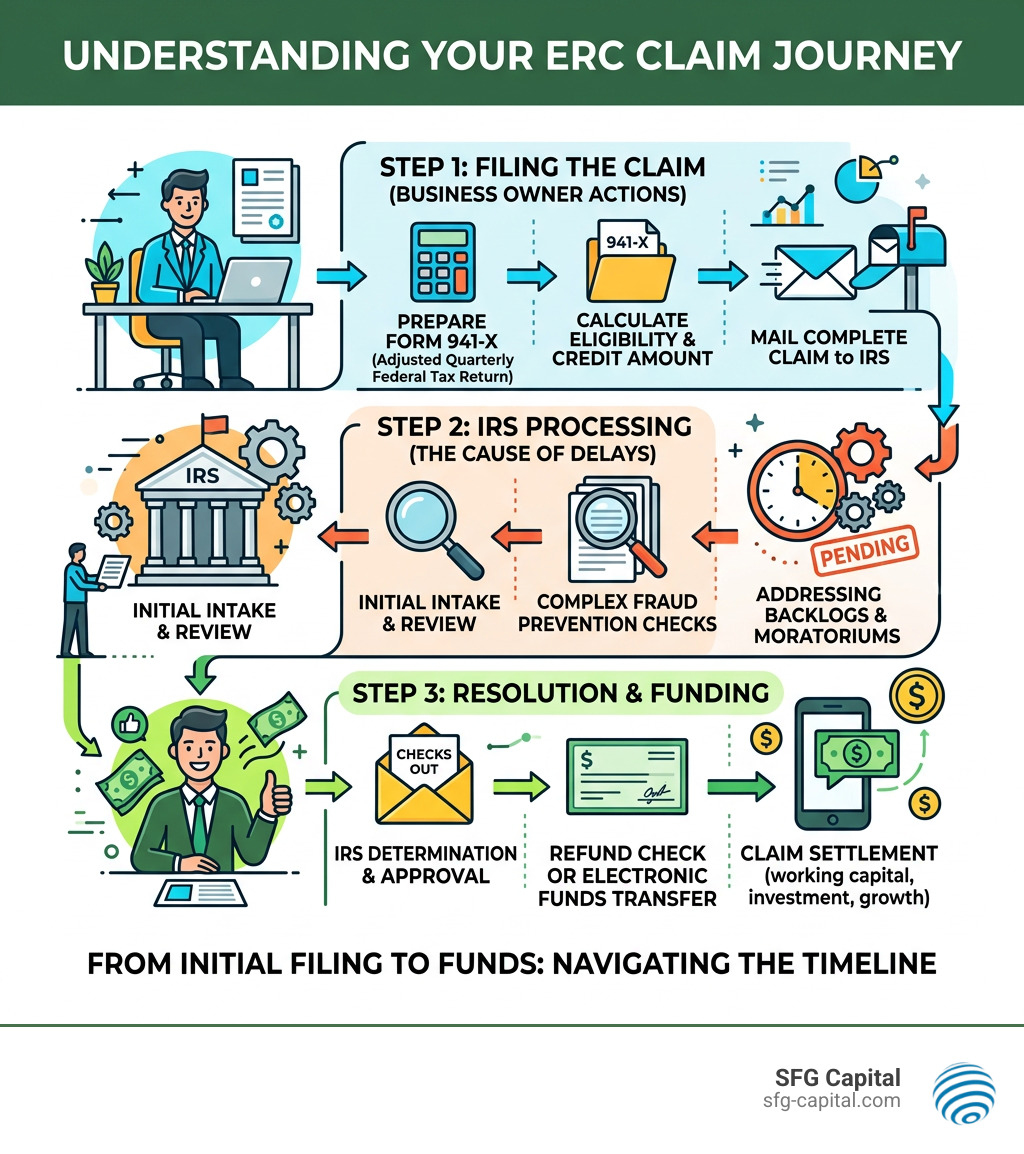
- Complexity of Form 941-X: Unlike a standard tax return, the 941-X (Adjusted Employer’s Quarterly Federal Tax Return) requires manual processing. Each claim must be cross-referenced with PPP loan data to ensure wages aren’t being “double-dipped”—a process that is time-consuming and prone to bottlenecks.
- Refund Theft: In some cases, claims were actually processed, but the checks were stolen or sent to the wrong address, adding months of additional delays as businesses wait for replacement payments.
The Impact of the IRS Moratorium on Employee Retention Credit Delays
In September 2023, the IRS took the drastic step of announcing a moratorium on processing new ERC claims. This pause was intended to allow the agency to catch up on the existing backlog and develop better fraud-detection tools. While the moratorium was initially supposed to end in late 2023, it was extended multiple times.
The IRS finally began to moves forward with Employee Retention Credit claims again in August 2024. However, the resumption hasn’t meant a return to “business as usual.” The agency shifted to a risk-based processing model, meaning they aren’t necessarily processing claims in the order they were received. Instead, they are cherry-picking the “safest” looking claims and the most “obviously fraudulent” ones first, leaving hundreds of thousands of middle-ground claims in limbo.
Understanding the Risk Categories Causing Employee Retention Credit Delays
To manage the 1.2 million claims that were pending by late 2024, the IRS sorted submissions into three buckets:
- Low Risk (20-40%): These are claims that show clear eligibility, such as a massive revenue decline that matches previous tax filings.
- Unacceptable Risk (60-70%): This is the largest category. These claims often feature “red flags” like using an aggressive third-party promoter (an “ERC mill”) that charged a percentage-based fee.
- High Risk: These are claims that the IRS shares more warning signs of incorrect claims for, such as businesses that didn’t exist during the pandemic or those claiming credits for family members.
If your claim falls into the “unacceptable risk” category, you might be facing years of waiting. Don’t Panic: Understanding the Status of Your Employee Retention Credit is essential during this time; a delay doesn’t always mean a denial, but it does mean your documentation is under a microscopic review.
Current Status of the IRS Backlog in 2025
As of early April 2025, the IRS ERC Backlog Update: Tracking Your Refund Status in 2025 shows that approximately 597,000 claims remain in the inventory. While the IRS set ambitious goals to process 500,000 claims by the end of 2024 and another 500,000 by the end of 2025, many experts believe the program will stretch well into 2026.
The National Taxpayer Advocate has been vocal about the “unacceptable” lack of communication from the IRS regarding these delays. For many businesses in Travis County and beyond, the statute of limitations is also becoming a concern. Generally, the IRS has up to five or six years to audit these claims, while taxpayers only have a limited window to sue for their refunds if the IRS remains silent.
| Feature | 2020 ERC | 2021 ERC (Q1-Q3) |
|---|---|---|
| Max Credit | $5,000 per employee/year | $7,000 per employee/quarter |
| Gross Receipts Decline | >50% vs 2019 | >20% vs 2019 |
| Qualified Wages | 50% of up to $10k | 70% of up to $10k |
| Small Employer Limit | 100 or fewer employees | 500 or fewer employees |
Legal Remedies and Options for Delayed Claims
If your business is facing a financial hardship due to Employee Retention Credit delays, you do have cards to play. You don’t have to wait forever.
- Taxpayer Advocate Service (TAS): This is an independent organization within the IRS. You can file Form 911 to request their help. While TAS was previously restricted from taking ERC cases during the moratorium, they are now accepting cases where the delay is causing “significant hardship” (like the risk of closing your doors). ERC Refund Delayed · Taxpayer Advocate Service Options are a vital first step for businesses in crisis.
- Refund Litigation (The 6-Month Rule): Under I.R.C. § 6532, if the IRS has not made a decision on your claim within six months of filing, you have the right to file a lawsuit in federal court to compel payment. Many businesses are now taking this route, filing in the U.S. Court of Federal Claims.
- Compounding Interest: One silver lining is that the government must pay interest on delayed refunds. Currently, the rate is around 8% compounding daily. For a large claim, this interest can add up to tens of thousands of dollars. Navigating the ERC Refund Maze: What Your Claim Status Means often involves weighing the cost of a lawyer against the potential interest recovery.
Withdrawing or Correcting a Pending Claim
If you realized after filing that your claim was aggressive or potentially incorrect, the IRS offers an “out.” The Withdraw an ERC claim program allows you to retract a pending claim as if it were never filed, helping you avoid future audits and penalties.
For those who have already received their checks but now realize they weren’t eligible, the Voluntary Disclosure Program (VDP) allows you to repay 80% of the credit (keeping 20% to cover the promoter fees you likely paid) without facing further penalties. The Waiting Game: Understanding and Overcoming ERC Refund Delays is much easier when you know your claim is 100% compliant.
Essential Documentation to Avoid Further IRS Scrutiny
The best way to shorten Employee Retention Credit delays is to be “audit-ready” from day one. If the IRS sends a request for information (IDR), you usually only have 30 days to respond. If you aren’t prepared, your claim will likely be disallowed.
Ensure you have the following in a digital and physical folder:
- Gross Receipts Test Evidence: Quarterly profit and loss statements from 2019, 2020, and 2021.
- Suspension Order Documentation: If you qualified via the “Suspension Order Method,” you must have the specific government order (state, county, or city) that forced your operations to close or limit capacity. General “stay at home” orders or supply chain issues often aren’t enough on their own.
- PPP Allocation Sheets: You must show exactly which wages were paid for with PPP funds and which were used for ERC. You cannot use the same dollar for both programs.
- Qualified Wage Calculations: Detailed payroll reports showing Form 941-X adjustments for each employee, excluding family members and ensuring health insurance costs are properly allocated.
According to A Comprehensive Guide to 2026 ERC and 941-X Processing Times, the businesses that get paid the fastest are those that provide “narrative” summaries explaining exactly how they qualified under the law.
Frequently Asked Questions about ERC Delays
How can I check the status of my ERC refund?
You can call the IRS at (800) 829-4933. Be prepared for long hold times. Alternatively, you can request an IRS Account Transcript. If the transcript shows a code “971” followed by a “977,” it means your amended return was received and is in the queue. Is Your ERC Refund Here Yet? Ways to Track Your Employee Retention Credit suggests that working with a tax professional who has access to the practitioner priority line is often the most efficient way to get a real update.
What is the deadline to file for the Employee Retention Credit?
The window for 2020 wages closed on April 15, 2024. For wages paid in 2021, the deadline to file an amended return is April 15, 2025. While there has been legislative talk about ending the program early to fund other bills, these dates remain the current law. Check A Comprehensive Guide to 2026 ERC and 941-X Processing Times for any last-minute legislative changes.
Why did I receive Letter 105-C or 106-C?
Receiving a Letter 105-C means the IRS has officially disallowed your claim. This is not the end of the road, but the clock is ticking. You generally have 30 days to file an administrative appeal or two years to file a refund suit in court. Understanding your Letter 105-C is critical; the letter should provide a factual explanation for the denial, which you can then rebut with your documentation.
Conclusion: Don’t Let IRS Delays Stall Your Business
At SFG Capital, we understand that for a business in Austin or anywhere in Travis County, waiting 18 to 24 months for a six-figure refund isn’t just an inconvenience—it’s a barrier to growth. Employee Retention Credit delays have turned a relief program into a source of stress for many.
We specialize in helping businesses bypass the IRS “waiting game.” Through our ERC advances and refund buyouts, we provide immediate liquidity based on your pending claim. We take on the IRS wait so you can get back to running your business. Our fees are performance-based, and we offer expert assistance to ensure your claim is documented well enough to withstand IRS scrutiny.
If you are tired of checking the mailbox and hearing “it’s still processing,” we can help. Let us turn your “limbo” status into capital you can use today.