
Everything You Need to Know About Texas ERC Refund Buyouts
What Texas Business Owners Need to Know About ERC Refund Buyouts
Texas ERC refund buyouts let you sell your pending Employee Retention Credit claim to a funding company today — instead of waiting 8+ months for the IRS to process it.
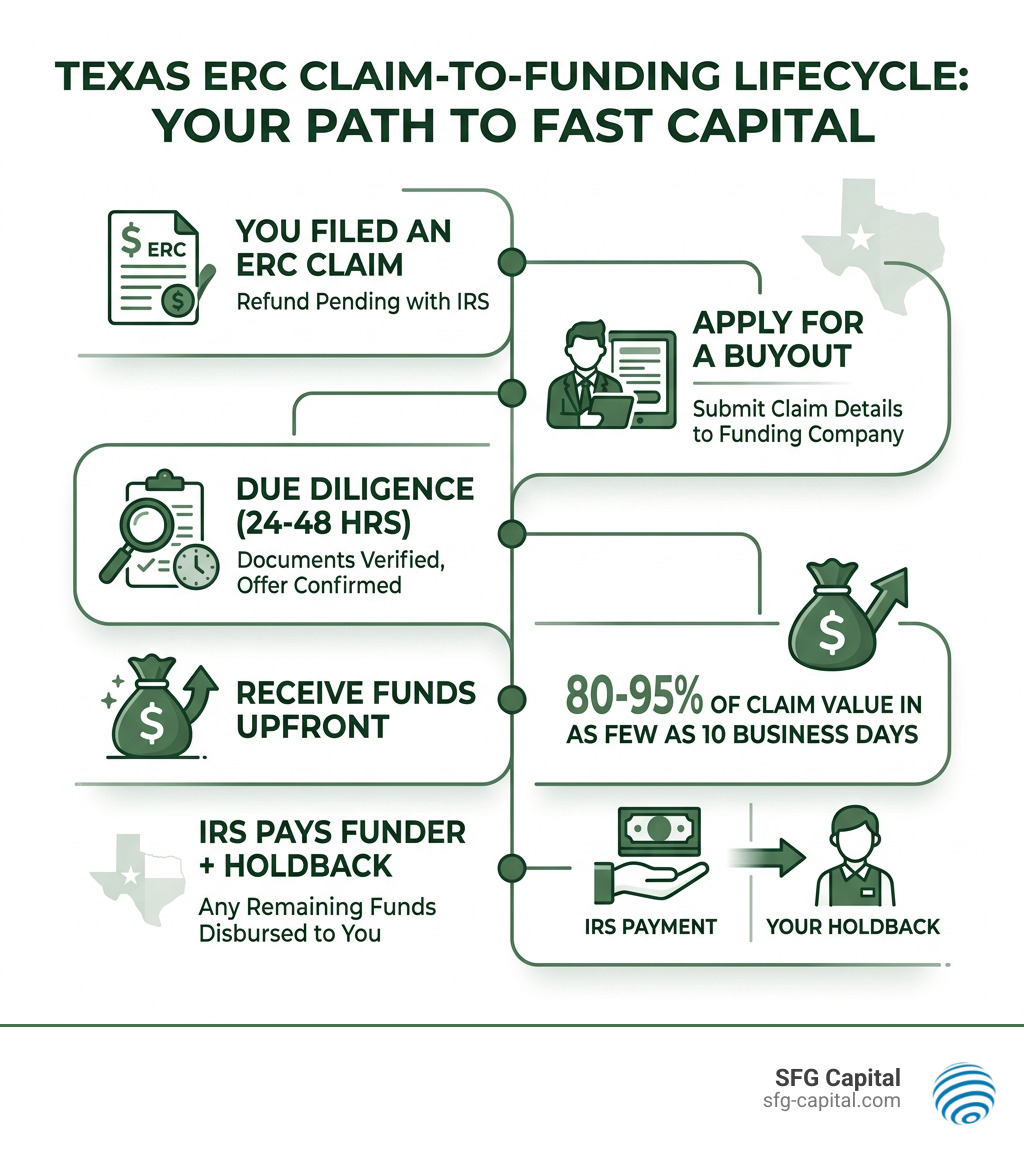
Here’s how it works at a glance:
| Step | What Happens |
|---|---|
| 1. You filed an ERC claim | Your refund is pending with the IRS |
| 2. You apply for a buyout | A funding company reviews your claim |
| 3. Due diligence (24-48 hrs) | Documents verified, offer confirmed |
| 4. You receive funds | 80-95% of your claim value, upfront |
| 5. IRS pays the funder | Any holdback goes directly to you |
The key facts:
- Buyouts are not loans — no monthly payments, no debt added to your balance sheet
- You can receive 80-95% of your ERC refund value immediately
- Minimum claim sizes typically range from $100,000 to $750,000 depending on the program
- Funding can happen in as few as 10 business days
The COVID-19 pandemic hit Texas businesses hard. The CARES Act created the Employee Retention Credit to help — but the refund many businesses are still owed is stuck in an IRS backlog that exceeded 597,000 unprocessed claims as of early 2024. For business owners who need that capital now, waiting simply isn’t an option.
I’m Santino Battaglieri, founder of SFG Capital, and I’ve helped businesses access capital by purchasing and funding over $500 million in ERC claims — including claims from Texas businesses like an electrical contractor in Bryan, Texas, who qualified for a $2.6 million refund. In this guide, I’ll walk you through everything you need to know about Texas ERC refund buyouts so you can make a confident, informed decision.
Understanding the Employee Retention Credit for Texas Businesses
The Employee Retention Credit (ERC) isn’t a loan or a “handout”—it’s a refundable tax credit designed to reward business owners who kept their teams on the payroll during the height of the pandemic. For many of our neighbors in Travis County and across the Lone Star State, this credit has been a lifeline.
To qualify, your business generally needed to have W-2 employees and meet one of two main criteria: either a significant decline in gross receipts or a full or partial suspension of operations due to government orders. Because the rules are different for 2020 and 2021, the math can get a bit “Texas-sized” in its complexity.
In 2020, you could claim 50% of up to $10,000 in qualified wages per employee for the year. In 2021, the program became even more robust, allowing for 70% of the first $10,000 in wages per quarter for the first three quarters. When you add it all up, a business could potentially receive up to $26,000 per employee.
If you haven’t checked your eligibility yet, the IRS Eligibility Checklist is a great place to start. However, keep in mind that even if your CPA initially thought you didn’t qualify, the rules changed several times—most notably allowing businesses that took PPP loans to also claim the ERC. For a deeper dive into the “when” and “how” of these funds, check out our guide on Decoding ERC Processing: Your Timeline for Employee Retention Credit Refunds.
Why IRS Delays Make Texas ERC Refund Buyouts Essential
If you feel like you’ve been waiting for your refund since the last time it snowed in Austin, you aren’t alone. The IRS is currently grappling with a massive backlog. As of early 2024, there were over 597,000 unprocessed claims sitting in a digital pile.
Initially, the IRS aimed for a 90-day turnaround. That goal has since doubled to a 180-day processing window, and in reality, many Texas filers are seeing wait times of eight months to a year—or longer. This is largely due to the September 2023 moratorium announcement, where the IRS hit the “pause” button on processing new claims to combat a surge in questionable filings.
For a local business owner trying to manage inventory or expand their team, this delay creates a massive cash flow gap. You can read more about why these delays happen in The Waiting Game: Understanding and Overcoming ERC Refund Delays.
How the Moratorium Affects Texas ERC Refund Buyouts
The moratorium didn’t just stop new claims; it slowed down the ones already in the system. The IRS increased its fraud scrutiny, meaning every line item is being double-checked. While the IRS has signaled they will move forward with ERC claims that are legitimate, the pace remains frustratingly slow.
This is where texas erc refund buyouts become essential. Instead of letting your capital sit in an IRS queue, a buyout allows you to unlock that liquidity immediately. It turns a “maybe next year” refund into “cash in the bank next week.”

How Texas ERC Refund Buyouts Work: Process and Eligibility
We often get asked: “Is this just a high-interest loan?” The answer is a firm no. A buyout is structured as an asset purchase. You are selling the rights to your future refund in exchange for immediate capital.
| Feature | ERC Refund Buyout | ERC Bridge Loan |
|---|---|---|
| Structure | Asset Purchase | Debt/Liability |
| Payments | None | Monthly Interest/Principal |
| Balance Sheet | No new debt | Increases debt-to-income |
| LTV (Loan to Value) | 80% to 95% | Typically 60% to 80% |
| Speed | Fast (approx. 10 days) | Varies by lender |
By choosing a buyout, you avoid adding a new monthly bill to your plate. We take on the wait, and you get to get back to business. You can find a full breakdown of these options in our article Sell Your ERC Claim: A Guide to Advance Payments and Buyouts.
Eligibility Criteria for a Texas ERC Refund Buyout
Not every claim is eligible for a buyout, but the requirements are straightforward. Most programs require a minimum claim amount of $100,000. For larger institutional buyouts, that threshold might jump to $750,000.
To qualify for our ERC Advance Funding, your business must be currently operational. We also perform a due diligence check to ensure your initial filing was accurate. We aren’t just looking for numbers; we’re looking for the “why” behind your claim to ensure it stands up to IRS standards.
Navigating IRS Notices and Audit Risks in Texas
Receiving a letter from the IRS can make even the toughest Texan a little nervous. If you’ve already filed, you might see a Letter 105-C, which is a notice that your claim has been disallowed (denied), or a Letter 106-C, Employee Retention Credit, which indicates an adjustment to your account.
If you receive one of these, don’t panic. You usually have 30 days to appeal. Furthermore, the IRS introduced a Voluntary Disclosure Program for those who may have been misled by “ERC mills” into filing improper claims. This program allowed businesses to repay 80% of the credit and avoid penalties.
One critical thing to remember is IRS Notice 2021-20. This notice explains that while the ERC refund itself isn’t taxable income, it does reduce the deductible wage expenses on your income tax return. This means you may need to amend your previous years’ tax filings. For tips on staying on top of your paperwork, see our guide on ERC Refund Status Check: Don’t Be Left in the Dark.
Frequently Asked Questions about Texas ERC Claims
How do I check my ERC refund status?
The most direct way is to call the IRS Business and Specialty Tax Line at (800) 829-4933. Be prepared for a wait! You can also check your tax transcripts online through the IRS portal. For a step-by-step walkthrough, we recommend this guide on How to Check ERC Refund Status. If the status is “pending” and you’re tired of checking the mailbox, it might be time to stop waiting. See Don’t Wait for the IRS: How to Get an ERC Loan or Advance Today.
What happens if the IRS audits my claim after a buyout?
This is a common concern. Most buyout agreements include a “holdback” portion. For example, if you have a $1 million claim, we might provide $800,000 (80%) upfront. The remaining $200,000 is held until the IRS actually pays out. If an audit occurs and the claim is reduced, the holdback is adjusted accordingly.
Because we do extensive due diligence before funding, we help ensure your claim is “audit-ready.” The IRS is currently performing more thorough reviews as they move forward with ERC claims, so having a professional set of eyes on your documents is a huge advantage.
Are there Texas-specific considerations for ERC filers?
Absolutely. First, don’t confuse the federal Employee Retention Credit with the Texas “Emission Reduction Credit” (also abbreviated as ERC) managed by the TCEQ. One helps you keep your employees; the other is about air quality in nonattainment areas. We focus on the one that puts money back in your payroll account!
We’ve seen incredible success stories right here in our backyard. From the electrical contractor in Bryan receiving $2.6 million to small tech startups in Austin’s Silicon Hills, Texas businesses are uniquely positioned to benefit from these funds. If you’re looking for a way to bridge the gap while the IRS catches up, our ERC Bridge Loans and buyouts are designed specifically for the Texas market.
Conclusion
At SFG Capital, we understand that for a Travis County business, time is money. You shouldn’t have to put your growth plans on hold because of federal processing delays. Whether you need to cover payroll, invest in new equipment, or simply want the peace of mind that comes with a healthy cash reserve, texas erc refund buyouts offer a path forward.
We pride ourselves on a performance-based approach, ensuring that we only succeed when you do. If you’re ready to stop waiting and start growing, we’re here to help you Bridge the Gap: Advance Your ERC Refund Today.
Don’t let your hard-earned credit sit in a government backlog. Get Your ERC Funding Solution today and put your capital back to work where it belongs—in your business.